
- Über uns

- Unsere Dienstleistungen
- Ihre Branche
- Ressourcen
- Nachrichten & Blog
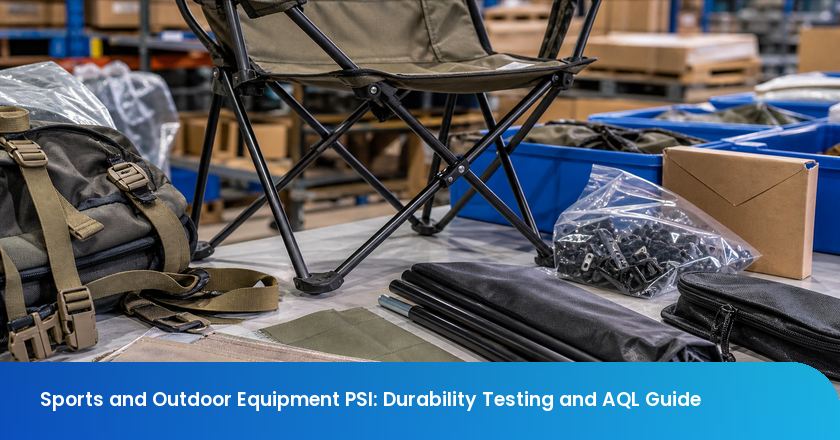
Sports and outdoor equipment PSI should start from the way the product is stressed in use, because the defect that matters is often a failed strap, lock, seam, joint, coating, or label claim rather than a simple cosmetic mark.
Sports and outdoor products are used under movement, load, weather, repeated handling, and seasonal demand. A clean product photo does not prove that a folding chair lock holds, a backpack seam carries weight, a tent accessory set is complete, a strap is stitched correctly, or a coating can survive the buyer's intended use.
AQL remains valuable for sampled workmanship defects, but it should sit beside product-specific durability checks. CPSC guidance for sporting and camping equipment points to safety and flammability considerations for certain products, while ISO 2859-1:2026 supports lot-by-lot sampling. The buyer still has to define what "durable enough to release" means for the product category.
Key Takeaways
- Use risk drives the checklist: straps, seams, frames, locks, poles, buckles, fasteners, and moving parts should be checked according to real use.
- AQL controls visible defects: scratches, stains, poor stitching, missing parts, label errors, and packaging issues need agreed defect classes.
- Claims need evidence: waterproof, heavy-duty, UV-resistant, flame-resistant, or kids-use claims should not rely on appearance alone.
- Seasonal timing raises risk: late defects on outdoor goods can miss the selling window, so release evidence should be specific and early.
Start With the Stress Path of the Product
The useful inspection question is not only what the item looks like; it is where the item carries load, moves, bends, rubs, folds, locks, or contacts the user.
Sports and outdoor products vary widely, but the inspection logic is similar. A folding chair has lock and frame stress. A backpack has seam, zipper, strap, and buckle stress. Camping goods may add flame, weather, or accessory risk. Fitness accessories may add grip, handle, tube, cord, or moving-part risk. The inspection plan should map these stress paths before sampling begins.
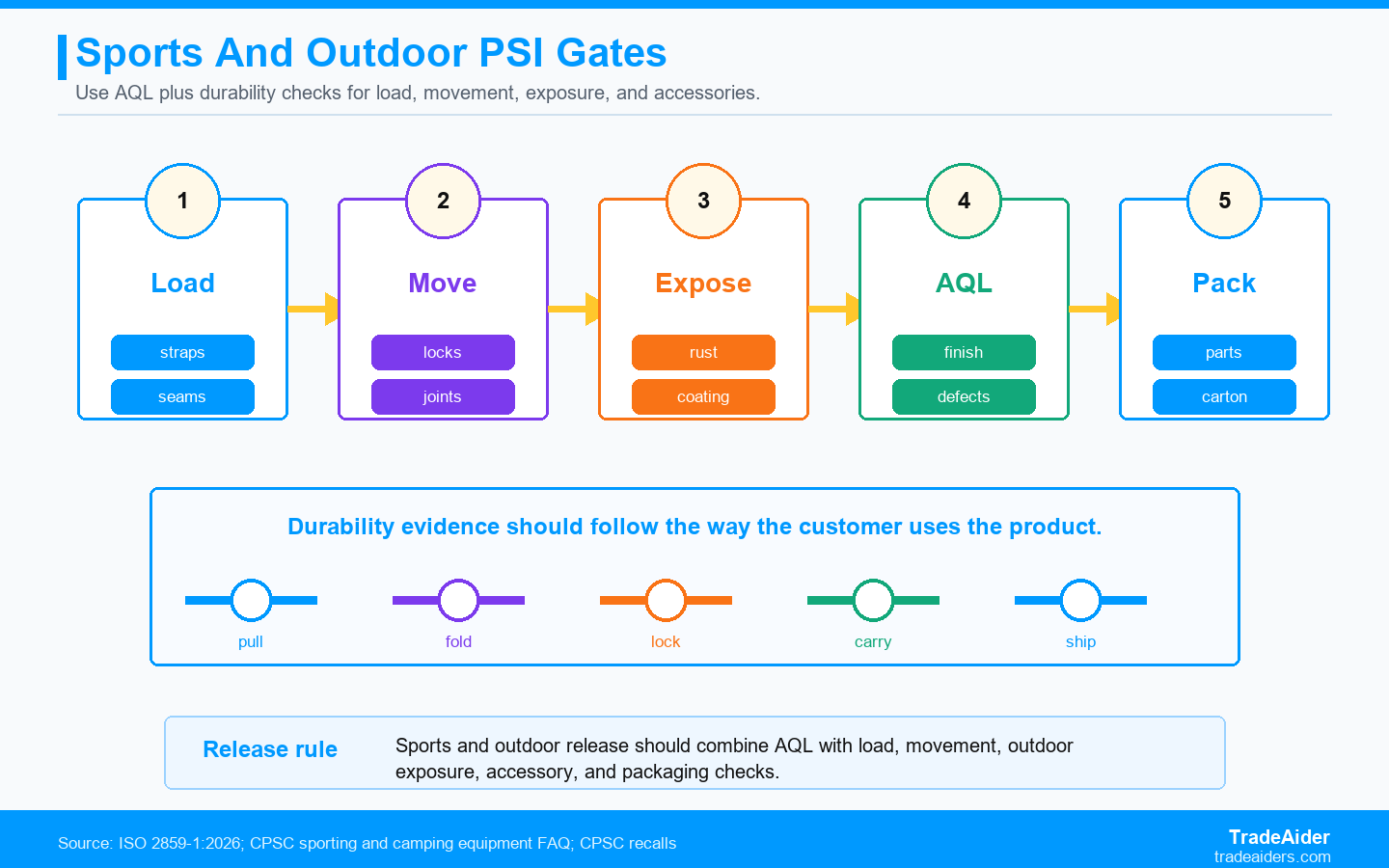
Sports and outdoor PSI should connect AQL defects with load points, seams, moving parts, weather exposure, labels, accessories, and packaging.
Load points should be named as inspection locations
A strap, buckle, handle, D-ring, frame joint, hook, seam, rivet, or pole connector is not an ordinary detail when it carries load. The buyer should mark which locations need pull, fit, flex, or visual stress checks and which findings should stop shipment. This prevents the report from focusing only on easy-to-see cosmetic areas.
On-site PSI should not invent certified load ratings, but it can perform agreed simple checks and capture evidence. Photos of stitching density, hardware shape, lock engagement, strap attachment, and failed samples are more useful than a general note that the product was 'function checked'.
For repeated orders, the buyer can turn common failure points into a short stress-path map. The map names the part, the use stress, the practical inspection action, and the release consequence. This keeps the inspection focused when the factory is packing fast, and it gives the buyer a consistent way to compare one supplier, season, or production run with another.
Moving parts and locks need a defined operating cycle
Folding chairs, carts, poles, scooters, exercise accessories, pumps, locks, clips, buckles, valves, and adjustable parts should be operated in a repeatable way. The inspection brief should state how many cycles, what visible behavior to record, and which failures count as major or critical.
The report should also separate first-use failure from long-term durability. PSI can catch binding, weak locks, missing parts, sharp edges, obvious looseness, and abnormal operation. It cannot replace laboratory endurance testing, but it can stop a shipment that fails basic use before export.
Weather and material claims should be checked against evidence
Outdoor claims such as waterproof, UV-resistant, rust-resistant, flame-resistant, heavy-duty, or all-weather need evidence outside ordinary appearance. CPSC notes flammability considerations for some sporting and camping equipment, and some products may require specific test methods or certificates depending on intended use and market.
Inspection should verify whether the claim appears on the product, package, manual, or marketing insert, and whether the buyer file supports that claim. If the claim changed after approval, the lot should be held for buyer review rather than released as a normal label variation.
AQL Should Cover Workmanship Without Hiding Durability Risk
AQL is a sampling method, not a durability theory. It works best when the buyer defines which findings count as critical for use.
Ordinary defects still need clear sampled limits
Sports and outdoor shipments often have many visible defect types: stains, scratches, missing accessories, rough edges, stitching defects, color variation, label errors, poor retail boxes, carton damage, and wrong instruction sheets. AQL sampling is useful for controlling these repeated issues across the lot.
The defect list should be written in buyer language. For example, a loose thread on a decorative patch may be minor, while skipped stitches at a load-bearing strap are major or critical. Without this distinction, the inspector may count defects correctly but classify them poorly.
Durability checks should be scoped, not improvised
A buyer may ask for a pull check, fitting check, cycle check, water-spray clue, inflation hold, zipper operation, buckle opening force, or simple assembly trial. These checks should be practical, repeatable, and appropriate for PSI. They should not pretend to be full laboratory validation unless a defined test method is used.
The best scope states what to do, how many samples to check, what evidence to photograph, and what result triggers hold or rework. This keeps the inspection useful while avoiding overbuilt testing that a factory visit cannot support.
The report should name the boundary of each check. For example, a repeated opening check can reveal weak locks, binding, missing parts, or obvious looseness, but it does not prove lifetime endurance. A simple water-spray clue can reveal visible leakage or poor seam protection, but it does not replace a formal waterproof rating. Clear boundaries make the release decision more defensible.
Seasonal goods need earlier visibility than ordinary stock
Sports and outdoor products often have a selling window. If camping chairs, tents, beach items, winter accessories, or fitness launch products fail at final inspection, the buyer may lose both rework time and season timing. A defect that would be manageable in a steady category can become expensive when the selling season is short.
A simple scenario estimate shows the pressure: if a 5,000-unit seasonal order has a 6 percent lock or strap defect and rework takes five factory days, the buyer may lose a full week of distribution time before the season peak. That is why during-production checks may be useful for first orders or new designs.
Labels, Accessories, and Packaging Complete the Release Decision
Outdoor product quality includes what the customer receives, understands, assembles, carries, and stores, not only the main item.
Accessory completeness should be checked by selling unit
Many sports and outdoor products ship with poles, pegs, straps, screws, pumps, repair patches, carry bags, manuals, batteries, chargers, clips, or spare parts. Missing accessories create immediate returns because the customer cannot use the product as intended.
Inspection should open selected retail packs, verify the accessory BOM, photograph kit layouts, and check whether similar accessories are mixed across SKUs. A correct master carton count is not enough if the retail selling unit is incomplete.
Packaging should match the expected handling path
Outdoor goods may be long, heavy, flexible, sharp, collapsible, or easily scratched. Packaging should protect poles, frames, coated parts, inflated items, fabric surfaces, and retail presentation. For e-commerce goods, drop and parcel handling assumptions should influence inner protection and carton strength.
The inspector should check whether straps rub against coated parts, metal parts can puncture fabric, frame ends can break cartons, and accessories can move freely inside the package. Packaging is part of release because it can create defects after inspection but before customer receipt.
Sports and Outdoor PSI Release Checklist
The checklist below keeps sampled appearance control separate from product-specific durability checks.
| Inspection Layer | What To Check | Release Rule |
|---|---|---|
| Load path | Straps, seams, buckles, handles, hooks, joints, frame supports | Hold for failed or weak load-bearing features |
| Function | Folding, locking, adjusting, zipping, clipping, inflating, assembling | Escalate failed operating cycle or unsafe behavior |
| Material and outdoor clues | Coating, corrosion, odor, fabric, waterproof or flame claims, UV claims | Hold unsupported or changed claims for buyer review |
| AQL workmanship | Scratches, stains, stitching, missing parts, labels, carton defects | Accept, reject, or rework by agreed class |
| Accessories | Carry bag, poles, pegs, screws, pump, manual, repair kit, spare parts | Release only when the selling unit is complete |
| Packaging | Inner protection, carton strength, SKU marks, e-commerce protection | Repack if handling can damage the product |
Where TradeAider Fits In Sports and Outdoor PSI
TradeAider can support sports and outdoor buyers with pre-shipment inspection for AQL workmanship, function, assembly, straps, buckles, seams, labels, accessories, retail packs, and carton protection. Buyers should provide approved samples, use assumptions, defect classes, accessory BOM, label files, and any simple durability checks required at the factory.
For seasonal or first-run products, during-production inspection can catch lock, seam, material, or accessory problems before the full lot is packed. If the supplier is new, a factory audit can help evaluate whether process control supports repeat outdoor orders.
SPAR Scenario: The Folding Chair Failed at the Lock
Situation: A buyer ordered folding camping chairs for a summer launch, with carry bags, carton labels, and a published load claim.
Problem: The sampled chairs looked clean, but several units had inconsistent lock engagement after repeated opening and closing. The cartons were already close to final packing.
Action: The buyer held shipment, asked the supplier to sort lock components, and required reinspection photos and short operating videos from affected carton groups.
Result: The supplier corrected the lock issue before shipment, but the buyer moved the operating-cycle check into during-production inspection for the next seasonal order.
Sports and Outdoor PSI Checklist
- Map load points and moving parts before inspection.
- Define simple durability checks and failure triggers.
- Classify strap, seam, lock, and frame defects by use consequence.
- Open retail packs to verify accessories and instructions.
- Check packaging against the expected handling path.
Who Is TradeAider?
TradeAider is a quality control service provider for importers, brands, and e-commerce sellers sourcing from China and other Asian supply markets. Its services include pre-shipment inspection, during-production inspection, pre-production inspection, factory audit, container loading supervision, product testing coordination, and real-time inspection reporting.
For buyers who need a practical release decision rather than a generic pass/fail file, TradeAider can help turn product specifications, approved samples, defect classes, packing requirements, and destination-market evidence into a focused inspection scope. Buyers can start with a TradeAider inspection request when the lot is packed or when production risk needs earlier visibility.
Frequently Asked Questions
Is AQL enough for sports and outdoor equipment?
AQL is useful for sampled workmanship defects, but it is not enough by itself. Sports and outdoor equipment also needs product-specific checks for load points, seams, straps, fasteners, moving parts, accessories, labels, and packaging because use failures may not appear as simple cosmetic defects.
Can PSI perform durability testing?
PSI can perform agreed simple checks such as fitting, operating, pull clues, cycle checks, or assembly trials when the method is defined. It should not pretend to replace laboratory endurance testing, certification, or validated load testing unless a formal test method is used.
What should buyers define before outdoor product inspection?
Buyers should define intended use, critical load points, defect classes, accessory BOM, label claims, packaging method, simple factory checks, sample size, and release triggers. These inputs help the inspector focus on the defects that affect customer use.
Why are seasonal outdoor products risky at final inspection?
Seasonal products have less recovery time. A lock, seam, strap, or accessory failure found after final packing can delay distribution and miss the sales window. Earlier checks during production can reduce this timing risk for new or high-volume orders.
Verwandte Artikel
Erweitern Sie Ihr Unternehmen mit TradeAider Service
Klicken Sie auf die Schaltfläche unten, um direkt in das TradeAider Service System zu gelangen. Die einfachen Schritte von der Buchung und Zahlung bis zum Erhalt der Berichte sind leicht zu bedienen.

