
- Über uns

- Unsere Dienstleistungen
- Ihre Branche
- Ressourcen
- Nachrichten & Blog
Effective apparel quality inspections and sorting follow a clear sequence: freeze the garment file, map the lot by style, color, size, and carton, apply AQL sampling, check measurements and workmanship, verify labels and packing, classify defects, sort affected goods, and reinspect corrected units before release. Apparel QC fails when inspection finds defects but the buyer has no rule for which garments to sort, rework, or ship.
Apparel inspection is not only visual workmanship. It also touches product identity, fiber labeling, size consistency, color shade, care labels, packing, and market requirements. The FTC textile and wool labeling guidance is a reminder that label information can be part of compliance and customer promise, not decoration.
For some apparel categories, safety requirements also matter. The CPSC Flammable Fabrics Act guidance covers flammability standards for clothing and textiles. A factory inspection cannot replace required testing, but it can verify whether required labels, documents, and buyer checks are present.
For sampled inspection, ISO 2859-1:2026 is the current AQL-indexed reference for lot-by-lot inspection by attributes. Apparel buyers should use it with a real lot map because size, color, shade lot, style, and packing version can hide subgroup problems.
Inspection body consistency also matters. ISO/IEC 17020:2026 emphasizes competence, impartiality, and consistent operation for inspection bodies. In apparel, that means the inspector must apply the same measurement and severity rules across sizes, colors, and cartons.
- Freeze the garment file first: tech pack, approved sample, size chart, tolerances, BOM, trims, labels, packing, and shade rules.
- Sample across the lot: style, color, size, shade lot, carton range, production date, and packing version matter.
- Classify defects before sorting: critical, major, and minor defects should drive release, rework, or rejection.
- Sorting needs boundaries: isolate affected colors, sizes, cartons, or production groups instead of treating the whole shipment blindly.
How Do Apparel Quality Inspections and Sorting Work?
Apparel quality inspection checks garments against the buyer's tech pack, approved sample, size specification, workmanship standard, labels, trims, color, packing, and carton requirements. Sorting then separates conforming garments from defective or suspect groups so the buyer can release clean goods, rework affected items, reject serious defects, or reinspect corrected units.
The key difference between inspection and sorting is action. Inspection finds and classifies defects. Sorting removes, corrects, or isolates the goods affected by those defects. If a report finds 90 loose threads but the buyer does not know which sizes, colors, or cartons are affected, the finding is hard to act on.
Apparel is especially sensitive to subgroup problems. One color can have shade variation, one size can measure out of tolerance, one sewing line can have puckering, one trim lot can be wrong, or one packing team can mix labels. A good inspection report should show whether defects are random or concentrated.
The ASQ seven basic quality tools are useful because apparel sorting depends on counts and patterns. A check sheet records defect types, and a Pareto-style view helps the buyer focus on the few defect families that create most of the release risk.
Step-by-Step Apparel Inspection and Sorting Workflow
The workflow should move from garment requirements to sorting action, not only to defect photos.
| Step | What to Check | Evidence Needed | Sorting or Release Rule |
|---|---|---|---|
| 1. Garment file review | Tech pack, sample, size chart, BOM, labels, packing | Approved file version and risk notes | Pause if requirements conflict |
| 2. Lot mapping | Style, color, size, carton range, shade lot, packing version | Lot map and sample spread | Sample all meaningful subgroups |
| 3. Measurement check | Key points of measure and tolerance | Measurement table and photos where needed | Sort size or style groups if repeated |
| 4. Workmanship check | Seams, stitches, stains, holes, trimming, pressing, symmetry | Defect photos, counts, locations | Sort, repair, or reject by severity |
| 5. Label and packing check | Fiber, care, origin, barcode, size, carton, polybag | Label photos and packing proof | Relabel or repack before release |
| 6. Sorting and reinspection | Affected garments, cartons, colors, sizes, or dates | Correction proof and reinspection result | Release only verified clean goods |
Sorting should be planned before the supplier starts opening cartons. Otherwise the factory may remove only obvious defects while leaving the affected subgroup mixed with clean goods.
The strongest apparel reports show defect type, severity, location, frequency, color, size, carton number, and whether the supplier corrected or only promised correction.
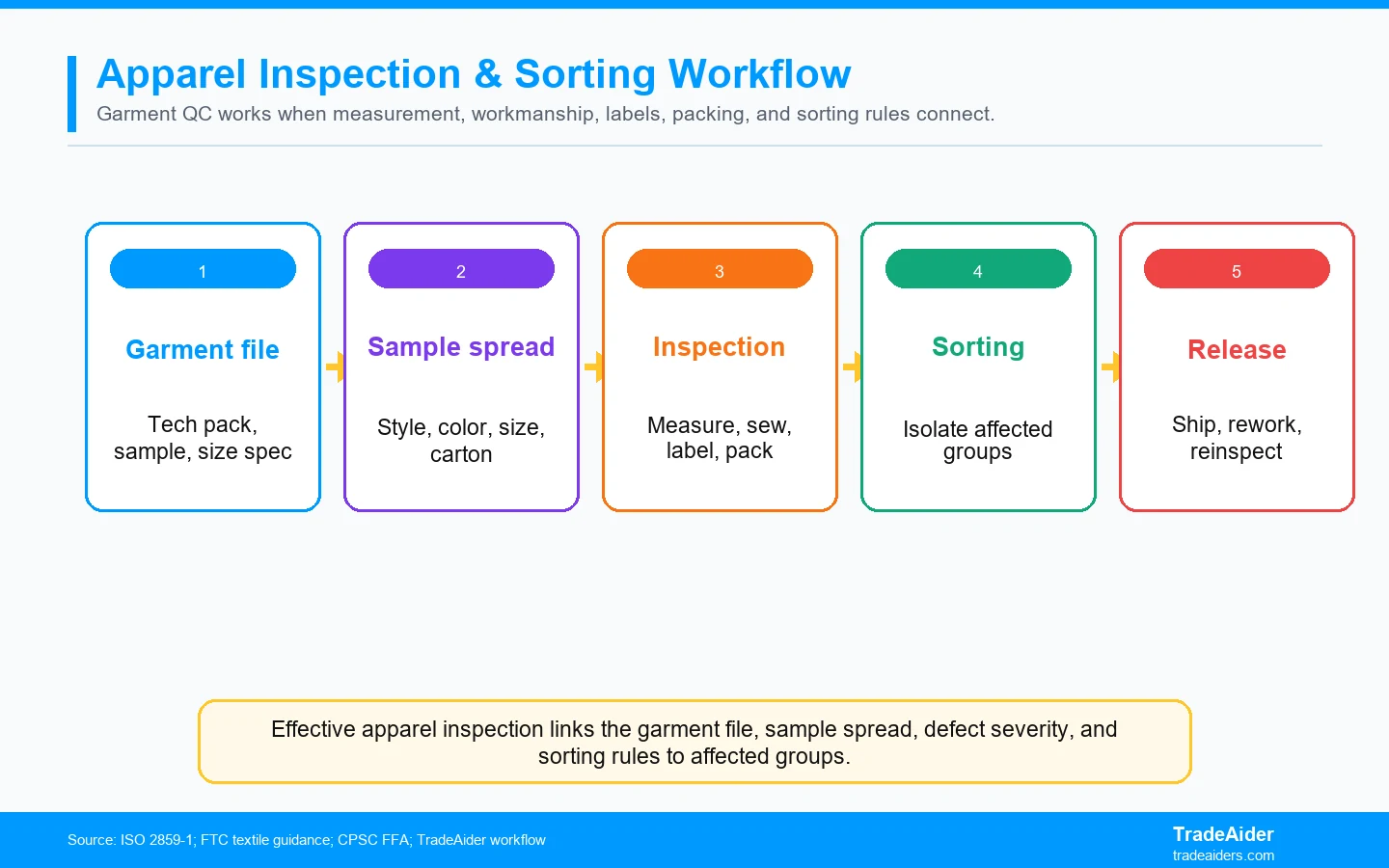
Effective apparel inspection links the garment file, sample spread, defect severity, and sorting rules to affected groups.
Start With the Garment File Before You Touch the Cartons
Apparel inspection quality depends on the clarity of the tech pack, approved sample, size chart, labels, and packing file.
The garment file should be version-controlled
The buyer should send the latest tech pack, bill of materials, approved sample photos, size chart, measurement tolerances, color standards, trim details, label artwork, care instructions, packing method, carton marks, and any approved deviations. If the factory has a different version, the inspection starts from confusion.
Version control is especially important when apparel moves through sampling, salesman samples, pre-production samples, size-set approval, bulk production, and packing. A small trim change or label update can create a large sorting problem if the inspector does not know which version is approved.
Measurement rules need exact points
A measurement check should state points of measure, tolerance, garment position, and sample quantity. Chest, waist, hip, inseam, sleeve length, shoulder, body length, waistband, and opening measurements can change by product and size. The inspector should not guess where a buyer wants the tape placed.
Measurement defects should also be judged by consequence. One slight out-of-tolerance point on a flexible casual garment is different from repeated size drift on fitted apparel or uniform programs. The buyer's selling promise should guide severity.
AQL Sampling Must Respect Apparel Subgroups
A mathematically correct sample can still be weak if it ignores color, size, shade lot, or carton spread.
Map style, color, size, and carton range
Before sampling, the inspection agency should know how many units exist by style, color, size, carton range, packing version, and production date. If the lot includes several colors and sizes, the sample should not come only from the easiest cartons or the most common size.
TradeAider buyers can use the AQL calculator for sample size planning, but apparel needs subgroup judgment. A size breakdown, shade lot, or label version can create risk even when the total sample count looks correct.
Shade and size problems often concentrate
Shade variation may appear by fabric roll, dye lot, colorway, or production date. Size drift may appear by sewing line, operator group, cutting batch, or style. Packing mistakes may appear by carton range or label station. Good reports make those patterns visible.
The buyer should ask for defect counts by subgroup when the issue suggests concentration. That makes sorting more efficient because the factory can focus on the affected area instead of reopening every carton without a plan.
The Apparel Inspection Process Should End With Sorting Rules
Sorting turns defect findings into clean, affected, corrected, and rejected groups.
Defect severity drives sorting priority
Critical defects may include safety issues, illegal or missing required labels, contamination, sharp objects, or severe hazards. Major defects may include wrong size, failed seam strength where relevant, broken zipper, hole, stain, poor workmanship, wrong label, visible shade mismatch, or missing trim. Minor defects may include small loose threads or slight cosmetic issues within tolerance.
The buyer should not wait until the report arrives to decide severity. If loose thread is minor but open seam is major, the checklist should say so. If a missing fiber label stops sale in the target market, it should not be treated as a cosmetic issue.
Sorting should define the affected universe
Sorting is efficient only when the affected universe is clear. The factory may sort one color, one size, one carton range, one sewing line, one trim lot, one shade lot, or the full shipment depending on evidence.
After sorting, reinspection should verify correction. The buyer should not accept a supplier message saying everything fixed unless the report shows what was opened, what was removed, what was reworked, and what was reinspected.
Labels, Care Information, and Packing Are Apparel Quality Issues
A garment can look well made and still fail because label or packing evidence is wrong.
Label accuracy supports compliance and customer trust
Fiber content, care instructions, size, country of origin, brand label, hangtag, barcode, warning label, and retail packaging should be checked against the buyer file and destination requirements. Wrong labels can create receiving errors, marketplace listing problems, or regulatory exposure.
The CPSC clothing guidance is a reminder that some apparel questions move beyond appearance. If a requirement depends on flammability, children's product rules, or another regulated property, inspection should verify documents and labels but not pretend to replace the required test method.
Packing mistakes often create returns without product defects
Apparel buyers often lose margin from mixed sizes, wrong polybags, missing hangtags, crushed cartons, moisture exposure, barcode mismatch, wrong carton marks, or poor fold presentation. These are quality issues because they affect receiving, selling, and customer experience.
The inspection checklist should include carton quantity, assortment ratio, inner packing, size stickers, barcode scan where needed, retail presentation, moisture protection, and carton condition. If packing defects are found, sorting may mean repacking rather than garment repair.
Scenario Estimate: Sorting by Color Can Save Days of Rework
Apparel sorting works best when the report identifies the subgroup, not only the defect type.
Assume a 12,000-piece apparel order includes four colors. Inspection finds shade mismatch concentrated in one color across two carton ranges. If the buyer treats the whole shipment as suspect, the supplier may reopen all cartons and delay the order.
If evidence shows the issue affects 1,500 pieces, the factory can sort and rework that subgroup first. At $0.18 per garment for handling, the targeted sort costs about $270 in direct sorting labor, while opening all 12,000 pieces at the same rate would cost about $2,160 before delay and repacking risk.
This estimate is illustrative. The real value is not a guaranteed saving; it is the sorting rule. Apparel inspection should identify the affected subgroup clearly enough that clean goods are not trapped with defective goods.
Where TradeAider Fits in Apparel Quality Inspection
TradeAider helps apparel importers define garment files, apply AQL sampling, inspect measurements and workmanship, verify labels and packing, supervise sorting, and confirm correction before shipment.
For new styles, Pre-Production Inspection can verify samples, materials, trims, labels, and readiness before bulk sewing. For active production, During Production Inspection can catch measurement or workmanship drift before the full lot is packed.
For final release, Pre-Shipment Inspection can check finished garments when the order is 100% complete and at least 80% packed for export, using AQL sampling, garment checks, label photos, packing evidence, and defect classification.
When hidden performance or regulatory claims matter, TradeAider can coordinate product testing services so the buyer does not ask visual apparel inspection to prove what requires a test method.
SPAR Scenario: Sorting Protected the Clean Apparel Subgroup
The buyer avoided holding clean cartons because the inspection separated defect concentration from the rest of the lot.
Situation: A buyer ordered 9,600 knit tops across three colors and six sizes.
Problem: Final inspection found open seams and wrong care labels, but the defects were concentrated in one color and two carton ranges.
Action: TradeAider mapped defects by color, size, and carton number, then supervised sorting, relabeling, and reinspection for the affected subgroup.
Result: The buyer released 8,180 clean units, held 1,420 units for correction, and shipped after one targeted reinspection instead of reopening the full order.
Apparel Inspection and Sorting Checklist
Prepare this file before booking apparel inspection or sorting.
- Latest tech pack, approved sample, BOM, trim details, and color standards.
- Size chart, measurement points, tolerances, and size-run breakdown.
- Label artwork, care label, fiber content, origin, barcode, hangtag, and carton mark rules.
- Lot map by style, color, size, shade lot, carton range, and production date.
- Critical, major, and minor apparel defect examples.
- Sorting rule for affected colors, sizes, cartons, or production groups.
The checklist should tell the factory what must be sorted, not only what was found. That is the difference between a report that describes problems and a report that helps release clean goods.
After correction, keep the defect photos, measurements, and sorting result. They should become the starting point for the next production run's quality file.
If your apparel order needs inspection, sorting, or reinspection before shipment, send TradeAider the tech pack, approved sample, size chart, lot breakdown, label file, and shipment date. The next step is to plan apparel inspection and sorting with clear subgroup and release rules.
Frequently Asked Questions
What is checked during apparel quality inspection?
Common checks include measurements, workmanship, seams, stitches, fabric defects, shade, trims, labels, size markings, packing, carton marks, quantity, and buyer-specific requirements.
What is sorting in apparel quality control?
Sorting separates conforming garments from defective or suspect garments. It may be done by color, size, carton range, production date, defect type, or severity.
Does apparel inspection replace textile testing?
No. Inspection can verify labels, workmanship, measurements, and packaging. Flammability, restricted substances, fiber claims, or performance claims may require documents or laboratory testing.
How is AQL used in apparel inspection?
AQL helps set sample size and acceptance rules for critical, major, and minor defects. It should be applied with a lot map that covers styles, colors, sizes, and cartons.
When should apparel be reinspected after sorting?
Reinspect after the supplier repairs, relabels, repacks, or sorts affected goods, especially when major defects, label issues, or concentrated subgroup problems were found.

Verwandte Artikel



Erweitern Sie Ihr Unternehmen mit TradeAider Service
Klicken Sie auf die Schaltfläche unten, um direkt in das TradeAider Service System zu gelangen. Die einfachen Schritte von der Buchung und Zahlung bis zum Erhalt der Berichte sind leicht zu bedienen.

