
- Über uns

- Unsere Dienstleistungen
- Ihre Branche
- Ressourcen
- Nachrichten & Blog
For a cross-border TikTok Shop seller, quality control fails when the product page, approved sample, and shipped unit describe different things. A polished listing cannot repair a missing piece, the wrong variation, or a numbered carton population that cannot be tied back to the checked product. The practical release rule is to make every buyer-facing claim traceable to an approved physical reference, a defined product population, and a retained evidence file.
The policy examples below come from TikTok Shop US Seller Center. They show why accuracy, product quality, fulfillment, returns, and appeals need to be connected. They are not a global policy summary: before listing, check the current Seller Center requirements for the target market, category, and fulfillment model.
A Listing Is a Product Specification, Not a Marketing Draft
TikTok Shop's current US Product Quality Policy says the physical product should match its listing descriptions, images, and specifications. The policy also says products should be free of defects or damage and meet applicable safety, compliance, and labeling requirements. That makes the listing a working product specification. Treat its material statement, size range, color, contents, package facts, warnings, and visible product details as facts the factory and release owner must be able to check—not as separate marketing copy.
Start by identifying the claim that would create the clearest buyer mismatch if it changed. For a kit, that may be the count and contents. For an apparel item, it may be fiber content, sizing, color, or care label. For an electrical accessory, it may be model compatibility, included components, plug type, or warnings. The important point is not to create the longest possible checklist. It is to turn each material buyer promise into a specific, observable approval point.
Assign one owner to approve the final claim sheet and one owner to stop a release when the physical product no longer matches it. If the listing team, factory, and warehouse each keep different versions, a late correction can be made in one system while the old fact still reaches the buyer in another. A controlled version number, date, SKU, variation, and approved sample reference are usually enough to prevent that drift.
What Must Stay Connected Before a TikTok Shop Listing Goes Live
The release owner needs one connected approval path for the claim, sample, variation, packed-carton boundary, and evidence file. This does not turn an inspection into platform certification. It does give the seller a way to answer a simpler, urgent question before orders open: “Can we show that the buyer-facing promise and the product population we are releasing are the same?”
- Claim: the exact facts shown to the buyer, including variation-specific details.
- Reference: the approved sample, labeled image set, or controlled specification used to judge the claim.
- Population: the production lot, color, size, or SKU variation that the evidence actually covers.
- Packing boundary: the numbered cartons or packing-list range that contains that population.
- Evidence: the inspection observations, packing records, photos, and corrective-action proof that can be retrieved later.
When those five items agree, the seller has a defensible release record. When one does not agree, the mismatch tells the team where to act: correct the listing before orders, rework the product, isolate a variation, or rebuild the record scope. That is more useful than a broad “pass” label because it names the actual buyer promise at risk.
Build the Claim-to-Carton File Before Bulk Production
TikTok Shop's listing policy says product details such as title, description, images, variations, and applicable warnings must accurately reflect the product. The current Product Listing Policy is the source for that rule. Here, a claim-to-carton file means one controlled record that links the product page to the units and cartons released. It is an operating method, not a platform-issued template or a substitute for legal and category review.
Build the file before bulk production makes changes expensive. The seller supplies the buyer-facing facts; the factory identifies how each fact will be controlled; the quality owner decides what can be observed; and the warehouse or forwarder preserves the packing reference. Where a sample or early check is needed, use it to confirm the reference before the listing and factory move forward on different assumptions. TradeAider's pre-production inspection service can help a seller review the approved sample before bulk claims are locked when an independent check is needed.
| Buyer-facing claim | Factory or packing reference | Release evidence | Action if it differs |
|---|---|---|---|
| Model, color, and variation | Approved sample, artwork, and SKU code | Unit photos and variation record | Isolate the affected variation and correct the source of truth |
| Contents, material, and observable features | Bill of materials, kitting instruction, and sample | Inspection observation and count record | Rework or revise before buyers are shown an inaccurate claim |
| Size, label, warning, and package facts | Approved label and packing specification | Label, package, weight, or dimension check | Hold the nonmatching product until facts and packing agree |
| Released product population | Lot reference, carton marks, and packing list | Carton-range map and retained photos | Do not extend the evidence to cartons it cannot identify |
A listing-ready quality file connects each customer-facing claim to an approved sample, a defined product lot, the packed carton range, and a retained evidence folder. Here, the carton range means the numbered cartons that hold the same identified product population. Its practical value is that it narrows the decision. A mismatch in one color, size, or carton range does not automatically make every unit defective, but it does mean the seller should not claim that the evidence covers a wider population than it actually does. Keep the SKU and variation boundary visible in every record so the corrective action can be equally specific.
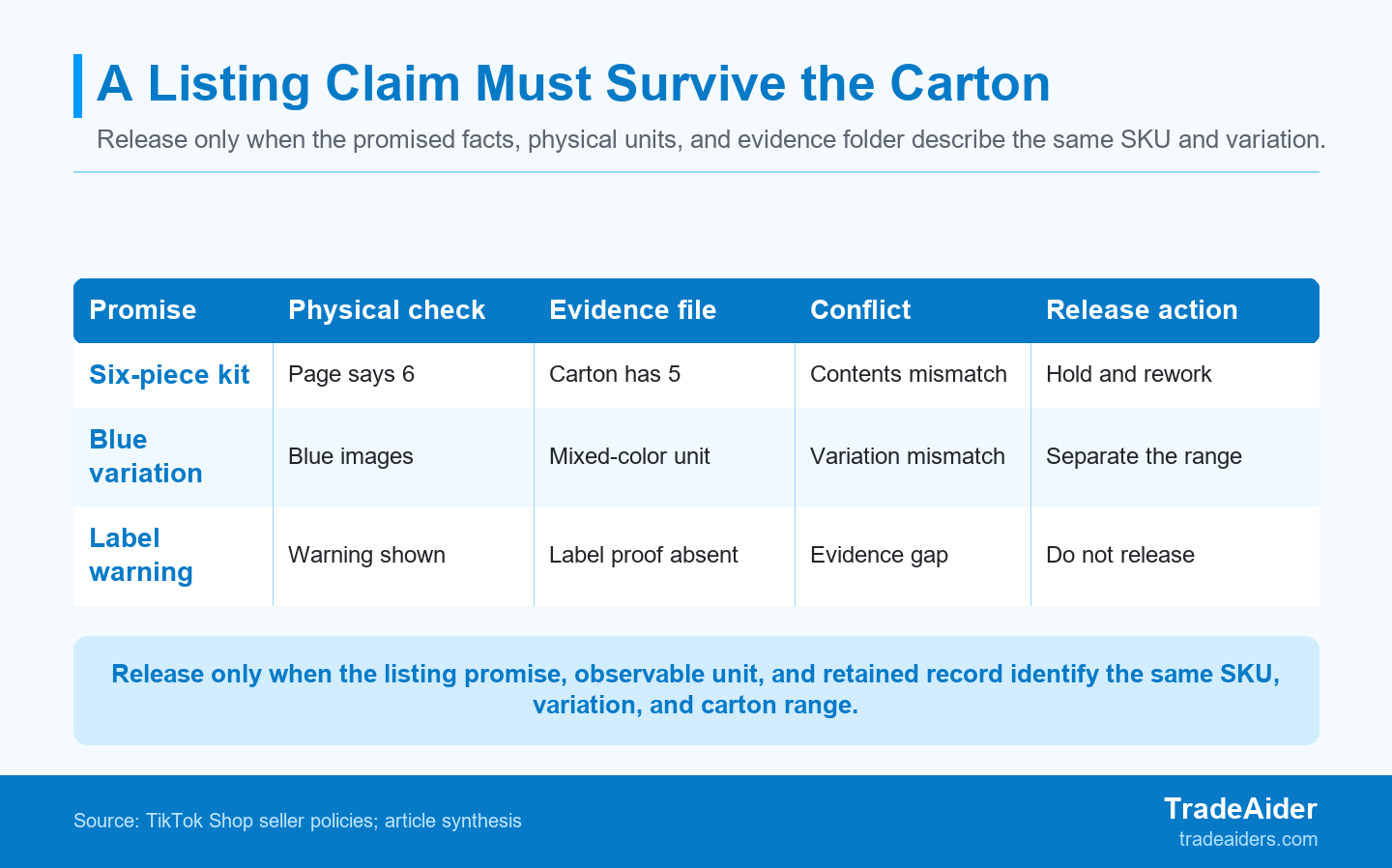
A listing is release-ready only when its claim, the packed product, and the retained evidence point to the same SKU and variation.
Start With the Listing Claim Sheet
A claim sheet turns buyer-facing product facts into observable checks with an owner and approved reference. Include only fields that matter to the buyer, safety or category requirements, product identity, and fulfillment. For each field, record the listing wording or image, the SKU or variation it applies to, the approved reference, the check method, and the person who can authorize a change.
Do not hide uncertainty in a vague phrase such as “assorted accessories” when the item count or components are essential to the purchase. Likewise, do not approve one neutral sample and assume it proves every color or variation. If a claim differs by variation, make the variation boundary explicit on the sheet. This gives product, content, and quality teams the same question to answer when a supplier proposes a substitution.
Map Each Claim to the Lot and Carton Range
Map the carton range to the checked product variation so the evidence boundary stays concrete. Instead of saying that a whole purchase order was checked, the seller can show which color, SKU, packing run, and numbered cartons were included. Use the factory’s actual carton mark, packing-list line, production reference, or inner-pack label rather than inventing a tracking code no one on the floor uses.
This detail matters when a change happens late. A revised kitting instruction may affect only cartons packed after a shift change; a substitute label may affect one color; a mixed inner pack may affect one warehouse allocation. The release owner should be able to identify the last known matching unit and the first potentially nonmatching unit. That boundary keeps rework, recounting, and any listing correction proportional to the actual risk.
Use Inspection to Test the Promise Against the Packed Unit
TikTok Shop states that it may inspect or test products, listings, and fulfillment practices and may request supporting documents. Its Product Quality Policy is the current US source for that statement. A seller should therefore treat the factory check as a comparison against the approved claims, not as a generic factory scorecard. The check should cover the product facts a buyer can see or experience, the variation boundary, and the evidence needed to explain a correction later.
A pre-shipment inspection (PSI) is a final review of finished goods and packing shortly before shipment. For a meaningful pre-shipment sample, production should be 100% complete and at least 80% packed. That packing readiness lets the team check the unit and the carton context together; it does not mean that 80% packed equals 80% production complete. Define the sampling plan, acceptance criteria, product variations, required photos, and carton references in advance. The platform does not choose that inspection scope for the seller.
TikTok Shop's Shop Performance Score guidance recommends accurate listings, proactive quality control, and action on negative reviews as product-satisfaction practices. Its current guidance supports that approach. The operational implication is modest but important: inspect the claims most likely to trigger a mismatch complaint, then make sure the responsible team can correct the product, packing, or listing before it scales across a larger population.
A pre-shipment inspection can compare agreed claims with observable finished units and packaging; it cannot certify future marketplace performance or decide a platform dispute. During bulk production, a seller can check variation, contents, and packaging while production can still change. That earlier checkpoint is especially useful when the production line is assembling kits, changing labels, or moving among color runs that could diverge from the approved listing reference.
Keep Packaging and Fulfillment Checks Separate
TikTok Shop's fulfillment policy covers seller handling, tracking, dispatch, delivery, and fulfillment performance requirements. The current policy sets that separate operational boundary. Those obligations sit next to product quality, but they are not the same check. A carton can have the right tracking path and still contain the wrong variation; a correctly assembled item can still be packed, labeled, or handed off in a way that creates a fulfillment issue.
Keep two sign-offs. The product-and-packaging sign-off asks whether the unit, inner pack, label, carton mark, and contents match the controlled claim. The fulfillment sign-off asks whether the selected fulfillment method, shipping data, and handoff meet the current Seller Center requirements for that market. Do not use one approval as evidence of the other. This separation also helps customer service identify whether a complaint calls for a product correction, a packing investigation, or a delivery review.
Prepare the Evidence File Before the First Return
TikTok Shop's return and refund policy identifies product mismatch, defects, and wrong products as return or refund issues and describes seller evidence responsibilities in disputes. Its Return and Refund Policy is the current source. The evidence file should be prepared while the production facts are still accessible, not rebuilt from memory after a buyer complaint. Retain the approved sample reference, final listing assets, variation map, inspection observations, product and carton photos, packing-list reference, supplier explanation, and any rework or corrective-action record.
TikTok Shop says product-quality appeals may require compliant supporting documents and a corrective action plan. Its Product Quality Violation Appeal guide is the current source. Do not mistake document volume for useful proof. A helpful file lets a reviewer see what claim applied, which product population was affected, what the seller found, what was corrected, and how the corrected population was checked. Follow the current alert instructions in Seller Center, because the requested documentation and timing can vary.
Set a retention owner and a retrieval rule. For example, store the inspection report under the SKU and production reference, keep carton photos with the packing record, and attach a rework record to the exact variation and cartons it changed. Customer service then has a controlled factual record, while operations can spot whether a complaint is isolated or shows a pattern that should stop another release.
Illustrative Scenario: A Kit Count Mismatch Before Listing
In the illustrative order, a changed kitting insert leaves one color's cartons with five pieces while the planned product page promises a six-piece set. The cross-border seller plans to list 1200 home-organization kits in three colors, with 400 units per color. The approved listing sample contains all six pieces. During bulk packing, the kitting insert changes for one color, while the other two color variations still retain six pieces.
The issue is not simply that “the order failed.” The listing promise and one physical product population conflict. The changed color, packing run, and mapped cartons provide the boundary for the response. The other color variations should remain separately identifiable, but they do not erase the mismatch in the affected range. This is an illustrative operating decision, not a TradeAider client case or a prediction of any TikTok Shop outcome.
Hold Only the Color and Cartons That No Longer Match
The five-piece color variation should stay isolated until rework and a carton-range count check restore the six-piece listing promise. The release record shows a 1200-unit order with 400 units in the affected color. The release owner first records the affected SKU, color, packing run, and carton range; then confirms whether any orders have been accepted. If the product page has not gone live, the seller can decide between restoring the missing sixth piece or changing the proposed product facts before buyers see an inaccurate claim. If buyers can already order, do not use a late copy change to blur which physical units are already committed.
The preferred corrective action is to restore the missing piece, recount the affected kits, update the carton map, and recheck the released contents statement, variation, and images against the corrected population. Release the held color only when the count check and carton-range record show that every released unit matches the final claim. This example is a quality-control decision, not a prediction of TikTok Shop enforcement or a seller-performance result. That proportional hold avoids extending a five-piece mismatch to cartons that still match, while also avoiding a broad six-piece promise that the affected cartons cannot support.
Hand Off a Listing-Ready Quality Packet
A listing-ready packet lets operations, inspection, warehousing, and customer-service teams retrieve the same product facts without reconstructing them after a complaint. Before release, the packet should identify the final listing version, approved sample or specification, variation map, agreed inspection points, inspection observations, carton-range record, packing photos, and any open correction with its release owner.
The handoff should state what is clear and what is still conditional. A completed sample check does not approve an unobserved late production run. A checked carton range does not prove the facts of cartons outside that range. A pending label change should stay visible until the final approved label and units have been rechecked. These boundaries make the packet useful for a warehouse handoff and for a later customer-service review.
When finished goods and cartons are ready, a seller can compare the finished packed units with the release file before shipment. Provide the SKU list, variation map, approved references, carton marks, and the specific claims that require observation. This creates a scoped physical check instead of a generic request for a “pass” report.
Before the release decision, confirm that every attached document still describes the same product population. Check the final image set against the approved sample; check the packing list against the carton marks; check the carton photos against the listed variation; and check that any corrective action is closed for the units being released. If one point remains open, state the affected scope and release condition rather than leaving an ambiguous “pending” label. The packet should also name the person who can answer a warehouse question, the person who can approve a listing correction, and the person who can decide whether an isolated range can move safely.
TradeAider can turn those named checks into an independent inspection scope where the supplier, SKU, variation, carton marks, and observable claims are available. The supplier still owns product changes and the seller still owns current marketplace compliance, but an independent report can preserve what was observed at the agreed stage.
For a new launch or a high-risk change, write the handoff in one page: release population, matched claims, unresolved points, record location, corrective-action owner, and next verification date. If the seller needs an independent scope for those facts, request a pre-shipment inspection plan for the SKU and carton range.
Frequently Asked Questions
Can a Pre-Shipment Inspection Prove TikTok Shop Compliance?
No. A pre-shipment inspection can document agreed product and packing facts, but it cannot certify platform compliance or decide a TikTok Shop dispute. It is a physical verification tool: the scope should name the SKU, variation, sample size, observable claims, packing condition, and photo or carton records needed. The seller remains responsible for current listing, category, market, legal, fulfillment, and Seller Center requirements. Use the report as evidence for a controlled release decision, not as a promise about future marketplace performance. Recheck current platform rules before each launch, category expansion, or market change.
What Should Match Between a Listing and a Carton?
The product identity, variation, contents, observable condition, labels, and package facts should all match the approved listing claim for the covered SKU. The carton itself also needs to identify the product population through a useful mark, packing-list line, or other record. It is not enough that a carton carries a broad style name if the color, kitting version, or contents changed. The evidence must be narrow enough to show exactly which released units it supports. Keep the carton reference with the corresponding inspection photos and final approved listing version for every released range.
When Should a Seller Update a Listing Instead of Rework?
Update a listing only when the correct, compliant product facts will be shown before buyers place orders; otherwise rework or isolate the nonmatching product. A product page cannot be a retroactive explanation for goods that buyers have already been promised. Confirm the final product, variation, images, dimensions, contents, warnings, and any category-specific detail before the listing is released. TikTok Shop's US listing guide tells sellers to make product details accurate, honest, clear, and compliant before listing. Read the current listing guide before making a category or market-specific decision and retain the approved version in the release file.
What Evidence Helps With a TikTok Shop Quality Appeal?
Use the current Seller Center instructions, then provide relevant product, compliance, inspection, packing, and corrective-action records that address the alert. A concise evidence chain is stronger than unrelated files: show the listing claim, approved reference, affected SKU or carton range, observed issue, corrective action, and verification record. Keep documents legible, current, and consistent with the product under review. The platform determines whether an appeal is accepted, so do not promise an outcome based on a report or document bundle alone. Preserve the original record alongside any correction for clear comparison.

Verwandte Artikel



Erweitern Sie Ihr Unternehmen mit TradeAider Service
Klicken Sie auf die Schaltfläche unten, um direkt in das TradeAider Service System zu gelangen. Die einfachen Schritte von der Buchung und Zahlung bis zum Erhalt der Berichte sind leicht zu bedienen.

