
- Über uns

- Unsere Dienstleistungen
- Ihre Branche
- Ressourcen
- Nachrichten & Blog
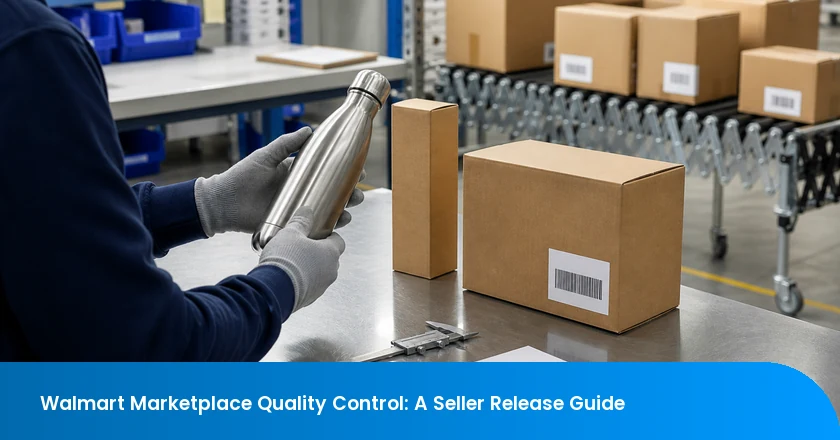
The costly Walmart Marketplace failure is rarely a visible factory defect alone. It is a product, listing, label, or carton mismatch that cannot be tied to a defined population when the seller needs to release inventory. Walmart lists defective products, product-quality concerns, and items not as described among seller-performance drivers.Walmart's Seller Performance Standards A supplier's passed message is not enough; the item a customer receives must reconcile to the cartons that actually move.
This is an operational release guide, not legal advice or a promise of account performance. Use it to identify which range is proven to match the approved SKU and which range needs correction or evidence.
A Seller Release Starts With Four Connected Controls
Build the check around the physical product, the customer-facing listing, the package and fulfillment route, and evidence for applicable claims. Freeze the approved sample, bill of materials, listing copy, barcode artwork, pack count, and defect criteria before bulk output. For a new SKU or revision, use a Pre-Production Inspection to lock product and package requirements before bulk output.
Walmart evaluates outcomes including returns, negative feedback, fulfillment, tracking, and cancellations. That does not mean every factory defect becomes a marketplace event. It means quality, delivered condition, and product accuracy should be checked together before cartons are hard to sort or relabel. You can turn buyer requirements into a written inspection standard rather than letting the factory inspect against a generic defect list.
For marketplace inventory, quality means that the product a customer receives, the listing they relied on, and the identifiable cartons released all point to the same SKU version.
Match the Product to the Listing, Identifier, and Pack
Compare a sellable unit with the live listing and with the files used to pack it. Walmart advises sellers to verify that product quality matches what is displayed online and that advertised parts are included.Its negative-feedback guidance makes this a customer-experience check, not merely factory paperwork.
Put title, images, variant attributes, included components, size or count, instructions, and package artwork beside the unit. Then scan the GTIN or UPC, the product identifier that maps to the sellable item. Walmart requires a product ID for Marketplace items and says each product needs its own unique ID for setup.Walmart's product-ID policy A correct scan does not prove every claim, but it catches a wrong item or variation before it is mixed into cartons.
Treat a new component, new pack count, revised artwork, or new listing claim as a version change. Check that version on the unit, label, carton, and packing record. If it repeats while production is open, use During Production Inspection to verify a repeated product-to-listing mismatch before packing.
Treat Safety Documentation as a Separate Evidence Gate
A visual inspection can confirm what is on a unit; it cannot create the test, certificate, or technical evidence needed for an applicable regulated claim. Walmart says listing labels, information, and images must not conflict, and requires safety documentation for children's and other regulated consumer products when applicable.Read the policy overview
For a regulated claim, make the product version, destination market, and supporting document visible in the release packet. Walmart's policy makes clear that required safety documentation is a separate obligation from the visual condition of the unit. The rule depends on product and market, so do not infer compliance from a neat appearance or from an old supplier report. If a claim needs more than a visual check, use product testing support when a regulated claim needs evidence beyond visual inspection.
Release a Defined Population With a Five-Part Packet
A release packet is the records needed to approve a defined carton range: approved physical product, customer-facing listing, GTIN or UPC, route-specific package condition, and applicable evidence. Add the condition that makes the decision usable: name the carton or unit range checked. If five checks look correct but the factory cannot say which cartons contain the revised package, hold that unproven range, reconcile the packing record, correct the attribute, and recheck it.
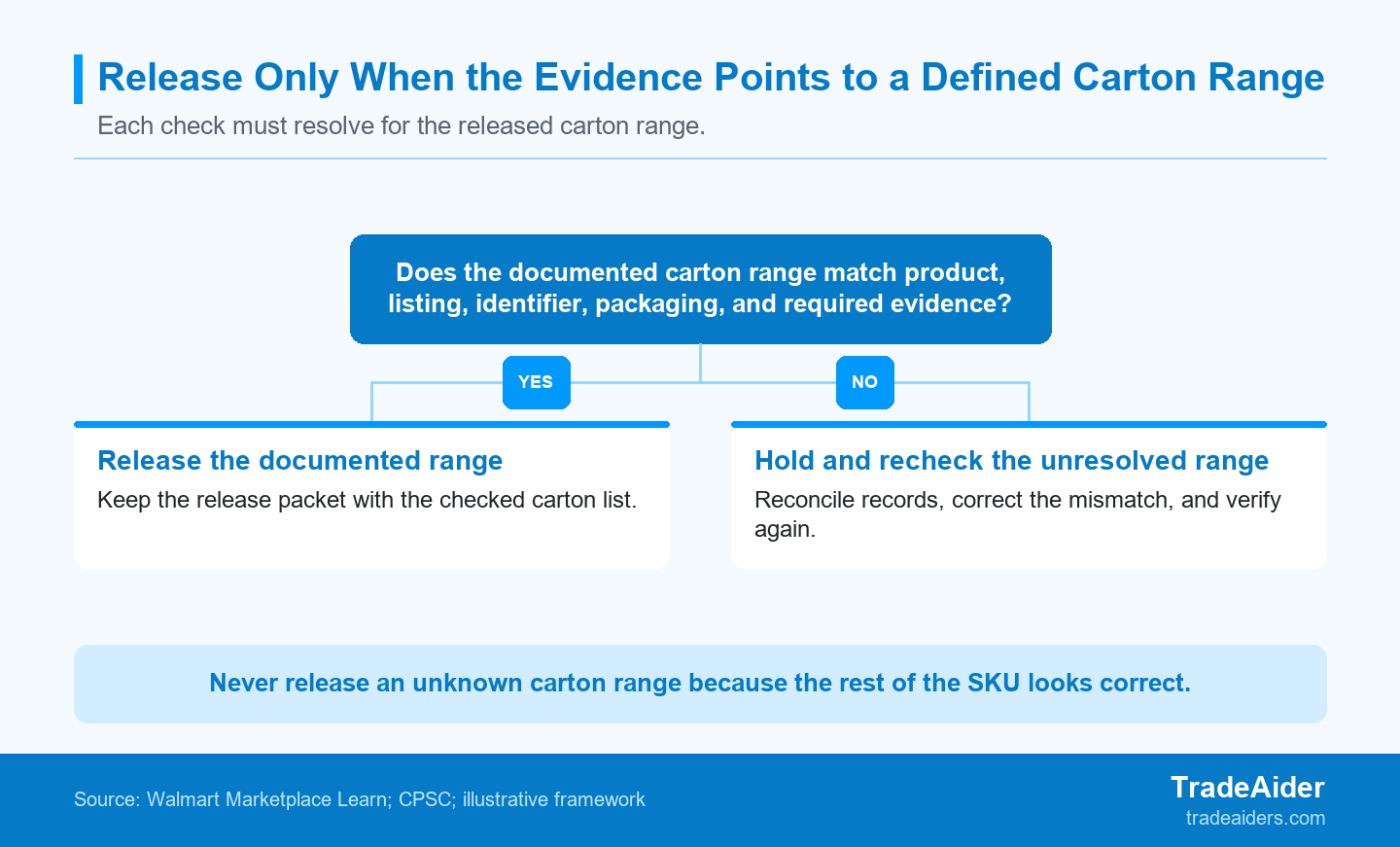
A release packet is not a pass/fail score. One unresolved carton range changes the decision for that range from release to hold and recheck.
WFS Inbound and Seller-Fulfilled Orders Need Different Pack Checks
WFS inventory must be ready for sale in packaging that protects the item and keeps it contained through transit; Walmart may test packaging and reject items that do not meet requirements or show high damage.WFS preparation guidance Seller-fulfilled orders follow a different branch: Walmart requires accurate tracking after carrier tender and restricts competitor packaging and promotional inserts.Shipping and fulfillment policy
A Release Packet Is Only Useful if It Names the Checked Range
“SKU passed” is not enough after a late label or pack change. Record the PO, SKU version, completed and packed quantity, carton numbers or range, inspection scope, exceptions, correction record, and recheck result. A complete carton map lets the seller isolate a narrow range; a missing map makes the honest answer “unknown,” which is a reason to pause release rather than average a few good samples against unclear cartons.
Illustrative Scenario: A Correct Product With the Wrong Carton Mark
An illustrative US seller is preparing a China-made storage-bin SKU for WFS. The 2400-unit PO is complete and 1920 units are packed in 96 cartons. The new sellable unit matches a 12-piece listing and its UPC scans correctly, but four sampled cartons show a prior 10-piece carton mark. The factory cannot map that old mark to a finished-carton range. The seller records the PO, the current listing version, the individual-unit UPC scan, the exact 96-carton packing list, and photographs from all 4 sampled cartons before making a release decision. The seller asks the factory to identify each carton in the affected sequence, confirm its mark and quantity, and isolate any unit that cannot be tied to the revised files.
The issue is a document-product conflict affecting an unknown portion of the packed population. Hold the old-mark cartons and any carton without a version record. Do not hold the confirmed new-mark range merely because it shares the SKU.
How the Seller Separates a Corrected Range From an Unknown Range
Relabel the confirmed old-mark cartons, reconcile carton numbers to the packing list, and recheck carton mark, SKU count, UPC, and packing-list match for that corrected range. Release only the corrected, mapped range; hold cartons with no reliable version record. For this 2400-unit, 96-carton order, the 4 sampled cartons are evidence points, not a statistical pass or fail result. This scenario is illustrative, not a TradeAider client result or a Walmart policy interpretation. The buyer should also retain photos of the old and new marks, the corrected carton list, and the recheck result. That record identifies what was changed, the precise range affected, and the evidence used to separate release-ready inventory from cartons that still need investigation.
Prepare the Evidence Before Requesting an Independent Check
Send the PO, approved sample, current listing copy, barcode artwork, carton photos, defect criteria, applicable test evidence, and current production and packing status. TradeAider scopes a Pre-Shipment Inspection to an order that is 100% complete and at least 80% packed for export. Schedule a Pre-Shipment Inspection for the completed export-packed population when those conditions are met.
- Name the SKU, version, listing, and carton range.
- Mark every unresolved product, label, or evidence mismatch.
- Define the correction and recheck condition before release.
If you are comparing providers, review TradeAider's inspection approach and real-time visibility. When the release packet is ready, contact TradeAider to scope an independent marketplace release check.
Frequently Asked Questions
Does Walmart Marketplace require a quality inspection?
Walmart policy does not make a factory inspection a universal substitute for seller responsibilities. An inspection can support a defined-lot decision, but the seller still needs accurate listing information, applicable documents, and a fulfillment process that follows current policy.
Can a WFS shipment be inspected after it arrives?
WFS may inspect arriving items and packaging, but sellers should verify the release packet before handoff. Corrections after arrival can add delay, fees, or sorting work, so confirm the carton range and applicable route requirements first.
When is product testing more useful than visual inspection?
Use testing or certification evidence when a regulated product or claim cannot be confirmed by looking at the finished unit. Identify the product and destination requirement, then check that the document applies to the actual version being released.
What records should I send to an inspection provider?
Send the PO, approved sample or specification, listing copy, barcode and label artwork, carton photos, packing list, completed and packed quantities, and any applicable test evidence. Name recent artwork, component, or pack-count changes as well.

Verwandte Artikel



Erweitern Sie Ihr Unternehmen mit TradeAider Service
Klicken Sie auf die Schaltfläche unten, um direkt in das TradeAider Service System zu gelangen. Die einfachen Schritte von der Buchung und Zahlung bis zum Erhalt der Berichte sind leicht zu bedienen.

