
The technology trends that matter for third-party inspection in 2026 combine continuing advances in digital records, AI, sensors and remote participation with new implementation milestones. This year, updated rules for certain accredited remote assessments and the EU digital product passport registry make evidence security and product-data readiness practical priorities. Other technologies below are longer-running directions to evaluate for the actual inspection task, rather than inventions or proven industry-wide adoption this year.
Testing, inspection and certification, often grouped as TIC, involve different activities and decisions. Their technology needs vary across consumer goods, manufacturing and industrial assets. The developments below are a buyer-facing selection, with technical capabilities and program requirements identified in their respective contexts.
Match Inspection Technology to the Evidence You Need
- Connect digital findings with the current order, product revision and reviewed report.
- Evaluate AI, sensors and remote capture on the actual features and operating conditions.
- Protect inspection records and retain their source and correction history.
- Apply product-specific sustainability requirements and appropriate examination methods.
- Use a representative pilot and competent review to assess a proposed workflow.
Digital workflows connect inspection evidence and decisions
Digital transformation connects the order, product revision, sample identity, raw findings, review and final report. Its value comes from preserving those relationships as information moves between the inspector, supplier and buyer. A photograph becomes more useful when the reader can identify the checked item, feature and applicable requirement.
Structured forms can capture measurements, defect descriptions and images together. Reviewers can then follow an observation back to its source. Revision history matters when a defect is corrected, a measurement is repeated or a conclusion changes. Keep the earlier finding and the reason for the update visible to the authorized users.
TradeAider's published pre-shipment inspection service describes real-time visibility during inspection through its website service system. This supports timely discussion of observed findings. Its PSI stage applies when the order quantity is 100% complete and at least 80% packed for export.
A live update and a reviewed report have different uses. A buyer may act quickly on a visible concern while the team is still completing its agreed checks. The report should identify what was examined, the results, relevant limitations and the version being used for the order decision. Agree how corrections and unresolved items will appear.
AI and automation expand the checks that can be assisted
Artificial intelligence, or AI, can assist pattern recognition, image sorting and review. Automation can also use programmed rules, sensors and handling equipment. Assess the complete arrangement, including how it captures a feature, interprets the input and responds to an uncertain result.
A camera system checking a repeated surface feature needs suitable presentation and lighting. Evaluation should include the actual product variants and relevant defect types. A result from a carefully arranged demonstration gives limited information about a different finish, angle or production condition. Keep the evaluation conditions with the performance findings.
NIST presents its AI Risk Management Framework as voluntary guidance for incorporating trustworthiness into the design, use and evaluation of AI systems. It provides a risk-management basis for considering deployment and oversight. It does not establish the detection capability of a particular inspection setup. NIST AI Risk Management Framework.
Reporting assistance introduces a related issue. A tool may summarize findings or draft a narrative, but the reviewer still needs to compare that text with the original observations. Confirm product identity, defect counts, units and unresolved items. A fluent summary can omit a limitation that changes the buyer's decision.
Define who handles false alarms, suspected missed defects and unfamiliar inputs. Keep the model or program version identifiable and determine when changed conditions require reassessment. People responsible for technical conclusions need enough information to challenge the output and arrange an appropriate further check.
IoT connects condition data with maintenance and inspection
The Internet of Things, or IoT, connects devices that collect and exchange data. In an inspection or maintenance workflow, sensors can provide temperature, vibration or other condition readings. To interpret them, identify the measured quantity, device location, time reference, operating state and any gaps in the record.
NIST's long-running research on prognostics, health management and control connects sensing, diagnostics and prognostics with manufacturing and maintenance decisions. This is a technical development context. It provides no industry-wide adoption rate or guaranteed reduction in failures. NIST condition-monitoring research.
Condition monitoring observes what is happening. Diagnostics investigates a condition or fault, while prognostics estimates future behavior. Predictive maintenance needs a validated connection between signals, equipment condition and the action taken. An alert should lead to an identified review or maintenance response, with uncertainty retained when the cause remains unresolved.
Connected devices also introduce security needs. NIST describes its IoT device cybersecurity capability baseline as a starting point for organizations manufacturing, integrating or acquiring IoT devices. Consider those device capabilities alongside the inspection-data workflow and its access arrangements. NIST IoT baseline abstract.
Remote and hybrid inspection broaden participation
Remote participation lets a specialist or buyer review documents, observe a live activity or discuss a finding from another location. A hybrid arrangement combines remote participation with work at the site. Select the arrangement around the evidence the particular task requires.
Before a live session, agree how the team will identify the site, product and checked units. Plan camera access, lighting, close views, measurement visibility and record retention. Determine who controls item selection and movement. The remote participant needs to know which areas or operations remain outside the available view.
A concrete change for 2026 concerns remote conformity assessment. The Standards Council of Canada (SCC) bulletin states that January 30, 2026 is the application date for IAF MD 4:2025 when information and communication technology (ICT) is used in assessments and audits under its listed management-system, validation/verification, product-certification and personnel-certification accreditation programs. ICT itself is optional. Where used within that scope, the requirements address agreement, security, risk planning, infrastructure readiness, competence and reporting. SCC ICT bulletin.
For buyers commissioning work within those programs, check that the agreed assessment plan and report address the ICT arrangement now in use. An ordinary product-inspection assignment still follows its actual contract, method and evidence needs; the bulletin is not a universal mandate to conduct consumer-goods inspection remotely. A view of the outside of a carton cannot establish a concealed assembly condition.
Agree a fallback for lost connection, unreadable details or unavailable measurements. This may involve a different capture method, an on-site check or a rescheduled activity. Record the resulting limitation and its effect on the task before using a partial session to support a broader conclusion.
Blockchain adds a shared record option
Blockchain is a possible approach to sharing transaction history. NIST describes blockchains as distributed digital ledgers with tamper-evident and tamper-resistant properties under normal network operation. This concerns the behavior of the recorded transactions within that network. NIST blockchain overview.
An inspection record still depends on the original observation, correct product identity and authorized handling of corrections. Ask what is stored, what remains in another system and how a reader retrieves the underlying evidence. A recorded document identifier needs a reliable connection to the actual document and its revision.
Evaluate a shared ledger when several parties need a common transaction history. Consider access, governance, recovery and correction procedures alongside the integration cost. A controlled document system may already address the actual record need. The selection should follow the parties' evidence-sharing problem and operating arrangements.
Cybersecurity becomes part of the inspection workflow
Digital inspection creates dependencies on accounts, devices, networks and stored records. NIST presents the Cybersecurity Framework as a resource for managing organizational cybersecurity risk. Use the inspection workflow to identify the assets and decisions that need protection. NIST Cybersecurity Framework.
Decide who can view, upload, revise and approve each record. Review access when staff or contractors change roles. Plan how devices are maintained, how sensitive files are shared and how suspicious account activity is reported. A report needs an identifiable authorized version when it passes between organizations.
Availability also matters. Define how the team continues or records limitations when a device, account or network is unavailable. Retain appropriate backups and test the recovery arrangements needed for the work. Keep these controls aligned with confidentiality, retention and contractual requirements for the inspection information.
Include people in the plan. Staff should recognize unexpected file requests, credential prompts and changes to instructions. Assign an owner to investigate incidents and assess which findings or decisions could be affected. Technology suppliers and inspection teams need clear responsibilities at the interfaces between their systems.
Sustainability rules increase demand for structured product data
The European Commission’s digital product passport (DPP) page records the registry launch on July 20, 2026, alongside a testing environment. That is a concrete product-data infrastructure milestone this year. The Commission describes progressive introduction across selected product groups; the registry launch does not make a passport mandatory for every product or replace each group’s legislation and implementation conditions.
For an importer preparing a potentially affected product, this year’s practical work is to connect product identifiers, material information and supporting records, and to test how required data can be exchanged. First establish the applicable product rules and timeline, then assign the data owners. The Commission labels its general timeline indicative; do not turn an infrastructure milestone into an unsupported deadline for every order.
Environmental, social and governance concerns, often grouped as ESG, cover many different questions. A recycled-material claim, an energy measurement and a labor-practice assessment require different evidence. Identify the claim, boundary, method, period and responsible owner. Then determine which inspection, testing or verification activity can contribute.
For example, an agreed inspection might record the markings and material references visible on identified goods. A laboratory test or a separate material-traceability record may address another requirement. Keep the evidence connected to the product and the claim it supports. Broad sustainability wording gives little direction unless the team knows what must be substantiated.
Digital records can help organize that information and expose missing inputs. Preserve the underlying technical documents and their scope when transferring values into another system. Data completeness, actual conformity and the meaning of a marketing claim each need the appropriate review.
Advanced NDT improves how examination data is captured
Nondestructive testing, or NDT, examines materials or components without destroying their usefulness. Industrial applications include welds, structures and equipment. Developments in sensing, electronic scanning and digital records can change how teams plan coverage and review examination data.
TWI explains that phased-array ultrasonic testing uses multiple elements with controlled timing to steer or focus an ultrasonic beam electronically. Its guidance also discusses applicability, complexity and training. Those conditions matter when deciding whether phased-array examination fits a particular job. TWI phased-array explanation.
Compare methods against the material, likely discontinuity, geometry and access. Agree the procedure, coverage, reference and acceptance criteria with the responsible technical owner. A digital image or scan can support later review, but its interpretation depends on how it was acquired and what the examination covered.
Robotic carriers and remote-access platforms introduce another layer of planning. Consider positioning, surface access, sensor contact where required and how the coverage is demonstrated. A camera view and an ultrasonic result answer different questions. The equipment arrangement and the selected method must jointly address the intended examination.
Adoption depends on a defined task and competent people
Evaluate a proposed technology through a defined task and representative pilot. Establish a comparable baseline, the relevant product conditions, expected outputs and response to uncertain results. Include setup, integration, training, review and ongoing maintenance when judging the operating commitment.
| Technology direction | Evidence to examine | Pilot question |
|---|---|---|
| Digital workflow | Order-linked findings and correction history | Can the reviewer trace a report entry to its source? |
| AI or automation | Representative evaluation and unresolved results | What happens with an unfamiliar defect or variant? |
| Connected sensors | Device, time, condition and missing-data records | Can an alert be connected to a useful response? |
| Remote participation | Identity, capture coverage and limitations | Which physical evidence remains unavailable? |
| Shared digital records | Source document, access and correction controls | Can all authorized parties retrieve the same revision? |
| Sustainability data | Product-specific claim and supporting records | Who resolves a missing or inconsistent value? |
| Advanced NDT | Method, coverage, settings and qualified interpretation | Does the examination address the target discontinuity? |
Illustrative example. An importer receives an automated defect summary for coated housings. The underlying images omit a recessed surface and show an older color revision. Preserve both records, identify the missing view and obtain the current reference. Arrange appropriate physical views or checks for the affected feature before using the summary to decide that feature. This is a hypothetical evidence gap, with no measured client outcome.
The pilot should show whether the revised capture and review process supplies the required evidence. Record unresolved cases and assign the next action. Competence includes understanding the product, method and technology's operating limits. Training and a named decision owner help translate a system output into a justified inspection conclusion.
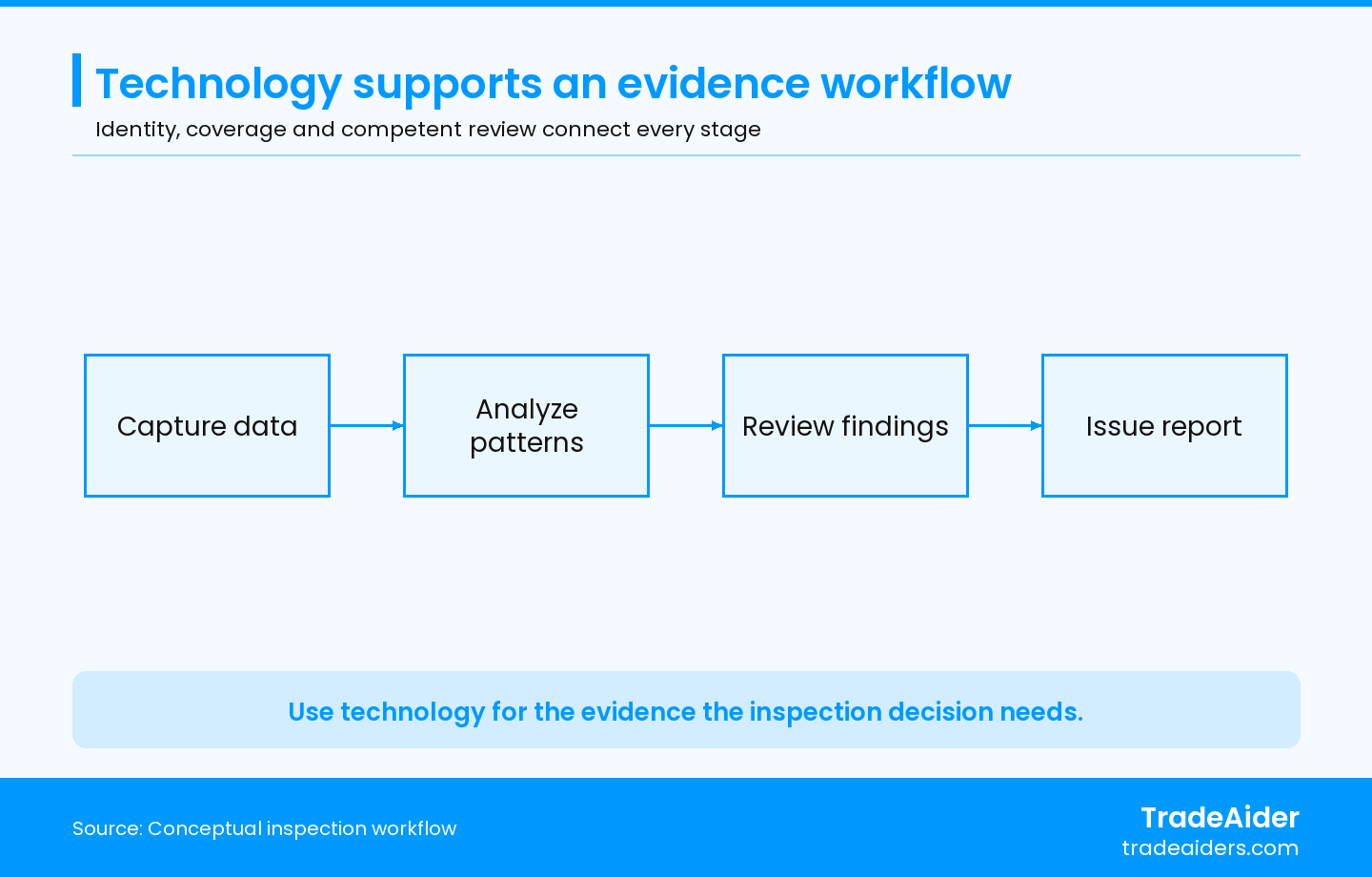
Conceptual evidence workflow. Digital tools support capture and analysis, while the agreed task and competent review determine the report scope.
Discuss the evidence your order needs
Start a TradeAider inquiry with available product and order information, factory, destination, intended timing and known concerns. Include the specifications and records you already have. Contact our team to discuss feasible checks and a report of agreed observations. Before inspection, agree references, sampling, equipment, access and how limitations will be recorded. Identify the report recipient's practical language and evidence needs.
Frequently Asked Questions
Does adopting inspection software change an organization's accreditation scope?
Software adoption alone does not extend an accreditation scope. Any applicable accreditation or scheme requirements still govern the activity. Review the specific activity, method, personnel and delivery arrangement through the responsible organization's procedures. A digital feature can change how work is performed, so the organization needs to assess the relevant impact before presenting the result under an accredited scope.
What happens when two digital inspection records disagree?
Preserve both versions and resolve their product identity, timing, method and correction history before relying on the affected conclusion. Identify which record is under review and who can authorize a correction. If the difference concerns an actual product observation, examine the underlying evidence and arrange a further check where needed. Keep the reason for the final disposition traceable.
Is a digital product passport a substitute for an inspection report?
A digital product passport organizes required product information. An inspection report records the findings of a defined inspection activity. Their relationship depends on the applicable product rules and the information being requested. An inspection record may support a relevant field within its scope, while other fields may require laboratory results, manufacturer data or other specified evidence. Check each field's actual requirement.

Verwandte Artikel



Erweitern Sie Ihr Unternehmen mit TradeAider Service
Klicken Sie auf die Schaltfläche unten, um direkt in das TradeAider Service System zu gelangen. Die einfachen Schritte von der Buchung und Zahlung bis zum Erhalt der Berichte sind leicht zu bedienen.

