
- Über uns

- Unsere Dienstleistungen
- Ihre Branche
- Ressourcen
- Nachrichten & Blog

A factory audit can show whether controls exist, but it cannot turn a supplier snapshot into a reliable shipment record when the material, production, and carton references do not point to the same goods. For this sourcing risk, the practical question is whether the importer can connect a current US-bound order to a continuous evidence trail—not whether a supplier passed one audit visit.
That makes a favorable audit useful but incomplete: it can test systems, while the importer still needs to establish the relevant supply-chain facts for the particular material population and order under review.
Why a Factory Audit Is Not Enough for UFLPA Sourcing Risk
The Uyghur Forced Labor Prevention Act (UFLPA) is a US import rule that creates a rebuttable presumption for goods made wholly or partly in Xinjiang or by entities on the UFLPA Entity List. For goods within the UFLPA's scope, a factory audit is not the decision point; the importer needs supply-chain evidence that can answer CBP's questions about the goods under review. The DHS UFLPA overview states that goods made wholly or in part in Xinjiang, or by an Entity-List-linked entity, are subject to the rebuttable presumption under 19 U.S.C. 1307. The boundary matters because an audit report is not a substitute for a material, production, and shipment record that identifies the same population.
- Use the audit to test record controls: Can the supplier retain purchase, production, and lot identifiers without gaps?
- Use traceability to test the shipment: Do those records reach the finished SKU and the cartons or invoice range that will move?
- Use a hold rule when a link breaks: Contain the identifiable material population instead of treating a general audit result as a broad clearance.
An audit can test whether a supplier's controls appear to exist at a point in time. It cannot, by itself, connect every input in a specific shipment to its upstream source and current product lot. That distinction is operational rather than semantic: an audit may reveal that a factory keeps production records, but the shipment file still fails if the material code on those records cannot be matched to the finished SKU and carton range.
CBP's own UFLPA FAQ points importers to the Entity List and importer guidance, reinforcing that the legal and operational resources must be checked alongside supplier evidence. Keep the compliance conclusion with the importer and appropriate advisers. Use the factory visit to establish what the supplier can document, who owns each record, and how a later shipment check can retrieve it.
Start With a Current Risk and Entity Screen
Supplier and material screening needs a current source and entity review because the Forced Labor Enforcement Task Force (FLETF), the US interagency task force that maintains UFLPA strategy resources, updates its strategy and Entity List over time. The 2025 FLETF strategy update records Entity List changes and high-priority sector work. Treat a screen as an intake control that needs a refresh trigger—not as permanent proof that a supply chain sits outside the law's scope.
Start with the legal importer, the direct supplier, the factory, the material or component supplier named on current documents, and any trading company that sits between them. Then add the product inputs that could carry meaningful upstream exposure, such as cotton yarn, polysilicon, PVC, aluminum, seafood ingredients, or any input identified by the buyer's own product map. The goal is not to create an enormous questionnaire. It is to identify which names and material paths must be kept current before the purchase order becomes a shipment problem.
Refresh the screen when a mill, spinner, processor, component maker, trading party, material code, or production location changes. The January 2025 DHS and CBP Entity List update added 37 PRC-based companies, illustrating why a spreadsheet frozen at supplier onboarding is not enough. A current screen still does not prove origin or admissibility; it tells the buyer where the record chain requires more attention.
Build a Traceability Chain That Can Reach the Shipment
Shipment traceability means records that connect inputs and production to the specific finished goods and shipment range. A useful packet forms one continuous chain: supplier identity, material or component origin, purchase and transport records, production transformation, finished SKU, and the carton or invoice range under review. The chain is only as strong as the first link that cannot be matched to the next one.
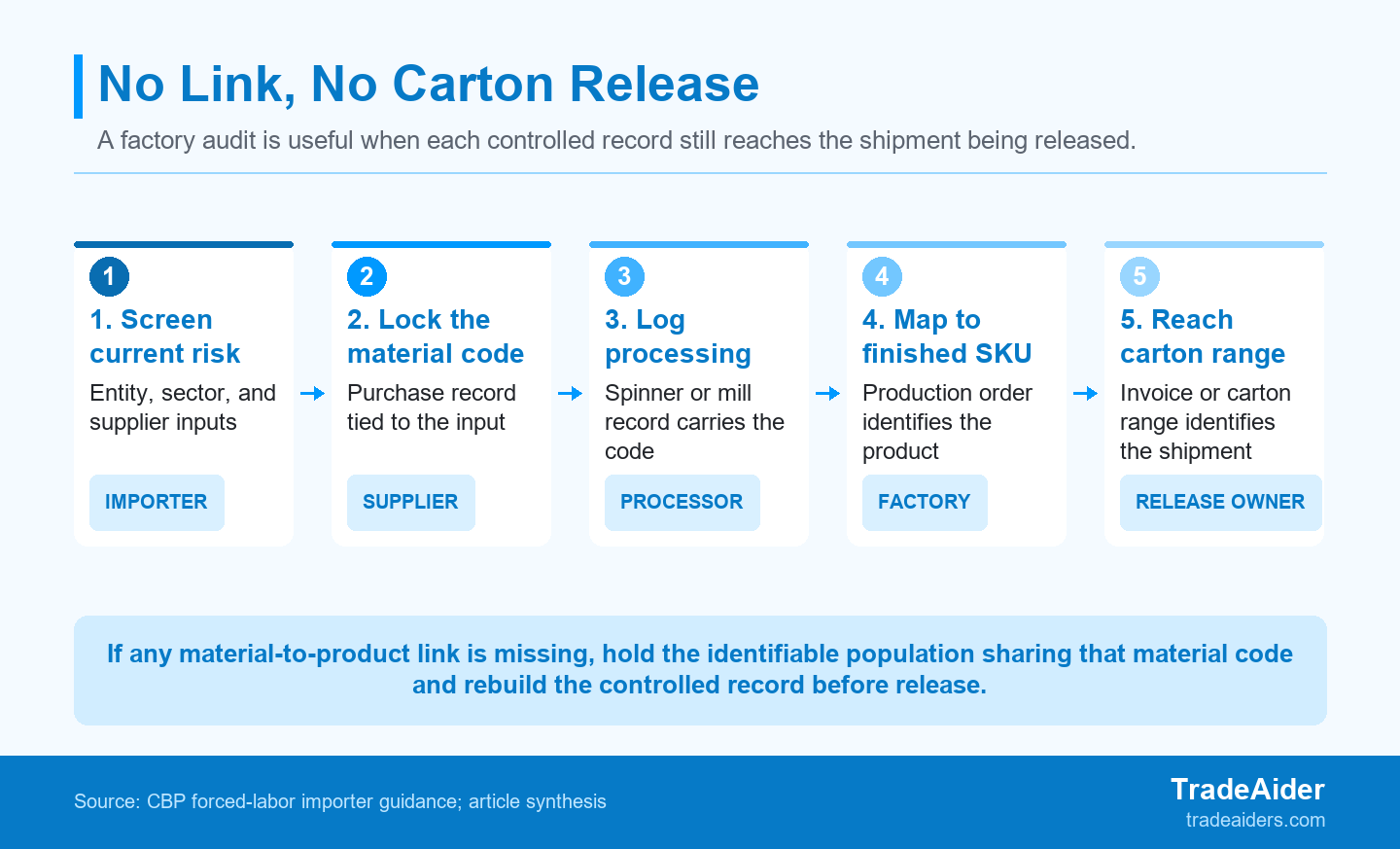
The release decision applies only when the same material population can be followed through each record gate to the carton range.
| Evidence link | Record to control | Decision if it is missing |
|---|---|---|
| Current screen | Supplier, facility, intermediary, and material-source names | Pause the affected path for updated screening and ownership review |
| Material identity | Purchase record, material code, supplier reference, and input description | Do not treat the finished SKU as traceable until the source link is rebuilt |
| Transformation | Production order, processing record, yield or lot reference | Widen the hold to every unit sharing the undocumented input |
| Finished product | SKU, colorway, approved bill of materials, and production range | Keep the evidence limited to the product configuration it actually describes |
| Shipment population | Carton marks, packing list, commercial invoice, or lot range | Do not release cartons that the file cannot identify |
The useful inference is simple: a broken material-to-product link should expand the hold to the population sharing that input, not automatically to every item on the purchase order. That is a practical evidence-management rule, not a legal conclusion. It gives the buyer a defensible way to ask, “Which cartons can this record actually support?” before anyone treats an audit score or supplier declaration as a release statement.
CBP describes supply-chain traceability as critical to importer due diligence and recognizes isotopic testing as a potential tracing tool for certain origin questions, particularly cotton. Its Isotopic Testing Guidance also makes clear that testing is a specialized, time-intensive tool. Use it to answer a defined evidence question where appropriate; do not let a test result replace the transaction, production, and lot records that show which goods it concerns.
First Link Material Records to the Finished SKU
A material record becomes shipment evidence only when its supplier, purchase, and transformation references can be matched to the finished SKU configuration that uses it. For a garment, that may mean tying the spinner or mill record to a yarn or fabric code, then tying that code to the bill of materials and the production order. For electronics, the connection may run through a component number, approved vendor list, work order, and finished model. The document names must match the buyer's actual configuration, not just a broad product family.
Ask for controlled references rather than a stack of filenames: the material code, supplier name, PO or invoice reference, date range, production order, finished SKU, and owner who can explain a mismatch. If a supplier changes a material source mid-order, preserve the before-and-after boundary. A later file should not imply that one declaration covers both inputs simply because they appear in the same style or order.
Then Link the Finished SKU to the Carton Range
A finished-SKU file must also identify the carton, invoice, or lot range under review; otherwise it cannot show which current shipment population it covers. The dependency matters because a complete upstream file can still be overextended when cartons mix an earlier material run with a later one, or when the packing list identifies a style but not the production or carton range.
Set the shipment boundary in the same language the factory can observe: carton marks, inner-pack labels, production-batch code, packing-list line, or container-loading sequence. The buyer does not need every record printed in every carton. The buyer needs enough identifiers to show that the records, the finished SKU, and the export population refer to the same goods. If that last connection is unavailable, the right response is to hold or separate the affected range while the trace is rebuilt.
Turn the Audit Into a Traceability Checkpoint
The audit becomes more useful when it asks whether the factory can preserve supplier, material, production, and lot identifiers that later connect to the shipment packet. Instead of asking only whether records exist, test whether a responsible person can retrieve one current material record, explain its link to a work order, and identify which finished SKUs and carton range used it. That converts a general system review into evidence the buyer can use later.
- At supplier qualification: identify who maintains approved supplier and material records, and how a supplier or factory change is approved.
- During bulk production: check whether the material code, production order, and finished SKU still agree after substitutions, rework, or production-line changes.
- Before release: confirm the packing-list or carton identifiers can narrow the evidence to the goods about to move.
A buyer that needs this early systems check can use a factory audit to test traceability controls before bulk production begins. When the order is already running, the more useful question is whether the material and production records remain connected to the current build. TradeAider can then verify records during production before they reach export packing, using the buyer's controlled material and lot map as the comparison reference.
Use Pre-Shipment Inspection as a Physical Evidence Match
A pre-shipment inspection can document agreed observable SKU, packaging, carton, and lot identifiers against a buyer-controlled packet; it does not decide UFLPA admissibility or certify origin evidence. Its value is a dated physical record of what the inspector saw on an identifiable export population, plus a clear escalation when the cartons and the packet do not match.
For Pre-Shipment Inspection, the order quantity should be 100% complete and at least 80% packed for export. The 80% threshold concerns packing readiness, not production completion. At that stage, a buyer can ask the inspector to photograph carton marks, record packing-list references, compare labels and SKU configuration, and note which carton range was available for observation. Those facts do not resolve an upstream origin question, but they keep the shipment side of the evidence chain from becoming vague.
If the material-to-lot map and packing range are ready, an importer can scope a pre-shipment inspection around the traceability packet. Give the inspector observable instructions: the SKU list, carton-mark format, lot or invoice range, photos required, and the person who must receive a mismatch. Do not ask the inspector to issue a legal conclusion. Ask for facts that let the importer decide whether the physical shipment still matches the controlled record.
Illustrative Scenario: A Missing Yarn Record Changes the Hold Scope
This illustrative scenario uses two material populations so the hold decision follows the broken yarn link rather than the purchase-order label alone. It is not a TradeAider client case, a legal finding, or a prediction of CBP action.
Hold the Affected Material Population, Not the Whole Purchase Order
A US importer has a 4,800-unit apparel order from one factory: 2,400 knit hoodies use a named recycled-cotton yarn, while 2,400 woven overshirts use a separate fabric code. Production is complete and each product family has a carton range. The factory can identify the finished SKU and cartons, but the hoodie yarn purchase record does not identify the spinner for the yarn code used in the current lot. The overshirt fabric file is separately linked to its material and production records. The missing spinner record breaks the trace from one yarn code to every hoodie carton using it.
A favorable factory audit and the overshirt file do not repair that gap. In this example, the buyer holds the 2,400 hoodie units, requests controlled spinner, purchase, transformation, and lot records, and keeps the overshirt decision separate and conditional on its own file. The corrective task is to connect the repaired yarn record to the same hoodie SKU, production order, and carton range—not to obtain a generic statement that describes the supplier's overall business.
Before lifting the hold, the buyer checks that the repaired record covers the same yarn code and all held hoodie cartons. If the factory cannot separate hoodie cartons by yarn run, the hold may need to widen because the buyer cannot honestly identify the population the record covers. The example is a document-control method only; legal applicability and any response to a government inquiry require the importer's appropriate compliance and legal process.
Make the File Response-Ready Before Freight Moves
CBP's June 2026 launch notice for its updated Forced Labor Enforcement Operational Guidance for Importers highlights supply-chain documentation appendices and UFLPA due-diligence examples. The companion CBP operational guidance is the primary resource for current importer process information. Its 2026 UFLPA dashboard update tracks shipments that were stopped, released, denied, or remain pending in enforcement. Keep the file organized before freight moves; building a trace only after a shipment is stopped makes it harder to establish which record belongs to which population.
- Name one evidence owner: the person who controls the supplier, material, production, and shipping references.
- Keep a current material-to-SKU map: record each input code, supplier, production order, finished SKU, and the scope of any substitution.
- Set a hold trigger: identify the missing link that stops the affected population from moving and the person who can authorize a recheck.
- Retain the physical match: preserve inspection observations, carton photos, packing references, and any mismatch report with the same lot range.
The practical lesson is not to predict an outcome from an enforcement dashboard. It is to avoid an unowned, scattered file when a buyer must explain the current material path and carton population quickly.
When you have the supplier list, material-to-SKU map, purchase and production records, carton or invoice range, and a named hold owner, send your material-to-lot map to TradeAider for inspection scoping. The resulting scope can focus on observable factory and shipment identifiers while the importer retains responsibility for the UFLPA assessment and the truth of supplier-provided records.
Frequently Asked Questions
Can a Factory Audit Prove UFLPA Compliance for Imports?
No, a factory audit tests controls and records at a point in time, but it cannot establish UFLPA admissibility. It also cannot prove an entire shipment's upstream supply chain. CBP's UFLPA FAQ directs importers to the Entity List and importer guidance for current implementation resources. Use the audit to test whether a supplier can preserve material, production, and lot identifiers, then use a current material-to-carton record chain to determine what evidence actually covers the US-bound shipment.
What Records Should Be Linked to a UFLPA Shipment?
Link supplier and material identifiers, purchase and transformation records, finished SKU references, and the invoice, carton, or lot range for the goods under review. The records need to describe the same material population through each step. A complete supplier declaration that cannot be tied to the current SKU or carton range is not enough to show which shipment population it covers.
Can Isotopic Testing Replace Full Supply-Chain Documentation?
No, isotopic testing can support a defined origin question, but it cannot replace shipment-specific transaction and traceability records. CBP describes it as a potential tool for certain origin questions, and it should complement rather than replace the broader record set. Testing may help answer a defined material question where it fits the commodity and evidence need. It does not identify the finished-carton population unless the buyer's records connect that material result to the current shipment.
What Can Pre-Shipment Inspection Contribute?
A pre-shipment inspection can document agreed finished-goods, packaging, carton, and lot observations against a buyer-controlled packet, but it cannot determine UFLPA admissibility. Its contribution is an observable, dated record of the shipment range the inspector saw. The importer should define the SKU list, carton marks, packing references, photos, and escalation contact before the visit.
Verwandte Artikel



Erweitern Sie Ihr Unternehmen mit TradeAider Service
Klicken Sie auf die Schaltfläche unten, um direkt in das TradeAider Service System zu gelangen. Die einfachen Schritte von der Buchung und Zahlung bis zum Erhalt der Berichte sind leicht zu bedienen.

