
- Über uns

- Unsere Dienstleistungen
- Ihre Branche
- Ressourcen
- Nachrichten & Blog
The main types of inspection processes are pre-production inspection, during production inspection, pre-shipment inspection, container loading supervision, incoming or receiving inspection, process inspection, final inspection, supplier audit, and product testing coordination. Their applications differ because each process answers a different buyer question: is the setup ready, is production drifting, is the finished lot acceptable, did the right cargo load, can hidden claims be proven, or can the supplier repeat the order reliably?
Importers often ask for inspection as if it were one service. In practice, the right inspection process depends on when evidence can still change the outcome. A late final check may document a defect after the best correction window has closed.
ISO 9001 connects quality work to planned processes, customer requirements, competence, control of externally provided processes, operational control, performance evaluation, and improvement. That system view is useful because inspection is one control point inside a broader order process.
ISO/IEC 17020:2026 describes inspection as activities that can cover materials, products, processes, services, or installations and their conformity with requirements. For importers, the practical message is that inspection process and inspection object should match the risk.
For finished-lot acceptance, ISO 2859-1:2026 is the relevant sampling framework. It does not replace PPI, DPI, audit, or testing; it supports a specific type of lot-by-lot attribute decision.
- PPI applies before mass production: use it for samples, materials, tooling, artwork, and production setup.
- DPI applies while correction is still possible: use it for process drift, repeated defects, and high-risk production.
- PSI applies to finished goods: use it for AQL sampling, workmanship, labels, packing, and shipment release.
- Testing and audits cover different questions: testing proves hidden claims; audits judge supplier systems.
Which Inspection Process Should an Importer Use?
Use pre-production inspection when setup or materials are uncertain, during production inspection when defects may spread before completion, pre-shipment inspection when finished goods need release evidence, loading supervision when carton count and container handover matter, product testing when hidden safety or performance claims must be proven, and supplier audit when factory capability is the real question.
The easiest way to choose is to name the decision first. If the buyer must decide whether the factory is ready to start, choose a process before production. If the buyer must decide whether the line is drifting, choose a process during production. If the buyer must decide whether to pay and ship, choose a finished-lot process.
Quality-control tools also depend on process timing. NIST explains process monitoring as a way to identify when corrective action is needed. That is the logic behind DPI: it is most valuable when the buyer still has time to correct the process rather than only sort finished goods.
Commercial PSI should not be confused with government-mandated preshipment inspection programs. The WTO Agreement on Preshipment Inspection deals with specific government-related PSI activities. A private importer inspection supports a purchase and release decision; it does not replace customs, product compliance, or destination-market obligations.
Inspection Processes and Their Applications
Match the inspection process to the buyer question that must be answered next.
| Inspection Process | When to Use It | Best Application | Main Limit |
|---|---|---|---|
| Pre-Production Inspection | Before mass production | Materials, components, samples, artwork, line readiness | Cannot prove full-lot quality |
| During Production Inspection | Early or mid-production | Process drift, repeated defects, corrective action | May need follow-up after correction |
| Pre-Shipment Inspection | 100% complete and mostly packed | AQL sampling, workmanship, labels, packing, release | May be late for root-cause correction |
| Container Loading Supervision | At loading handover | Carton count, container condition, seal, loading photos | Does not replace product inspection |
| Incoming or Receiving Inspection | After arrival or before assembly | Warehouse acceptance, component screening, supplier scorecard | Too late to prevent export shipment |
| Supplier Audit | Before supplier approval or after repeat failure | Capability, systems, process control, documentation | Does not inspect one shipment in detail |
| Testing Coordination | Before approval or shipment | Chemical, electrical, flammability, durability, performance claims | Requires suitable lab method and lead time |
The table shows why a buyer can receive an accurate report and still choose the wrong process. A PSI report can correctly identify a repeated defect after the goods are packed, but a DPI may have preserved more leverage. A supplier audit can reveal weak systems, but it will not confirm carton-level shipment condition.
Some orders need more than one process. A new supplier with a complex product may need audit, PPI, DPI, and PSI. A stable repeat order may need only PSI. A regulated or safety-sensitive category may need testing regardless of inspection timing.
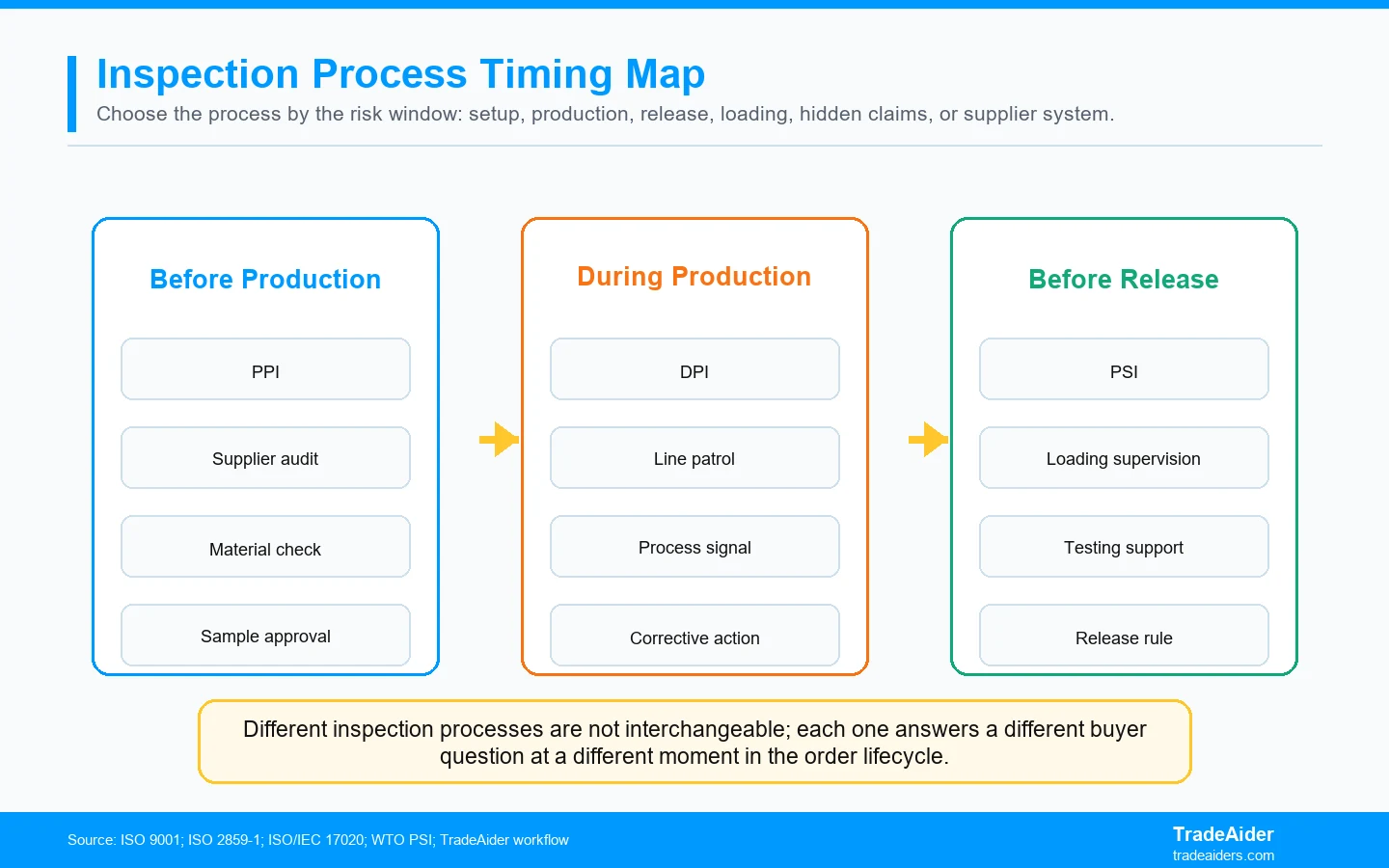
Different inspection processes are not interchangeable; each one answers a different buyer question at a different moment in the order lifecycle.
Inspection Processes Work Best When Matched to Timing
The inspection process should be chosen by the earliest moment when useful evidence can still change the result.
Before-production processes reduce setup risk
Pre-production inspection applies when the buyer is not yet sure that the factory can start correctly. It checks approved samples, materials, components, tooling, trims, artwork, packaging, work instructions, and first-piece understanding before the defect can multiply through the lot.
Supplier audits belong even earlier when the buyer needs to know whether the factory has the capability, equipment, management system, subcontracting control, and documentation discipline to handle the order. An audit should not be disguised as shipment inspection; it answers a supplier-selection question.
Production processes protect correction leverage
During production inspection applies when a defect mechanism can spread across the lot. It checks early finished units, semi-finished goods, line conditions, rework handling, material changes, and whether corrective action is working.
This process is especially useful for products with tight tolerances, repeated assembly, color matching, adhesive bonding, stitching, electronics function, mixed SKUs, or quality history. It gives the buyer a chance to correct before all cartons are sealed.
Final and Loading Processes Support Release, Not Root-Cause Control
PSI and loading supervision are powerful late-stage processes, but they answer different questions.
PSI is the finished-lot release process
Pre-shipment inspection normally applies when production is complete and export packing is ready enough for representative sampling. It checks product identity, workmanship, dimensions, function, labels, accessories, carton marks, packing condition, and defect counts before payment or shipment release.
TradeAider describes Pre-Shipment Inspection as a finished-goods check before shipment. For best evidence, the buyer should make sure the lot is complete, cartons are accessible, and defect classes are agreed before the inspector arrives.
Loading supervision protects handover evidence
Container loading supervision applies at the handover point. It checks container condition, carton count, shipping marks, loading sequence, seal number, and visible damage while goods enter the container.
It should not be used as a substitute for PSI because the product may no longer be open for detailed sampling. Its value is count, condition, and custody evidence at a moment when cargo mistakes can still happen.
Incoming Inspection, Process Inspection, and Testing Serve Different Owners
Some inspection processes belong to the importer, some to the manufacturer, and some to a laboratory or receiving team.
Incoming inspection is useful but late for import prevention
Incoming or receiving inspection happens after arrival at a warehouse, assembly site, or distribution point. It can protect inventory acceptance, supplier scorecards, and downstream production. It is common for components and repeated supplier programs.
For overseas sourcing, receiving inspection is often too late to prevent freight, customs, and return costs. It is best used as a feedback loop to improve the next PPI, DPI, or PSI plan rather than as the only control.
Testing proves hidden claims that visual inspection cannot
Visual inspection can check labels, appearance, basic function, dimensions, and packaging. It cannot prove restricted substances, electrical safety, flammability, long-term durability, material composition, or detailed performance claims without a suitable method.
TradeAider product testing services can be coordinated with inspection when the buyer needs laboratory evidence alongside factory observations. The process selection should state which claims require testing before shipment release.
Applications by Product Risk
The same product category can need different processes depending on supplier history, defect mechanism, and sales channel.
New suppliers and new products need earlier evidence
A new supplier, new material, new mold, new color, new accessory set, or new packaging design usually deserves earlier inspection. PPI can catch setup errors, and DPI can catch process drift before the finished lot is difficult to correct.
A stable repeat order from a capable factory may not need every process every time. The buyer should still review return data, defect history, production changes, and current lot complexity before defaulting to only final inspection.
Regulated or safety-sensitive products need separate proof
Products involving children, electrical function, batteries, chemicals, flammability, food contact, protective use, or safety claims need inspection and evidence boundaries. The inspection process may verify labels and documents, but product testing or compliance review may still be required.
This boundary protects the buyer from overtrusting a visual report. Inspection is a strong evidence tool, but it should not claim to prove what it has not tested.
Scenario Estimate: The Wrong Process Can Move Cost From Prevention to Sorting
Process selection is often a timing cost hidden inside the inspection fee decision.
Assume an importer orders 20,000 assembled units with a clip-fit feature that can drift when a fixture wears. If the buyer uses only PSI and the defect appears in 3% of finished goods, about 600 units may require sorting, rework, repacking, or replacement after the lot is complete.
If a DPI at 30% completion finds the same pattern early, the buyer can isolate a smaller exposure, correct the fixture, and verify the next production run before all cartons are sealed. The earlier process may add one inspection day, but it can preserve supplier correction leverage.
This estimate is a decision screen, not a universal savings claim. When the defect mechanism can spread, the better process is the one that finds it while correction is still practical.
Where TradeAider Fits in Process Selection
TradeAider helps importers choose inspection processes by unresolved risk, timing, and evidence requirement instead of forcing every order into one final inspection format.
For setup risk, TradeAider can arrange Pre-Production Inspection. For process drift, During Production Inspection can check early output and correction evidence while the factory can still act.
For release risk, Pre-Shipment Inspection can verify the finished lot with AQL sampling, labels, packing, function checks, and defect reporting before shipment.
If the main concern is supplier capability, loading handover, or hidden claims, TradeAider can connect inspection work with factory audit, loading supervision, or testing coordination so the process fits the buyer question.
SPAR Scenario: Switching From PSI to DPI Changed the Outcome
The buyer changed the inspection process after realizing the real risk was production drift.
Situation: A buyer planned one final inspection for a mixed-color plastic order from a new supplier.
Problem: The approved color tolerance was tight, and early production showed shade variation by material batch.
Action: TradeAider added a during production inspection and asked the supplier to separate output by material batch for review.
Result: The buyer accepted a half-day line correction, isolated two material-batch groups for extra review, and kept PSI for final release evidence instead of sorting the full order after packing.
Inspection Process Selection Checklist
Choose the process by the decision window, not by the most familiar service name.
- Use PPI when materials, samples, tooling, artwork, packaging, or setup are uncertain.
- Use DPI when a defect mechanism can spread during production.
- Use PSI when finished goods need AQL-based release evidence before payment or shipment.
- Use loading supervision when carton count, seal, container condition, and handover proof matter.
- Use audit when supplier capability and system reliability are the question.
- Use testing when hidden safety, chemical, durability, or performance claims must be proven.
A useful process plan should state what happens if the process fails. If a PPI fails, does production stop? If a DPI fails, does the line correct and reinspect? If PSI fails, does the buyer sort, rework, hold, or cancel release?
When those actions are not defined, the report can arrive on time and still leave the buyer uncertain. Process selection is complete only when the next decision is clear.
If you are deciding between PPI, DPI, PSI, loading supervision, audit, or testing, send TradeAider the product type, PO, approved sample, supplier history, production status, and top defect risk. The next step is to select the right inspection process for your order before the decision window closes.
Frequently Asked Questions
What are the main types of inspection processes?
The main types include pre-production inspection, during production inspection, pre-shipment inspection, loading supervision, incoming inspection, process inspection, supplier audit, and testing coordination.
Is final inspection the same as pre-shipment inspection?
They are often similar in importer usage when finished goods are checked before shipment, but PSI should include shipment-ready lot structure, sampling, packing, labels, and release evidence.
When should I use during production inspection?
Use DPI when defects can spread before completion, such as assembly drift, color variation, poor bonding, repeated function failure, or supplier process instability.
Can loading supervision replace product inspection?
No. Loading supervision verifies handover, carton count, seal, loading condition, and visible damage. It does not provide detailed product sampling like PSI.
When is testing needed instead of inspection?
Testing is needed when the claim cannot be proven visually, such as chemical, electrical, flammability, durability, or detailed performance requirements.

Verwandte Artikel

Erweitern Sie Ihr Unternehmen mit TradeAider Service
Klicken Sie auf die Schaltfläche unten, um direkt in das TradeAider Service System zu gelangen. Die einfachen Schritte von der Buchung und Zahlung bis zum Erhalt der Berichte sind leicht zu bedienen.

