
- Über uns

- Unsere Dienstleistungen
- Ihre Branche
- Ressourcen
- Nachrichten & Blog

A final random inspection is a final-stage random check of an identified finished shipment. It helps a buyer decide what to do with the goods in scope: release them, hold them, request correction, or verify a defined scope again. It is not a promise that every unit is defect-free, and it is not a substitute for the technical or compliance evidence a product may separately require.
That distinction matters at the point where freight, payment, and delivery commitments are close. A useful final check starts with identified finished goods, an agreed random selection, current acceptance criteria, and a release rule written before the inspector arrives. When those elements line up, the report gives the buyer evidence for a shipment decision instead of another vague status update.
An FRI Answers a Shipment Question, Not a Quality Promise
FRI should be used as evidence for a named shipment decision.
A Final Random Inspection (FRI) examines selected goods that are ready to leave the factory. In this context, a lot is the specific finished population that the sample is intended to represent. It might be the full purchase order, a production-date range, or a separately identified carton group. The buyer should be able to answer four questions before the visit: Which finished goods are in scope? Which requirements will be checked? Which sampling plan applies? What action follows each possible result?
This keeps the language honest. A passed sample can support release under the agreed rule. A failed or uncertain sample can support a hold, corrective action, or recheck. Neither result turns a sample into a census of every unit, and neither result explains a root cause without further evidence from the factory.
- Finished population: the goods the visit is meant to represent.
- Random sample: the selected units inspected against the agreed criteria.
- Report: the evidence record of observations and result.
- Release rule: the buyer's stated hold, correction, recheck, or release instruction.
Start With a Finished, Accessible Shipment
TradeAider calls its Pre-Shipment Inspection service PSI/FRI and states it is conducted when 100% of an order is complete and at least 80% is packed. The published Pre-Shipment Inspection (PSI/FRI) service describes this as its own readiness context, rather than a universal timing rule for every buyer or factory.
Pre-Shipment Inspection (PSI) means an inspection arranged before shipment release. On TradeAider's service page, PSI and FRI are used for the same final-stage service context. Other providers may organize the labels differently, so the operational question matters more than a naming debate: can the inspector access a finished, identifiable population that still represents the shipment the buyer intends to release?
A final-inspection brief should identify the lot, current criteria, sample plan, and response owner. Add the latest approved specification, approved reference sample where one exists, carton marks, packing requirements, quantity, functional checks, and any known changes made during production. A clear brief also names the person authorized to decide whether a finding triggers a hold or a recheck.
What to Give the Inspector Before the Visit
A current inspection brief makes the final sample interpretable against the buyer's stated criteria. Send the final purchase-order revision, the production and packing status, the lot identifier, the inspection plan, required packaging and labeling details, and any test instructions that can be performed on site. If the buyer cannot describe what would block release, the visit may document observations without resolving the shipment decision.
Include the latest approved artwork or label file when those details matter, and call out any unresolved change made after the order was placed. A brief should also distinguish information that is merely helpful from the evidence that can change the release decision. That lets the inspector prioritize the checks that are commercially consequential.
Use Random Sampling as a Lot Decision
NIST describes acceptance sampling as random selection from a lot to make a disposition decision, not to estimate the lot's quality. NIST's acceptance-sampling guidance is useful here because it separates a release decision from a claim that the buyer has measured the full population.
That is why a buyer should first define the lot boundary. If cartons from several production windows are mixed without traceable records, a finding may require a broader hold because the affected scope cannot be narrowed responsibly. If the relevant carton range and change history are traceable, a buyer may be able to ask for a focused correction and verification instead. The inspection method does not make that commercial choice on its own; it gives the buyer a disciplined basis for it.
ISO 28590:2017 provides guidance on selecting an appropriate attribute-sampling system for a particular situation. Read the ISO 28590 scope as a reminder that the plan should fit the decision context, the lot, and the characteristic being inspected.
ISO 2859-1:2026 defines acceptance sampling plans for inspection by attributes. The ISO 2859-1 page identifies the standard's scope; it does not choose the buyer's lot size, inspection level, or acceptance rule for a particular order.
ISO 2859-2:2020 specifies an attribute-sampling system for lots in isolation. The ISO 2859-2 scope is a useful boundary when the buyer is dealing with a one-off lot decision rather than assuming a continuing production sequence.
Set the AQL Plan Before the Sample Is Drawn
Acceptance Quality Limit (AQL) is an agreed sampling-plan parameter set before sample selection. It gives the buyer and inspection team a shared reference for the plan; it is not a general statement that a supplier is permitted to make defects.
NIST says a sampling plan requires an agreed AQL and inspection level, which determines the relationship between lot size and sample size. NIST's AQL planning note supports the practical rule: lock the plan before anyone selects units.
Put the selected plan, critical-defect handling, and any product-specific exceptions in writing before the visit. A buyer that needs a quick way to document the chosen lot and plan can use TradeAider's AQL calculator, then confirm that its output matches the commercial agreement and current requirements.
Check the Shipment Against Buyer-Specific Criteria
A final inspection cannot substitute for product testing or compliance evidence that the product or market requires.
An FRI commonly checks quantity, visual workmanship, dimensions, labels, packaging, accessories, and functional points that can be evaluated at the visit. The useful question is not simply whether an item looks acceptable. It is whether the selected unit matches the current reference the buyer has approved. A color, label, carton mark, accessory, or function should be judged against a stated requirement, not an inspector's preference or a superseded file.
Build the criteria in the same order the goods will be inspected. Start with order quantity and carton markings, then move to packaging, appearance, measurements, accessories, and agreed functional checks. For each point, record the acceptable reference, any permitted variation, and the severity of a failure. This removes guesswork when a factory asks whether an observed deviation is a cosmetic note, a correction item, or a release-blocking issue. It also makes later rechecks faster because the team can revisit the exact control point rather than restating the entire brief. Keep the evidence beside each requirement so later review can distinguish an observed condition from a clarified expectation or changed instruction during fulfillment.
Bring the acceptance reference under change control. If an approved sample, packaging artwork, or measurement tolerance changed, identify which revision governs this shipment and which cartons may have been produced before the change. TradeAider's inspection standard resource can help a buyer organize the checks, but the order-specific brief remains the controlling reference for the visit.
A practical inspection brief also distinguishes defect classes from commercial priorities. For example, a cosmetic deviation may be handled differently from a missing safety label, a wrong plug, or a product that fails an agreed on-site function check. The buyer should document those distinctions before sampling so the inspector can record findings consistently and the factory knows what requires correction.
Keep Inspection and Compliance Evidence Separate
A final inspection does not replace separate product testing or compliance evidence when those are required. The inspection report can record whether an agreed visual, packaging, or on-site functional check was observed, but it does not create laboratory evidence or market approval merely because the goods were inspected before shipment.
Inspection asks whether the shipment and its sample match the agreed inspection criteria at that point in time. Testing may ask a different question about a material, a safety characteristic, a chemical limit, durability, electrical performance, or a market requirement. Decide before production which questions need a test report, which can be checked in the final visit, and which require both. That separation avoids discovering after a passed inspection that the buyer still lacks evidence needed for the intended market.
Where the product risk calls for separate technical proof, plan it independently and make the result part of the release record. Confirm the sample identity, the test method, and the report owner so the result can be tied back to the goods in scope. TradeAider's product testing service is the more relevant path when the buyer needs technical testing beyond a final inspection visit.
Turn the Result Into a Release Instruction
ISO 10005:2018 gives guidelines for establishing, reviewing, accepting, applying, and revising quality plans. The ISO 10005 scope supports treating the response to an inspection result as a reviewed plan rather than a vague note at the end of a report.
The release instruction should name the scope, action owner, and verification condition. It should also state the evidence that will close the issue, such as a carton reconciliation, corrected labeling record, focused recheck, or an approved test result. This prevents an informal promise to fix the problem from becoming the sole basis for release.
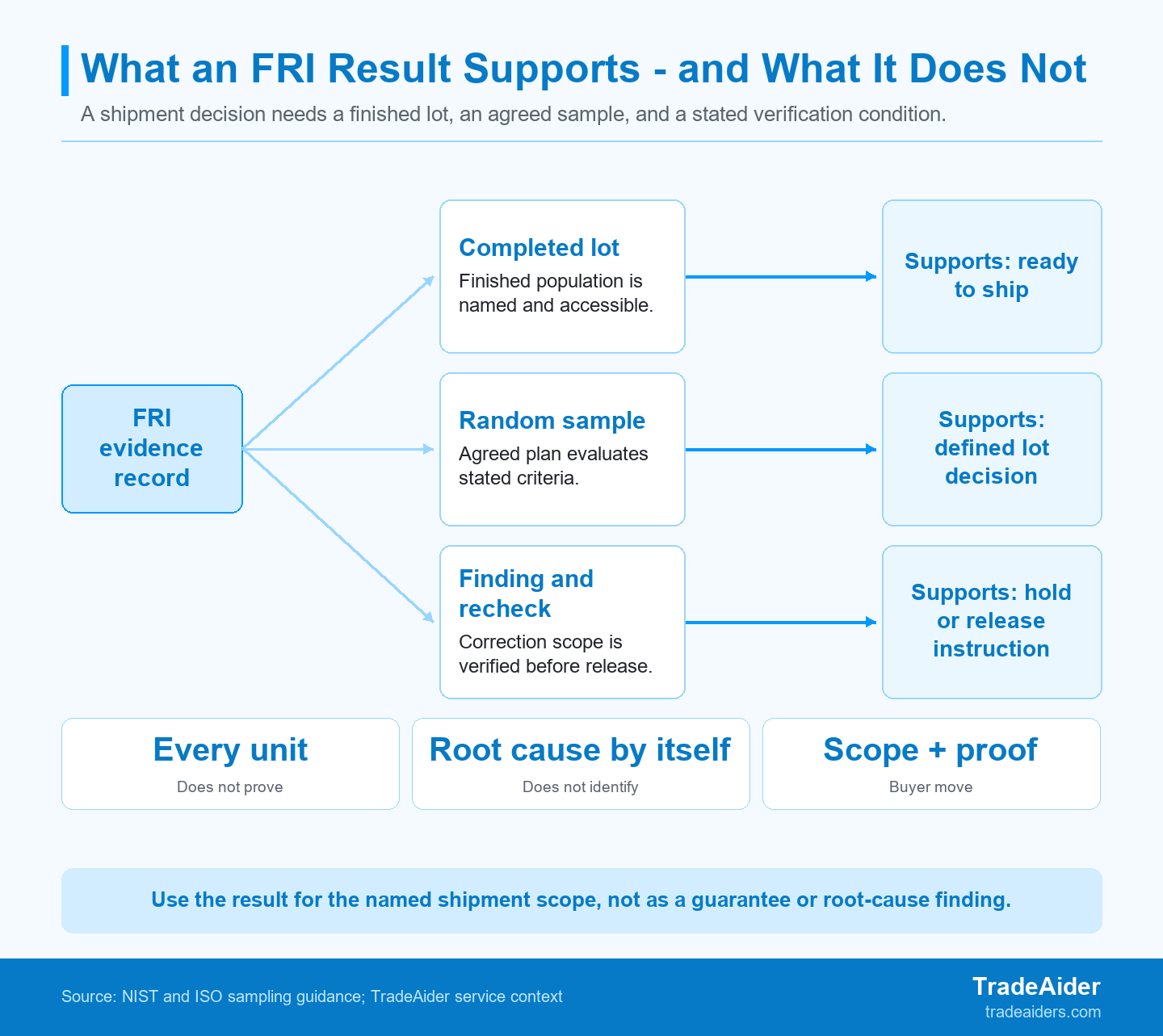
An FRI result is strongest when the finished lot, agreed sample, and verification condition all point to the same shipment decision.
State the scope in operational language: the full purchase order, named carton range, production dates, or goods produced after a documented correction. Then state who acts, what evidence closes the issue, and who has authority to release the goods. This approach gives the factory a clear task and keeps the buyer from releasing a broader population than the evidence supports.
| Result condition | Evidence still needed | Buyer instruction |
|---|---|---|
| Sample meets the agreed rule | Finished-lot identity and report are clear | Release the named scope |
| Finding needs correction | Affected scope and correction record | Hold that scope and recheck it |
| Scope cannot be bounded | Traceability and root-cause evidence | Hold the wider shipment pending verification |
FRI ends before freight execution, so a buyer should also decide how the shipment will stay controlled after release. When the order is sensitive to loading condition, carton count, or container sealing, container loading supervision can extend the evidence trail from the final inspection report to the loading event. It answers a later operational question; it does not rewrite the FRI result.
Illustrative Scenario: A Functional Finding at Final Check
A functional sample finding can support a shipment hold while the affected scope and correction are verified.
The following example is illustrative, not a TradeAider client case. It shows why a final sample result should be paired with traceability evidence before the buyer decides how wide a hold should be.
Hold the Shipment Until the Functional Scope Is Verified
The sample alone does not show root cause or full order exposure.
An importer of portable digital luggage scales is preparing a 9,600-unit order for dispatch.
The order is packed by production date and a 320-carton range is available for a final-stage sample.
The factory states that finished goods are complete and the named carton range is ready for inspection.
A selected unit displays a different reading after a repeat-cycle check with the agreed reference load.
The production-date record identifies the carton range but cannot demonstrate whether earlier production dates used the same calibration check.
The sample result shows a functional concern within the inspected sample, while the missing calibration record prevents the buyer from bounding the full affected population. The buyer cannot safely turn one observed functional drift into either a full-order rejection or a full-order release. Because the calibration record cannot bound the exposure, the result supports a full shipment hold while the factory establishes scope and correction evidence.
Hold the full shipment pending root-cause evidence, production-date traceability, and a targeted functional recheck. The factory should first show which production dates and calibration records are implicated, then propose a verification population that the buyer can trace back to those records.
Segregate finished goods and validate the calibration process before selecting the verification sample.
Release only the scope supported by the documented correction and focused functional recheck.
This is an illustrative scenario, not a TradeAider client case or a universal product-test requirement. Its lesson is simple: when records cannot connect a finding to a bounded population, the buyer should enlarge the hold before making a release decision.
Book FRI With a Decision-Ready Brief
A decision-ready booking brief gives the inspection visit a defined commercial purpose.
Before requesting an FRI, send the purchase-order revision, finished quantity, packing status, factory address, requested inspection date, lot or carton identifiers, current specification, approved sample or images where relevant, AQL plan, defect handling, functional checks, and report recipients. Also name the action owner and the response you expect if a finding is observed. These details reduce the chance that a late report creates a new argument about scope instead of a usable decision.
For an order with a close dispatch date, include the latest time at which a hold, correction, or recheck can still protect the shipment plan. Ask for real-time visibility during the visit if the decision team needs to react before cargo is booked or loaded.
When the finished-lot status, criteria, sampling plan, and response rule are ready, Schedule your FRI inspection
Frequently Asked Questions
Clear FAQ answers help buyers apply the article's finished-lot, sample, and response model.
Is final random inspection the same as pre-shipment inspection?
At TradeAider, PSI and FRI name the same final-stage inspection service context for a finished lot before release. The published service description uses both terms for an inspection conducted before release once the order is complete and sufficiently packed. Other providers may use their own labels, so confirm the practical scope: the finished lot, sample plan, criteria, report timing, and response path.
When should an FRI be scheduled before shipment release?
Schedule an FRI only when the agreed finished lot is complete, accessible, and ready to represent the intended shipment. The inspector needs access to the goods, relevant packaging, and current documentation. Book early enough that a hold, correction, or focused recheck can still happen before dispatch. A visit booked after the cargo has become operationally irreversible has less decision value.
Does a passed FRI guarantee quality across every unit?
A passed FRI supports only the named lot decision under the documented conditions; it cannot guarantee every unit. It also does not replace a separate test program or compliance evidence when those are needed. The safe reading is narrower: the named lot met the agreed inspection rule under the recorded conditions.
What should a buyer provide before an FRI?
Provide the current specification, finished-lot identity, inspection criteria, sample plan, and release response rule before the inspector visits. Add packaging and label requirements, approved samples or images, functional checks, known changes, report recipients, and the person who can authorize a hold or release. The clearer the brief, the easier it is to turn the inspection result into a decision that the factory and buyer can both execute.

Verwandte Artikel


Erweitern Sie Ihr Unternehmen mit TradeAider Service
Klicken Sie auf die Schaltfläche unten, um direkt in das TradeAider Service System zu gelangen. Die einfachen Schritte von der Buchung und Zahlung bis zum Erhalt der Berichte sind leicht zu bedienen.

