- Über uns

- Unsere Dienstleistungen
- Ihre Branche
- Ressourcen
- Nachrichten & Blog
UN 38.3 and Dangerous Goods Packaging Guide for Lithium Batteries
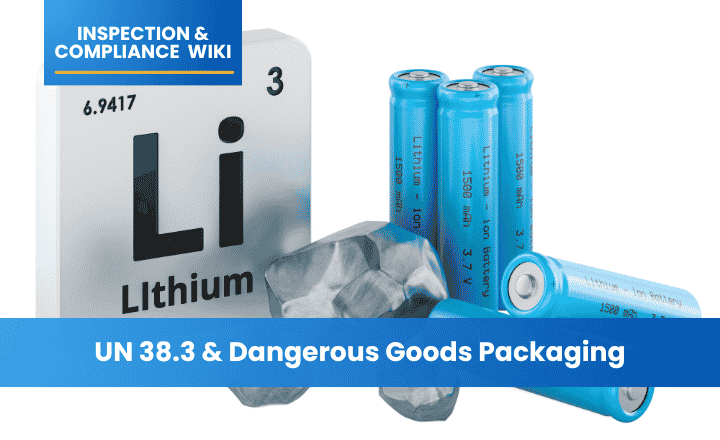
Lithium ion and lithium metal batteries—whether shipped as standalone energy storage units, packaged alongside equipment, or embedded inside consumer products—are internationally classified as Class 9 Miscellaneous Dangerous Goods. Due to their high energy density and potential for thermal runaway, unstable chemical combustion, or toxic gas venting during air, ocean, and road transit, global transport authorities strictly enforce hazardous materials regulations.
Regulatory bodies including the International Air Transport Association (IATA DGR), the International Maritime Organization (IMO IMDG Code), and regional authorities (such as US DOT 49 CFR) mandate that all lithium battery shipments possess valid UN 38.3 test certification and comply with specialized dangerous goods (DG) packaging, drop testing, and warning labeling requirements.
Regulatory Categorization and UN Shipping Numbers
Determining the correct dangerous goods classification depends on the lithium battery chemistry, state of charge (SoC), and physical packaging configuration:
| UN Number | Proper Shipping Name | Packaging Configuration | Primary Dangerous Goods Risk Level |
|---|---|---|---|
| UN 3480 | Lithium Ion Batteries | Standalone rechargeable lithium batteries / cells (not contained in equipment). | High Risk; strict air freight quantity limits (≤30%). |
| UN 3481 | Lithium Ion Batteries Contained in / Packed with Equipment | Batteries packed alongside or built inside products (e.g., laptops, power tools). | Medium Risk; governed by Packing Instructions 966 / 967. |
| UN 3090 | Lithium Metal Batteries | Non-rechargeable lithium primary batteries (e.g., CR2032 cells, military batteries). | High Risk; prohibited on passenger aircraft. |
| UN 3091 | Lithium Metal Batteries Contained in / Packed with Equipment | Non-rechargeable batteries packed alongside or built inside equipment. | Medium Risk; governed by Packing Instructions 969 / 970. |
UN 38.3 Technical Testing Suite Architecture
The UN Manual of Tests and Criteria, Part III, Section 38.3 specifies eight rigorous laboratory stress tests that lithium cells and battery packs must undergo without leakage, venting, disassembly, rupture, or fire:
| Test ID | UN 38.3 Test Parameter | Environmental / Physical Simulation Protocol | Pass / Fail Criteria |
|---|---|---|---|
| T.1 | Altitude Simulation | Stores cells at low pressure (11.6 kPa) for ≥ 6 hours at 20℃ to simulate unpressurized aircraft cargo holds. | No mass loss (>0.1%), no leakage, no venting, no rupture, no fire. |
| T.2 | Thermal Test | Cycles cells between -40℃ and +72℃ across 10 extreme thermal shocks. | No structural degradation; open-circuit voltage retention ≥ 90%. |
| T.3 | Vibration Simulation | Applies logarithmic frequency sweeps (7 Hz to 200Hz) across 3 perpendicular axes over 3 hours. | No electrical short-circuiting; zero mechanical damage to terminals. |
| T.4 | Mechanical Shock | Subjects batteries to half-sine shock pulses (150 gn peak acceleration for small cells). | Zero internal short-circuiting or terminal dislocation. |
| T.5 | External Short Circuit | Applies an external short circuit (< 0.1Ω) at 57℃ until internal cell temperature cools down. | Internal temperature must remain < 170℃; no fire, no disassembly. |
| T.6 | Impact / Crush | Applies heavy mechanical crush force (13 kN) to simulate vehicle collision or cargo collapse. | No internal fire or explosion within 6 hours post-test. |
| T.7 | Overcharge Test | Applies double maximum continuous charge current for 24 hours to rechargeable battery packs. | Zero thermal runaway or flame generation. |
| T.8 | Forced Discharge | Forces negative current through primary or secondary cells to simulate reverse polarity failure. | Zero cell rupture or flame generation. |
Dangerous Goods Packaging Standards and 1.2m Drop Testing
Packaging dangerous goods requires specialized structural cushioning, electrical insulation, and strict physical resistance:
- Short-Circuit Prevention: Battery terminals must be individually insulated using non-conductive plastic caps, blister trays, or tape to prevent terminal-to-terminal contact during handling.
- 1.2-Meter Outer Packaging Drop Test: Fully packaged commercial cartons (containing batteries packed with or contained in equipment) must survive a 1.2-meter free-fall drop test in any orientation onto a solid concrete surface without cell damage, terminal exposure, or package rupture.
- UN Specification Packaging (Class 9 Boxes): Standalone battery shipments (UN 3480) exceeding exemption thresholds require certified UN-marked packaging boxes (e.g., 4G/4GV fiberboard boxes) tested for stacking strength, moisture resistance, and burst resistance.
Practical Module: On-Site Battery Verification & Pre-Shipment Inspection
Quality Control (QC) inspectors auditing lithium battery manufacturing facilities or performing Pre-Shipment Inspections (PSI) must execute the following verification steps:
| Inspection Gate | Verification Focus | Practical Auditor Action |
|---|---|---|
| Documentary Check | UN 38.3 Test Summary & SDS Verification | Verify that the factory provides a valid UN 38.3 Test Summary Report matching the exact battery model number, cell capacity, and manufacturer name, alongside a current Safety Data Sheet (SDS / MSDS). |
| State of Charge (SoC) Check | Air transport SoC compliance (30% max) | Measure battery open-circuit voltage using calibrated digital multimeters across a random sample to confirm the State of Charge does not exceed 30% for UN 3480 air shipments. |
| Labeling & Markings Audit | Class 9 DG hazard labels & UN numbers | Inspect master cartons to ensure the correct Class 9 Lithium Battery Hazard Label, UN shipping number (e.g., UN 3481), handling instructions, and emergency contact details are clearly printed. |
| 1.2m Factory Drop Test | Packaging structural integrity check | Select 1 master carton at random and perform an on-site 1.2-meter drop test on concrete to confirm inner cushioning and short-circuit isolation hold up under impact. |
Ensure Dangerous Goods Compliance: On-Site Battery & Packaging Audits.Don't risk freight rejections or port detentions. Verify UN 38.3 test summaries, battery State of Charge (SoC), packaging drop resistance, and Class 9 DG markings through our certified independent audit services. ➔ Get a Free Audit Plan
Frequently Asked Questions (FAQ)
What is a UN 38.3 Test Summary, and why do freight forwarders require it?
The UN 38.3 Test Summary is a standardized legal document mandated by international transport regulations that confirms a specific lithium battery cell or pack has successfully passed all T.1–T.8 safety tests. Freight forwarders and airlines require this document prior to booking cargo space.
What is the difference between UN 3480 and UN 3481 shipments?
UN 3480 refers to standalone rechargeable lithium ion batteries shipped as bulk power sources without equipment. UN 3481 refers to lithium ion batteries that are packed inside or alongside the physical electronic device they power (such as a wireless router or power tool).
Are button cell batteries exempt from UN 38.3 testing and DG labeling?
Button cells (e.g., CR2032) installed in equipment are generally exempt from formal Class 9 outer dangerous goods labeling, but the underlying cell chemistry must still pass UN 38.3 testing requirements.
Can an importer re-use UN 38.3 certificates from a cell manufacturer for a custom battery pack?
No. If multiple individual cells are welded or assembled into a custom multi-cell battery pack with a Battery Management System (BMS), the complete final battery pack assembly must undergo new, independent UN 38.3 testing.
What happens if a lithium battery shipment arrives at customs without proper dangerous goods packaging?
Airports and ocean ports will immediately freeze non-compliant hazardous shipments, issuing heavy administrative fines, rejecting cargo loading, or forcing mandatory return to origin or destruction at the shipper’s expense.
References
[1] United Nations. Recommendations on the Transport of Dangerous Goods: Manual of Tests and Criteria, Part III, Section 38.3[R]. New York and Geneva: United Nations, 2025.
[2] International Air Transport Association. Dangerous Goods Regulations (IATA DGR 67th Edition): Lithium Battery Guidance Document[R]. Montreal: IATA, 2026.
[3] International Maritime Organization. International Maritime Dangerous Goods Code (IMDG Code)[S]. London: IMO, 2024.
Reference Notes
- UN Manual of Tests and Criteria Section 38.3 defines international testing standards and parameters required for all commercial lithium battery transport.
- IATA Dangerous Goods Regulations govern air transport safety limits, packaging instructions (PI 965–970), SoC restrictions, and labeling for lithium batteries.
- IMDG Code sets mandatory ocean freight regulations for maritime transport of hazardous materials, Class 9 packaging, and container stowage rules.
Related Knowledge Base
ISTA Packaging StandardsISO 17025: General Requirements for Testing and Calibration LaboratoriesMIL-STD-810H: Environmental Engineering Considerations and Laboratory TestsCarton Drop Testing: ISTA and Amazon FFP Packaging StandardsPackaging and Drop Test Standards (ISTA 3A)Laboratory Testing Standards (LTS)
TradeAider