
- About Us

- Our Services
- Your Industry
- Resources
- News & Blog
E-Commerce quality metrics only become useful when marketplace outcomes, customer return reasons, factory defect data, AQL results, and supplier corrective actions are connected in one decision loop.
ODR, return rate, AQL, defect rate, reinspection rate, and CAPA are often discussed as separate metrics. That is why many sellers know a number changed but cannot decide what to do next. The account dashboard shows customer-facing symptoms. The inspection report shows factory-side evidence. The quality team has to connect the two.
This glossary treats each metric as a decision signal. A high return rate is not automatically a supplier defect. A clean AQL result does not guarantee low ODR. A CAPA that looks detailed is not useful unless it changes the next inspection checklist. The goal is to turn eCommerce quality data into repeat-order control.
Key Takeaways
- ODR is an account metric: It measures customer-facing seller performance, not factory defect rate.
- Return rate needs reason codes: Returns become useful only after separating quality, listing, sizing, damage, logistics, and customer-preference reasons.
- AQL is pre-shipment evidence: It supports lot acceptance decisions before goods enter inventory.
- CAPA closes the loop: Corrective action should update specifications, supplier controls, and the next inspection plan.
- Dashboard value comes from mapping: The best quality dashboard maps complaints and returns back to SKU, lot, supplier, inspection finding, and release decision.
Metrics Need Two Layers: Marketplace Outcomes and Factory Controls
ECommerce sellers need two kinds of metrics. Marketplace outcome metrics show what customers and platforms experience after sale. Factory control metrics show what was checked before shipment. Confusing the two leads to weak decisions. For example, a return rate increase may come from a product defect, damaged packaging, misleading listing photos, wrong size expectations, or late delivery.
ODR is a seller-account outcome metric
For Amazon sellers, Amazon Seller Central order defect rate guidance describes order defect rate as a customer-service performance metric and identifies the under-1% expectation. ODR can include customer-facing events such as negative feedback, A-to-z claims, and chargebacks, depending on the marketplace context. It is an important warning metric, but it does not tell you which factory process failed.
A seller should therefore treat ODR as a red dashboard light, not as a root-cause diagnosis. If ODR rises after a new lot arrives, investigate quality evidence, customer messages, return reasons, delivery issues, and listing accuracy. A factory inspection may be part of the answer, but the metric itself does not prove the supplier caused every defect.
Return rate is useful only after reason mapping
Return rate is more actionable when the seller breaks returns into reasons: defective item, damaged in transit, wrong item, missing part, size mismatch, color mismatch, poor listing expectation, buyer remorse, late delivery, or packaging damage. Only some of these belong in supplier CAPA or pre-shipment inspection.
The best return dashboards connect each return reason to SKU, lot, purchase order, supplier, destination warehouse, inspection date, and product version. Without that mapping, a seller may blame the factory for listing issues or blame the listing when a repeat material defect exists.
AQL is a lot-release metric, not a customer satisfaction score
ISO 2859-1:2026 supports acceptance sampling by attributes for lot-by-lot inspection. In practical eCommerce language, AQL helps a seller decide whether a sampled shipment is acceptable before it enters inventory. It does not predict every return, and it does not replace customer feedback after sale.
AQL works when the defect classes match the seller's actual risks. If customers return a product because accessories are missing, the next inspection should treat missing accessory as a major defect. If returns are driven by wrong color expectation, the specification should include approved sample photos, tolerance, and listing-match checks.
Reference Table: What Each Quality Metric Actually Tells You
| Metric | What It Measures | Best Use | Common Misuse |
|---|---|---|---|
| ODR | Customer-facing order defect events | Account health warning and escalation trigger | Using it as proof of factory defect without root cause |
| Return rate | Returned units as share of sold units | Finding SKU and lot patterns after reason mapping | Treating every return as a quality defect |
| AQL result | Sampled lot acceptance against defect limits | Release, reject, rework, or reinspect before shipment | Treating pass as guarantee of zero defects |
| Defect rate | Defects found in inspection sample or production data | Tracking supplier process changes and repeat issues | Comparing rates without same sample basis |
| Reinspection rate | How often reworked lots need another check | Measuring supplier correction reliability | Counting reinspection as success without CAPA |
| CAPA status | Corrective and preventive action progress | Closing root causes before repeat order | Accepting written promises without verification |
A seller dashboard should not contain every possible metric. It should contain the few metrics that change release decisions. If a number does not lead to hold, rework, retest, listing correction, supplier CAPA, or packaging change, it is probably a reporting decoration rather than a quality control tool.
Turn Return Reasons Into Inspection Requirements
The strongest eCommerce quality systems start after the sale and work backward. Customer messages, photos, refunds, negative reviews, and return reasons reveal what the pre-shipment checklist missed. The next inspection should not repeat the old checklist unchanged if the market has already shown a new failure mode.
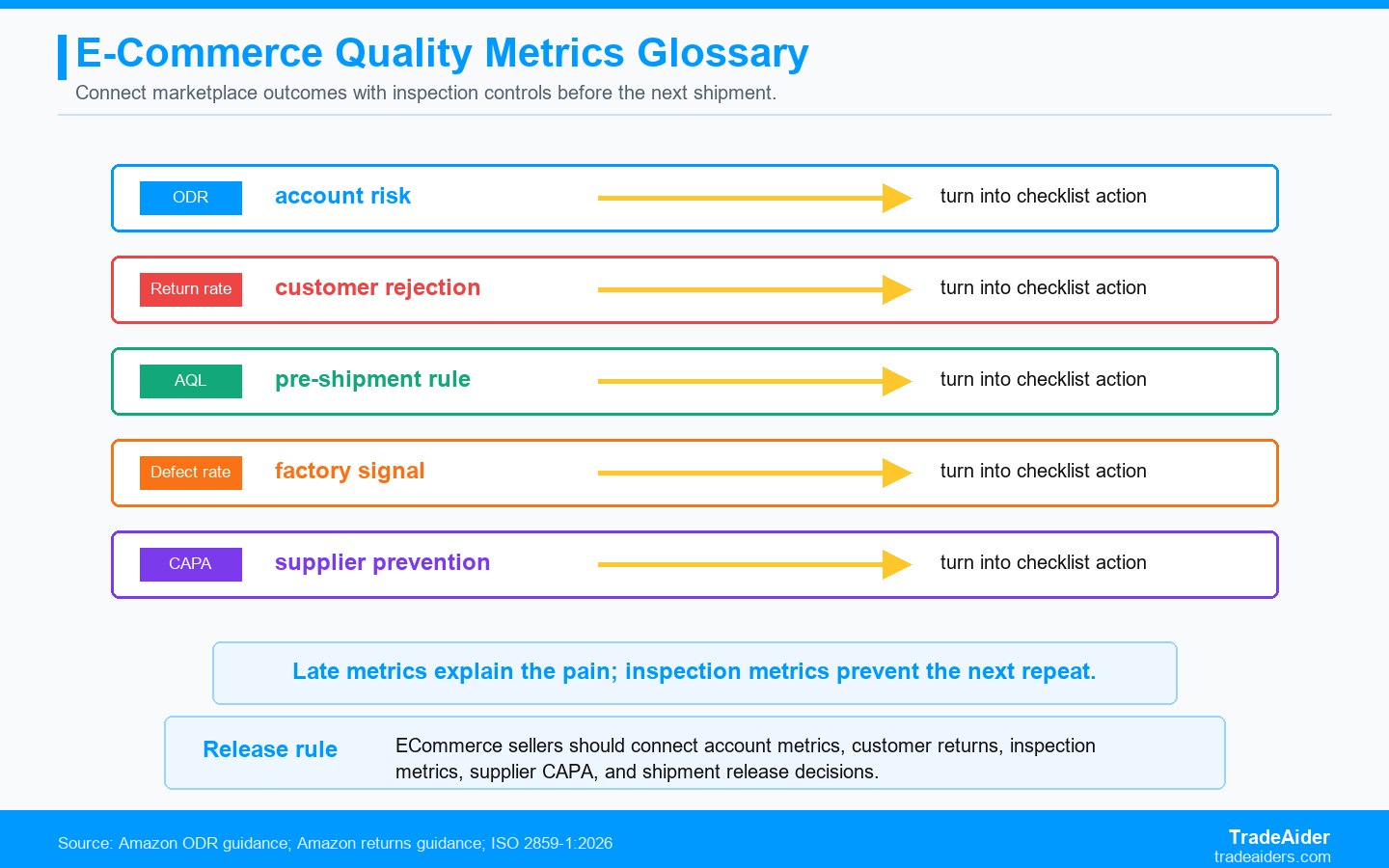
ECommerce sellers should connect account metrics, customer returns, inspection metrics, supplier CAPA, and shipment release decisions.
Map complaints to physical evidence
A complaint such as 'does not work' is too vague for factory action. The quality team should translate it into observable evidence: battery dead on arrival, wrong adapter, loose switch, missing accessory, cracked housing, incorrect manual, poor packaging, barcode mismatch, or cosmetic damage. Each translated reason can become an inspection checkpoint.
This translation prevents emotional supplier discussions. Instead of saying customers are unhappy, the buyer can say that 18 returned units from lot A had broken clips, and the next inspection will classify clip breakage as a major defect with photos required.
Separate listing issues from shipment defects
Some returns are caused by product quality; others are caused by listing expectation. If customers say an item is smaller than expected but dimensions match the specification, the corrective action may be listing photography or size presentation. If customers say the color is wrong and the inspection report shows a broad color range, the corrective action belongs in supplier control and approved-sample tolerance.
This distinction matters because factory inspection cannot solve an inaccurate listing, and listing edits cannot solve repeat manufacturing defects. A good dashboard flags the owner of the corrective action, not just the symptom.
Convert repeated returns into supplier CAPA
When the same defect appears across returns and inspection findings, the seller should move from complaint handling to CAPA. CAPA should describe root cause, containment, correction, prevention, verification method, and the next inspection change. A supplier note saying 'we will improve quality' is not enough.
For example, if returned units show cracked packaging corners, CAPA may require stronger retail box board, revised master carton stacking, corner drop review, and reinspection photos of the updated pack. The next PSI should verify those changes instead of only counting finished goods defects.
Use AQL and Reinspection as Release Controls
AQL and reinspection should sit inside a release workflow. The first inspection identifies whether the lot meets the agreed limit. If it fails, the supplier corrects the affected issue. Reinspection then verifies whether the correction was real and whether new defects were introduced during rework.
AQL should be connected to defect classes
An AQL result without defect classification is weak evidence. Critical defects should often trigger hold regardless of count. Major defects drive accept or reject decisions. Minor defects may be accepted within tolerance if they do not affect function, safety, listing promise, or customer experience. The defect class should reflect the category, not a generic template.
For eCommerce, major defects often include missing accessory, nonworking function, wrong color, wrong barcode, damaged retail packaging, incorrect warning, and visible defect that harms listing consistency. Minor defects may include tiny nonfunctional marks outside the customer's normal view, if the brand accepts that level.
Reinspection should verify correction, not just sample again
A reinspection is useful only if it checks what changed. If a supplier reworked packaging, the reinspection should open cartons, inspect updated retail boxes, and photograph corrected packing. If a supplier replaced accessories, the reinspection should count accessories across affected SKUs. Repeating the original checklist without focusing on correction can miss the same failure.
Reinspection rate is also a supplier reliability metric. If the same supplier repeatedly fails first inspection and passes after urgent rework, the buyer should ask whether the supplier's normal process is stable enough for larger orders.
CAPA should update the next purchase order
The most common dashboard failure is closing CAPA in a spreadsheet but not updating the next order. Specifications, approved samples, inspection checklists, packaging requirements, and supplier production controls should change after a repeat failure. Otherwise the same defect returns under a new PO number.
A practical rule is to add a 'changed since last order' field to the next inspection booking. The inspector should know which defect or correction is being verified, and the report should show that verification directly.
Illustrative Dashboard Rule for Repeat Orders
A useful eCommerce quality dashboard can be simple. Imagine a SKU sells 2,000 units per month. Return rate moves from 2.5% to 4.0%, and 40% of the additional returns mention a broken component. That creates about 12 extra broken-component returns per month. If each return costs $16 after refund handling, support, inbound loss, and replacement friction, the added visible cost is about $192 per month before review damage or account risk.
The dashboard rule should not be 'panic at 4%.' It should be more specific: if a defect reason adds more than the cost of one inspection or appears in two consecutive lots, require supplier CAPA and add that defect to the next PSI checklist. This turns a backward-looking metric into a release control.
Use thresholds that trigger action
Thresholds should be tied to action. ODR near marketplace limits may trigger account-health review and customer-service triage. Return rate spikes may trigger SKU-level root-cause analysis. AQL failures trigger rework or reject. Repeat defects trigger CAPA. Reinspection failures trigger supplier escalation or sourcing review. Each metric needs an owner and next step.
Without action thresholds, dashboards become monthly reports that describe damage after it happens. With action thresholds, the same data becomes a prevention system.
Where TradeAider Fits In E-Commerce Quality Metrics
TradeAider helps connect seller metrics to factory evidence through pre-shipment inspection, product checks, packaging verification, AQL reporting, and real-time inspection visibility. Sellers can send return reasons, review screenshots, customer photos, and SKU history before inspection so the checklist targets repeat failure modes.
This is especially useful when a seller has enough data to know something is wrong but not enough evidence to decide whether the next shipment should be released. TradeAider can verify the physical lot against the updated checklist and provide photos that show whether the supplier corrected the issue.
Use inspection evidence to close the metric loop
A seller quality loop has four steps: collect customer and marketplace data, translate it into observable product or packaging checks, inspect the next lot against those checks, and update supplier CAPA based on findings. The inspection report becomes the bridge between account metrics and factory action.
If your return reasons or ODR warnings are pointing to repeat product issues, send TradeAider the SKU list, return reason summary, product specification, and last inspection report. The next inspection can focus on the failure modes that already cost money.
SPAR Scenario: Return Reasons Became the Next PSI Checklist
Situation: An online seller saw return rate rise on a repeat SKU after switching to a new packaging supplier.
Problem: The account dashboard showed returns, but the return reason codes were mixed. Customer photos showed cracked retail boxes and missing accessories, while the last inspection checklist focused mostly on cosmetic product defects.
Action: The buyer mapped return reasons to inspection checkpoints, added retail-box compression and accessory count to the next PSI, and required supplier CAPA for packing method.
Result: The next inspection found repeat accessory shortages in one carton group and weak corner protection. The buyer held affected cartons, approved rework, and added packaging evidence to future release rules.
Quality Metrics Checklist for Repeat Orders
- Review ODR and return rate by SKU, lot, and time window.
- Translate return reasons into observable product or packaging defects.
- Update defect classes before the next AQL inspection.
- Require CAPA for repeat defects, not only refunds.
- Use reinspection to verify the specific correction.
- Track whether the next lot reduces the same defect reason.
Who Is TradeAider?
TradeAider is a quality inspection, testing, and certification service provider in China. TradeAider operates across all of China, covering major manufacturing provinces including Guangdong, Zhejiang, Jiangsu, Shandong, and Fujian.
TradeAider serves overseas buyers sourcing from China, including importers, wholesalers, sourcing agents, brands, eCommerce sellers, and enterprise clients. Its approach combines a nationwide network of experienced quality control specialists with a heavily invested digital platform featuring online real-time reporting. Clients can monitor inspections live, communicate directly with inspectors, and address issues during production rather than after shipment - a proactive model focused on problem-solving and prevention, not just defect identification.
Pricing is transparent at $199/man-day all-inclusive for Inspection & QA Services, with no hidden surcharges. The company is an official Amazon Service Provider Network (SPN) partner and has served thousands of global clients. Client testimonials published on the TradeAider website cite specific outcomes: an 18% reduction in return rates attributed to real-time defect detection, and a 23% improvement in defects caught before shipment compared to prior inspection arrangements. These are client-reported figures.
Frequently Asked Questions
What is the difference between ODR and AQL?
ODR is a customer-facing account metric, while AQL is a pre-shipment lot inspection method. ODR shows whether orders create marketplace defects such as claims, negative feedback, or chargebacks. AQL shows whether a sampled shipment meets agreed defect limits before release. Use ODR to detect business risk and AQL to control future shipment quality.
Is return rate always a quality problem?
No. Return rate can rise because of product defects, damaged packaging, wrong item, inaccurate listing content, sizing expectations, shipping delays, or customer preference. Sellers should map return reasons before blaming the factory. Only the reasons linked to observable product, pack, label, or accessory failures should become supplier CAPA or inspection checklist changes.
How should sellers use CAPA?
Sellers should use CAPA to prevent repeat defects, not just to collect supplier promises. A useful CAPA identifies root cause, containment, correction, prevention, verification method, and the next inspection requirement. The next PO or PSI checklist should show what changed because of the CAPA, and reinspection should verify the correction with photos or test results.
Which metrics should be reviewed before a repeat order?
Before a repeat order, review return rate by reason, ODR trend, negative reviews, customer photos, inspection defect history, reinspection results, supplier CAPA status, and any packaging or specification changes. The goal is not to collect more numbers; it is to decide what the next inspection must verify before the repeat shipment is released.
Related Articles


Grow your business with TradeAider Service
Click the button below to directly enter the TradeAider Service System. The simple steps from booking and payment to receiving reports are easy to operate.

