
- About Us

- Our Services
- Your Industry
- Resources
- News & Blog
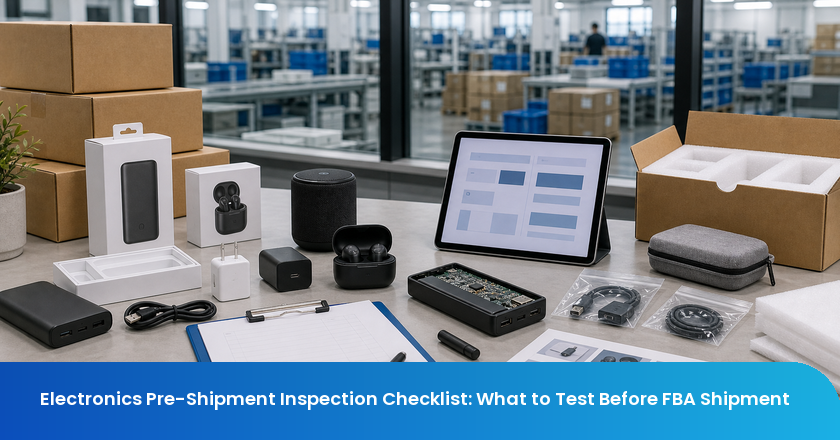
An FBA-bound electronics shipment should be inspected before it becomes an Amazon warehouse problem. The real risk is not only that Amazon may find a document or battery issue later; it is that the buyer loses the easiest moment to correct function, label, accessory, and carton problems while the goods are still near the factory.
For electronics sellers, FBA readiness is a product release decision first and a warehouse routing decision second. If the product does not work, the battery file is unclear, the barcode is wrong, the manual is mismatched, or the accessory set is incomplete, a clean master carton will not protect the listing. The checklist below is built around that sequence.
Key Takeaways
- FBA preparation does not replace product release inspection; electronics need function, identity, battery, label, accessory, and packaging checks before warehouse shipment.
- Amazon battery and dangerous goods requirements make documentation and battery data part of shipment readiness, not a separate afterthought.
- FCC authorization evidence is separate from PSI, but model and label consistency should be verified before US-bound RF devices move into FBA inventory.
- The best checklist gives a release rule for each gate: pass, rework, hold, or escalate for document review.
The Direct Answer
Before sending electronics to FBA, inspect five gates in order: product function, model identity, battery and compliance file, accessories and barcode, then retail and master carton packaging.
Amazon Seller Central explains requirements for lithium batteries and lithium-battery-powered products, including the need for lithium battery test summary documentation under UN 38.3. Source: Amazon lithium battery requirements.
Amazon also maintains dangerous goods guidance for products that may require classification before fulfillment. Source: Amazon dangerous goods policy. For RF devices sold in the United States, the FCC RF device guidance notes that RF devices must use the appropriate authorization procedure before marketing, importation, or use.
Those sources do not turn PSI into a platform approval service. They show why the pre-shipment inspection file must include battery, label, product identity, and documentation checks when the shipment is headed for a marketplace fulfillment network.
FBA Electronics Release Gates
The diagram shows why warehouse evidence should come after product evidence. Barcode and carton checks matter, but they should not hide a failed function path, unclear battery file, or mismatched model identity.
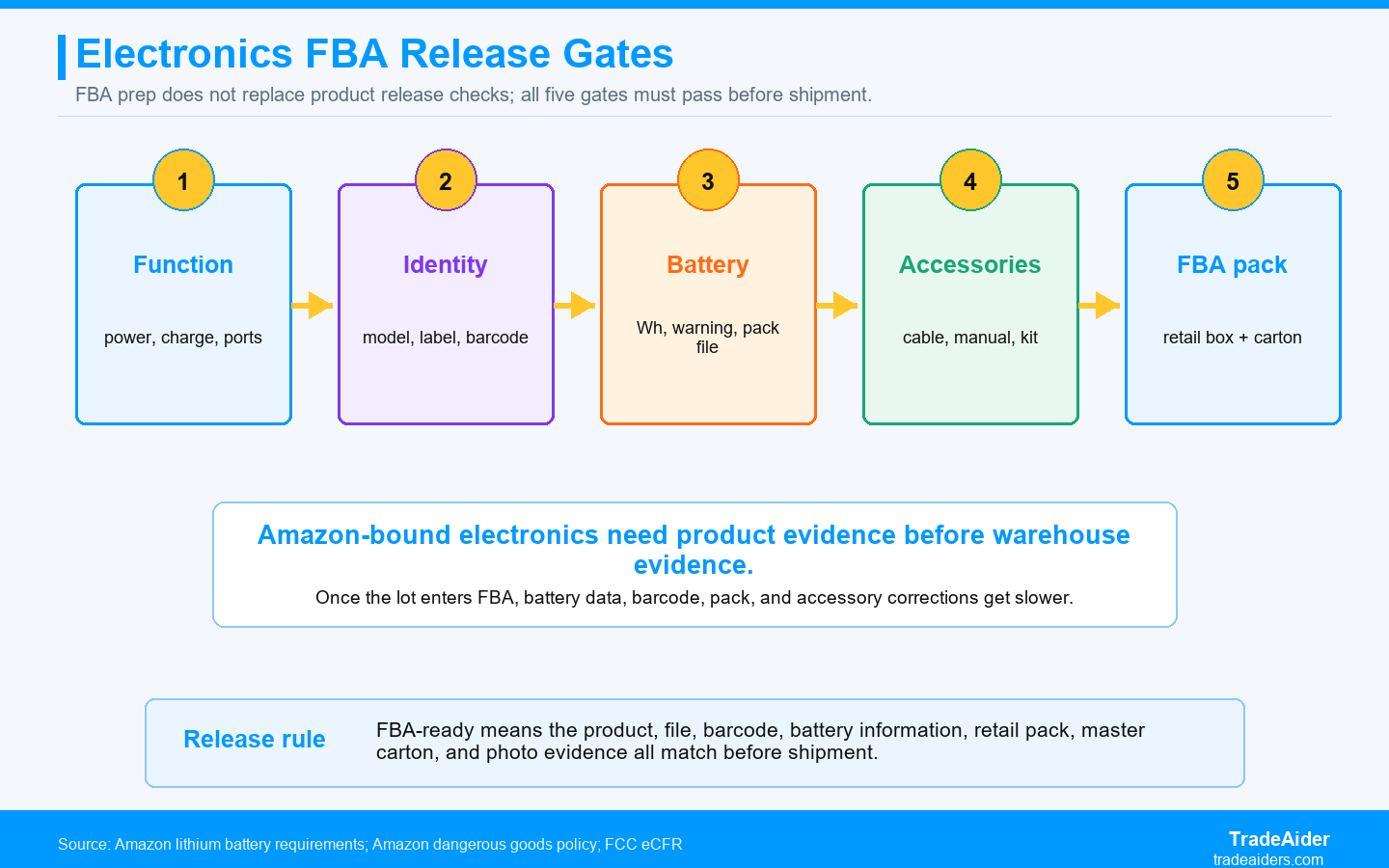
Amazon-bound electronics need product evidence before warehouse evidence.
| Gate | Inspection Check | FBA Risk If Missed | Release Rule |
|---|---|---|---|
| 1. Function | Power, charging, buttons, screen, pairing, app, reset, accessory use | Inventory reaches FBA but generates returns and poor reviews | Hold or rework repeated function failure |
| 2. Identity | SKU, model, label, barcode, manual, firmware or version | Wrong listing match, barcode issue, or buyer confusion | Release only when unit, pack, and file match |
| 3. Battery file | Wh rating, lithium battery summary, warning text, charger, pack state | Dangerous goods review, listing block, or shipment delay | Escalate document gaps before warehouse shipment |
| 4. Accessories | Cable, remote, screws, adapter, inserts, manual, app QR code | Customer returns for missing kit parts | Rework all affected kits before carton close |
| 5. Packaging | Retail box, FNSKU, master carton, carton mark, protection, photo evidence | Warehouse receiving or customer experience issue | Release only with barcode and carton proof |
Gate 1: Product Function Comes Before Warehouse Routing
The first gate asks whether the product can survive the basic buyer use path. For electronics, that usually means power input, charging behavior, controls, display or indicator behavior, sound or output, connection, reset, and accessory compatibility. The exact path depends on the product, but the principle is stable: do not let a unit enter FBA just because the carton looks ready.
A useful scope uses a short test script instead of a vague instruction such as 'check function.' For a rechargeable device, the script may include charge indicator, power-on, mode selection, short operation, charging port fit, included cable, and manual consistency. For a wireless device, it may include pairing, distance spot check, reset, and label identity. These steps are small, but they change the quality of the evidence.
Consider a 2,400-unit FBA shipment with a 1.5 percent hidden pairing failure. If each affected unit creates only $18 in refund, replacement, support, and review-management exposure, the direct cost is about $648. The bigger risk is operational: once units are distributed into FBA, isolating a factory batch problem becomes slower and more expensive.
Gate 2: Identity And Battery Evidence Decide Whether The Lot Is The Right Lot
The second gate connects the physical product to the seller file. The unit model, SKU, rating label, manual, carton barcode, retail pack, and platform listing should not tell different stories. Electronics sellers often underestimate this point because the product can look identical while the commercial identity has changed.
Battery evidence deserves its own attention. If the product contains lithium batteries, the buyer should make sure the factory file, label, warning text, charger information, and shipment documentation are consistent before FBA shipment. PSI cannot create missing compliance documents, but it can catch a mismatch between the physical product and the file the seller plans to rely on.
For US-bound RF devices, PSI should also check whether the model identity and visible labeling match the authorization file supplied by the buyer. That is not the same as approving the product. It is a defensive evidence check that prevents a different version from being shipped under a file that belongs to the approved sample.
Gate 3: Accessories, Barcode, And Carton Proof Protect The FBA Outcome
The third gate is where many FBA shipments fail in a commercially painful way. A cable shortage, wrong insert, missing remote, incorrect FNSKU, unreadable barcode, or weak master carton may not look like a product defect at first. But it can create receiving friction, customer complaints, repacking costs, and stranded inventory.
The inspection should photograph the retail pack, the master carton, barcode placement, accessory set, manual, and any warning insert. The report should also show opened kits, not only sealed cartons. If an accessory issue is found, the buyer needs evidence that the factory reworked affected cartons, not only a promise that the problem was corrected.
That is why the checklist should end with a release decision rather than a long photo album. Release when product, barcode, accessory, battery, label, and carton evidence match. Rework when the issue is clear and correctable. Hold when the buyer cannot tell whether the physical lot matches the FBA file.
Where TradeAider Fits Before FBA Shipment
TradeAider's role is to help importers convert an FBA shipment into a release-evidence workflow before goods leave the supplier. The service does not make Amazon approval decisions, does not certify dangerous goods, and does not replace platform policy review. It gives the seller an inspection report that can reveal whether the actual lot is ready to be sent into that channel.
Scenario: The FBA Plan Was Ready, But The Product File Was Not
An Amazon seller books shipment after receiving factory photos of sealed cartons. During PSI, sampled units power on, but two units fail charging after a short cycle. The manual shows an older model number, the FNSKU label is correct, and the accessory bag is missing one cable in several opened kits. This is not a warehouse labeling issue. It is a release evidence issue.
The right decision is to separate defects by gate. Function failure may require extra sampling and factory correction. The manual mismatch requires document and pack rework. The accessory shortage requires carton isolation and recheck. The FNSKU being correct is useful, but it does not cancel the other release risks.
How To Use Real-Time Findings Without Overreacting
When TradeAider reports findings in real time, the buyer should ask three questions before making a decision. First, is the defect isolated or repeated across cartons? Second, does the issue affect customer use, platform compliance, or only presentation? Third, can the factory rework and prove correction before shipment?
This keeps the seller from rejecting a shipment for a minor cosmetic issue while missing a larger identity or battery problem. It also keeps the seller from accepting a clean carton set when opened-kit evidence shows a real accessory shortage. The value is not just faster reporting; it is faster evidence-based sorting.
What To Put In The Inspection Brief
Before booking an Amazon FBA inspection, send the PO, SKU list, listing title, FNSKU rules, product specification, approved sample notes, battery and charger file, manual, accessory list, carton mark, packing photos, and destination marketplace. If a battery or dangerous goods review is pending, mark that clearly so the inspector does not treat the issue as a normal packaging check.
If the shipment is not yet packed, use the brief to decide whether a During Production Inspection would catch the issue earlier. If the shipment is complete and at least 80 percent packed for export, a PSI can work as the final release gate before the inventory enters the FBA pipeline.
FBA sellers should also separate factory readiness from forwarding readiness. A freight forwarder may correctly prepare shipment paperwork and still be moving inventory that has not passed product release. The forwarder sees cartons, labels, dimensions, and routing. The inspection team sees units, accessories, function, visible defects, and whether opened kits match the seller file. Both jobs matter, but they do not answer the same question.
The most useful checkpoint is before the shipment is sealed beyond easy correction. If the inspector finds missing cables while cartons are still accessible, the factory can open, add, reseal, and provide rework evidence. If the same problem appears after goods reach FBA, the seller may face stranded inventory, removal orders, customer returns, or manual replacement work in a much more expensive location.
Buyers should also define how many cartons may be opened for kit verification. Factories sometimes resist opening cartons because repacking takes time. For electronics, that resistance has to be balanced against the risk of a silent kit error. A seller can agree on controlled carton opening, photo evidence, resealing rules, and carton selection before inspection day so the inspector is not negotiating basic access on site.
A final FBA-specific rule is to avoid treating every finding as an Amazon issue. A wrong FNSKU is a platform packing issue. A missing charger is a product kit issue. A vague battery file is a compliance evidence issue. A failed pairing test is a product function issue. Separating these categories makes the corrective action faster and keeps the seller from asking the wrong party to solve the problem.
The checklist should also record who can approve each correction. A warehouse label fix may be approved by the seller's operations team. A charger or battery change should go back to product or compliance ownership. A repeated function failure should go to quality ownership before the forwarder receives the shipment. That approval routing keeps the final release decision from depending on a rushed message thread.
Who Is TradeAider?
TradeAider provides inspection, factory audit, e-commerce quality support, and real-time reporting services for importers buying from overseas suppliers. For FBA electronics sellers, the practical value is a report that connects product evidence with marketplace-ready packing evidence before the shipment leaves the factory area.
If your shipment is already planned for FBA, prepare the product file, battery information, barcode rules, accessory list, and packing status, then contact TradeAider to schedule the inspection scope.
Frequently Asked Questions
Can TradeAider inspect Amazon electronics?
Yes, TradeAider can inspect Amazon-bound electronics at the shipment level, including function, identity, labels, accessories, packaging, barcode evidence, and report photos. It does not approve products for Amazon or replace Amazon policy review.
Should FBA barcode checks come before function checks?
No. Barcode checks are important, but they should come after product release checks. A correct barcode on a defective or mismatched product only helps the wrong inventory move faster into the warehouse.
What if a battery document is missing?
Treat missing battery documentation as an escalation item, not a normal minor defect. PSI can record the mismatch and verify visible battery or label details, but the seller must resolve the compliance document gap before shipment.
Is a carton inspection enough for FBA shipments?
A carton inspection alone is not enough for electronics. FBA readiness requires both warehouse evidence and product evidence, especially function, accessory completeness, battery information, label consistency, and opened-kit verification.
Related Articles
Grow your business with TradeAider Service
Click the button below to directly enter the TradeAider Service System. The simple steps from booking and payment to receiving reports are easy to operate.

