
- About Us

- Our Services
- Your Industry
- Resources
- News & Blog
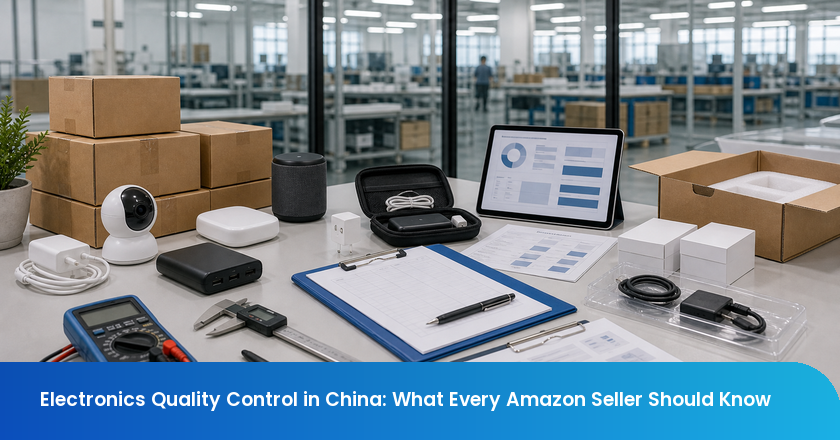
Electronics quality control in China should verify product function, firmware or version, battery information, charging behavior, accessories, labels, FCC or other compliance evidence, packaging, barcode, carton marks, and Amazon-ready documentation before shipment. For Amazon sellers, a working sample is not enough; the produced lot must match the listing, the compliance file, and the FBA release plan.
Electronics are attractive for Amazon sellers because margins can be strong and demand can scale quickly. They are also risky. A small component change, wrong firmware version, missing charger label, weak battery documentation, bad packaging, or wrong FCC attribute can create listing suppression, returns, safety complaints, or account health pressure. Quality control must connect product performance with compliance evidence.
A seller should not rely only on supplier statements such as tested, certified, or Amazon ready. The seller needs a controlled file: product specification, approved sample photos, firmware version, battery information, test reports, FCC or other market evidence, labels, instructions, packaging, barcode plan, carton marks, and inspection report. The inspection should check the actual shipment against that file.
- Product checks: function, power, charging, buttons, ports, display, sound, firmware, accessories, and cosmetic defects.
- Compliance checks: FCC path, battery information, safety documents, labels, manuals, and Account Health readiness.
- Amazon checks: FBA barcode, packaging, set contents, carton marks, battery questions, and product-detail consistency.
- Decision rule: do not release electronics until the physical lot matches both product spec and compliance file.
The Direct Answer
Amazon electronics QC should combine functional inspection, version control, battery and FCC evidence checks, packaging review, FBA label control, and compliance-file readiness.
Amazon announced that product and food safety compliance requirements began moving to the Account Health dashboard on May 29, 2025, with sellers able to monitor violations, submit documents, file appeals, and coordinate product verification. Source: Amazon Account Health compliance update.
Amazon also announced a lithium-ion battery air-shipping update effective January 1, 2026, requiring sellers to provide requested battery compliance information and noting state-of-charge requirements for certain lithium-ion batteries packed with products. Source: Amazon lithium-ion battery air-shipping update.
FCC equipment authorization procedures are set out in 47 CFR Part 2, Subpart J, including Supplier's Declaration of Conformity and Certification pathways. Source: FCC equipment authorization procedures.
FCC rules for unintentional radiators in 47 CFR 15.101 identify authorization requirements for digital devices, peripherals, and external switching power supplies. Source: 47 CFR 15.101.
These sources show why Amazon electronics QC is more than a factory function test. The seller needs evidence that the product can be listed, shipped, and defended if Amazon requests documents. Inspection supports that file by verifying the real goods and packaging.
Electronics QC Matrix For Amazon Sellers
Electronics inspection should connect physical product, compliance file, and FBA release.
| QC Area | What To Check | Amazon Seller Risk | Inspection Output |
|---|---|---|---|
| Function | Power on/off, charging, ports, buttons, display, sound, connectivity, basic use | Returns and negative reviews | Function photos, test notes, defect counts |
| Version control | Model, firmware, PCB mark, component clues, packaging version, instruction version | Old or changed version ships | Version photos and sample comparison |
| Battery | Battery type, capacity label, Wh, pack condition, compartment, charging accessory, warning | FBA hazmat or air-shipping issue | Battery label and pack evidence |
| FCC and labels | FCC ID or SDoC support where applicable, rating label, manual statement, responsible-party file | Listing compliance request or suppression | Label photos and file match |
| FBA packaging | Barcode, set contents, accessories, retail pack, carton mark, drop or protection risk | Receiving errors and customer damage | Pack photos and carton evidence |
The matrix should be customized by product. A Bluetooth speaker, charger, LED light, remote control, heated insole, power bank, smart home sensor, and USB accessory have different risk profiles. The seller should not use one generic electronics checklist for every ASIN.
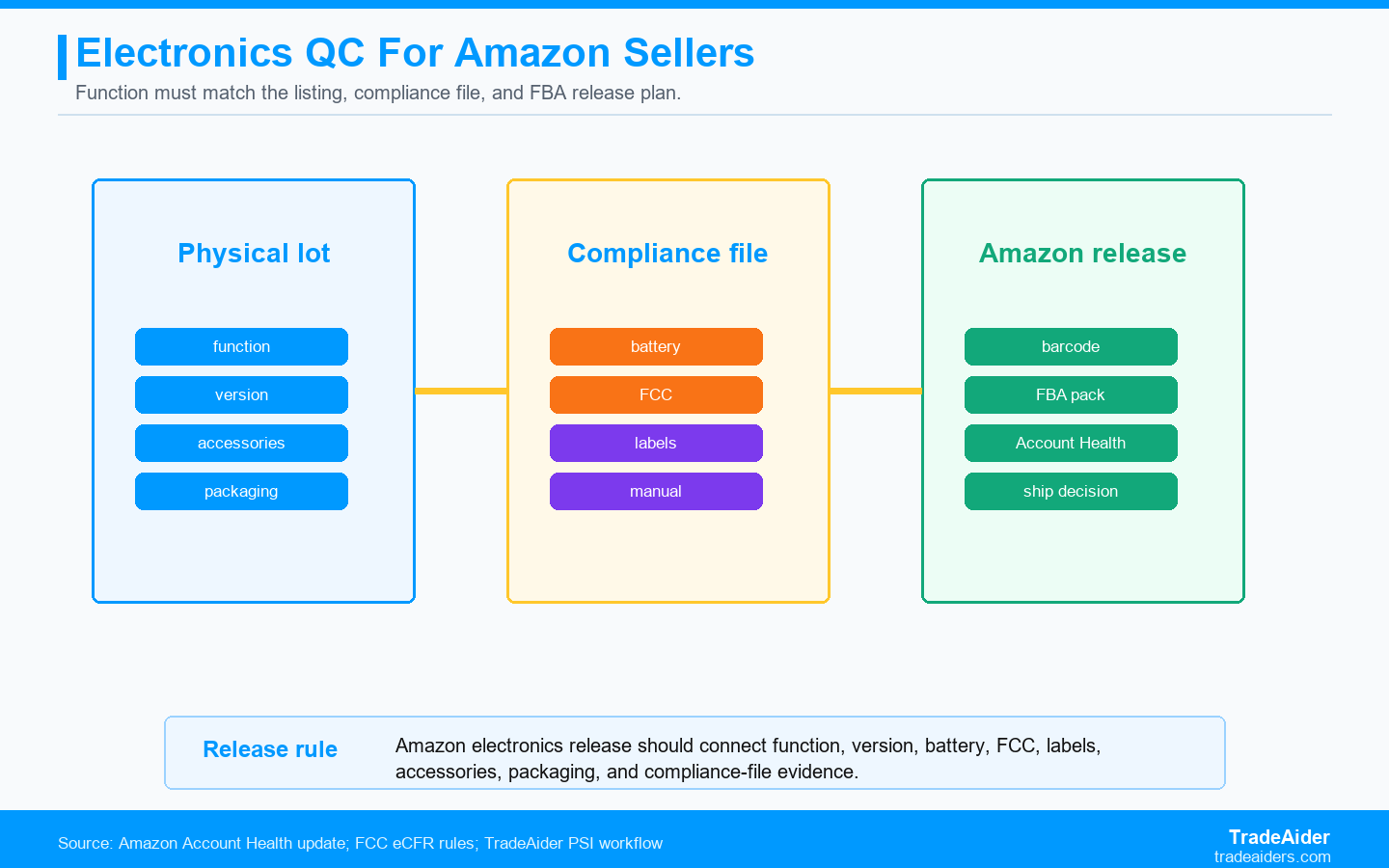
Amazon electronics release should connect function, version, battery, FCC, labels, accessories, packaging, and compliance-file evidence.
Function And Version Checks
A production lot can fail even when the supplier's sample worked.
Electronics inspection should test sampled units according to the buyer's basic use path. That may include power on/off, charging, indicator lights, display, buttons, ports, sound, Bluetooth pairing, Wi-Fi setup, remote control, app connection, sensor response, cable connection, or accessory compatibility. The test should be realistic and repeatable within inspection time.
Version control is critical. The seller should check model number, firmware, product label, manual version, packaging artwork, accessory set, and visible component clues where available. A supplier may ship an old firmware version, substitute a charger, change a cable, or use a different battery pack without telling the seller. Those changes can affect function and compliance.
The buyer should define what the inspector can and cannot test. PSI can check practical function and visible evidence, but it cannot replace full reliability testing, EMC testing, electrical safety testing, battery safety testing, or software QA. The inspection should be one layer of a broader control plan.
Battery And FCC Evidence Checks
Battery and RF issues are common Amazon electronics tripwires.
If the product contains batteries, the seller should collect battery type, cell count, capacity, Wh, packaging configuration, battery label, test summary or compliance evidence where relevant, warning label, and shipping information. The inspector can photograph battery labels, product labels, packaging, and accessories to confirm that the shipment matches the seller's file.
For radio frequency or digital devices, the seller should confirm whether FCC Certification or Supplier's Declaration of Conformity applies. The inspector can verify visible FCC ID, rating label, model, responsible-party statement in the manual where provided, and whether the physical product matches the compliance file. The legal authorization path should be handled before production, not after FBA receiving.
The seller should be careful with supplier-provided reports. A report for a similar model, different charger, old PCB, or previous buyer may not support the current ASIN. Electronics sellers should match report photos, model numbers, applicant, factory, labels, and product version before shipment.
Packaging, Accessories, And FBA Checks
Many electronics returns come from missing accessories or damaged retail packs, not only product failure.
Electronics inspection should open sampled retail packs and verify cable, charger, adapter, remote, manual, warranty card, mounting parts, protective film, and any bundled accessory. Missing accessories can create immediate customer returns even when the device works.
Packaging should protect the product from transit damage and customer disappointment. The inspector should check retail box condition, inner tray, foam, bags, screen protection, battery isolation where relevant, barcode, set labels, carton marks, and shipping carton strength. Electronics boxes can be damaged by internal movement if accessories are not separated properly.
FBA readiness should include barcode accuracy, scannability where practical, carton quantity, carton mark, product label, and set completeness. If the product is sold as a bundle or kit, the packaging must keep the set together and match the listing promise.
Where TradeAider Fits In Electronics QC
TradeAider fits by checking the physical electronics lot against the seller's product and compliance file.
TradeAider can use Pre-Shipment Inspection to verify electronics function, version, labels, battery information, accessories, packaging, barcode, carton marks, and visible compliance evidence before shipment.
For production-stage risk, During Production Inspection can check components, labels, packaging, and function before the whole lot is finished. For repeated supplier problems, factory audit service can review process controls and records.
The business fit is Amazon release discipline. TradeAider does not replace FCC authorization, lab testing, legal review, or Amazon compliance submission, but it helps sellers verify that the real shipment matches those files.
SPAR Scenario: The Electronics Shipment Worked But The File Did Not Match
The device powered on, but the seller's compliance evidence was not aligned.
Situation: An Amazon seller orders a Bluetooth device from China. The supplier provides a previous FCC report and says the product is ready for FBA.
Problem: PSI finds that the product powers on and pairs, but the rating label uses a different model number from the report, the manual references an old accessory, and the battery label does not match the seller's listing data.
Action: TradeAider documents the mismatch, the seller pauses shipment, and the supplier corrects labels and manual files. The seller reviews whether the product version still matches the FCC and battery evidence.
Result: The seller avoids sending a functional but poorly documented electronics lot into FBA, where compliance questions could have been much harder to fix.
Action Card: Electronics QC Checklist For Amazon Sellers
Build one file for the product and one checklist for the shipment.
- Send product spec, approved sample photos, firmware or version details, manual, label files, packaging file, and ASIN plan.
- Check function: power, charging, ports, buttons, display, sound, connectivity, and accessories.
- Verify battery type, capacity, Wh, label, warnings, pack condition, and shipping information where relevant.
- Verify FCC ID or SDoC-related labels and manual statements where applicable.
- Open sampled retail packs and confirm accessory count, barcode, set contents, carton marks, and FBA-ready packaging.
- Hold shipment if product version, label, battery data, or compliance file does not match the actual lot.
The seller should also monitor recalls and safety complaints in the product category. CPSC recall data frequently includes consumer electronics, chargers, batteries, and other powered products. A recall pattern can reveal risk areas that should be added to the inspection and testing plan.
For repeat orders, update the checklist after returns. If customers complain about charging, add charging checks. If they complain about missing accessories, open more packs. If Amazon requests compliance documents, connect that request to label and file checks before the next shipment.
Electronics sellers should treat compliance and QC as one release system. A product that works but lacks the right file can be blocked. A product with documents but poor function can create returns. Release only when both layers are aligned.
Shipment Release Rule For Electronics
Do not release electronics on function alone.
A practical electronics release rule should require three matches: the product must match the approved sample, the labels and packaging must match the seller's listing and shipment plan, and the compliance evidence must match the exact product version. If any layer is uncertain, the seller should hold shipment until the mismatch is resolved.
This matters because electronics defects can be invisible at first glance. A changed adapter, altered battery pack, different firmware, revised PCB, missing warning, or wrong manual can create a problem after Amazon receiving or after customers start using the product. The inspection report should therefore include version photos, label photos, accessory photos, and packaging photos, not only a note that sampled units powered on.
For higher-risk electronics, sellers should pair PSI with earlier controls. During production checks can identify wrong components, labels, or packaging before the whole order is packed. Supplier audits can review whether incoming parts, function tests, aging tests, and record controls are actually managed. Final inspection is strongest when earlier controls already reduced variation.
If you are sourcing electronics from China for Amazon, send TradeAider the product spec, compliance files, label artwork, battery data, packaging file, and FBA plan. The next step is to ask TradeAider to inspect the electronics shipment against your Amazon release file.
Frequently Asked Questions
Can electronics inspection replace FCC testing?
No. Inspection verifies the shipment and visible labels. FCC authorization, SDoC, or certification evidence must be handled through the proper compliance path.
What electronics checks matter most for Amazon sellers?
Function, version, labels, battery information, accessories, packaging, barcode, FCC evidence match, and Account Health document readiness are all important.
Should battery data be checked before FBA?
Yes. Battery type, capacity, Wh, packaging configuration, labels, and Amazon-required battery information should match the listing and shipment file.
What is the biggest electronics QC mistake?
Shipping a product that works in a quick test but does not match the compliance file, label file, battery data, packaging, or listing promise.
Related Articles
Grow your business with TradeAider Service
Click the button below to directly enter the TradeAider Service System. The simple steps from booking and payment to receiving reports are easy to operate.

