
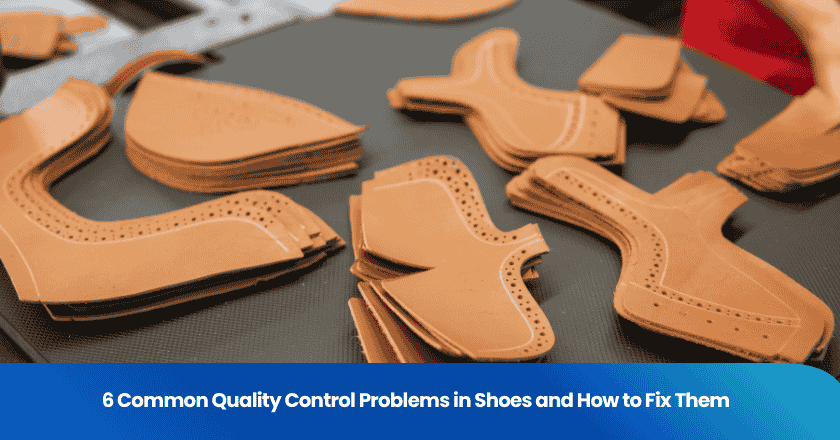
Footwear looks simple from the outside. Inside a shoe factory, though, the product goes through dozens of separate processes — material cutting, lasting, stitching, cementing, finishing, sizing, packing — and each one is an opportunity for a defect to enter the order. For importers sourcing shoes from China, understanding which defects appear most often, what causes them, and how to catch them before shipment is the difference between a clean delivery and a returns crisis.
These are the six quality control problems that appear most consistently in footwear inspections — drawn from on-site inspection findings across the industry — along with practical fixes that work within a real import workflow.
Key Takeaways
- The six most common shoe defects are: material defects, adhesive/cementing failure, poor finishing, metal and sharp points, inconsistent sizing, and stitching failures.
- Most defects are preventable with inspections at multiple production stages — not just at the end of the production run.
- Adhesive failure and sizing inconsistency are the two defect types most likely to generate customer returns and negative reviews.
- A golden sample agreed before production begins is the single most effective reference tool for catching all six defect types.
Why Footwear QC Requires a Multi-Stage Approach
Unlike a simple product where a single pre-shipment inspection adequately covers the defect spectrum, footwear involves materials sourced from multiple sub-suppliers, dozens of manual assembly operations, and finishing steps where cosmetic defects are introduced at the very end of the line — long after structural work is complete. A sole separation discovered in a final random inspection (FRI) at 80% production completion represents a rework or remake cost that far exceeds the cost of a mid-production check that would have caught the adhesive process error weeks earlier.
The practical framework for footwear QC is: incoming material inspection (before cutting begins), during-production inspection at 30-50% completion, and final random inspection at 80%+ completion. Each stage catches a different class of defect. Skipping to FRI-only leaves material defects, structural failures, and sizing errors undiscovered until the cost of correction is at its highest.
Problem 1: Material Defects
What It Looks Like
Material defects appear on the upper, lining, or outsole as visible scars, holes, scratches, stains, color inconsistency, surface blooming (a white residue that appears on rubber or leather after production), or unwanted texture patterns. On natural leather, some degree of imperfection is intrinsic to the material — but the question is whether the usable area of each hide is sufficient to cut clean panels for the required shoe size, and whether defect placement falls in a visible area of the upper.
Material defects on synthetic textiles and coated fabrics typically arise from incorrect storage conditions (high humidity causing delamination in coated fabrics, UV exposure causing color fading), manufacturing contamination, or sub-supplier quality failures upstream of the shoe factory itself.
The Fix
Incoming quality control (IQC) on raw materials before cutting begins is the only reliable way to eliminate material defects from finished goods. At IQC, inspectors assess leather for usability (minimum usable area per hide for the cutting plan), check synthetic fabrics for color consistency against the approved standard, and verify that coated materials show no delamination or contamination.
For leather, a usability assessment protocol — specifying the maximum permitted defect zone size and location per panel — should be part of your purchase specification, not a negotiation at the IQC stage. Storage environment management at the factory level (temperature, humidity control, UV protection for coated materials) is the preventive measure; IQC is the detection layer.
Problem 2: Adhesive and Cementing Failure
What It Looks Like
Adhesive failure in footwear ranges from visible symptoms — overflow glue, glue marks on the upper, excess cement squeeze-out at the sole edge — to structural failures that aren't visible until the shoe is worn: sole separation, delamination of the outsole from the midsole, or insole lifting. Cosmetic adhesive issues (glue marks, overflow) are typically classified as minor defects. Cementing failure — where the bond between the upper and the outsole breaks under normal use — is a major defect that generates returns, negative reviews, and potential liability claims.
Adhesive failure is among the highest-frequency defects reported in footwear inspections. It's also among the most preventable.
The Fix
Three root causes account for the majority of cementing failures: wrong adhesive for the material combination, expired or incorrectly stored adhesive, and poor surface preparation before bonding. Each requires a different intervention.
For adhesive selection, the factory's technical documentation should specify the approved adhesive type and grade for each material combination in the product — upper material to insole board, outsole rubber to midsole foam, and any secondary bonds. This specification should be reviewed during your factory audit before production begins.
Expired adhesives are a systematic risk in high-volume factories where large quantities of adhesive are purchased in bulk and rotate slowly. A procedure requiring visible date-labeling of all adhesive containers at working stations, with regular checks by line supervisors, addresses this root cause directly. Surface preparation — roughing, priming, and cleaning the bonding surfaces before cementing — is the most workmanship-dependent part of the process and the most common training gap. Inline inspection at the lasting and cementing stations catches the most common application errors before they are buried under the finished upper.
Problem 3: Stitching Failures
What It Looks Like
Stitching defects in footwear appear in several forms: skipped stitches (where the needle fails to catch the thread, leaving a gap in the seam), broken stitching (where the thread has snapped under tension during production), over-stitching (where the stitch line runs beyond the intended path, creating a visible error on the finished upper), uneven stitch density, loose threads at seam ends, and grinning seams (where the seam allowance gaps open, making the stitching visible through the upper material).
On dress shoes and premium leather goods, stitching quality is among the primary visual signals of product quality to the end consumer. On athletic and casual footwear, stitching failures that compromise structural integrity — particularly at stress points around the toe box, heel counter attachment, and outsole welt — generate functional failures and returns.
The Fix
Machine calibration is the most direct preventive measure: sewing machines must be set to the correct stitch density (stitches per inch), tension, and needle type for the thread and material combination. A calibration check at the start of each shift, documented by the line supervisor, catches machine-related causes before they affect the production run.
Worker skill is the second variable. Complex stitching operations — curved seams, corner stitching, attachment of decorative elements — require trained operators who understand the required result, not just the process. Providing workers with clear visual reference standards at each station, comparing acceptable versus unacceptable stitching outcomes, significantly reduces the variation that generates defects. A during-production inspection at 30-50% completion is the earliest practical point at which systematic stitching defects become detectable at scale.
Problem 4: Metal Contamination and Sharp Points
What It Looks Like
Metal contamination in footwear is a safety defect — not a cosmetic one. It appears as exposed metal components (eyelets, buckles, rivets, or decorative trims) with sharp edges or points, steel shanks without protective covering accessible to the wearer's foot, broken needle fragments embedded in the upper or insole from the stitching process, or, in rare cases, construction fasteners (nails, staples) accidentally left inside the shoe cavity during lasting.
Sharp points and exposed metal edges that can cut or puncture the wearer are classified as major safety defects. They are also among the defect types most likely to trigger CPSC recall action if they reach consumers — particularly for children's footwear.
The Fix
The standard approach in textile manufacturing — passing finished goods through a metal detection gate — works well for garments but is less effective for footwear, since most shoes legitimately contain metal components (shanks, eyelets, rivets). Metal detection is still useful for individual components (uppers, insoles) checked in isolation before assembly, but it cannot reliably distinguish a steel shank from an unintended nail in a completed shoe.
More reliable control comes from: a broken needle policy at stitching stations (requiring any broken needle to be immediately reported, located, and documented — all fragments accounted for before the workpiece continues down the line); visual inspection of all metal trims and hardware for sharp edges before assembly; and final random inspection procedures that include a manual check of interior shoe surfaces for sharp points, as well as a visual check of all exterior metal hardware for sharp edges. Inspectors should use a finger sweep of the interior of each inspected pair as a standard procedure — the same motion a consumer makes when trying on a shoe.
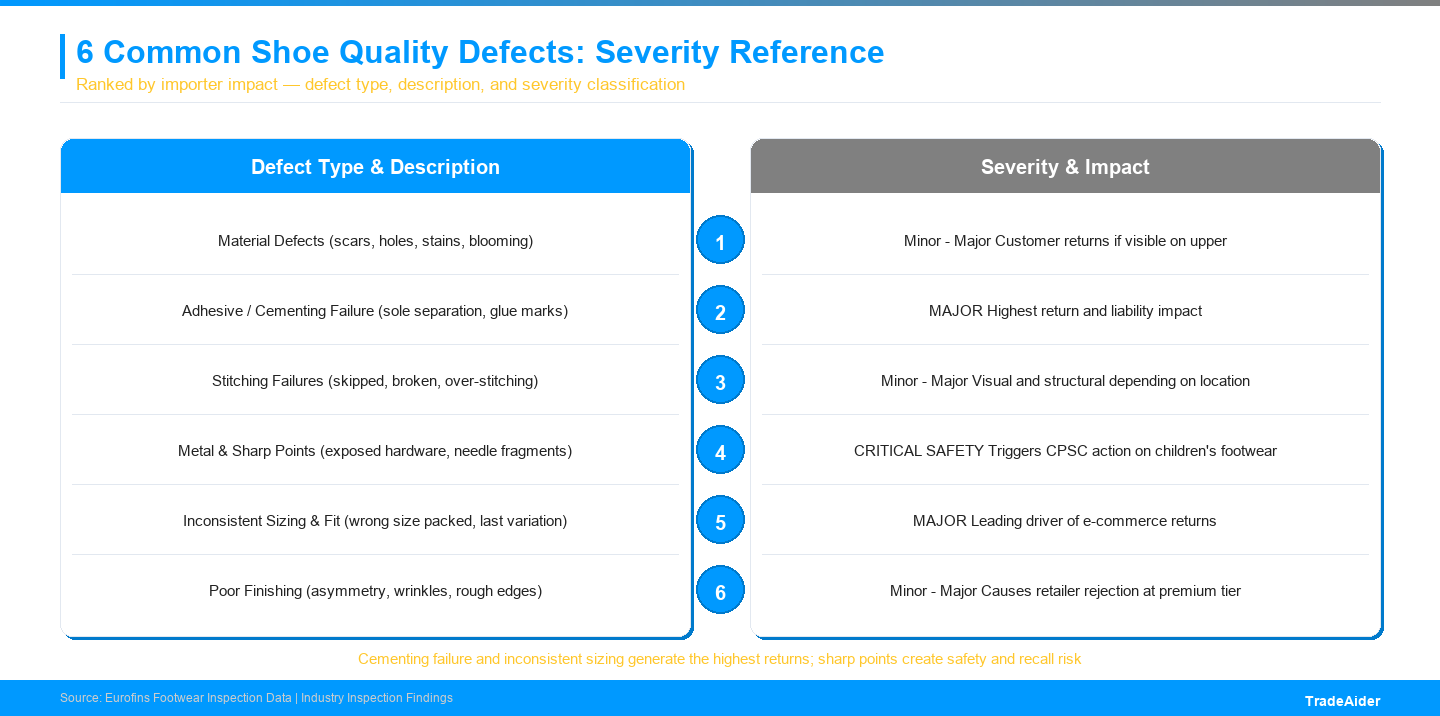 Defects that affect structural integrity (cementing failure, sharp points) carry higher return and liability risk than cosmetic defects — even when they appear less frequently in inspections.
Problem 5: Inconsistent Sizing and Fit
What It Looks Like
Sizing inconsistency in footwear manifests in several ways: shoes labeled the same size that measure differently on a size stick, left-right asymmetry within a pair (where one shoe is visibly longer or wider than the other), width variation across the production run, last-related fit issues where the shoe's interior volume doesn't match the last size specification, and packing errors where the wrong size is packed in the labeled box.
Size and fit complaints generate the highest return rates in e-commerce footwear. For an Amazon FBA seller, a sizing inconsistency that affects even a small percentage of units can accumulate reviews rapidly, trigger suppression of the listing, and require a full inventory audit. For a Shopify brand, sizing inconsistency is particularly damaging because the customer's first purchase experience defines whether they return.
The Fix
Sizing control in footwear requires consistent lasts, calibrated cutting patterns, and standardized lasting tension — and regular checking against a reference sample at every stage. The golden sample approved before production begins is the primary reference: all production output is compared against it, not against an abstract specification on paper. Any deviation from the golden sample in size, shape, or fit is a non-conformity.
At final random inspection, the inspector should measure a statistically valid sample of pairs using a size stick, verify left-right symmetry within each pair, and open a representative sample of cartons to verify that the shoe inside matches the size marked on the box and carton label. Mispacked sizes are among the easiest defects to miss in a high-speed packing line and among the most disruptive for importers to resolve after goods arrive at the warehouse.
Problem 6: Poor Finishing — Asymmetry, Wrinkles, and Edge Quality
What It Looks Like
Finishing defects in footwear include: asymmetric upper height (where the shoe's shaft or toe cap is not the same height on both shoes of a pair), uneven trimming of edges and allowances, pressing marks on the upper material from lasting equipment, wrinkle marks on the upper where the lasting tension was incorrect or inconsistent, slanted heels, and rough or unfinished edge treatment on outsoles and midsoles.
Finishing defects are primarily cosmetic, but they have a significant effect on perceived quality and retail acceptance. Premium footwear buyers and major retailers typically have detailed approved inspection criteria with AQL levels for cosmetic defects that are tighter than industry defaults. A shipment that passes an AQL 2.5 general inspection may still fail a brand-specific inspection at a major US or EU retailer.
The Fix
Finishing quality is most directly tied to worker training, machine calibration, and process standardization. Each process — lasting, trimming, edge painting, pressing — should have a documented standard operating procedure with photographs of acceptable and unacceptable output at each station. New workers should be qualified on each operation before they are assigned to production, not trained on live production orders.
Machine calibration matters most for lasting (last height and tension settings) and pressing (temperature and pressure for heat-forming operations). A calibration log, checked at the start of each shift, catches drift in machine parameters before it affects the run. For the most critical operations, an inline quality check by a dedicated QC operator at the finishing stations — not just end-of-line inspection — catches defects when they can still be corrected on the individual pair, before they accumulate into a systematic batch issue.
How to Structure a Footwear QC Program That Catches All Six
No single inspection point catches all six defect categories. A robust footwear QC program layers three inspection types:
- Incoming Quality Control (IQC): Catches material defects (Problem 1) before they enter production. Triggered when raw materials arrive at the factory.
- During Production Inspection (DPI): Catches adhesive process errors (Problem 2), stitching failures (Problem 3), and early sizing issues (Problem 5) when 30-50% of the order is completed and corrections are still cost-effective. TradeAider's during production inspection service is designed precisely for this window.
- Final Random Inspection (FRI/PSI): Catches finishing defects (Problem 6), metal contamination and sharp points (Problem 4), packing errors in sizing (Problem 5), and any structural defects that survived earlier stages. TradeAider's pre-shipment inspection service covers a complete AQL-based sample at this stage, with real-time reporting available during the inspection.
For new suppliers, a factory audit before production begins is the additional layer that validates whether the factory has the technical capability and QC processes in place to produce footwear to your specification — catching systemic capability gaps before they generate a defective order.
Frequently Asked Questions
What AQL level should I use for footwear inspections?
AQL 2.5 is the most common default for general consumer footwear inspections, applied to major defects (structural, safety, significant cosmetic). AQL 4.0 is typical for minor defects. However, premium footwear for direct-to-consumer brands or major retailers often applies tighter tolerances — AQL 1.5 or even 1.0 for critical cosmetic defects. The AQL level should be specified in your purchase order or quality agreement with the factory, not negotiated at the time of inspection. Use the AQL calculator to determine the correct sample size for your order quantity and AQL level.
Is sole separation a major or minor defect?
Sole separation — where the outsole bond fails — is universally classified as a major defect, regardless of the extent of separation at the time of inspection. Even a minor separation at the toe or heel indicates a cementing process failure that will worsen with wear, and the defect represents both a functional failure and a potential safety issue (trip hazard). Any shipment with sole separation in the sample should be placed on hold pending investigation of the root cause and verification that the entire batch is not affected.
How do I ensure sizing is consistent when ordering from a factory in China?
Consistent sizing requires a confirmed size specification agreed before production — not assumed from the factory's default last set. Your size specification should state the target internal length for each size (in millimeters), the permitted tolerance (typically ±2mm for standard consumer footwear), and the last code used. A fit sample in the critical size (usually the median size in your order) should be approved before bulk production begins. During-production inspection should include a size measurement check against the approved specification, not just a visual comparison to the golden sample.
Artículos Relacionados

Haga crecer su negocio con el Servicio TradeAider
Haga clic en el botón de abajo para ingresar directamente al Sistema de Servicios TradeAider. Los pasos simples desde la reserva y el pago hasta recibir los informes son fáciles de operar.

