
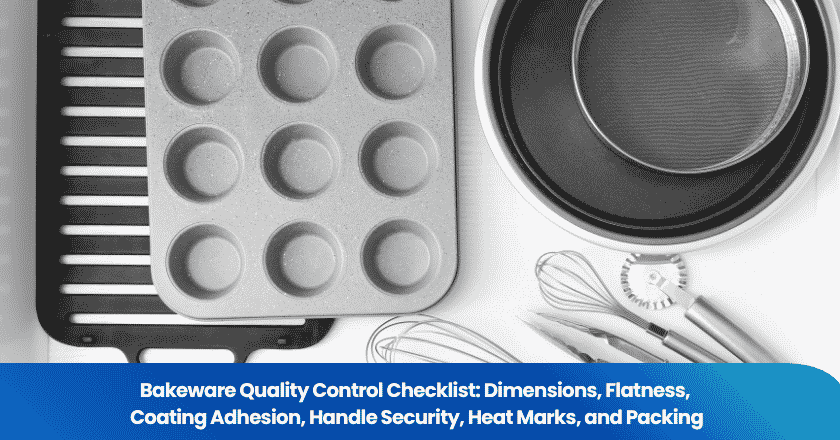
A bakeware order can meet its nominal size and still be unusable as a set: the rack may not fit, a detachable handle may have a different oven limit, or nested rims may scratch the coating before delivery. Buyers need an inspection that checks the complete supplied configuration and separates workmanship findings from the evidence behind performance claims.
This bakeware quality control checklist covers dimensions, flatness, coating adhesion, handle security, heat marks and packing. It focuses on metal baking sheets, pans and molds, including separate handles and removable parts. Glass, ceramic, silicone-only and disposable bakeware need material-specific procedures. Agree which factory checks are practical and which heating, coating or food-contact questions require a separate assessment.
The Six Bakeware Checks to Put on the Inspection Sheet
Use these six checks to agree what the factory report must establish for the actual retail set. Provide drawings, coating information, intended oven use, assembly instructions and the packing layout. Confirm separate sample and equipment needs for heating and damaging coating tests before booking.
- Dimensions: measure the specified internal and external length, width, depth and feature positions. Check fit with supplied racks, lids or removable bases. Record the endpoints, units and readings, then compare them with the drawing tolerance.
- Flatness: inspect the unrestrained pan on the defined reference surface or fixture. Record rocking and specified gaps separately, including orientation and sample temperature. Compare the initial condition with the fully cooled result after heating where required.
- Coating adhesion: adhesion means how well the coating remains attached to the surface beneath it. Inspect coating defects, then use the specified destructive test on designated samples. Record the method, location, rating and observed failure; keep tested pieces out of saleable stock.
- Handle security: examine rivets, screws, welds and locking parts in the intended configuration. Follow the specified attachment, load or cycling test. Check movement, cracks and unintended release against the agreed limits, without adding an improvised overload.
- Heat marks: photograph the starting condition, follow the approved heating and cooling procedure, and inspect for color change, residue, blistering, peeling and deformation. Judge each observation against the relevant appearance or functional requirement.
- Packing: open production packs, inspect contact points between nested items, and verify separators, accessories, set quantities and artwork. Look for rim dents and coating damage after unpacking. Any shipping-performance test needs its own agreed procedure.
Require the configuration, criterion and observed result together. A flatness gap without its support arrangement or an adhesion rating without its method is not enough to interpret acceptance. Resolve missing conditions with the responsible technical team rather than let a convenient factory demonstration define the requirement.
BSI's public description of BS EN 13834:2020 identifies safety and performance requirements for ovenware used in traditional domestic ovens. Its scope excludes single-use, throwaway ovenware and products intended only for microwave use. If the buyer adopts this standard, use the applicable full requirements and methods; its catalog description does not supply a universal factory test temperature or handle load.
Will the Pan and Its Supplied Accessories Fit?
For the purchase specification, distinguish external size across rims or handles from the usable cavity dimensions. The inspection should identify which definition it measured and whether the complete assembly fits its intended accessory. A nominal pan-size name does not settle oven clearance or the fit of a supplied rack.
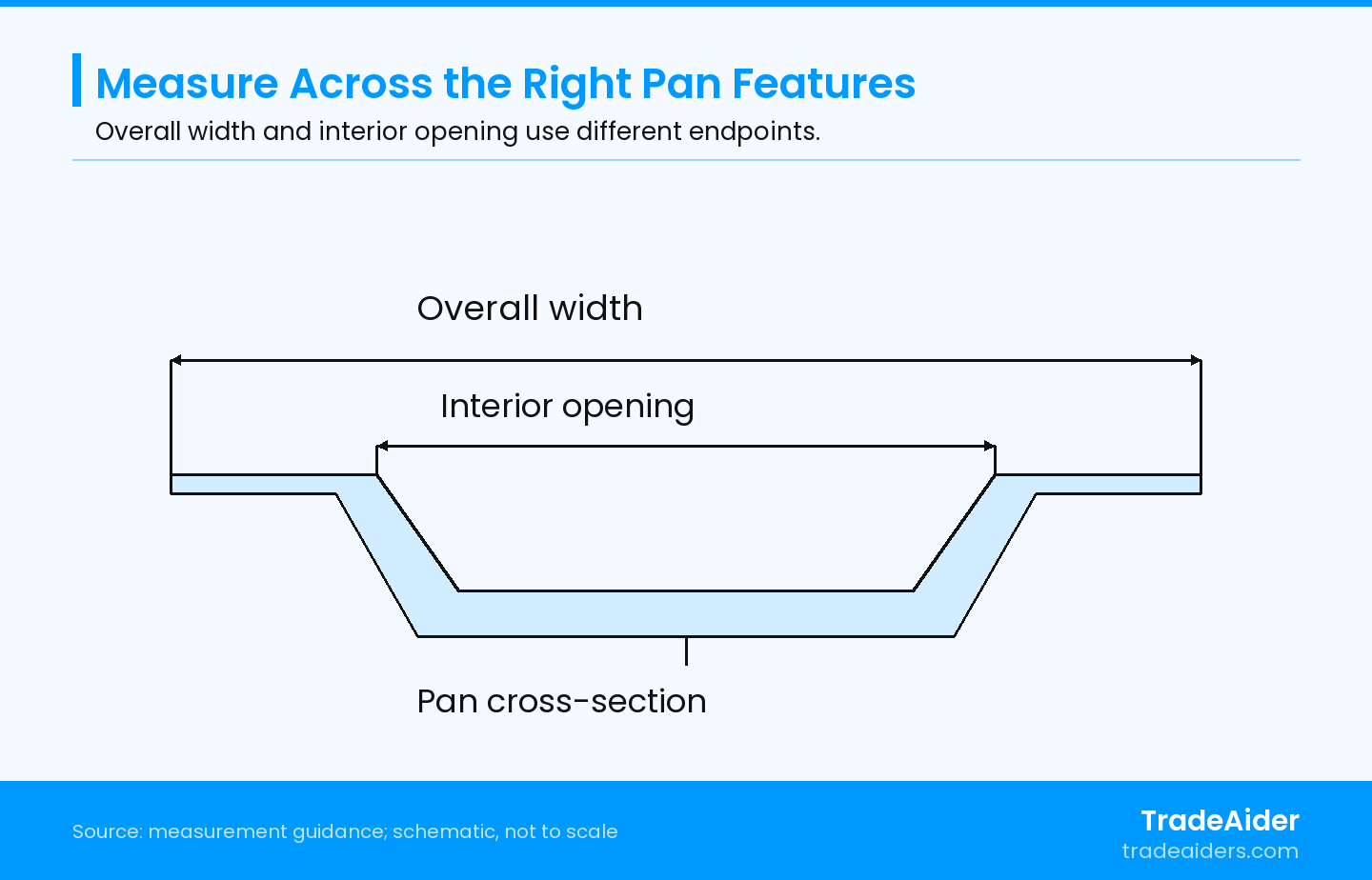
Schematic reference locations, not a scale drawing. Use the drawing's specified endpoints and depth; these two widths answer different questions.
An example of that distinction appears in Nordic Ware's quarter-sheet pan and rack specifications, which list interior and external dimensions separately. Those are specifications for that particular product, not tolerances for another supplier's pan. For an import order, make the same distinction explicit in the drawing and retail description rather than treating a nominal size name as the measurement method.
For molds and multi-cavity pans, check the specified cavity depth, opening size and spacing. Confirm the fit and seating of removable bottoms, springform closures, racks and lids where supplied. An accessory should engage in the ordered configuration without forcing the pan out of shape. Record an actual fit failure as well as any dimensional reading; a dimension within tolerance does not settle every assembly interaction.
Where sheet thickness matters to the order, request readings at the drawing's specified locations. A rolled rim or reinforcement cannot stand in for the working sheet. The method should account for coating and geometry; any sectioning or stripping needs designated destructive samples.
Distinguish Hot-Use Behavior from Permanent Distortion
Ask for the pan's initial flatness in the specified support and conditioning state, with restraints removed. A corner held down during measurement does not describe the delivered shape. The drawing and intended rack support determine which gaps or rocking observations matter, rather than a blanket assumption that every underside must sit flat on a tabletop.
A ribbed, embossed or intentionally shaped base should be assessed against its own drawing, not against an assumption that every underside must lie flat. Check operating stability separately where it is relevant. For a pan used on an oven rack, the specified support points may differ from those on a tabletop. Record which arrangement was used so the result is not confused with a different use condition.
When the plan includes heating, take an initial measurement and repeat the agreed measurement after the prescribed cooling period. Record any specified hot-state observation separately. Temporary movement during heating and permanent distortion after cooling are different findings. A pan that recovers its shape afterward may still need assessment if the agreed hot-use requirement concerns stability or retaining its contents.
A supplier's comparison is meaningful only with the same support, loading and temperature state. Heating an empty pan and a loaded pan answers different questions. If a failed sample is bent back into shape, retain the initial result and request verification of the production correction rather than accepting the reworked sample as the original condition.
An Adhesion Pass Does Not Clear Every Coating Claim
Decide which promise needs evidence: coating attachment, nonstick release, cleaning durability and food-contact suitability are separate questions. Select the relevant assessments instead of ordering one tape test to stand in for all four.
For coating defects, distinguish the food-contact cavity from exterior cosmetic surfaces. The report should identify scratches, exposed metal, blisters or loose material by location and against approved examples. A single surface-defect total can conceal very different consequences for the buyer.
The public scope of ASTM D3359-23 covers rating the adhesion of relatively ductile coating films on metallic substrates using pressure-sensitive tape over cuts in the film. It also notes that the methods do not distinguish higher levels of adhesion and that failure in a multicoat system can occur between layers. Use an agreed suitable method and rating; an unspecified tape pull is not equivalent to this standard.
Before commissioning adhesion testing, confirm that the chosen method is suitable for the coating and the available test area. Curved cavities and embossed surfaces may prevent the intended procedure. Request the location, method and failure layer; do not accept a result translated into another method's rating scale without a valid basis.
Cutting and tape testing damage the coating. Mark and segregate those samples, collect loose material safely, and keep them out of goods intended for food use. A satisfactory attachment result does not establish abrasion life, nonstick release performance, dishwasher resistance or suitability at an unspecified temperature. Each additional product claim needs the appropriate supporting assessment.
Match Coating Documents to the Actual Formulation and Use
For the US market, FDA's guidance on food-contact component regulatory status explains that the status of an article depends on its constituent substances and their intended uses. An effective Food Contact Substance Notification applies to the identified manufacturer, substance and conditions. A coating adhesion pass therefore cannot replace the relevant material assessment or justify a generic “FDA approved” claim for an unverified formulation.
Match supplied declarations and laboratory reports to the pan model, metal, coating layers, color and intended food-contact conditions. Ask whether a change of coating supplier or formulation affects the supporting basis. Use the destination market's applicable requirements; the US example is not a worldwide rule. Document matching and factory workmanship checks address different questions, so report a mismatch clearly rather than turning it into a visual-test conclusion.
Check the Use Limits of the Complete Handle Configuration
Identify whether the product has integral rims, fixed handles, detachable handles or a closure. For the actual carrying feature, require attachment condition and the specified loading or cycling result. Rivet movement, cracking or poor seating needs investigation; a brief firm hand feel does not establish security under the claimed use.
For a detachable handle, verify the correct matching part, insertion, locking and release actions. Examine wear, incomplete engagement and movement at the connection. The visible position of a latch is not sufficient if the mechanism has not engaged. If the instructions require removal before oven use, inspect that requirement and the product labeling; do not heat the handle with the pan merely to simplify the test.
Confirm the use limits of each component in the assembled product. A metal body's stated oven limit does not automatically cover a polymer grip, removable handle or lid. Before a hot-use test, establish the intended configuration, temperature, load, handling and cooling procedure. Check attachment security again after the prescribed sequence when required. Keep an ambient assembly check separate from a complete thermal or fatigue qualification.
Some bakeware has only integral gripping rims, while other items use separate handles or closures. Mark inapplicable checks accurately and inspect the relevant feature instead. A springform latch, for example, secures the mold's assembly; it should not be treated as a carrying handle unless the product is designed for that use. Inspect edges and pinch points according to the actual handling instructions.
Decide What the Heat-Related Change Actually Means
A heat-mark finding needs an initial surface reference and the adopted heating conditions: configuration, temperature, duration, cycles, load and cooling. Ask which requirement the change is being judged against. Competent operators should use the controlled procedure and product instructions; arbitrary empty-pan heating is not a substitute.
After the prescribed cooling, distinguish color change from deposited residue, blistering, peeling, cracking or exposed metal. Use only the agreed cleaning method if cleaning is part of the assessment, and retain the observation before cleaning. An abrasive scrub that removes a mark may also alter the surface; it cannot silently replace the original result. Note location and extent so the buyer can compare with its appearance and functional criteria.
A color change alone does not identify a failed coating bond or chemical hazard. Conversely, a surface that retains its color has not demonstrated chemical suitability or long-term durability. Refer physical damage to the relevant finish or attachment check and refer material questions to the applicable documentation or laboratory assessment. If the instruction label and supporting temperature conditions conflict, resolve the intended use before describing the product as compliant with that claim.
Find the Contact Path Behind Nested-Pan Scratches
Request inspection of actual nested production packs, with the contact arrangement photographed before separation. Rims, bases, handles and accessories can touch different surfaces. The report should connect a scratch or dent with the likely contact location so the supplier can propose a specific separator or restraint change, without claiming that the pattern alone proves its cause.
For nested pans, a flat separator at the bottom may leave sidewalls or rims unprotected. Follow the actual nesting geometry and movement allowed by the pack. Confirm that protective material is suitable for the surface and does not introduce contamination. Check set count, model, size, detachable parts, care instructions, barcodes and artwork against the packing list. A visually tidy stack is not enough if its metal edges contact a coated baking surface.
The public scope of ASTM D4169-23e1 describes laboratory evaluation of shipping units through a sequence of anticipated distribution hazards. It does not replace material specifications or existing pre-shipment procedures. If shipping-performance testing is required, agree the applicable procedure and evaluate the complete packed unit; a visual packing check does not establish the outcome of a distribution test.
Hypothetical Example: Scratches Follow the Nested Pan's Rim
Suppose an inspector photographs an undamaged coated pan, places the next pan above it using the supplier's proposed packing, and performs the agreed packing trial. Scratches then appear along a path that matches the upper pan's rim. Record the initial condition, contact points, trial conditions and resulting marks. The pattern supports investigation of that packing interface; it does not prove that every scratch in the shipment has the same cause.
The supplier changes the separator arrangement to protect the identified contact path and repeats the same trial with untouched samples. No new marks are observed in that trial. Preserve both results and verify the corrected arrangement in production packs. The comparison supports the local packing correction, while any broader transit-performance claim still needs its specified test. Separately investigate scratches already present before unpacking or trial handling.
Use the Findings to Specify the Supplier's Next Action
Match the follow-up to the observed problem. Incorrect cavity size needs a drawing or tooling review; distortion after cooling needs investigation under the recorded heating conditions; a loose rivet needs attachment review. Coating loss and a mismatched material report require their respective physical and document checks. Keep the original finding separate from any repair, replacement or revised packing result.
TradeAider's inspection standard guidance explains how customer requirements and sampling inform inspection. Agree quantities separately where appearance checks, measurements, heating trials and destructive coating tests need different sample plans. A sampling plan does not supply bakeware temperatures, adhesion ratings or dimensional tolerances.
TradeAider conducts pre-shipment inspection when the order quantity is 100% complete and at least 80% packed for export. Provide the approved bakeware, drawings, coating information, intended-use instructions, test procedures and packing layout before the visit. Confirm which checks can be performed with the available equipment and which require a separate laboratory procedure.
Contact TradeAider to arrange your bakeware inspection with the model-specific requirements ready. The resulting observations should make clear what was checked, which criterion applied and what supplier or laboratory follow-up remains.
Frequently Asked Questions
Can an adhesion test replace a nonstick performance test?
No. An adhesion test assesses coating attachment under its specified method; nonstick performance concerns release during use. A coating may remain attached while failing a separate release requirement. Agree the relevant methods and criteria for each claim, including any conditioning or cleaning cycles. Do not infer a service-life guarantee from a passing adhesion rating.
Should a baking pan be rejected if it moves while heating?
The decision depends on the agreed hot-use and cooled-flatness requirements. Record temporary movement and the result after prescribed cooling separately. Recovery after cooling does not automatically satisfy a requirement for stability while hot, and a hot observation alone does not describe permanent deformation. Judge the actual use configuration and retain the recorded test conditions.
Is a missing handle test always an inspection failure?
No, a separate-handle test is not applicable to a pan without that feature. Inspect integral rims or other intended gripping features as required instead. For a product with an attached or detachable handle, distinguish a missing required test from a completed failed test. Confirm the approved method and configuration before treating a brief hand check as evidence of load or heat resistance.
Can a successful separator trial prove export-carton protection?
No. A separator trial only supports the conditions and contact arrangement it actually evaluates. Export-carton protection also depends on the complete pack and relevant distribution hazards. Verify that production uses the corrected arrangement, then apply the separately specified shipping-performance procedure where required. Keep the local scratch-prevention result distinct from a broader transit qualification.
Artículos Relacionados

Haga crecer su negocio con el Servicio TradeAider
Haga clic en el botón de abajo para ingresar directamente al Sistema de Servicios TradeAider. Los pasos simples desde la reserva y el pago hasta recibir los informes son fáciles de operar.