
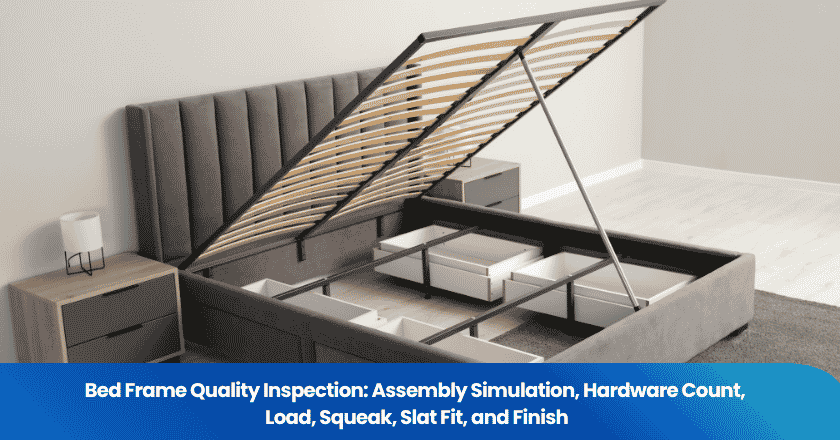
A bed frame order is ready for acceptance only when its packed components make the bed the customer ordered. Correct carton counts can still conceal a missing center support, incompatible hardware or slats that do not match the intended mattress requirements. Buyers therefore need assembly, support and performance findings for a complete retail set, rather than photographs of a prepared showroom bed.
Bed frame quality inspection should cover assembly, hardware, load, squeak, slat fit and finish, with results tied to the ordered size and construction. The guide below helps importers decide what to include and how to interpret failures on ordinary adult wood, metal or upholstered frames. Bunk beds, medical beds, and powered or storage-lift mechanisms need additional product-specific assessment.
What the Bed Frame Inspection Should Establish
Use the following checks to commission an inspection of the ordered model and size. Provide the drawing revision, hardware list, retail instructions and performance requirements. Ask the supplier to resolve missing criteria with its responsible technical team before the visit; an observation can be documented without inventing a pass threshold.
- Assembly simulation: build the complete bed in the instructed sequence. Record any misaligned hole, forced joint, inaccessible fastener or instruction error. Compare dimensions, alignment and assembly requirements with the approved drawing and sample.
- Hardware count and identity: count each fastener type separately, including washers, brackets, tools and declared spares. Check length, thread and head type against the parts list; an equal total count can conceal a wrong screw.
- Slat fit and support: measure spacing and seating separately. Check end supports, holders, retention, center rail and any support legs. Compare with the frame drawing and the intended mattress requirements.
- Load performance: use the specified bed configuration, loading positions, forces or masses, duration and sequence. Record movement during loading and any permanent change afterward against the agreed limits.
- Squeak and movement: repeat the specified use simulation in a quiet area. Locate noise at joints, slat holders or floor contacts, and record its repeatability before tightening or lubricating anything.
- Finish and accessible surfaces: inspect visible faces and hidden contact areas. Compare color and cosmetic defects with the approved reference; separately flag sharp edges, splinters, loose staples and damaged structural joints.
Request results linked to the complete bed's carton identifiers, size and component versions. This lets the buyer distinguish a wrong or missing packed component from a performance defect in a correctly assembled bed. Any result obtained after adjustment should remain separate from the original finding.
Define One Complete Saleable Bed Before Selecting Samples
A meaningful assembly simulation uses a complete set of packed components, not a showroom bed that has already been fitted and adjusted. Select the cartons required for one saleable unit and keep them together. Confirm that the size, color and component codes agree before opening them, especially when the headboard, rails and support system ship separately.
Separate packages can contain essential structural parts. For example, IKEA's US MALM Full bed frame listing says the SKORVA midbeam is included in the price but packaged separately, while the slatted base and mattress are sold separately. That is a model-specific example; use the ordered product's packing list to establish what constitutes a complete set.
The report should state whether the supplied instructions and tools produce a complete bed without drilling, substitute fasteners or forced joints. Where assembly stops, the useful evidence is the affected instruction step and the two mating components before supplier intervention. A technician's undocumented workaround is a customer assembly problem, even if the finished bed later stands correctly.
Ask for the dimensions that determine mattress fit and support: the internal opening, rail positions and the required support-foot contact. Squareness measurements should be judged against the drawing tolerance. A protruding bolt, tilted bracket or unsupported leg should be described by its effect rather than hidden behind an overall dimension pass.
Check whether the manual distinguishes mirrored parts and whether the specified tool can reach each connection. If assembly time affects the sales promise, agree the number and familiarity of assemblers; a factory technician's time is not a reliable estimate for a first-time customer.
A Complete Hardware Bag Can Still Contain the Wrong Parts
Specify a type-by-type hardware check against the bill of materials, or BOM, the approved component and quantity list. Total screw count alone is insufficient: length, thread and head geometry can determine whether a joint clamps correctly. The report should distinguish declared spares from wrong extras or required parts left unused after assembly.
A pictorial inventory can help match parts to their assembly steps. The MALM assembly instructions show numbered fittings and quantities before the assembly sequence. Use the equivalent approved document for the inspected bed; fittings and counts from another model are not interchangeable acceptance criteria.
During assembly, watch for cross-threading, stripped threads, rotating inserts and bolts that reach the end of a blind hole before clamping the joint. A bolt can feel tight while the bracket remains loose. Conversely, a bolt that is too long may project into a mattress contact area or damage a finished face. Verify the joint condition rather than relying solely on resistance at the tool.
For a loose joint, ask whether the original hardware and specified tightening procedure were used before accepting “tightened” as the correction. Excess tightening can damage wood-based panels or inserts. Keep unauthorized replacement parts identifiable and request a recheck of the actual corrected production set.
Confirm the Support System Fits the Intended Mattress
Confirm mattress compatibility before approving the support specification. A supplier's standard slat arrangement is not automatically suitable for every mattress the bed will be sold with.
Slat spacing is the clear gap between adjacent slats; end seating is the portion of a slat resting on or engaged with its support. They answer different questions. Correct spacing helps establish the specified mattress support pattern, while adequate seating and retention keep individual slats in position. Check both against the approved design before loading the bed.
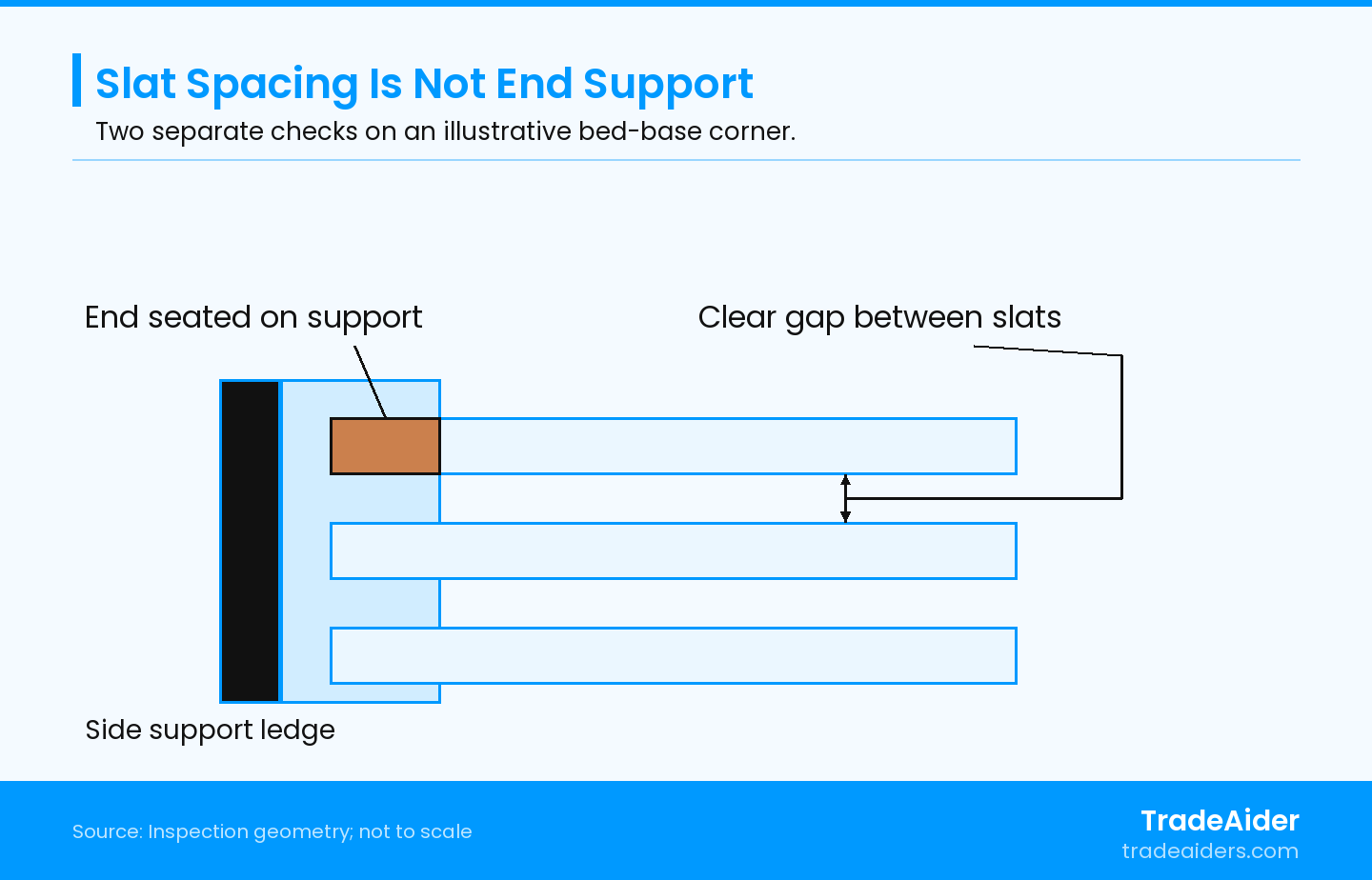
Illustrative top view, not to scale. Check both the gap between slats and each end support against the approved design; the drawing does not prescribe dimensions or a universal construction.
Compare slat count, material, dimensions, gaps and end seating with the approved support design. A reported gap alone does not establish that short slats stay in their holders. Where the design allows movement, require its prescribed retention assessment rather than insisting on a rigid connection that was never intended.
Mattress requirements also matter. TEMPUR's Australia/New Zealand bed-base guidance specifies slat width and spacing, secure fastening at each end, and center support for bases larger than single size. Those conditions apply to the mattresses covered by that regional guidance. Confirm the actual mattress manufacturer's requirements instead of treating any one brand's spacing as a universal bed-frame standard.
The center rail and its legs should support the bed as designed without lifting the surrounding frame. Before-and-after loading evidence can show whether a holder, bracket or foot moved. Splinters or protrusions that can damage the mattress remain separate findings even when the support spacing is correct.
Read the Load Result for the Actual Bed Configuration
A bed frame load result is meaningful only for the configuration and loading method used. Record the frame size, base, mattress or specified loading pad, support-leg settings, load positions, applied weight or force, duration and sequence. A distributed load across the sleeping surface and a concentrated load near an edge stress the bed differently; passing one does not establish performance under the other.
The public scope of BS EN 1725:2023 covers safety, strength and durability of fully assembled adult beds for domestic and non-domestic use. It excludes categories including bunk, high and medical beds. Its stated basis of persons weighing up to 110 kg is not an instruction to place 110 kg on every bed as a factory acceptance test. Obtain the applicable full method and requirements when testing to the standard.
Look for the unloaded reference, movement while loaded, and the result after the specified recovery period. Deflection is displacement under load; permanent deformation remains after unloading. Cracks, separated welds, loose inserts and detached supports need their own findings rather than being overridden by one acceptable measurement.
Use suitable equipment and a controlled test area; people standing or jumping on a bed are not calibrated test loads. Stop if a component fails or movement creates a hazard. Repeated durability loading, impact testing and a complete standards assessment require their specified equipment and procedures. A short shipment inspection should state exactly which checks were performed rather than describe the bed as certified from a limited test.
Use a Repeatable Squeak to Identify the Correction
A useful noise finding states when the sound occurs and which contact moves. Ask the team to compare the same assembly, support surface, mattress or loading arrangement and movement sequence. That evidence helps distinguish a slat-holder problem from a loose frame joint; an unexplained “noise OK” or “bed squeaks” gives little basis for supplier correction.
A video can connect a sound with movement, but it is not a calibrated noise measurement. If a numerical limit forms part of acceptance, agree the instrument, microphone position, background conditions and sequence beforehand. Otherwise, retain the reproducible symptom and its location without inventing a sound-level verdict.
Hypothetical example: a sampled bed is quiet under a centered load but clicks repeatedly when the prescribed load moves toward one side. Inspection reveals a slat end shifting inside a damaged holder. Tightening the headboard bolts would not address that observation. The useful next step is to document the holder, compare it with the approved part and check whether the same defect appears on additional samples under the agreed follow-up plan.
After an authorized replacement or adjustment, repeat the same sequence and retain both results. Do not add felt, lubricant or extra screws unless they are part of the approved construction or an explicitly approved correction. A quiet retest after an unrecorded modification says little about the packed products the customer will receive.
Separate Appearance Defects from Contact and Structural Defects
Inspect finish under the agreed lighting and viewing conditions, using the approved color and appearance reference. Check headboard faces, rail edges, corners and mating components together so differences in color or sheen are visible. Record defect size and location; a photograph without scale or an identified surface is difficult to compare with a cosmetic limit.
For wood and wood-based components, look for splits, chipped edges, exposed substrate, lifting veneer and damaged inserts. For metal frames, inspect burrs, corrosion, coating damage and visible weld defects. On upholstered parts, check seam alignment, loose threads, exposed staples and fabric trapped in assembly points. Sharp or loose features that can contact a hand or mattress deserve separate attention from a small cosmetic mark.
If coating adhesion testing is specified for a metal frame, ASTM D3359-23 addresses tape-based assessment of relatively ductile coating films on metallic substrates. It does not make an improvised tape pull on any wood, fabric or finish an equivalent test. Agree the method, coating conditions, sample location and acceptance rating, and identify tested pieces that can no longer be sold as undamaged stock.
Separate Assembly Problems, Performance Failures and Missing Evidence
Separate what failed from what could not be judged. A missing bracket, a crack after the specified test and an unavailable load criterion require different follow-up. Identify the affected model, size, cartons and components, then explain the practical consequence: incomplete assembly, lost support, repeatable noise or an appearance mismatch. Keep photographs tied to those observations.
Agree defect classifications and sampling before the visit. TradeAider's inspection standard guidance explains the role of customer requirements and sampling in inspection arrangements. The sampling plan and any separately specified functional-test sample size should be clear; neither supplies a missing bed-specific load or fit tolerance.
For pre-shipment inspection, the order quantity must be 100% complete and at least 80% packed for export. Send the bed-frame drawing, BOM, instructions, approved references, mattress compatibility requirements and test conditions before the visit so the planned checks match the product being shipped.
Contact our team to arrange a bed frame inspection and confirm the assembly, measurement and functional checks for your order.
Frequently Asked Questions
Does one assembled sample cover every bed size?
No. Different sizes may use different rail lengths, slats, center supports or hardware packs. Set sample coverage around the actual construction and risk differences. A result from one size should not automatically be reported as a completed assembly or load check on another.
Can a bed frame be inspected without a mattress?
Many dimensional, hardware and assembly checks can be completed without a mattress. Load and noise checks must use the mattress, pad or other arrangement specified by the chosen method. State that arrangement in the report; substituting a bare-frame test can change load distribution and contact noise.
Does a squeak always mean the bed is structurally unsafe?
No. Sound alone does not establish structural failure, and a quiet bed does not prove adequate strength. Locate the moving contact and assess it against the design and test results. A sound associated with cracking, a loose structural joint or lost support requires investigation beyond cosmetic noise acceptance.
Should extra screws be reported as a hardware defect?
Declared spare hardware is acceptable when it matches the approved packing list. Unexplained leftover parts after assembly need checking: they may be spares, incorrect extras or required parts that were omitted from an assembly step. Reconcile them with the instructions before judging completeness.
Artículos Relacionados


Haga crecer su negocio con el Servicio TradeAider
Haga clic en el botón de abajo para ingresar directamente al Sistema de Servicios TradeAider. Los pasos simples desde la reserva y el pago hasta recibir los informes son fáciles de operar.