
- Acerca de Nosotros

- Nuestros Servicios
- Su Industria
- Recursos
- Noticias y Blog
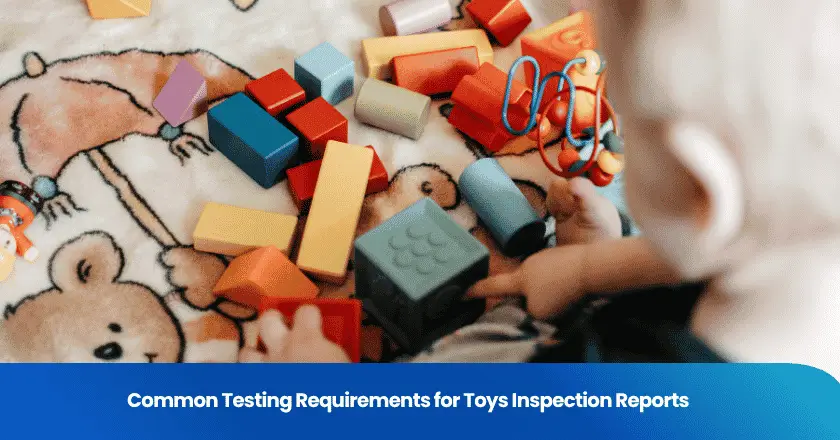
Toys are among the most heavily regulated consumer product categories worldwide, given their direct contact with children and elevated safety risk profiles. For brands, importers and e-commerce sellers sourcing from China, a valid, standards-aligned toy inspection and testing report is not just a quality document — it is a mandatory prerequisite for customs clearance, marketplace listing and regulatory compliance. Non-compliant or unqualified reports can lead to shipment detention, mandatory recalls, administrative fines and permanent brand damage.
Understanding standard testing requirements, regional regulatory frameworks and report accreditation rules is essential for every business operating in the global toy supply chain. This guide breaks down the core testing items, major international standards, official accreditation qualifications and common testing types that define credible toy inspection reports.
Core Testing Items in Toy Safety Inspection Reports
A comprehensive toy safety evaluation covers four core risk dimensions, each with standardized testing protocols defined by regional regulations.
Physical and Mechanical Properties Testing
Physical and mechanical testing is the foundation of toy safety, designed to eliminate injury hazards during normal use and reasonably foreseeable abuse. Key test items include:
- Small part detachment and choking hazard assessment for age-appropriate categories
- Sharp point and sharp edge accessibility testing
- Tensile and torque testing for attached parts such as eyes, buttons and small components
- Impact, drop and compression tests to verify structural integrity
- String, cord and strap length measurement to prevent strangulation risks
- Stability and overload testing for ride-on and large activity toys
Flammability Performance Testing
Flammability testing verifies that toy materials do not present rapid-burn fire hazards. It applies to plush toys, fabric toys, costume toys and paper-based play products, measuring burn rate, flame spread speed and afterglow time against regulatory limits to ensure children have sufficient time to move away in the event of ignition.
Chemical Substance Compliance Testing
Chemical safety is the leading cause of global toy recalls. Standard testing screens for restricted substances across materials, coatings and components:
- Heavy metal migration (lead, cadmium, chromium, mercury, arsenic and others) in surface coatings and substrate materials
- Phthalate content limits in plastic, PVC and soft polymer components
- Banned azo dyes, formaldehyde and allergenic fragrances in textile and plastic toys
- Total lead content and other toxic element limits per destination market rules
Electrical Safety Testing
For battery-operated, electronic and ride-on toys, electrical safety testing verifies insulation performance, battery compartment protection, wiring integrity, overheat resistance and electric shock prevention under both normal use and single-fault conditions.
Major Global Toy Safety Standards
Toy inspection reports must be structured against the mandatory standards of the target market. The following frameworks form the global baseline for toy compliance.
EU: EN 71 Series and Toy Safety Directive
The EU Toy Safety Directive (2009/48/EC) sets the legal safety requirements for all toys placed on the European market, supported by the harmonized EN 71 standard series. The three most widely referenced parts are EN 71-1 (mechanical and physical properties), EN 71-2 (flammability) and EN 71-3 (migration of certain elements). Products meeting these standards qualify for CE marking.
United States: ASTM F963 and CPSIA Regulations
In the United States, ASTM F963 is the mandatory consumer safety specification for toys, enforced by the U.S. Consumer Product Safety Commission (CPSC). It covers mechanical safety, flammability, chemical limits and labeling requirements for all toys intended for children 12 and under. The Consumer Product Safety Improvement Act (CPSIA) adds mandatory third-party testing requirements, total lead content limits and tracking label rules for all children’s products entering the US market.
China: GB 6675 National Toy Safety Standard
GB 6675 is China’s mandatory national toy safety standard, consisting of four core parts covering basic safety norms, mechanical and physical properties, flammability and migration of specific elements. It applies to all toys sold in the domestic Chinese market and is widely used as the baseline quality framework for export-oriented toy production.
Other Key Regional Standards
- Canada: Hazardous Products (Toys) Regulations SOR/2011-17, previously referenced as CRC c.931, governing mechanical, chemical and flammability requirements for the Canadian market.
- Japan: ST 2024 (formerly ST 2002) toy safety standard, administered by the Japan Toy Association, covering physical safety, flammability and chemical limits.
- Australia / New Zealand: AS/NZS ISO 8124 series, aligned with the international ISO 8124 toy safety standard and enforced as the mandatory entry requirement for both markets.
Accreditation Qualifications for Authoritative Toy Inspection Reports
A toy testing report is only legally and commercially valid when issued by an accredited laboratory. For the Chinese market and most cross-border e-commerce platforms, two core qualifications are universally required.
CMA (China Metrology Accreditation)
CMA is the mandatory statutory accreditation for testing institutions operating in China, issued by provincial and national market supervision authorities. Only CMA-accredited laboratories are legally authorized to issue inspection reports that carry legal effect for judicial evidence, administrative enforcement and marketplace compliance verification. Reports issued under CMA qualification bear the official CMA mark and are admissible for domestic regulatory and commercial disputes.
CNAS (China National Accreditation Service for Conformity Assessment)
CNAS accreditation verifies that a laboratory meets international ISO/IEC 17025 standards for technical competence and operational management. CNAS-accredited reports are recognized through international mutual recognition arrangements across more than 100 countries and regions, making them the standard requirement for export customs clearance and international brand audit acceptance.
For most cross-border toy sellers, a report bearing both CMA and CNAS accreditation provides the broadest validity for domestic platform listing and international export compliance.
Common Types of Toy Testing and Inspection
Different production and commercial scenarios call for different testing models. The four most common types are defined below.
Type Testing
Type testing is a full, comprehensive evaluation of a product against all applicable safety standards, conducted on representative prototype or pilot production units. It verifies that the product design itself conforms to all relevant technical specifications, safety requirements and performance benchmarks. Type test reports are typically required for new product certification, CE marking documentation and initial market entry filings.
Routine Factory Testing
Also known as production line routine testing, this is the regular quality verification performed on finished products during mass production. It covers core functional and safety items such as assembly integrity, basic function performance and visual defects, and is designed to catch process deviations and batch-to-batch quality drift.
Sampling Inspection
Sampling inspection draws a statistically representative random sample from a finished production batch, then evaluates the sample against agreed acceptance criteria — most commonly the international AQL (Acceptable Quality Limit) standard. It is the standard pre-shipment quality verification model for bulk production orders, providing reliable batch quality assessment at moderate cost.
Special Targeted Testing
Special testing is performed to verify specific performance or compliance characteristics based on buyer request or regulatory requirements. Common examples include targeted chemical screening for a specific restricted substance, age grading validation, transport simulation testing or custom durability evaluation. It is used to address niche compliance requirements or resolve targeted quality concerns.
TradeAider Toy Inspection and Testing Support
TradeAider provides end-to-end toy quality and compliance support for brands, importers and e-commerce sellers sourcing from all major toy manufacturing regions across China.
Our local on-site inspectors conduct standardized pre-shipment inspections aligned with EN 71, ASTM F963 and GB 6675 standards, with customizable checklists for different product categories and age groups. We also partner with CMA and CNAS accredited testing laboratories to support full type testing, chemical screening and compliance report issuance for all major destination markets.
Clients receive official photo-documented inspection reports within 24 hours of on-site completion. Through our online service system, buyers can also monitor inspection progress and view real-time findings, enabling fast decisions on batch acceptance, on-site rework or follow-up testing requirements. Get a free queto.
Frequently Asked Questions
How long is a toy test report valid?
There is no universal fixed validity period for toy test reports. For unchanged product design, material and production process, reports typically remain valid for 1–2 years for most market regulators. However, if materials, suppliers or product specifications change, a new test report is required. Importers should also confirm specific validity rules with their target marketplace or regulator.
What is the difference between on-site inspection and laboratory testing?
On-site inspection evaluates physical workmanship, assembly integrity, packaging and labeling at the factory, using visual and handheld tools. Laboratory testing conducts quantitative chemical, flammability and precision mechanical tests in a controlled lab environment. The two are complementary: most buyers use on-site inspection for batch quality control, and laboratory testing for regulatory compliance certification.
Can one test report satisfy multiple market requirements?
Not always. While many test items overlap across standards, each market has unique threshold limits, required test items and labeling rules. For products sold in multiple regions, testing is usually scoped to cover all applicable standards in a single lab engagement to avoid redundant testing costs.
Do e-commerce platforms require specific report qualifications?
Most major cross-border and domestic e-commerce platforms require toy product reports to be issued by CMA and/or CNAS accredited laboratories, and to test against the mandatory standard of the sales market. Platforms may also require periodic report updates to maintain listing eligibility.
Conclusion
Toy safety testing and inspection reports are the backbone of compliant toy trade. They translate regulatory requirements into verifiable product data, protect children from preventable hazards, and shield businesses from the financial and reputational cost of non-compliance.
For businesses sourcing toys from China, understanding standard testing requirements, regional standard differences and report accreditation rules is the first step toward building a reliable, low-risk supply chain. When paired with professional on-site inspection and accredited laboratory testing, toy inspection reports become more than a compliance formality — they are a foundational investment in product safety, brand credibility and long-term market access.
Artículos Relacionados

Haga crecer su negocio con el Servicio TradeAider
Haga clic en el botón de abajo para ingresar directamente al Sistema de Servicios TradeAider. Los pasos simples desde la reserva y el pago hasta recibir los informes son fáciles de operar.

