
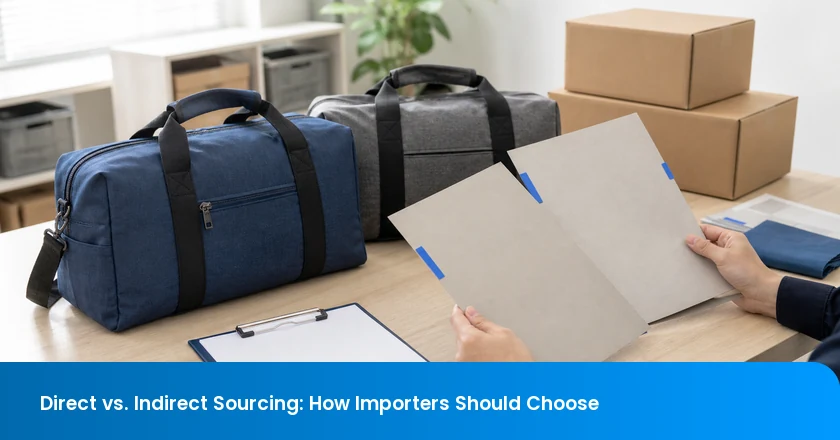
A direct contract does not create usable control if the buyer cannot obtain factory, change, and lot evidence. An intermediary can be a sound route when it can provide the same evidence and accept responsibility for correcting gaps. The practical choice between direct vs indirect sourcing is therefore not simply a choice between lower price and easier coordination. It is a decision about whether the people involved can identify the real factory, the approved product condition, the finished carton range, and the person who can resolve an exception before goods move.
Choose the Sourcing Model by the Proof You Can Own
The source model should be chosen by evidence ownership before price alone. For an import order, that means asking four practical questions before comparing quotes or accepting a supplier's preferred route:
- Can you name the producing factory? A trading company name is not a factory identity, and a factory name is not enough if it cannot be connected to the order.
- Who approves a product or material change? The person receiving a notice is not automatically the person authorised to accept the change.
- Can the finished cartons be linked to the approved version? A report, packing list, or product photo is weak release evidence when it cannot identify its carton or lot scope.
- Who owns the correction decision? The buyer needs a named party who can obtain records, separate affected goods, correct the condition, and confirm the result.
These are commercial control questions, not universal legal rules. A smaller buyer may sensibly use an intermediary for language, consolidation, or local follow-up. A larger buyer may contract directly with a factory for technical control and price negotiations. Either route becomes fragile when the evidence has no owner.
What Direct and Indirect Sourcing Mean for an Import Order
For this comparison, direct sourcing means that the buyer has a direct contractual relationship with its supplier. Indirect sourcing means that the buyer obtains products through an intermediary. The OECD's garment and footwear guidance uses those definitions and also cautions that the phrase “direct sourcing” should not be confused with other concepts in its due-diligence framework.
That distinction matters because a buyer can contract directly with a trading company, and a buyer can buy through an intermediary that works very closely with the producing factory. The question is not who sounds more “direct” in a sales conversation. It is which entity signed the buyer's agreement, which factory made the goods, and how the information moves between them.
Do not mix this source-route question with a company’s direct and indirect procurement categories. CIPS describes direct procurement as production inputs and indirect procurement as operational goods and services; its separate overview also discusses different supplier-relationship patterns. Those are useful internal spend categories, but they do not tell an importer whether a factory or intermediary can support the current order's records.
Start by recording the contractual supplier, every producing factory, and each site's role: finished assembly, component supply, packaging, or consolidation. Then specify lot traceability in plain language: the ability to connect finished cartons to the factory and product records that produced them. A buyer preparing that request can use a factory audit standard as a contextual checklist for the information that needs to be reviewed, while keeping product- and contract-specific decisions with the responsible buyer.
Direct Sourcing Removes a Handoff but Adds Buyer Work
A direct relationship can shorten one information handoff, but the buyer must still choose partners and maintain records needed to manage the risk. Direct contact can make it easier to discuss tooling, tolerances, component substitutions, production dates, and corrective actions with the people doing the work. It can also make pricing and capacity conversations more transparent. None of those advantages proves that the factory has the agreed capability, that its current lot follows the approved version, or that the buyer can enforce a correction on time.
When a buyer asks TradeAider to review a proposed manufacturing site, the useful brief starts with the actual factory, product scope, and controlled records—not a generic request to check “the supplier.” That same discipline makes a direct route easier to manage internally.
The buyer must therefore be ready to perform the coordination that an intermediary might otherwise perform: issue a controlled specification, establish who may approve deviations, follow up on unresolved questions, and keep a version history that the factory can use. The ISO and IAF guidance on external providers gives documented approved-provider information, defined criteria, and supplier performance monitoring as useful examples of control. It is not a sourcing contract template, but it shows why a factory name alone is not a control system.
Before changing to a factory-direct route, ask whether the buyer has enough capacity to review samples, issue revisions, resolve language or time-zone gaps, and act when production stops. Trade.gov's due-diligence guidance similarly advises businesses to select partners carefully and continue their checks as they expand. Direct sourcing is strongest when the buyer can turn that partner selection into an active record and escalation process rather than a one-time introduction.
Indirect Sourcing Works Only When the Intermediary Can Evidence Its Role
An intermediary route needs documentation that keeps the buyer's factory, product, and lot evidence reviewable across the relationship. A capable intermediary may add real value: it can consolidate small orders, translate technical questions, coordinate multiple factories, inspect local pack-out, and keep a production schedule moving. The extra handoff becomes a risk only when it creates an information gap that no one is contractually or operationally required to close.
Ask the intermediary to state, before the purchase order is released, whether it will disclose the manufacturing sites; how it will transmit approved drawings, bills of materials, artwork, and change notices; how it will map a carton range to each source; and who will obtain missing records. This is not a demand for every supplier's commercial secret. It is a request for the evidence required to make a buyer's product and shipment decision reviewable.
The OECD's general due-diligence guidance addresses impacts associated with supply chains and other business relationships. In practical sourcing terms, an intermediary does not make the buyer's need for records disappear; it changes who must preserve and explain the connection. An intermediary that can supply a factory map, controlled product history, lot records, and an escalation path may reduce the buyer's coordination load. One that can supply only a broad supplier declaration leaves the buyer unable to narrow a problem later.
Compare the Models Across Four Release-Critical Questions
Factory identity, change authority, lot traceability, and correction ownership are reader-facing comparison factors. They are more useful than a generic pros-and-cons list because each one becomes important when an order changes, an inspection finding appears, or cartons are ready to leave.
| Release-critical question | Direct factory route | Intermediary route | Do not move forward until |
|---|---|---|---|
| Who made the goods? | The buyer confirms the contracting factory and any approved subcontractor. | The intermediary identifies every producing factory and its role. | The factory name can be matched to the PO, product version, and shipment records. |
| Who may approve a change? | The buyer and factory use a controlled change contact and version record. | The intermediary passes an approved change to each site and records receipt. | The authorised version and approver are visible to every party that needs them. |
| Which cartons does evidence cover? | The factory links production and packing records to a defined lot or carton range. | The intermediary preserves that map through consolidation and final packing. | A report or correction can be tied to the same physical scope that will ship. |
| Who resolves an exception? | The buyer and factory have a named escalation and release authority. | The intermediary owns record retrieval and coordination, with buyer approval limits stated. | The affected goods, corrective action, and final decision have named owners. |
The better route is the one that can answer all four questions at the level of the real order. A direct factory route can be a poor fit for a buyer that cannot carry version control or site follow-up. An intermediary route can be a poor fit when it will not identify its factories or map its consolidated output. Low unit price matters, but it should be evaluated alongside the cost of an unresolved change, unidentified carton population, or delayed correction.
When an intermediary performs checks lower in the chain, the buyer still needs information that makes contractual compliance and chain integrity reviewable. In a labour-supply-chain assurance context, GOV.UK guidance makes that point explicitly. The context is narrower than ordinary product sourcing, but the operational lesson transfers: do not accept a statement that checks happened; request the information that shows which supplier, record, and corrective action the statement concerns.
Run a Four-Owner Test Before You Commit the Purchase Order
A buyer should assign a named evidence owner for factory, approved version, carton link, and correction decision before committing or releasing the order. Here, an evidence owner is the named person or organisation that can supply or correct a required record. The role can sit with the buyer, factory, intermediary, inspection provider, or several parties, but it must never be left as “the supplier team” or “someone at the factory.”
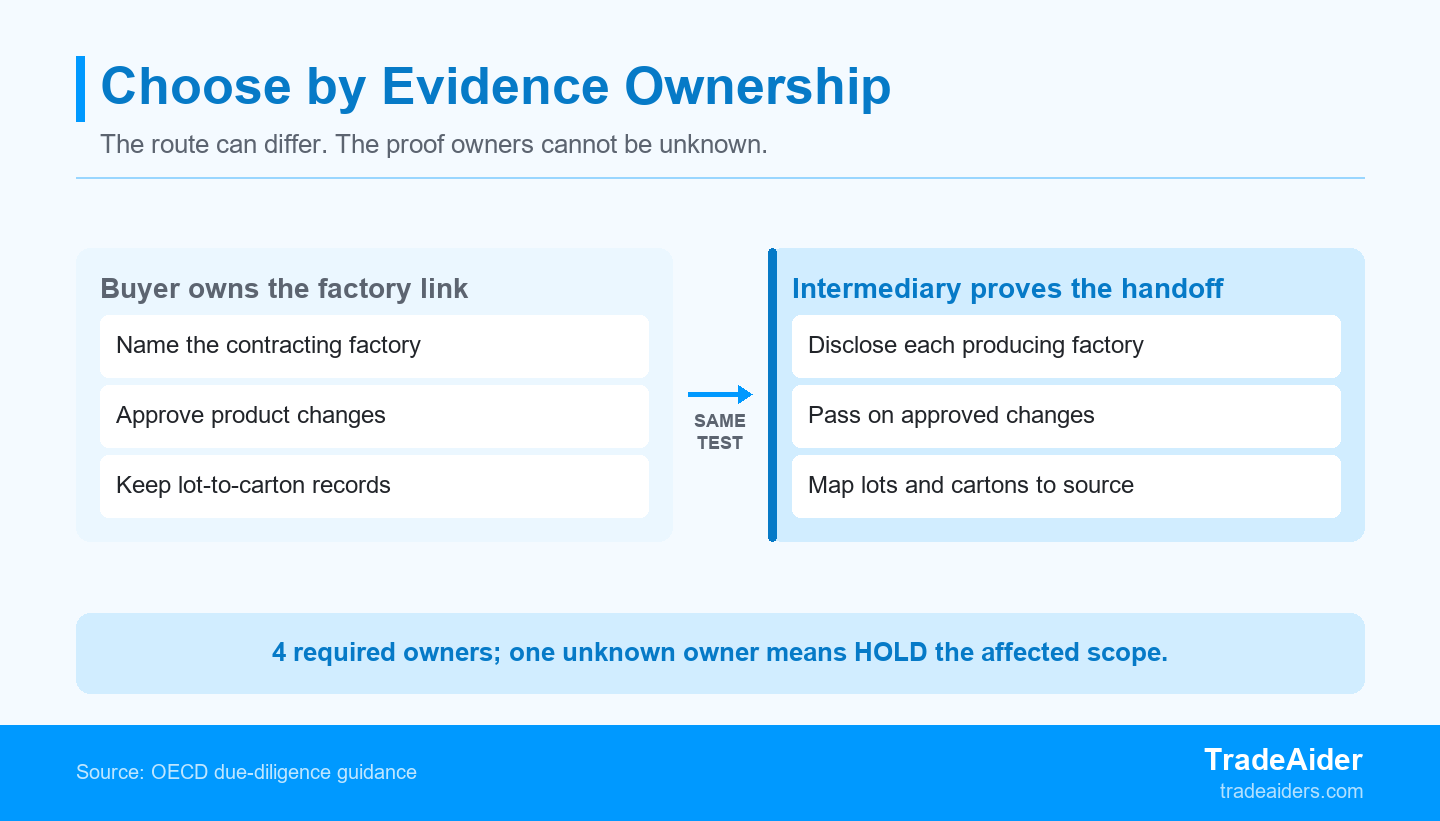
A source route is usable only when the factory, version, carton link, and correction decision each have a named owner.
- Factory identity owner: names the physical site, any approved subcontractor, and the contact who can confirm the site's output.
- Approved-version owner: holds the current drawing, bill of materials, packaging artwork, sample reference, or change approval that describes what should be made.
- Lot-to-carton owner: provides the production, pallet, carton, or packing record that connects physical goods to that approved condition.
- Correction owner: can obtain missing evidence, separate affected goods, arrange rework where authorised, and present the corrected scope for recheck.
If one owner is unknown, treat the source model as provisional for that order. The immediate action may be modest: add a factory field to the packing list, obtain a signed version notice, or identify carton ranges before collection. The important point is to close the gap before a shipment turns an unanswered question into a disputed fact.
TradeAider publishes a factory-audit service page. Once the buyer has defined the factory information that needs independent review, a factory audit service can be a relevant way to assess the stated site and its records. It does not select a supplier for the buyer or make a contract decision. Its value depends on the buyer bringing a clear question: which manufacturing site, product family, process, or documentation gap needs to be checked?
Worked Scenario: An Intermediary Cannot Separate Two Factory Lots
The two-factory carton example is an illustrative composite scenario. It shows why a buyer should distinguish an intermediary's useful coordination role from an unsupported claim that one factory record covers every carton in a combined shipment.
A home-fitness importer places an order for 1800 private-label gym bags in 450 cartons through an intermediary. A capacity constraint leads the intermediary to use Factory A and Factory B for the same SKU. Factory B uses a later zipper-pull revision that the buyer approved in email. When the cartons are ready for collection, the intermediary provides one invoice, one combined packing list, and one product description. The packing list has 450 cartons under the same SKU but no factory field. Carton marks and pallet labels do not separate the two outputs.
Map the Cartons Before You Release Either Factory's Output
A buyer should hold the full 1800-unit, 450-carton population until the factory and approved-version map is repaired. In this case, the intermediary can share Factory A's earlier production record but has no controlled Factory B record and cannot identify the carton ranges made by each site. The 450-carton population is therefore not a single traceable scope. A direct-contract record from Factory A cannot be extended to Factory B or to mixed cartons simply because the outer SKU description is the same.
The buyer asks the intermediary to obtain Factory B's approved zipper-pull record, produce a carton- or pallet-range map for both sites, and issue a revised packing list that separates the outputs. Until then, the cartons remain on hold. After the records arrive, the buyer can release only the subset whose factory identity, product version, inspection scope, and final packing record match. A during-production inspection may be the better control on a future multi-factory order if a construction or version change needs checking before final cartons are complete. This is an illustrative buyer control, not a universal rule that two factories are unacceptable or that every order needs the same hold.
Put the Chosen Source Model Into a Release Handoff
A release packet should connect the purchase order, factory, version, carton range, packing record, and exception owner. Keep it short enough to use when the collection date is near, but specific enough to show which record controls when information conflicts.
| Record | What it must identify | Owner when it changes |
|---|---|---|
| Purchase order and supplier route | Contracting supplier, producing factory or factories, approved subcontracting, and commercial release authority. | Buyer sourcing lead and named supplier or intermediary contact. |
| Approved product condition | Current specification, sample, artwork, component list, or controlled change approval. | Buyer technical owner and factory or intermediary version contact. |
| Lot and packing link | Production date or lot, factory, carton or pallet range, quantity, and packing-list version. | Factory production contact or intermediary consolidation contact. |
| Exception and final decision | Finding, affected scope, correction path, recheck result, and ship-or-hold authority. | Named buyer release owner, with supplier or intermediary action owner. |
This handoff makes the sourcing model visible at the moment it matters most: when finished goods, documents, and a collection deadline converge. It also makes an inspection brief more useful because the inspector can compare the current goods and packing against a defined factory, version, and scope instead of a generic product name.
TradeAider publishes a Pre-Shipment Inspection service page for final finished-goods and export-packing checks. If a finished order needs that defined comparison, provide the purchase order, approved specification, factory or intermediary contacts, change log, production status, and current packing-list version. The result can support a bounded release decision; it does not choose the supplier, settle every market requirement, or turn an undocumented carton population into proven goods. When that record set is ready, you can schedule a pre-shipment inspection.
Questions Buyers Ask
Does direct sourcing always mean buying from a factory?
No, direct sourcing means the buyer has a direct contractual relationship with the supplier, so the buyer should still confirm what that supplier actually manufactures and controls. A company may be the buyer's direct supplier while using another site for some work. Ask who makes the finished product, who makes critical components, whether subcontracting is approved, and which records identify each site's output. The contract path is only the starting point; the factory and lot evidence determine whether the route is usable for a particular order and for the shipping scope now under review.
Can an intermediary still provide good supplier visibility?
Yes, an intermediary can be a workable sourcing route when it can identify the factory, preserve version and lot records, and accept a clear responsibility for resolving exceptions. Its local coordination, consolidation, and communication can be valuable for a buyer with limited supplier-management capacity. The useful test is whether the intermediary can show the source and record path for the current goods—not whether it promises that it “manages everything.” If it cannot identify factories or separate carton groups, limit its release authority until that evidence is repaired and independently checked against the packing information.
Which records should an intermediary provide before shipment?
At minimum, request the identified factory, approved product version, lot or carton link, current packing record, and the named owner of any correction or release decision. The exact format can vary: a controlled specification, change notice, production report, carton-range map, and revised packing list may be enough for a simple order. The key is that the records point to the same goods. A report for one factory, a product photo from another version, and a combined packing list do not form one release record without a documented link that identifies the physical carton scope.
When should a buyer hold a shipment under either source model?
Hold the affected goods when the factory, approved version, lot scope, or correction owner cannot be connected to the finished cartons that are about to ship. Start with the narrowest scope the records can support: a named carton range, one factory output, or a clearly identified product family. If the goods are mixed or the traceability record is absent, the scope may need to widen. The goal is not to create an automatic full-order stop; it is to avoid releasing cartons whose identity, condition, and decision authority cannot be explained later to the buyer or consignee.

Artículos Relacionados

Haga crecer su negocio con el Servicio TradeAider
Haga clic en el botón de abajo para ingresar directamente al Sistema de Servicios TradeAider. Los pasos simples desde la reserva y el pago hasta recibir los informes son fáciles de operar.

