
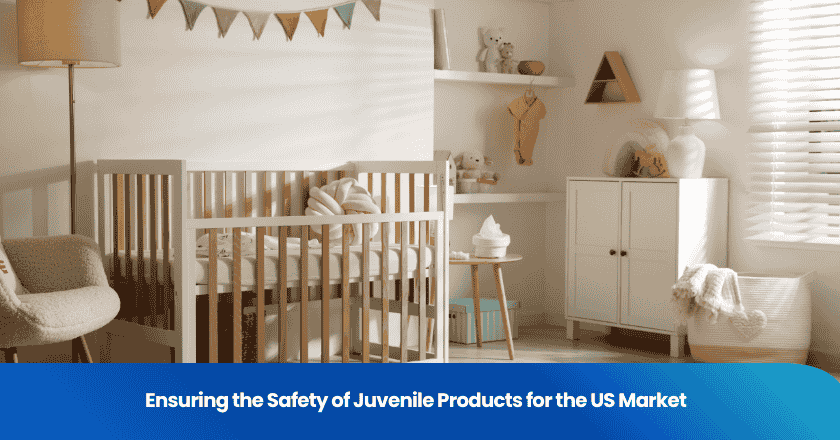
The US market applies some of the world's most demanding safety requirements to products intended for children. For importers bringing juvenile products from China — toys, infant furniture, baby gear, feeding products, strollers, cribs — the compliance framework is multi-layered, mandatory, and enforced at the point of import. Non-compliant shipments are detained or destroyed at customs; products that slip through and generate injuries trigger CPSC recall actions, civil penalties, and reputational damage that is very difficult to reverse.
This guide explains the regulatory structure governing juvenile product safety in the US, what third-party testing and certification is required, and how to build a quality control workflow that keeps compliant products moving through the supply chain.
Key Takeaways
- The Consumer Product Safety Improvement Act (CPSIA) makes ASTM F963 a mandatory safety standard for children's toys in the US — not a voluntary guideline.
- Children's products (designed for children 12 and under) must be tested at a CPSC-accepted third-party laboratory and accompanied by a Children's Product Certificate (CPC).
- Juvenile products fall into two regulatory tiers: those with published mandatory CPSC standards, and those covered only by voluntary ASTM standards — but even voluntary standards create liability exposure.
- Lead content, phthalates, small parts, and choking hazards are the most frequently cited non-conformities in CPSC enforcement actions against imported children's products.
The Regulatory Framework: CPSIA and the CPSC
What the Consumer Product Safety Improvement Act Requires
The Consumer Product Safety Improvement Act (CPSIA), enacted in 2008, fundamentally changed the compliance landscape for children's products sold in the US. Prior to CPSIA, most safety standards were voluntary — manufacturers could certify compliance themselves. CPSIA made third-party testing by CPSC-accepted laboratories mandatory for children's products, required the issuance of a Children's Product Certificate (CPC) for each product, and set statutory limits on lead and phthalate content that apply to all children's products regardless of product category.
The statute defines "children's product" as a consumer product designed or intended primarily for children 12 years of age or younger. This definition is broader than it might appear: a product marketed as suitable for teenagers but also used by younger children can fall within scope. Importers who misclassify a children's product as a general consumer product to avoid mandatory testing requirements are exposed to civil penalties and product recalls.
How the CPSC Enforces Compliance at the Border
US Customs and Border Protection (CBP) works with the CPSC to identify and detain shipments of non-compliant children's products at the port of entry. CBP officers can request production of the Children's Product Certificate and third-party test reports at any time. Products without a CPC, or with a CPC that references a test conducted at a non-CPSC-accepted laboratory, are detained pending further documentation or destroyed at the importer's expense.
The CPSC's Children's Product Certificate guidance requires the CPC to identify the product, the applicable regulations and standards, the testing laboratory (with its CPSC acceptance number), the date and location of manufacture, and the importer or domestic manufacturer responsible for the certification. The importer — not the factory — signs the CPC and assumes legal responsibility for its accuracy.
Mandatory Standards by Product Category
Toys: ASTM F963 (16 CFR Part 1250)
ASTM F963 — the Standard Consumer Safety Specification for Toy Safety — is the primary mandatory safety standard for children's toys in the US, codified at 16 CFR Part 1250. As of the current version, toys manufactured after April 20, 2024 must comply with ASTM F963-23. The standard covers a comprehensive range of safety requirements including material quality, toxicology, electrical and thermal energy, small parts, accessible edges and points, cords and elastics, magnets, projectile toys, and sound-producing toys.
Not all sections of ASTM F963 apply to all toys — manufacturers and importers must identify which sections are applicable to their specific product. Third-party testing is required for the applicable sections at a CPSC-accepted laboratory. The CPSC's Toy Safety Business Guidance page provides a section-by-section breakdown of testing and certification requirements, distinguishing between sections that require third-party testing and those that can be assessed by visual inspection alone.
Key Chemical Restrictions: Lead and Phthalates
Two chemical restrictions apply to all children's products as statutory requirements under CPSIA, independent of product-specific standards:
Lead content: The total lead content limit for children's products is 100 parts per million (ppm) in accessible substrate materials. Surface coating materials (paints, coatings) are subject to a separate 90 ppm limit on lead in paint, codified at 16 CFR Part 1303. These limits apply to any children's product — a toy, a piece of children's furniture, a juvenile carrier, a feeding product — regardless of the product's primary material.
Phthalates: CPSIA permanently bans certain phthalates (DEHP, DBP, BBP) at concentrations above 0.1% in any children's toy or child care article. An additional set of phthalates (DINP, DPENP, DHEXP, DCHP, DIBP) is also restricted at the same threshold in toys that can be placed in a child's mouth. Phthalates are commonly used as plasticizers in PVC — which is widely used in children's toys, teethers, bath toys, and inflatable products manufactured in China. This restriction requires specific phthalate testing for any product containing PVC or other plasticized materials.
Infant and Toddler Products: Category-Specific CPSC Rules
Beyond ASTM F963 for toys, the CPSC has issued mandatory rules for a growing list of infant and toddler product categories. These include:
| Product Category | Applicable CFR Part | Key Hazard Addressed |
|---|---|---|
| Full-size cribs | 16 CFR Parts 1219 / 1220 | Entrapment, strangulation, structural collapse |
| Non-full-size cribs | 16 CFR Part 1222 | Entrapment, strangulation, structural collapse |
| Infant walkers | 16 CFR Part 1216 | Staircase fall prevention |
| Baby monitors | 16 CFR Part 1264 | Strangulation from cords |
| Infant sleep products | 16 CFR Part 1236 | Safe sleep environment |
| Bassinets and cradles | 16 CFR Part 1218 | Structural integrity, entrapment |
| High chairs | 16 CFR Part 1231 | Fall prevention, structural stability |
| Strollers and carriages | 16 CFR Part 1227 | Stability, entrapment, structural integrity |
For product categories not yet covered by a mandatory CPSC standard, compliance with the applicable voluntary ASTM standard is not legally required — but it is the industry reference for what constitutes a safe product, and retailers typically require it. The ASTM committee responsible for juvenile products (Committee F15 on Consumer Products) has published standards for bouncer seats, infant carriers, swings, and other categories. Importers who bring products to market without complying with the voluntary ASTM standard for their category take on significant liability exposure if a product-related injury occurs.
A critical recent development: the CPSC notes that between 2010 and 2022, 154 US infant fatalities occurred as a result of nursing pillows being used for sleeping. The agency moved to regulate this category formally in 2024, illustrating the pattern of CPSC rulemaking — voluntary standards exist first, then mandatory rules follow when injury data demands it. Importers in currently unregulated juvenile product categories should monitor CPSC rulemaking activity closely, as mandatory standards can take effect within months of publication.
The Children's Product Certificate: What It Must Contain
A Children's Product Certificate (CPC) is required for every children's product subject to a CPSC regulation, standard, or ban. It must be issued by the manufacturer or importer, and must be in English. The CPC must identify:
- The name and description of the product
- A list of all applicable federal regulations and standards the product is certified to comply with (e.g., "16 CFR Part 1250 – ASTM F963-23: Sections 4.1, 4.3.5.1, 4.3.5.2, 4.6, 4.38...")
- The name, full mailing address, and telephone number of the manufacturer or private labeler, and the importer if different
- The contact information for the person maintaining records of the test results supporting the certificate
- The date and place of manufacture
- The date(s) and place(s) of testing
- The name, full mailing address, telephone number, and CPSC-assigned acceptance number of the third-party laboratory that conducted the testing
The CPC must be "furnished" with the product — this means it must be available to distributors, retailers, and consumers. For products sold online, this can be accomplished by making the CPC available on the product listing or by providing it as part of the product documentation. The CPC is not a label on the product itself — it is a separate document. It must be retained for 5 years following manufacture or importation.
CPSC Tracking Labels: A Separate Requirement
In addition to the CPC, children's products must bear a permanent tracking label on the product and its packaging. The tracking label must identify the manufacturer or private labeler, the location and date of manufacture, and cohort information (lot number, batch number, or other identifying information) that allows the product to be traced back through the supply chain. This is not the same as a general product label — it must be permanently affixed (not a sticker) and must appear on both the product itself and its packaging.
Tracking labels are the mechanism by which the CPSC identifies and contacts consumers when a recall is initiated. A missing or non-permanent tracking label is a separate violation from any product safety non-conformity, and enforcement actions for tracking label deficiencies are common in CPSC import detention records.
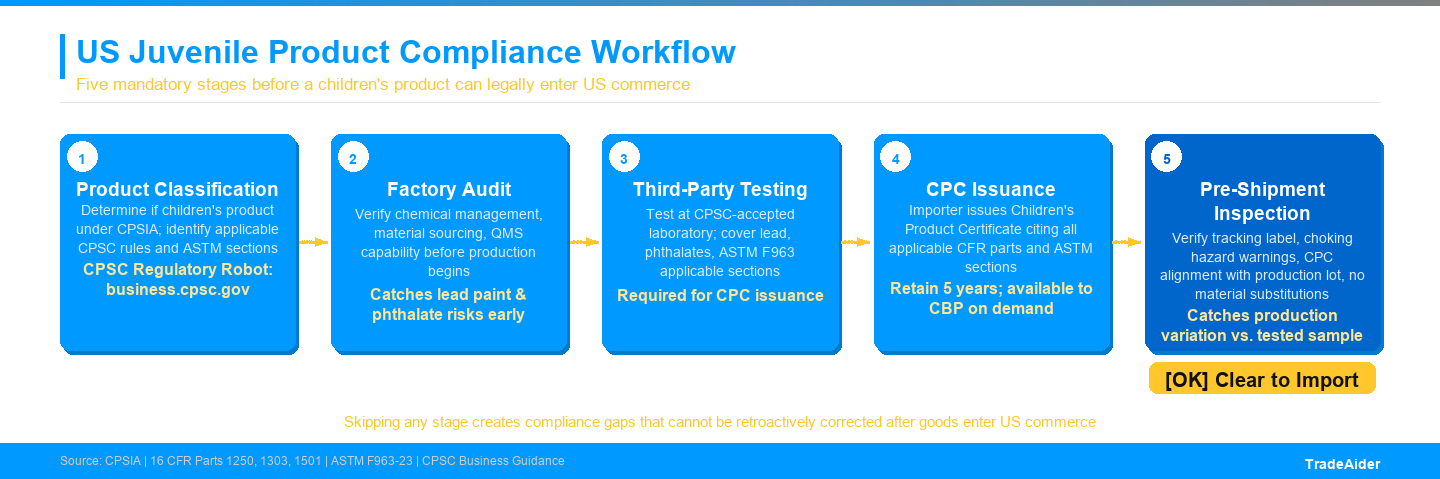 Compliance for children's products is a process, not a single test — each stage must be completed in sequence before the product can legally enter US commerce.
Building a QC Workflow for Juvenile Products
Stage 1: Product Classification and Standard Identification
Before any production begins, the importer must determine: Is this product a "children's product" under CPSIA? Which specific CPSC mandatory standards apply to this product category? Which sections of ASTM F963 (for toys) or the applicable category-specific ASTM standard are relevant to this product's design? What chemical restrictions apply? The answers determine the testing scope, the required laboratory, and the content of the CPC.
The CPSC's Regulatory Robot tool (available at business.cpsc.gov) guides importers and manufacturers through a product classification exercise that identifies applicable standards — a useful starting point, though it does not substitute for a compliance review by someone familiar with both the product and the regulatory framework.
Stage 2: Factory Assessment
A factory audit before production begins verifies that the factory has the quality management capabilities to produce a product that will pass the required third-party testing. This includes: review of the factory's own chemical management procedures (ensuring restricted substances are not used in production), assessment of mechanical safety controls relevant to the product (sharp points control, entrapment hazard management), and review of the factory's compliance documentation for previous product batches in the same category.
Many CPSC non-conformities in juvenile products — excessive lead in surface coatings, wrong phthalate profile in PVC components, small parts in products for children under 3 — originate in the factory's material sourcing choices, not the product design. A factory audit that includes a review of material datasheets and sub-supplier documentation catches these risks before they are built into the product.
Stage 3: Third-Party Testing and CPC Issuance
Testing must be conducted at a laboratory with CPSC acceptance for the specific standards being tested. The CPSC maintains a list of accepted third-party laboratories on its website — not all testing labs are CPSC-accepted, and a test report from a non-accepted lab does not satisfy the mandatory third-party testing requirement. Testing is typically conducted on production samples — either from a first-article run or from a production batch — not on pre-production prototypes, as material changes between prototype and production are common.
TradeAider's product testing service coordinates CPSC-compliant testing through accredited laboratories, with transparent pricing and real-time visibility into test progress. For importers managing multiple product categories, consolidating testing coordination through a single service reduces administrative complexity and ensures that the correct standards are applied consistently.
Stage 4: Pre-Shipment Inspection
A pre-shipment inspection for juvenile products must go beyond a standard AQL check. In addition to standard product workmanship and conformance-to-sample checks, the inspection should include: verification that the tracking label appears on both the product and its packaging; verification that the correct choking hazard warnings and age-grading information are on the product and packaging; documentation check to confirm that the CPC covering this specific production lot is available; and a check that no small parts are accessible in products for children under 3.
The inspection should reference the golden sample and the approved production specifications — not just the product category's general requirements. Variation between the tested sample and the production batch is among the most common compliance failures: the tested prototype passes, but the production batch uses a different paint, a different PVC compound, or a different fastener specification that was never submitted for testing.
Frequently Asked Questions
What is a Children's Product Certificate (CPC) and who is responsible for issuing it?
A Children's Product Certificate is a legal document required by CPSIA that certifies a children's product complies with all applicable CPSC regulations and standards. It must be based on testing conducted at a CPSC-accepted third-party laboratory. The importer is responsible for issuing the CPC for products manufactured outside the US — the factory's own compliance certification does not substitute for the importer's CPC. The importer's name and contact information must appear on the certificate, and the importer bears legal responsibility for its accuracy. A CPC must be retained for 5 years and must be available to CBP, CPSC, retailers, and consumers on request.
What is the difference between ASTM F963 and CPSC mandatory regulations for toys?
ASTM F963 is a voluntary consensus standard developed by ASTM International. However, Section 106 of CPSIA made ASTM F963 a mandatory consumer product safety standard for children's toys, codified at 16 CFR Part 1250. This means that compliance with ASTM F963 for toys sold in the US is now legally required — not optional. Separately, the CPSC has issued its own mandatory regulations under the Code of Federal Regulations for specific hazard categories (lead in paint at 16 CFR Part 1303, small parts at 16 CFR Part 1501, electrically operated toys at 16 CFR Part 1505) that must be cited in the CPC in addition to the ASTM F963 section references.
Does the voluntary ASTM standard still matter if CPSC hasn't made it mandatory?
Yes. For juvenile product categories not yet covered by a mandatory CPSC standard, the applicable voluntary ASTM standard defines the industry safety benchmark. US retailers — including Amazon, Walmart, and major specialty baby retailers — require compliance with the relevant voluntary ASTM standard as a condition of listing, regardless of whether the CPSC has mandated it. More importantly, failure to comply with the voluntary standard creates "failure to meet industry standard" liability exposure in personal injury claims. The voluntary designation means the CPSC cannot cite you for a regulatory violation — but it does not mean you are insulated from product liability if your product falls below the standard and injures a child.
How should production variation between tested samples and bulk production be managed?
The most important protection against production variation is a documented material specification that locks in the materials, components, and surface treatments used in the tested sample — and a process for reviewing any proposed changes against the test scope before implementation. If the factory changes a paint supplier, substitutes a different PVC compound, or uses a different hardware source between the tested sample and bulk production, those changes must be evaluated against the applicable test requirements. If the change affects a tested parameter, retesting of the changed material is required before the CPC can validly cover the production lot. Regular during production inspections that include material specification checks are the practical mechanism for catching unauthorized substitutions before they reach the finished goods stage.
Artículos Relacionados
Haga crecer su negocio con el Servicio TradeAider
Haga clic en el botón de abajo para ingresar directamente al Sistema de Servicios TradeAider. Los pasos simples desde la reserva y el pago hasta recibir los informes son fáciles de operar.

