
For Amazon FBA sellers, the bigger risk is often not the inspection cost; it is the compound cost of returns, bad reviews, stranded or removed inventory, lost ranking momentum, replacement shipments, and delayed cash recovery after defective products reach customers. Inspection is a visible upfront cost, while return-driven loss spreads across operations and account performance.
Inspection cost is easy to see. The seller receives a quote, compares it to product margin, and wonders whether the expense is worth it. Return cost is harder to see because it arrives later and in pieces: refund, return processing, replacement, removal, disposal, support time, review damage, lower conversion, and lost advertising efficiency.
This is why sellers should compare inspection cost with the expected cost of failure, not with the supplier's promise that quality is fine. If a defect escapes into FBA, the seller may no longer have direct control over correction. Inventory is already in the fulfillment system, customers are already buying, and the product's public reputation may already be affected.
- Inspection cost: visible, planned, and paid before shipment.
- Return cost: delayed, fragmented, and often larger than the refund itself.
- Lost-sales risk: reviews, conversion, ranking, stockout, and relaunch friction.
- Decision rule: inspect when the likely failure cost exceeds the control cost.
The Direct Answer
Inspection cost is usually the smaller risk when the defect can drive returns, negative reviews, FBA receiving issues, removal costs, or launch failure.
Amazon has published 2026 US referral and FBA fee updates noting continued fee structure changes and FBA fulfillment fee adjustments. Sellers should check current Seller Central fee pages for exact account-specific amounts, but the planning point is stable: FBA economics depend on per-unit fees and operational costs. Source: 2026 US referral and FBA fee update.
Amazon has also discussed return-rate insights and returns processing fees for high-return products, including a Return Insights dashboard and thresholds by fee category. Source: Return Insights and returns processing fee reminder.
Removal and disposal also matter when bad inventory must leave FBA. Amazon announced 2026 changes to how FBA removal and disposal fees are charged as units are processed, while fee rates remain a separate Seller Central detail. Source: FBA removal and disposal fee timing update.
Cost Comparison Framework
Compare inspection against the full failure chain, not only the refund amount.
| Cost Area | Inspection Scenario | Return/Lost-Sales Scenario | Why It Matters |
|---|---|---|---|
| Direct cash | One planned inspection or reinspection cost | Refunds, replacement, return handling, removal, disposal | Failure cost arrives later and repeats per unit |
| Inventory control | Goods corrected before FBA entry | Defective inventory already available for sale | Correction is harder after fulfillment entry |
| Customer signal | Defect prevented before review | Negative reviews and return reasons expose issue | Conversion and ranking can suffer |
| Launch timing | Short delay for correction | Launch damaged by returns or suppression | Early sales velocity is fragile |
| Supplier leverage | Final payment or release can be held | Supplier may dispute responsibility after shipment | Evidence is stronger before shipment |
This framework does not mean sellers should inspect every tiny replenishment with the same intensity. It means the seller should price the control point against realistic failure cost. A high-risk first order deserves more control than a stable repeat order with clean history.
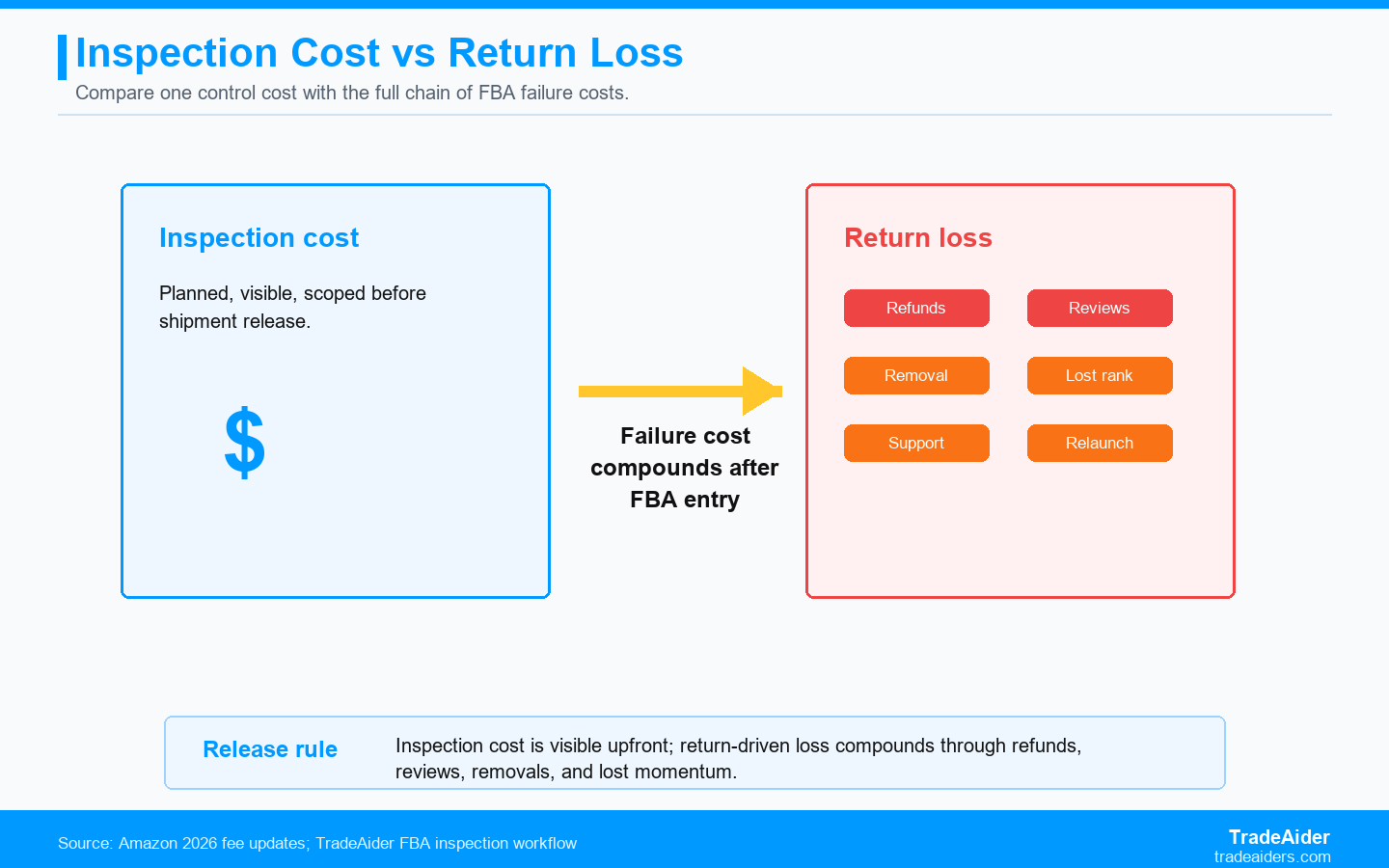
Inspection cost is visible upfront; return-driven loss compounds through refunds, reviews, removals, and lost momentum.
Why Returns Cost More Than Refunds
A return is often the first visible symptom of a quality-control failure, not the total loss.
The refund is only one line. A returned product may not be resellable. It may require removal, disposal, replacement, support messages, review management, or listing troubleshooting. If the defect appears repeatedly, the seller may pause advertising, stop replenishment, or hold the next shipment. That is lost opportunity cost.
Returns also produce data that Amazon and customers can see. Return reasons, customer complaints, and reviews may reveal that a product does not match the listing promise. Even if the seller fixes the next batch, the early public signal can stay attached to the ASIN. This is why inspection before launch is more valuable than inspection after returns appear.
The return cost also changes by category. Apparel, footwear, electronics, fragile items, high-touch consumer products, and giftable products often have different return dynamics. Sellers should use their own historical data rather than relying on a generic rule.
A Simple Return-Loss Formula
The seller should compare inspection with expected failure cost before deciding to skip control.
A useful planning formula is: expected failure cost equals affected units multiplied by the combined cost of refund exposure, replacement or removal, support time, review damage, and lost-sales impact. Some of those numbers are estimates, but estimating is still better than pretending the only cost is the supplier's unit price.
The formula becomes more important for launch shipments. A seller may not have historical return data yet, so the expected failure cost should include early review sensitivity and advertising waste. Spending on ads to send traffic to a defective product compounds the original quality mistake.
| Failure Cost Component | How To Estimate | Why It Belongs In The Model | Inspection Link |
|---|---|---|---|
| Refund or replacement | Expected defective units times net refund or replacement exposure | Direct cash loss | Function and completeness checks |
| Removal or disposal | Units likely to be pulled from FBA if defect pattern appears | Inventory correction cost | Pre-shipment sorting |
| Review damage | Conversion loss or relaunch effort after negative reviews | Public trust loss | Customer-visible defect checks |
| Support and operations | Messages, claims, photos, supplier dispute, relabeling time | Hidden labor cost | Report evidence and supplier leverage |
| Lost ranking momentum | Launch delay or reduced ad efficiency | Sales opportunity cost | Inspection before FBA entry |
This model does not need perfect precision. Its job is to make the invisible cost visible enough for a better decision. If the plausible failure cost is many times the inspection cost, skipping inspection is not frugal; it is simply moving risk into the future.
When Inspection Cost Is Clearly Worth It
Inspection is most valuable when the defect would be expensive to discover inside FBA inventory.
The first case is a new supplier or new product. Without history, the seller does not yet know whether the factory understands Amazon-ready labels, packaging, accessories, and customer-quality standards. Inspection buys evidence before the seller commits inventory to FBA.
The second case is a launch shipment. Early negative reviews can reduce conversion while the ASIN is still building trust. A small inspection delay can be cheaper than relaunching a listing after avoidable defects create a poor first impression.
The third case is a product with expensive correction. If relabeling, replacing parts, repacking, or removing inventory from FBA would be costly, the seller should inspect before shipment. Source correction is usually cheaper than destination correction.
When A Lighter Inspection Plan May Be Enough
Stable repeat orders can use a risk-based control plan instead of maximum inspection every time.
A repeat shipment from a stable supplier with no design change, no packaging change, low return rate, and clean inspection history may not need the same depth as a first order. The seller may focus on label verification, carton marks, quantity, and the known defect points rather than expanding the checklist every time.
However, a lighter plan should still be intentional. If the supplier changes material, component, label, pack, production line, or subcontractor, the order is no longer the same risk. Sellers should treat change as a trigger for stronger inspection.
Where TradeAider Fits In The Cost Decision
TradeAider fits by helping sellers compare control cost with failure exposure before inventory enters FBA.
TradeAider can scope Pre-Shipment Inspection around the seller's highest-cost failure points: FBA labels, barcode scan, carton marks, set packaging, accessories, function, visible defects, and listing-promise checks.
If the defect risk starts during production, During Production Inspection may reduce final failure. For Amazon sellers, TradeAider's e-commerce quality solutions help align inspection with marketplace realities rather than only factory workmanship.
The business fit is risk economics. TradeAider helps sellers ask whether a visible control cost is smaller than the invisible cost of returns, removals, negative reviews, and damaged launch momentum.
SPAR Scenario: The Inspection Was Cheaper Than Returns
The seller avoided a return pattern before the product reached FBA.
Situation: An Amazon seller prepares 2,800 rechargeable closet lights for FBA. The supplier says the goods passed internal QC and asks for final payment.
Problem: TradeAider PSI finds that 6 of 125 sampled units have weak magnetic plates and several retail boxes show old barcode placement. The supplier offers to ship and give a 3% discount.
Action: The seller compares the inspection cost against likely returns, review damage, relabeling, and removal risk. The seller holds shipment, requires rework and relabeling, and reinspects affected scope.
Result: The seller pays for inspection and reinspection but avoids sending a defect pattern into FBA. The control cost is smaller than the return and lost-sales scenario.
Action Card: Inspection Cost vs Return Risk
Use expected failure cost before deciding to skip inspection.
- Estimate refund, replacement, removal, support, and review impact, not only unit cost.
- Inspect first orders, launch shipments, changed products, and high-return-risk categories.
- Use a lighter plan only for stable repeat orders with clean history.
- Treat customer return reasons as inspection checklist inputs for the next PO.
- Compare inspection cost with the cost of defective inventory already inside FBA.
Sellers should review returns after every shipment and tag each return reason to a control point: supplier workmanship, packaging, label, accessory, function, listing mismatch, or customer misuse. Only the first group belongs in the factory inspection checklist, but that group should be acted on quickly.
The seller should also separate one-time accidents from repeatable patterns. One damaged unit may not justify a heavier inspection plan, but repeated complaints about the same accessory, fit, label, odor, color, or function point should trigger a stronger supplier instruction and a sharper PSI checklist.
Cost comparison should be reviewed before reorders, not only after a crisis. If returns stayed low, the seller may keep the current inspection scope. If returns rose, the seller should spend inspection budget on the exact failure path that customers exposed.
This review should include advertising and inventory timing. A defect discovered during peak season, coupon promotion, or low-stock period can cost more than the same defect during a quiet replenishment cycle. Timing changes the value of prevention.
That is why the same inspection quote can be cheap for one shipment and unnecessary for another. The decision should follow risk timing, not habit.
Good sellers make that calculation before the shipment is urgent, late, or emotionally pressured.
If you are weighing inspection cost against return risk, send TradeAider your product margin, order quantity, return history, defect concerns, launch deadline, and FBA requirements. The next step is to ask TradeAider to compare PSI scope with your likely FBA return and lost-sales exposure.
Frequently Asked Questions
Is inspection always cheaper than returns?
Not always. For low-risk repeat orders, a lighter plan may be enough. For first orders, launch shipments, changed products, or high-return-risk products, inspection is often the smaller risk.
What return costs should I include?
Include refund, replacement, support time, removal or disposal, relabeling, lost sales, review impact, advertising waste, and supplier dispute cost.
Can I use return data to improve inspection?
Yes. Map return reasons to factory-controllable causes and add those causes to the next inspection checklist.
Should I inspect before a prep center receives goods?
Yes, when product quality risk matters. A prep center may fix labeling or packaging, but it may not solve supplier workmanship, function, or component defects.
Artículos Relacionados

Haga crecer su negocio con el Servicio TradeAider
Haga clic en el botón de abajo para ingresar directamente al Sistema de Servicios TradeAider. Los pasos simples desde la reserva y el pago hasta recibir los informes son fáciles de operar.

