
- Acerca de Nosotros

- Nuestros Servicios
- Su Industria
- Recursos
- Noticias y Blog

Home decor and gift product inspection should connect visual quality, fragile protection, set completeness, safety triggers, labeling, and eCommerce packaging before the shipment leaves the factory.
Home decor and gift products look simple until the first shipment reaches customers. The main risk is rarely one dramatic factory failure. It is the combination of fragile materials, decorative finishes, assorted SKUs, gift-set components, destination warnings, and retail packaging that makes a product look sellable in the showroom but fail after parcel shipping.
For eCommerce sellers, pre-shipment inspection is not just a workmanship check. It is the last practical point to confirm that the physical goods match the listing promise: the right color, the right set count, the right protective packing, the right warning text, and enough evidence to release or hold the order with confidence.
Key Takeaways
- Inspect the full selling unit: For gift sets, the unit is not one item; it is the assembled retail promise customers receive.
- Protect the weakest component: Fragile glass, ceramic, resin, candle jars, and boxed accessories should drive the packing test, not the strongest item in the set.
- Treat labels as release evidence: Age claims, choking warnings, candle warnings, SKU labels, country of origin, and carton marks must match the destination and sales channel.
- Use AQL correctly: AQL sampling supports lot decisions, but only when defect classes reflect visible finish, assembly, packaging, and safety-critical issues.
- Keep photo proof: eCommerce sellers need inspection photos that show set count, retail pack condition, inner protection, carton packing, and SKU identity.
Why Home Decor PSI Is Different From Generic Retail Inspection
A generic retail inspection often starts with appearance, quantity, and packaging. Home decor needs that, but it also needs a stronger connection between appearance and survivability. A ceramic vase can pass color and dimension checks but still fail because the retail box has too much void space. A scented candle can look premium but create release risk if the warning label, glass container evidence, or accessory claims are incomplete.
Visual appeal and breakage risk move together
Home decor products sell through photographs, lifestyle scenes, and unboxing impressions. That means scratches, uneven glaze, dents, dust, glue marks, print misalignment, poor metallic finish, and warped gift boxes matter more than they would in many industrial categories. At the same time, the materials that create visual appeal - glass, ceramic, resin, wood, plated metal, paperboard, and fragrance containers - are often vulnerable in parcel networks.
The inspection plan should therefore treat the first visual defect as a clue, not as an isolated mark. If several sampled units show corner dents, cracked internal trays, chipped edges, or rubbed finishes, the release decision should move from cosmetic counting to root cause: packing compression, loose inserts, wet cartons, insufficient divider height, or unprotected decorative surfaces.
Gift sets fail through component mismatch
Gift products fail differently from single-SKU products because customers judge the complete set. Missing ribbons, swapped colors, incorrect scent assortment, wrong instruction cards, incomplete hardware, mixed language inserts, and inconsistent retail sleeves can create returns even when every individual component is well made. The inspection sample must be opened at the set level and reconciled against the bill of materials.
A practical rule is to inspect three identities for every set: the supplier's packing list, the physical contents, and the sales-channel listing. If the listing promises four ornaments, two hooks, one storage pouch, and a gift card, the inspection report should show that exact configuration. AQL can count defects, but only a set-level checklist can prove the promised bundle exists.
Marketplace packaging is part of product quality
For marketplace sellers, the carton is not just logistics. It is quality evidence. Customers may receive the product after courier handling, warehouse transfers, relabeling, or FBA routing. A retail pack that looks acceptable at the factory may fail if the inner tray bends, the printed sleeve scuffs, or heavy components touch fragile surfaces during vibration.
The best PSI reports for home decor include photos of the master carton, retail box, inner protection, opened set, barcode or SKU label, and any fragile markings. These images help the buyer decide whether to release, repack, add dividers, strengthen the carton, or hold only affected SKUs instead of freezing the entire order.
Build a Release Standard Before the Inspector Arrives
Inspection quality depends on the release standard the buyer gives to the inspector. A vague instruction such as 'check quality' is not enough for decorative products. The supplier and inspection team need the approved sample, product specification, packing method, defect classes, set composition, and destination labeling requirements before inspection starts.
Lock material, color, finish, and decoration masters
Home decor is sensitive to subjective judgment. One buyer may accept rustic variation; another may reject the same variation as poor workmanship. The inspection brief should clarify whether color variation, glaze pinholes, wood knots, hand-painted differences, scent shade, brush texture, or antique finish variation is acceptable. Without that boundary, the report may count defects that the brand would accept or miss variation that damages listing consistency.
A reliable release standard uses photos and measurable tolerances. For example, it can define maximum visible scratch length, acceptable color range against an approved sample, carton compression limits, label position tolerance, and whether natural material variation should be recorded as observation or defect. This keeps the factory, inspector, and buyer aligned before the lot is sampled.
Classify critical, major, and minor defects by customer harm
ISO 2859-1:2026 supports lot-by-lot inspection by attributes, but AQL does not decide which defects matter. The buyer has to classify defects based on customer harm and destination risk. A sharp edge, glass crack, missing warning, exposed magnet, unstable candle holder, or wrong age claim can be critical. A cracked ceramic item, missing set component, wrong SKU label, or unusable retail box is usually major. Tiny finish variation may be minor if it does not affect the listing promise.
This classification changes the release outcome. A lot with many minor rustic finish variations may still be sellable if the product page shows handmade variation. A lot with one repeat critical issue may need hold, rework, testing, or management review. The inspection report should show the buyer which type of risk is present, not only the total number of defects.
Define set count and carton identity
Gift sets and home decor assortments need stronger identity control than single-item orders. Each SKU should be tied to purchase order line, carton mark, inner pack, retail barcode, color, size, and destination. If a shipment contains similar designs, the inspection should include carton selection that reduces the chance of inspecting one clean SKU while another SKU carries the defect.
For eCommerce sellers, mixed-SKU errors create downstream costs: wrong listing fulfillment, stranded inventory, incorrect bundle content, customer claims, and expensive relabeling. A pre-shipment inspection should not only check the sampled units but also photograph carton marks and set labels so the seller can match the report to the shipping plan.
Fragile Protection and Transit Evidence
Fragile protection should be inspected as a system. The product, insert, retail box, master carton, carton fill, humidity exposure, pallet pattern, and handling marks all influence whether the goods survive export and parcel shipping. A beautiful sample unit inside weak packaging is not ready for release.
Drop risk is not the same as scratch risk
Drop risk concerns breakage, dents, lid separation, glass cracks, corner crushing, and internal movement. Scratch risk concerns rubbing, poor surface separation, unprotected metallic coating, dust trapped in packaging, and friction between accessories. A single protective action rarely solves both. Bubble wrap may reduce impact but still allow surface rubbing if components move.
The inspection should therefore record both impact protection and surface isolation. For ceramic and glass, check dividers, insert height, edge distance, and empty space. For plated metal and painted resin, check protective film, tissue, sleeve fit, and whether accessories rub the finished surface. For paper gift boxes, check corner strength and scuff resistance.
Inner packing should protect the weakest component
The weakest component should drive the pack review. If a gift set contains a ceramic cup, wooden lid, metal spoon, printed card, and candle jar, the candle jar and ceramic cup usually decide the protection requirement. If the inner tray protects only the main item while accessories move freely, the set can fail even when the headline product survives.
A useful inspection photo sequence shows the unopened retail box, opened box, component layout, protective materials, removed components, and repacked box. This helps the buyer see whether the packing can realistically be restored after inspection and whether customer unboxing still looks premium after transit.
Carton evidence should match the sales channel
A carton going to a distributor warehouse may need different evidence from a carton going into a parcel-heavy eCommerce route. For eCommerce, the buyer should confirm barcode readability, retail box condition, inner protection, carton compression, master-carton sealing, and whether the product can tolerate direct fulfillment handling. If a shipment is moving to a marketplace warehouse, SKU and carton identity photos become as important as cosmetic photos.
This is where real-time inspection visibility helps. If the inspector finds weak dividers or crushed inner corners, the buyer can ask for additional photos, authorize repacking of one SKU, or request a carton reinforcement check before the team leaves the factory. That is a better decision point than discovering the issue after inbound receiving.
Safety and Compliance Triggers
Pre-shipment inspection cannot replace laboratory testing, regulatory classification, or legal review. It can, however, confirm that the physical lot matches the evidence file: tested material, model, batch, label, warning, manual, and packaging. For home decor and gift products, this evidence connection is often the difference between a clean release and a preventable marketplace hold.
Candles and candle accessories need extra evidence
Candles are decorative products, but they are also fire-related consumer products. The CPSC candle and candle accessory standards page lists voluntary standards covering candle fire safety labeling, fire safety for candles, candle accessories, and glass containers. The National Candle Association safety standards summary also summarizes ASTM candle safety standards, including labeling, glass container, flame behavior, and accessory considerations.
For inspection, the practical question is not whether the inspector can perform a full candle safety test on site. The question is whether the shipment matches the tested or approved version: same vessel, wick, warning label, lid or accessory, set composition, and retail pack. If the factory changed glass thickness, wick count, fragrance load, holder design, or warning artwork, the buyer should not treat a visual PSI as enough evidence.
Magnets, small parts, and age claims should not be guessed
Gift products sometimes contain magnets, decorative beads, clips, miniature accessories, or removable parts. The CPSC small parts and choking hazard guidance explains that certain children's products with small parts can require warnings or be prohibited depending on age and use. Even when a product is marketed as home decor, listing language, packaging art, or gift positioning can create child-interest questions.
The inspection brief should say whether the product is adult decor, a children's product, or a general gift item with child-accessible parts. Inspectors can then verify warning presence, age grading on packaging, loose small parts in the received condition, and whether online listing claims match physical labels. If classification is unclear, the release rule should move to compliance review rather than inspector judgment.
EU product safety rules make traceability part of release
For EU-bound consumer products, the EU General Product Safety Regulation (EU) 2023/988 reinforces that product safety is not only about visible defects. Traceability, economic-operator information, warnings, and product identification can matter to market access. A shipment with correct workmanship but missing destination information can still create a compliance problem.
A home decor PSI should therefore include label and document checks for destination market, not only product appearance. At minimum, buyers should confirm SKU identity, importer or responsible-party information where required, warnings, language, country of origin, care information, and whether the physical pack matches the approved artwork.
AQL Workmanship Checks That Matter Most
AQL is useful when it is connected to the defects customers notice and the failures warehouses cannot fix. For home decor and gift products, the inspection checklist should balance surface, assembly, function, packaging, and identity defects. Too much focus on cosmetic marks can miss a wrong set count; too much focus on carton marks can miss a fragile item with repeat cracks.
Surface and finish defects should be judged against the listing
Surface defects include scratches, dents, glue overflow, stains, color variation, paint chips, uneven plating, poor polishing, print shift, warped paperboard, and visible dust trapped under clear coating. The inspector should compare these to approved samples and product-page images. A rustic item can allow natural variation, but that tolerance should be documented before inspection.
The report should separate acceptable natural variation from workmanship defects. This protects both sides: suppliers are not punished for approved handmade variation, and buyers are not forced to accept defects that change the product's advertised look.
Assembly and functional checks should follow real use
Some home decor items have simple functions: lids must fit, hooks must hold, frames must stand, drawers must slide, magnets must align, hinges must open, and lights or music boxes must operate. These checks should be performed as customers would use the product, not only as a quick factory demonstration. If an item is a wall decor product, hanging hardware and orientation matter. If it is a tabletop set, stability and component fit matter.
For functional gift items, the inspection plan should define how many units receive full function checks and what counts as failure. A loose lid may be minor for a decorative jar but major for a candle vessel shipped with fragrance. Context decides the defect class.
Packaging and labeling defects should drive release action
Packaging defects are often the defects customers see first. Torn retail boxes, weak inserts, incorrect barcode labels, missing warnings, wrong language, poor carton sealing, crushed corners, and mixed carton marks can turn acceptable products into unsellable inventory. The inspection report should show whether the issue can be reworked at the factory and whether reinspection is needed after rework.
A practical release rule is simple: do not ship until product identity, set count, warning text, retail pack, and master carton evidence all match the destination channel. If one of those layers fails, the buyer should hold affected SKUs, ask for corrective action, or reinspect the reworked lot.
Home Decor and Gift PSI Checklist
| Inspection Area | What To Check | Release Decision |
|---|---|---|
| Approved sample | Material, color, finish, size, scent, decoration, and tolerance | Release only if visible product matches approved standard |
| Gift set content | All components, accessories, cards, labels, and SKU combinations | Hold if the selling unit is incomplete or mixed |
| Fragile protection | Insert, divider, void space, corner protection, surface isolation | Repack or strengthen before shipment if repeat risk appears |
| Safety trigger | Candles, magnets, small parts, warnings, age claims, sharp edges | Escalate to compliance or testing review if evidence is missing |
| AQL workmanship | Critical, major, and minor defects by defect class | Accept, reject, or rework based on agreed AQL limits |
| eCommerce pack | Retail box, barcode, carton mark, master carton, photo evidence | Release only when pack identity matches sales channel |
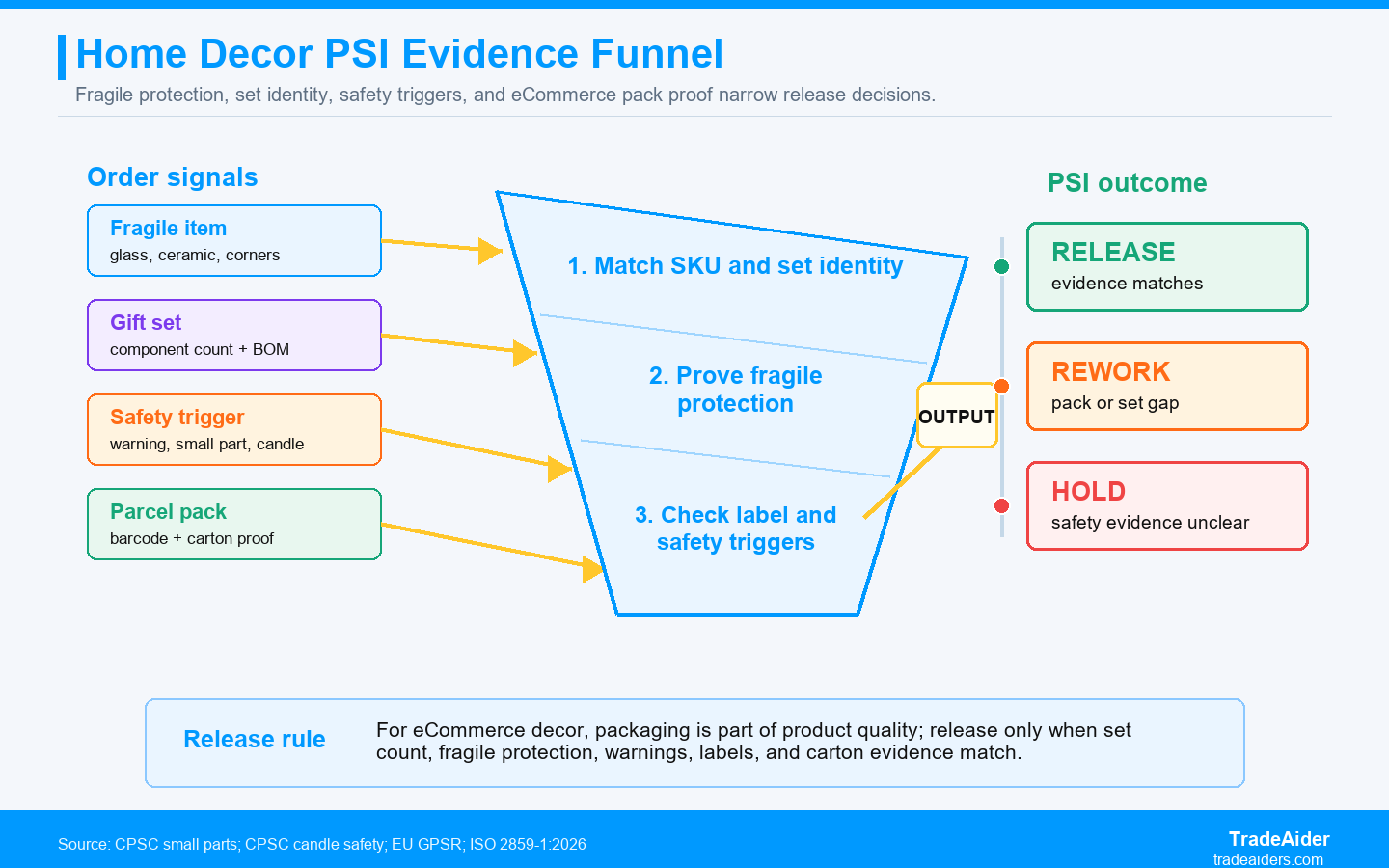
Home decor PSI should connect fragile protection, material risk, labels, set count, AQL defects, and eCommerce packaging.
This checklist should be attached to the purchase order or inspection booking. The supplier should know in advance that the inspection is checking both product quality and release evidence. That changes factory behavior: the team prepares correct cartons, accessible samples, approved artwork, and rework materials before the inspector arrives.
Where TradeAider Fits In Home Decor and Gift Product PSI
TradeAider is useful for this category because buyers often need decisions while the inspector is still on site. Through pre-shipment inspection services, TradeAider can check product appearance, set completeness, AQL workmanship, packaging, carton marks, and photo evidence before goods move into export flow.
For home decor orders, the buyer should provide TradeAider with the approved sample photos, SKU list, set bill of materials, packaging artwork, destination warnings, and sales-channel packing requirement. The inspection can then focus on the real release question: whether this exact lot is ready for customers, whether one SKU needs rework, or whether additional compliance evidence is needed before shipment.
Use real-time reporting for borderline release calls
Borderline findings are common in decorative products. A finish may be acceptable if variation is intended; a carton dent may be minor if inner protection is strong; a missing warning may be critical if it affects destination compliance. Real-time reporting lets the buyer ask for extra photos, compare against approved samples, and decide whether to accept, rework, or hold while the factory can still act.
If your order includes fragile decor, candle products, assorted gift sets, or marketplace-ready packaging, the next step is to send TradeAider the specification, SKU list, pack photos, and destination market so the inspection scope can be built around release evidence rather than a generic checklist.
SPAR Scenario: The Gift Set Looked Good but Failed Set Count
Situation: An eCommerce seller ordered a decorative holiday gift set with three ornaments, two hooks, a printed card, and a branded storage box. The factory sample looked correct, and the first opened unit passed visual inspection.
Problem: When the inspector opened cartons across multiple SKUs, one colorway had only two hooks and a different card insert. The retail box barcode was correct, so a warehouse receiving check would probably not catch the missing component before customer delivery.
Action: The buyer held only the affected colorway, asked the supplier to rework set contents, and requested reinspection photos showing opened sets, component count, and carton marks after rework.
Result: The shipment was delayed for that SKU, but the buyer avoided sending incomplete gift sets into the sales channel. The remaining SKUs moved because the inspection evidence separated affected cartons from clean cartons.
Pre-Shipment Release Checklist for Home Decor Sellers
- Send approved sample photos and finish tolerances before inspection.
- List each gift-set component and accessory by SKU.
- Define critical, major, and minor defects before AQL sampling.
- Require photos of fragile protection and opened retail packs.
- Escalate missing warnings, small parts, candle changes, or age-claim conflicts.
- Release only when set count, labels, packaging, and carton identity match.
Who Is TradeAider?
TradeAider is a quality inspection, testing, and certification service provider in China. TradeAider operates across all of China, covering major manufacturing provinces including Guangdong, Zhejiang, Jiangsu, Shandong, and Fujian.
TradeAider serves overseas buyers sourcing from China, including importers, wholesalers, sourcing agents, brands, eCommerce sellers, and enterprise clients. Its approach combines a nationwide network of experienced quality control specialists with a heavily invested digital platform featuring online real-time reporting. Clients can monitor inspections live, communicate directly with inspectors, and address issues during production rather than after shipment - a proactive model focused on problem-solving and prevention, not just defect identification.
Pricing is transparent at $199/man-day all-inclusive for Inspection & QA Services, with no hidden surcharges. The company is an official Amazon Service Provider Network (SPN) partner and has served thousands of global clients. Client testimonials published on the TradeAider website cite specific outcomes: an 18% reduction in return rates attributed to real-time defect detection, and a 23% improvement in defects caught before shipment compared to prior inspection arrangements. These are client-reported figures.
Frequently Asked Questions
Is AQL enough for home decor products?
AQL is necessary but not enough because home decor quality also depends on set completeness, fragile protection, labeling, and sales-channel packaging. Use AQL to judge sampled workmanship defects, then add checklist controls for approved sample match, gift-set content, warnings, retail pack condition, and carton identity. If the product has candles, magnets, small parts, or child-interest claims, compliance evidence should be reviewed separately from visual inspection.
What defects are common in gift products?
Common gift product defects include missing components, mixed colorways, wrong inserts, poor retail box finish, damaged sleeves, weak inner trays, scratched surfaces, glue marks, incorrect barcodes, and incomplete warning labels. The most expensive defects are often identity defects rather than cosmetic marks, because the warehouse may receive the item under the correct SKU while customers receive an incomplete or mismatched set.
Should candle products get extra checks before shipment?
Yes. Candle products should receive extra checks for warning labels, vessel condition, wick and accessory consistency, glass cracks, leakage, packaging protection, and whether the physical lot matches the tested or approved version. On-site inspection does not replace candle safety testing, but it can confirm that labels, components, and packaging match the evidence file before release.
What should eCommerce sellers send before inspection?
Send the purchase order, SKU list, approved sample photos, packaging artwork, barcode files, gift-set bill of materials, defect classifications, destination market, and any lab test or compliance documents relevant to the order. For fragile products, include pack photos or packing instructions. This allows the inspector to verify the actual release evidence rather than guessing what the seller intended.
Artículos Relacionados
Haga crecer su negocio con el Servicio TradeAider
Haga clic en el botón de abajo para ingresar directamente al Sistema de Servicios TradeAider. Los pasos simples desde la reserva y el pago hasta recibir los informes son fáciles de operar.

