Ask the inspector which requirement was left unverified, why the check was missed, and which products or lots it affects. Then ask what evidence would close the gap. If the site was unready, arrange the missed check once the setup is ready. If the equipment was unavailable, confirm the method and find a suitable setup or lab. If the item was outside the booked scope, find out whether separate, applicable evidence already exists. Keep the affected goods on hold while a required release check remains unresolved.
What “Not Tested” means for shipment
“Not Tested” records that the report provides no completed result for that check. Read the comments as well as the status. A test might have been skipped entirely, or the inspector might have been able to complete only part of it. Ask what was actually observed so you can retain usable findings and identify the part that remains open.
- Get the exact checklist line, the reason it was missed, and the affected model and lot.
- Confirm which evidence the purchase specification, customer requirement, or applicable rule calls for.
- Link the follow-up result to the affected goods before making the shipment decision.
Start with the document that made the check necessary. Find the item in the inspection checklist, approved specification, purchase order, or separate testing plan. Note any differences in wording. “Check that the unit powers on” and “verify operation under load” call for different observations. Ask the inspector to confirm which instruction was in the booking and the buyer’s quality lead to confirm which one governs release.
Keep a failed result, an incomplete result, and a genuinely inapplicable item separate. A failure has a recorded observation that misses a criterion. If a method was interrupted, ask which part was completed and where it stopped. For an item marked “Not Applicable,” ask what feature, configuration, or rule supports the exclusion. If the checklist lists a test for a product feature your model has, ask for a correction or follow-up before treating the row as closed.
Acceptance sampling uses observed sample evidence under a plan to help decide whether to accept the defined lot. The NIST Engineering Statistics Handbook describes this lot decision. When the report also lists a separate function or safety check, read its status on its own terms. A workmanship sample with no observed defects leaves an unperformed load check open.
Use TradeAider’s inspection standard to interpret the sampling part of the report. For the untested row, keep the original checklist wording and any pending evidence together so a later reader can see what the report actually covered.
Match the follow-up to the reason the check was missed
Ask whether the site was unready, suitable equipment was unavailable, or the check was outside the booked scope. The reason determines the next evidence request. If the report gives a reason such as “time insufficient,” ask what made the check impossible in the available time. A delayed setup and a method that takes several days call for different arrangements.
Reason on the reportAsk for nowWhat can close the rowSite or samples unreadyWhat prevented the check? Confirm access, sample identity, site preparation, and who will make the setup ready.A completed follow-up using the agreed method on the affected goods.Suitable equipment unavailableConfirm the specified method, equipment, range, and relevant calibration or setup checks.A valid result from a suitable on-site setup or a laboratory that meets the applicable requirements.Outside the booked scopeWho requires this check? Ask for the applicable specification, rule, or existing test report.Evidence accepted for that requirement, a newly scoped check, or a documented reason why the item does not apply.
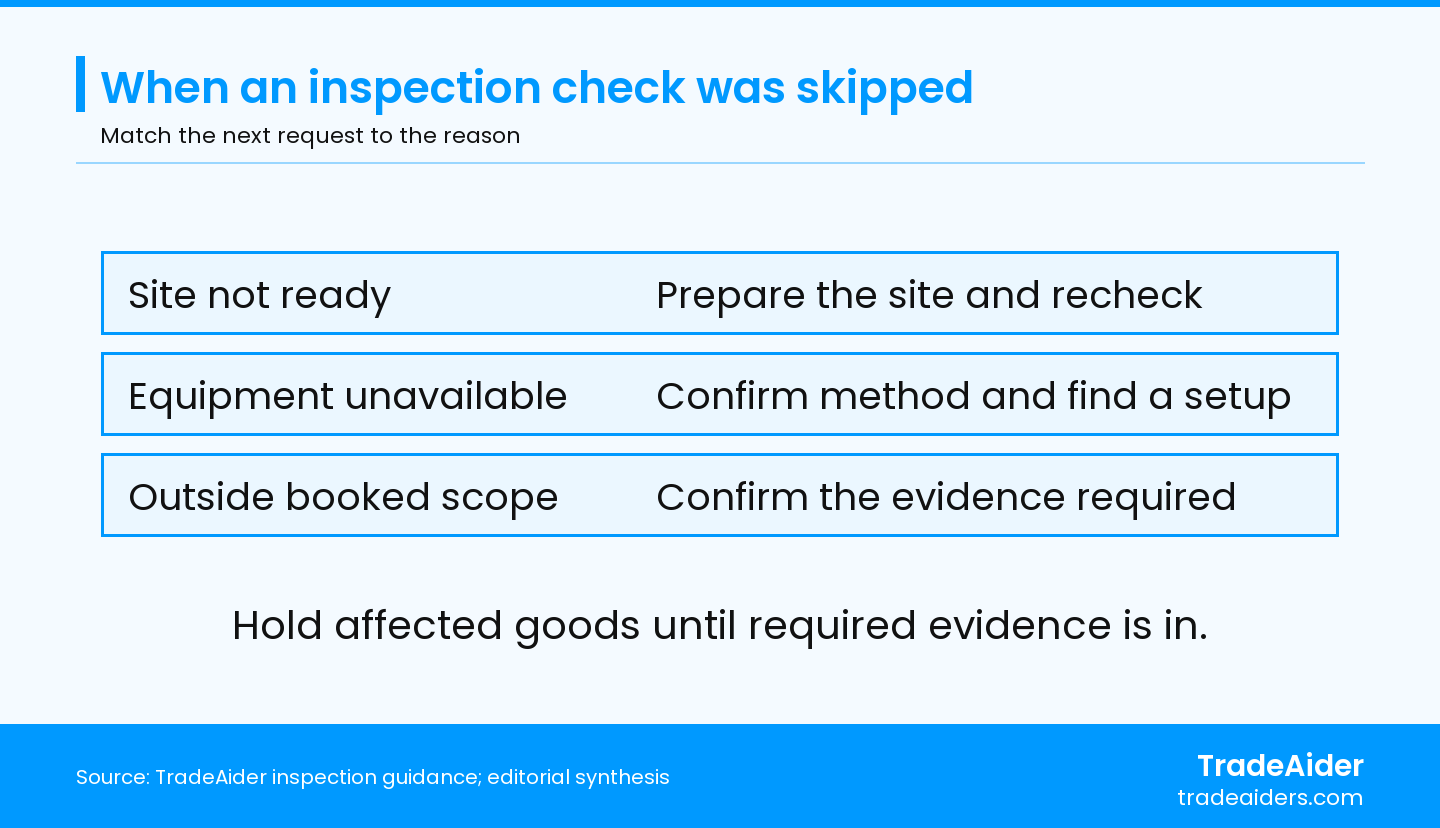
Start with the reason the check was missed. Use it to decide what to request before shipment.
Site or samples unready. Separate product availability from test readiness. Cartons may be available for selection while the test area is inaccessible or the required reference sample is locked away. Ask the factory for a named contact and confirmation of what will be available when the inspector returns. If the first test was interrupted, agree where a valid repeat starts. An earlier observation can be carried forward only if the method permits it and the same units can be identified.
Equipment unavailable. Ask the inspector or technical owner to identify the apparatus and conditions called for by the method. Confirm what was missing or unsuitable, such as a fixture with the wrong range. Agree who will supply it, where the test will be done, and how the setup will be documented. If the factory offers a demonstration in the meantime, record what it shows as a separate observation. A video of a unit turning on leaves the missing measured result unresolved.
ISO/IEC 17025 addresses competence, impartiality, and consistent operation in testing and calibration laboratories.
If the method needs a lab, send the product information, method, acceptance criterion, and desired sample coverage when discussing the testing assignment. Ask who performs the work and what report it will generate. Check whether any specific lab acceptance or accreditation scope applies to the test you need.
Outside the booked scope. Compare the agreed work order with the buyer’s technical requirements. A packaging checklist may require the inspector to confirm a report is on file while a separate test verifies the packaging performance. If the test had already been commissioned elsewhere, ask for the actual result and check its scope. If the booked service omitted a required check and no eligible result exists, agree a new inspection or test assignment and keep the row pending.
TradeAider performs pre-shipment inspection when the order quantity is 100% complete and at least 80% is packed for export.
Decide whether an existing result covers the pending check
Use a previous test report only when the requirement permits that kind of evidence and the result covers the current configuration or production group on an accepted basis. The date helps establish sequence. The decision also depends on who performed the work, exactly what they tested, and whether relevant materials, components, or conditions have since changed.
Ask the supplier to send the full report and explain how it applies to your order. Put the unperformed line beside the test report’s method and result. Look for the tested model or sample ID, variant descriptions, method revision, conditions, results and limitations. For sample-specific records, ask how the units were selected and identified. For a design or type test, ask what connects the tested design to the ordered version and whether the applicable requirements allow that coverage.
A laboratory report describes the items it actually tested. The European Accreditation Laboratory Committee’s reporting guidance explains the limitation on extending results to other items.
A report for the right model can still leave a gap. For instance, if the checklist calls for an inspector to witness a function on randomly selected shipment units, last month’s type test does not document that visit. Conversely, if the shipment file calls for qualifying type-test evidence and the current design is covered, an inspector can record that evidence separately without suggesting the test was repeated.
A UKAS accreditation schedule states which activities the accreditation covers.
Where accredited testing is required, read the applicable laboratory scope together with the report. A lab’s general accreditation mark alone does not identify the method or site covered. If the supplier sends a summary without the underlying result, ask the issuer to identify the test and any limits before closing the line.
Where U.S. children’s product third-party testing is required, the laboratory must be CPSC-accepted to perform the applicable test. The responsible firm issues a Children’s Product Certificate based on passing test results.
If a U.S. children’s product materially changes after initial certification, retest the finished product or the changed component for the rules affected by the change. The responsible firm issues a new Children’s Product Certificate based on passing results.
For an order in that situation, give the compliance reviewer the actual change record and evidence for the purchased configuration. Ask the reviewer to determine what earlier evidence still applies and which requirements need new results. Keep a legal or program requirement open while the necessary evidence is missing, even when the buyer and supplier agree on a commercial delivery date.
Use a hold record to make the shipment decision
Identify the exact row and affected goods, define the evidence that will close it, and name the release decision owner. If the stock covered by the gap cannot be distinguished reliably, start with the potentially affected group and narrow it when the factory can trace and physically identify the relevant goods.
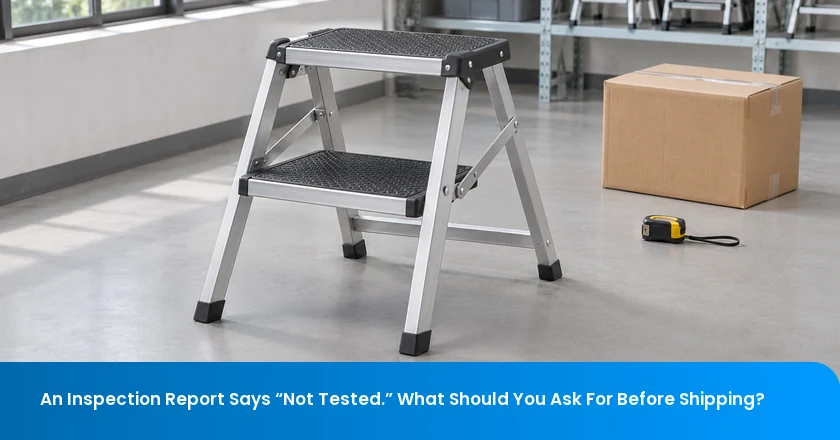
Illustrative scenario. A buyer orders two folding step-stool models. The buyer’s checklist requires a witnessed load check before shipment. The inspector records a completed result for Model A and marks Model B “Not Tested” because the available platform cannot safely hold the specified load arrangement. Finished units of both models are identified in separate carton ranges. The supplier offers a video of a worker standing on one stool, with no demonstration of the specified setup or identification of the sampled unit.
The buyer keeps Model B on hold and asks for a focused follow-up. The request identifies the carton range, selected product configuration, check method and buyer limit, and asks for a suitable platform and identifiable samples. The required evidence is the recorded setup and observations for the selected Model B units against the agreed criterion. Model A can be considered separately if its stock stays identifiable and all other release requirements are satisfied. If carton marks are mixed or unverified, the buyer needs a wider hold until sorting and identification restore that boundary.
Copy this line for each pending item. Record the original report entry even if the follow-up needs only one visit.
| Record field | What to enter for your shipment |
|---|---|
| Report and governing requirement | Report ID and line, specification revision, test method and criterion |
| Stock in scope | Order, product model, lot or carton range, and identification gaps |
| Reason and next evidence | What blocked the check, follow-up method or report, evidence owner and due time |
| Release status | Current hold or release scope, decision owner, and evidence needed or accepted |
If the follow-up has to make a fresh acceptance-sampling decision, confirm the affected lot size, inspection level, and acceptance quality limit (AQL) before selecting the sample. The AQL calculator can help check the plan inputs. Keep a check-specific sample count tied to the agreed method, especially when it differs from the workmanship plan.
Write the follow-up request before releasing the goods
A useful follow-up request states what the next report must show and which goods it must cover. Send the original report, the exact line and its recorded reason, the governing specification, and the identifiers of the affected goods. If an attachment is missing, name it and ask who can supply the current version. Ask when valid evidence can be ready relative to your shipping cutoff.
Tell the factory and inspector who will prepare the setup, control access to eligible units, and report the result. Where you need physical verification, confirm who will select the units and record their identifiers. If the agreed setup cannot be achieved in time, ask for the remaining limitation in writing. Use it to update the release decision or schedule instead of treating the booking confirmation as evidence.
Confirm the readiness of the specific test separately from packing readiness. For a follow-up visit, specify which cartons can be opened and how the checked items will be identified and repacked. When documents can close an item, ask for the cited result and retain the basis for accepting it. Keep the original report and the signed follow-up or addendum together so anyone reviewing the release can trace changes without mistaking them for initial findings.
For a China-sourced order, contact TradeAider with the marked report line, the affected models and lots, and your shipping cutoff. Include any available method or evidence requirements so the team can discuss the scope of a follow-up check and what the report can document.
FAQ
Can an inspection report pass if one check was not performed?
An overall inspection pass can coexist with an unperformed check when the report rules allow that status. Ask whether the missing check is a condition of release and whether the affected goods can be identified. If the inspection summary leaves the coverage unclear, request a written clarification from the issuer that preserves the original row and explains which findings the pass actually covers.
Can the factory send a video instead of a reinspection?
A factory video can close a check only when the agreed method and evidence requirements allow that kind of proof. Ask for enough context to identify the unit, condition, method and result, including any necessary sequence that a short clip might omit. If the requirement specifies an independent observation, a measured value or qualified laboratory testing, arrange evidence that meets that requirement.
Should you repeat the entire inspection after a missing test?
A targeted revisit can be enough when the goods, the agreed method, and the findings that still apply are identifiable. Before booking, check whether anything relevant changed after the first visit, such as rework, lot mixing or repacking that obscures the original identifiers. If it did, ask the quality lead to define which earlier checks need to be repeated and what stock the new results will cover.

Artículos Relacionados
Haga crecer su negocio con el Servicio TradeAider
Haga clic en el botón de abajo para ingresar directamente al Sistema de Servicios TradeAider. Los pasos simples desde la reserva y el pago hasta recibir los informes son fáciles de operar.