
- Acerca de Nosotros

- Nuestros Servicios
- Su Industria
- Recursos
- Noticias y Blog

Lighting inspection should connect electrical safety evidence, LED performance clues, driver identity, RF or smart-control evidence, labels, accessories, AQL workmanship, and packaging before shipment release.
LED and smart lighting inspection is easy to misunderstand. A fixture can turn on during factory inspection and still be wrong for release because the driver differs from the tested file, the label uses the wrong rating, the remote does not pair, the diffuser scratches easily, or the carton cannot protect the product during export.
The inspection should not pretend to replace electrical safety testing, photometric testing, RF authorization, or legal compliance review. Its job is to verify that the shipped lot matches the approved evidence and that sampled units perform the defined checks before cartons leave the factory.
Key Takeaways
- Power-on is only a start: Inspect driver identity, dimming, color temperature, flicker clues, remote pairing, labels, accessories, and packaging.
- Evidence must match the lot: Safety reports, rating labels, drivers, plugs, manuals, and model numbers should point to the same product.
- Smart lighting adds RF identity: Wi-Fi, Bluetooth, Zigbee, or remote-control features may require authorization evidence and app or pairing checks.
- AQL needs lighting-specific defects: Scratched diffusers, poor soldering clues, loose driver, color mismatch, dead LEDs, and weak packaging need defined defect classes.
- Release photos matter: Importers should keep photos of rating labels, driver labels, function checks, app screens, accessories, and carton protection.
Electrical Evidence Comes Before AQL
AQL tells the buyer whether sampled workmanship defects are within agreed limits. It does not prove that an LED fixture, driver, lamp, adapter, or smart-control module has the required safety or RF evidence. Before treating a lighting lot as releasable, the buyer should confirm which evidence file applies to the model being inspected.
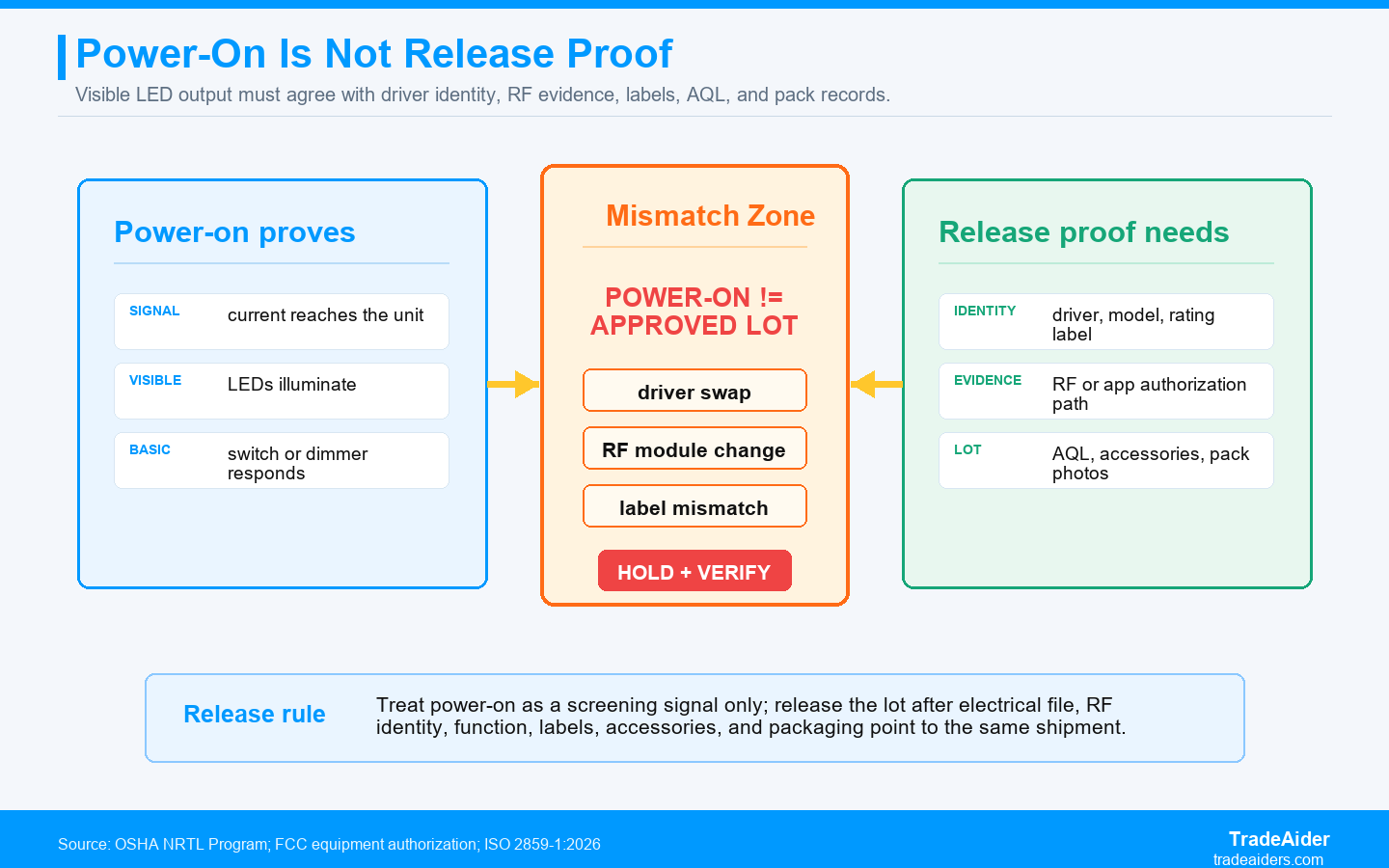
Lighting release should connect electrical safety evidence, AQL, function, smart connectivity, labels, accessories, and packaging.
Safety marks and reports should match the physical driver
The OSHA NRTL Program explains that recognized laboratories certify certain products against appropriate product safety test standards and authorize marks for certified products. For lighting buyers, the inspection task is to compare the physical lot to the approved identity: model, rating label, driver, cord, plug, manual, and packaging.
Driver substitution is a common release risk. If a factory uses a different driver because of cost or availability, the lamp may still power on, but the buyer may no longer have clean safety evidence. The inspection report should photograph driver labels and rating labels so the buyer can compare them to the approved file.
Smart lighting requires RF and app identity checks
Smart lighting may include RF modules, remotes, Bluetooth, Wi-Fi, Zigbee, or app control. The FCC equipment authorization guidance requires RF devices to follow the appropriate authorization procedure before they are marketed, imported, or used in the United States. Inspection should verify that the shipped model identity, app identity, remote, manual, and label match the buyer's evidence file.
A smart bulb that pairs in the factory app but not in the buyer's intended app is not ready for release. The inspection scope should define pairing steps, reset steps, remote-control checks, and which screens or photos the report should capture.
Labels should be inspected as evidence, not decoration
Lighting labels often carry model number, voltage, wattage, frequency, IP rating where claimed, certification marks, manufacturer or importer information, and warnings. A wrong rating label can create customer risk, marketplace rejection, or compliance questions. The label should be readable, durable enough for the intended placement, and consistent across product, manual, and carton.
If labels are applied after inspection or changed during rework, the buyer should require reinspection photos. A lighting lot is not fully released until the evidence on the product matches the evidence in the file.
LED Function Checks Should Go Beyond Power-On
Lighting products need practical function checks that reflect what customers experience. A short power-on test can miss dimming failure, color mismatch, flicker clues, unstable driver behavior, remote pairing, loose connectors, bad switch function, poor diffuser fit, or accessory gaps.
Check brightness consistency and color clues
Inspectors do not need to perform full photometric testing during PSI, but they can compare sampled units for obvious color temperature mismatch, visible flicker clue, dead LED, uneven brightness, delayed start, abnormal noise, or unstable dimming. These observations should be recorded as inspection findings, not lab results.
For decorative lighting, color consistency may be the customer-facing quality issue. For task lighting, brightness and adjustability may matter more. The buyer should define which function matters for the product's listing and use case.
Driver, connector, and housing fit should be visible
A loose driver, weak connector, pinched wire, poor strain relief, cracked housing, sharp edge, or rattling internal part can become a failure after shipment. The inspection should include exterior workmanship, assembly, and safe visual checks. If the product can be safely opened under the inspection scope, internal photos may be useful, but the buyer should not require unsafe disassembly.
For fixtures, fit and finish also matter: diffuser scratches, warped trim, screw alignment, bracket fit, gasket condition, paint defects, and poor sealing can affect installation or customer acceptance.
Smart features should be tested through the real setup path
Smart lighting checks should include pairing, reset, remote control, color change, dimming, timer or scene control where relevant, and manual override. The report should show the tested function with photos or screenshots. A note saying 'smart function OK' is too vague for a connected product.
If the factory uses a demo app or engineering mode, the buyer should decide whether that is acceptable. For release evidence, the better check is the same setup path the customer or installer will use.
AQL Defects for LED and Lighting Products
AQL sampling under ISO 2859-1:2026 can support lot-level accept/reject decisions, but lighting defect classes should be defined before inspection. The defect list should reflect product type: bulb, strip light, panel, fixture, lamp, outdoor light, emergency light, or smart lighting kit.
Critical defects should trigger hold
Critical defects may include wrong driver, wrong voltage, exposed conductor, missing safety label, failed insulation-related visual check, severe overheating clue, missing ground connection where applicable, wrong plug, or model mismatch against safety evidence. These should trigger hold or technical review regardless of minor defect count.
AQL should not dilute electrical identity problems. If the inspection finds one repeated wrong-driver issue, the buyer should treat it as a release gate, not as one cosmetic defect among many.
Major defects should follow installation and customer impact
Major lighting defects may include dead LED, visible color mismatch, failed dimming, failed remote, poor diffuser fit, damaged bracket, unreadable label, wrong manual, damaged retail box, missing accessory, or poor carton protection. These defects affect installation, sellability, or after-sale support.
Minor defects should be limited to small appearance marks that do not affect use, safety, label readability, installation, or listing accuracy. If a cosmetic issue is visible in normal customer use, it may be major for decorative products.
Packaging should protect diffusers and fragile surfaces
LED panels, glass lamps, acrylic diffusers, painted trims, and smart controllers can be damaged by weak inserts or loose accessories. Inspection should check retail box strength, inner protection, cable separation, accessory compartment, carton compression, and whether surface protection prevents rubbing.
Lighting returns often begin with damaged packaging. A fixture that works but arrives scratched, cracked, or missing a bracket still becomes a customer problem.
Lighting Release Evidence Table
| Evidence Layer | Inspection Check | Release Rule |
|---|---|---|
| Safety evidence | Model, rating label, driver, plug, manual, certification mark | Hold if physical identity differs from approved file |
| LED function | Power-on, color clue, dimming, dead LED, abnormal noise | Escalate repeat function failure or unstable behavior |
| Smart/RF identity | App, remote, pairing, reset, module identity, label | Release only when setup path matches buyer scope |
| AQL workmanship | Diffuser, trim, housing, connector, label, retail box | Accept or reject by agreed defect class |
| Accessories | Bracket, screws, remote, adapter, manual, gasket | Hold affected SKU if installation kit is incomplete |
| Packaging | Inner protection, carton strength, surface isolation | Repack if fragile or visible surfaces are exposed |
Use a release rule that separates driver mismatch from normal defects
A practical lighting release rule can be simple: if the sampled lot shows one wrong driver model in a carton group, the buyer should stop treating the report as a normal AQL result and move to identity verification. The inspector should photograph driver labels across affected carton groups, and the supplier should explain whether the issue is an isolated packing error or a production substitution.
This matters because a wrong driver can create a bigger risk than several minor scratches. A scratched diffuser may be reworked or discounted. A driver substitution can affect safety evidence, dimming behavior, lifespan, flicker, heat, or RF interaction in smart products. That is why driver, rating label, and model identity should sit above ordinary appearance defects in the release hierarchy.
Where TradeAider Fits In Lighting Products Inspection
TradeAider can support lighting importers with pre-shipment inspection, AQL workmanship checks, function checks, label review, accessory verification, packaging checks, and real-time reporting. For LED and smart lighting, the buyer should provide model list, approved driver, label files, app setup steps, accessory BOM, and defect classes before inspection.
The real-time reporting element is valuable when the inspector finds a driver, label, or pairing issue. Instead of waiting for a final report, the buyer can request extra label photos, pairing screenshots, or opened-kit evidence while the inspector is still at the factory.
SPAR Scenario: The Fixture Powered On but the Driver File Failed
Situation: A buyer ordered LED fixtures with a specific driver, rating label, and smart dimming function for a repeat SKU.
Problem: Sampled units powered on, but the driver label showed a substitute model. The carton and manual still used the approved SKU reference, so a basic power-on inspection would have missed the change.
Action: The buyer held the lot, requested driver evidence from the supplier, and asked for additional inspection photos of driver labels across carton groups.
Result: The supplier replaced affected drivers before export, and the buyer added driver-label photos as a mandatory release item for future orders.
LED and Smart Lighting Checklist
- Match driver, label, manual, carton, and evidence file.
- Check power-on plus dimming, color, pairing, and reset where relevant.
- Verify accessories needed for installation.
- Use critical gates for wrong driver, wrong voltage, or missing label.
- Photograph product labels, driver labels, pairing screens, and packaging.
- Reinspect after relabeling, driver change, or accessory rework.
If your shipment includes LED fixtures, lamps, drivers, remotes, or smart lighting modules, send TradeAider the driver file, label artwork, app setup path, and accessory checklist so the release evidence can be checked before export.
Who Is TradeAider?
TradeAider is a quality inspection, testing, and certification service provider in China. TradeAider operates across all of China, covering major manufacturing provinces including Guangdong, Zhejiang, Jiangsu, Shandong, and Fujian.
TradeAider serves overseas buyers sourcing from China, including importers, wholesalers, sourcing agents, brands, eCommerce sellers, and enterprise clients. Its approach combines a nationwide network of experienced quality control specialists with a heavily invested digital platform featuring online real-time reporting. Clients can monitor inspections live, communicate directly with inspectors, and address issues during production rather than after shipment - a proactive model focused on problem-solving and prevention, not just defect identification.
Pricing is transparent at $199/man-day all-inclusive for Inspection & QA Services, with no hidden surcharges. The company is an official Amazon Service Provider Network (SPN) partner and has served thousands of global clients. Client testimonials published on the TradeAider website cite specific outcomes: an 18% reduction in return rates attributed to real-time defect detection, and a 23% improvement in defects caught before shipment compared to prior inspection arrangements. These are client-reported figures.
Frequently Asked Questions
Can lighting inspection replace electrical safety testing?
No. Lighting inspection cannot replace electrical safety testing, photometric testing, RF authorization, or legal compliance review. It can verify that the shipped lot matches the approved evidence file and that sampled units perform defined visual and function checks. If the driver, rating label, plug, or model identity changes, release should be held for technical review.
What should be checked for smart lighting?
Smart lighting inspection should check model identity, RF or module evidence, app pairing, remote function, reset process, dimming, color change, manual, rating label, accessories, and packaging. The buyer should define the exact setup path before inspection so the report captures the same experience customers or installers will use.
Is a power-on test enough?
No. A power-on test only shows that the unit energizes under one condition. Lighting inspection should also check driver identity, label accuracy, dimming, color consistency clues, dead LEDs, remote or app control, accessories, packaging, and abnormal noise, heat, or flicker clues within the defined inspection scope.
What are common LED lighting inspection defects?
Common defects include wrong driver, failed dimming, color mismatch, dead LED, scratched diffuser, loose connector, damaged trim, missing bracket, wrong manual, unreadable label, remote pairing failure, weak retail box, and carton damage. The most serious release risks are electrical identity, labeling, and function failures.
Artículos Relacionados
Haga crecer su negocio con el Servicio TradeAider
Haga clic en el botón de abajo para ingresar directamente al Sistema de Servicios TradeAider. Los pasos simples desde la reserva y el pago hasta recibir los informes son fáciles de operar.

