
- Acerca de Nosotros

- Nuestros Servicios
- Su Industria
- Recursos
- Noticias y Blog

Pet product inspection should classify the product first, then verify material, load points, chew-risk parts, food-contact or treat boundaries, labels, AQL workmanship, accessories, and packaging before release.
Pet products are not one inspection category. A harness, chew toy, ceramic bowl, grooming brush, pet bed, litter accessory, feeder, and pet treat carry different risks. The first mistake buyers make is applying one generic pet-product checklist to every SKU. The second mistake is treating pet safety as if it can be decided only by appearance.
A practical inspection plan starts by classifying the product, then choosing checks that match how the animal and owner use it. Load points matter for harnesses. Chew and small-part risks matter for toys. Food-contact evidence matters for bowls and feeders. Animal food rules matter for treats. Packaging and labeling matter for every channel.
Key Takeaways
- Classify before inspection: Pet toys, harnesses, bowls, beds, grooming items, feeders, and treats need different release checks.
- Inspect real use points: Seams, buckles, clips, stitching, chew areas, sharp edges, and load points should drive the checklist.
- Do not mix edible and non-edible controls: Pet treats belong in animal food controls; pet bowls may need food-contact evidence; toys need physical safety checks.
- AQL needs category-specific defects: Broken clip, loose squeaker, sharp edge, poor stitching, coating chip, wrong label, and weak carton should not be treated the same.
- Keep lot evidence: Buyers should retain photos of material, labels, load points, opened packs, warning text, carton marks, and test or compliance files.
Classify the Pet Product Before Writing the Checklist
Pet product inspection starts with product type. A pet bed is mostly material, stitching, odor, fill, zipper, and packaging. A leash or harness is load-bearing. A bowl may touch food or water. A chew toy may be bitten repeatedly. A pet treat is animal food. Each category needs a different evidence file and a different defect hierarchy.
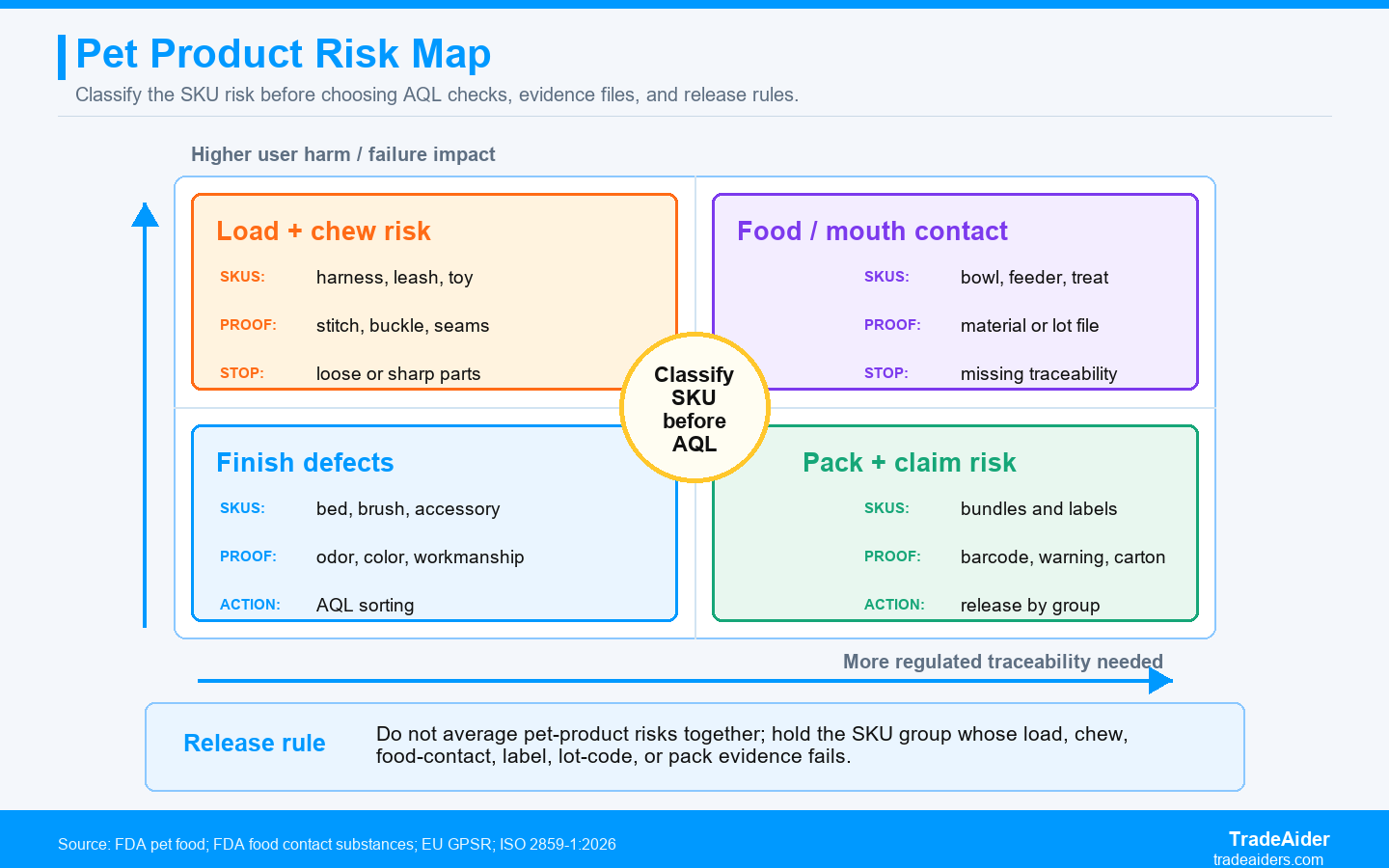
Pet product release should check material, load points, chew-risk parts, labels, accessories, AQL defects, and packaging.
Load-bearing products need strength and assembly focus
Harnesses, collars, leashes, carriers, and tethers should be inspected around load paths: webbing, stitching, buckle, D-ring, clip, adjuster, rivet, handle, and attachment points. The inspection should not only look at appearance. It should verify that the sample matches the approved construction and that obvious weak points, skipped stitches, loose hardware, or sharp edges are not present.
If the buyer has a pull-test or load-test requirement, that belongs in the specification and may require a defined test setup. On-site PSI can check construction and perform agreed simple checks, but it should not invent a load rating without a proper method.
Chewable products need detachable-part and edge checks
Pet toys, chew products, plush toys, squeaker toys, and rope toys should be checked for detachable parts, loose squeakers, weak seams, sharp edges, exposed staples, hard burrs, material shedding, and poor color transfer clues. The buyer should define intended pet size and use conditions because a toy for a small dog and a toy for a strong chewer have different risk expectations.
The inspection should also check whether packaging and labels overstate durability. A product marketed as aggressive-chewer safe needs stronger evidence than a decorative pet toy. If evidence is missing, the claim should be reviewed before release.
Beds, grooming items, and accessories need material controls
Pet beds, mats, apparel, grooming brushes, litter accessories, feeders, and carriers often fail through material, odor, stitching, surface finish, deformation, or packaging. Inspection should check fabric defects, filling distribution, zipper function, brush pin security, sharp plastic edges, odor, color transfer clues, and retail-pack condition.
The release decision should match customer use. A small scuff on a hidden part of a carrier may be minor. A sharp plastic burr on a grooming brush or loose pin near an animal's skin should be major or critical.
Food-Contact, Treat, and Safety Boundaries
Pet product inspection must avoid mixing product categories. Pet bowls, feeders, treat containers, and edible treats may need evidence outside a normal workmanship checklist. The inspector can verify physical identity and packaging, but the buyer needs the right regulatory and test file.
Pet food and treats are animal food, not toy inspection
The FDA pet food page states that FDA regulates pet food similarly to other animal foods and that animal foods must be safe, produced under sanitary conditions, contain no harmful substances, and be truthfully labeled. That means pet treats should not be handled as ordinary plastic or textile products.
For pet treats, inspection can verify packaging, lot code, expiration date, label, carton condition, seal, and visible damage, but it cannot replace food safety controls, facility controls, ingredient review, or microbiological testing. If a shipment includes edible items, the release process should include the relevant animal-food evidence.
Bowls and feeders may need food-contact evidence
Pet bowls and feeders touch food or water. The FDA food contact substances page explains that food contact substances include materials that contact food, such as packaging, preparation surfaces, or cookware, and that certain food contact substances require authorization. For pet bowls, buyers should consider whether material and coating evidence is required for the destination market.
Inspection can confirm that the shipped bowl matches the tested or approved material, coating, color, label, and packaging. If the supplier changes coating, pigment, stainless grade, silicone part, or plastic resin, the buyer should not treat a visual PSI as enough evidence.
General product safety still matters for non-food pet goods
For EU-bound consumer products, the EU General Product Safety Regulation (EU) 2023/988 creates a broader product safety framework for consumer goods. Pet accessories sold to consumers may need traceability, warnings, and product identification even when no pet-specific harmonized standard applies. Inspection should verify labels, warnings, importer information, and product identity against the buyer's destination requirements.
The key is not to invent a single universal pet standard. The key is to define the safety file for the actual product type and market, then inspect whether the lot matches it.
AQL Defects for Pet Products
AQL sampling under ISO 2859-1:2026 supports lot-level decisions, but pet products need defect classes based on animal use and owner expectations. A loose thread on a bed is different from a loose clip on a harness or a detached squeaker in a chew toy.
Critical defects should reflect animal harm and traceability risk
Critical defects may include sharp edges, broken load-bearing buckle, detached small hazardous part, exposed metal, contaminated edible pack clue, missing lot code for treats, wrong material identity for food-contact items, or label omission that affects safe use. These should trigger hold or escalation, not normal AQL averaging.
The buyer should decide before inspection which defects are critical. This prevents negotiation at the factory when a serious use-risk defect appears.
Major defects should reflect failure in normal use
Major defects may include weak stitching, broken zipper, poor buckle fit, missing accessory, coating chip, wrong size, wrong color, squeaker failure, damaged retail pack, unreadable barcode, wrong warning, or carton damage that affects sellability. These defects can create returns, poor reviews, or unsafe use.
Minor defects should be limited to small appearance issues that do not affect animal contact, owner use, label accuracy, or product durability.
Packaging should protect shape, hygiene, and identity
Pet products can deform, shed fibers, absorb odor, or lose shape during transport. Beds and plush toys need compression controls. Bowls need surface protection. Harnesses need label and size identity. Treats need seal and lot-code protection. The inspection should show whether packaging protects the product's use condition, not just whether a carton exists.
For eCommerce sellers, carton and retail-pack evidence also helps solve returns. If a customer reports crushed packaging or wrong size, the seller can compare the complaint to factory release photos.
Pet Product Release Evidence Table
| Product Type | Inspection Focus | Release Trigger |
|---|---|---|
| Harness/collar/leash | Webbing, stitching, buckle, D-ring, clip, size label | Hold for broken load path or hardware mismatch |
| Toy/chew item | Seams, detachable parts, sharp edges, squeaker, material shedding | Escalate loose small parts or sharp edges |
| Bed/textile | Fabric, fill, zipper, stitching, odor, compression | Rework visible defects or deformation before release |
| Bowl/feeder | Material, coating, food-contact evidence match, surface, label | Hold if material identity differs from approved file |
| Treat/edible item | Lot code, seal, expiry, label, carton condition | Do not release without animal-food evidence and traceability |
| Grooming item | Pins, bristles, edges, handle, accessory pack | Hold sharp or loose animal-contact parts |
Use different release rules when one order mixes product categories
Many pet-product orders combine several categories in one purchase order: a harness, a silicone bowl, a plush toy, and a treat pouch. The buyer should not accept one blended pass/fail result for the whole order. Each SKU should have its own release rule because the risk is different. A buckle failure belongs to load-path control, while a bowl coating change belongs to material evidence, and a treat lot-code issue belongs to animal-food traceability.
This category split also helps avoid unnecessary shipment freezes. If a plush toy has a seam problem, the buyer may hold that SKU while releasing correctly inspected bowls. If edible treats have missing lot codes, the buyer may hold the edible items while releasing non-food accessories. The inspection report should make that separation visible through SKU, carton, and product-type evidence.
Where TradeAider Fits In Pet Products Inspection
TradeAider can help pet product buyers through pre-shipment inspection for material appearance, stitching, hardware, load points, accessories, labels, packaging, lot identity, and AQL workmanship. Buyers should provide product type, intended use, approved sample, defect classes, material evidence, label files, and destination market before inspection.
The main value is category-specific release evidence. TradeAider can help buyers avoid treating a harness, toy, bowl, bed, and treat as if they all share the same checklist. Real-time reporting lets the buyer ask for extra photos of stitching, buckle, label, food-contact mark, or lot code while the inspector is still on site.
SPAR Scenario: The Harness Passed Appearance but Failed at the Buckle
Situation: A pet brand ordered adjustable harnesses with plastic buckles, D-rings, reflective trim, and size labels.
Problem: The harnesses looked clean, but sampled units from one carton group had brittle buckle clips and inconsistent stitching near the load point. The defect was not visible in closed retail packaging.
Action: The buyer held the affected carton group, asked for supplier CAPA on buckle material and stitching control, and required reinspection photos of buckles, seams, and size labels after sorting.
Result: Only corrected cartons were released, and future orders added buckle and load-point photos as mandatory inspection evidence.
Pet Products Inspection Checklist
- Classify each SKU before writing the checklist.
- Check load points for harnesses, collars, leashes, and carriers.
- Inspect chew-risk parts, seams, squeakers, and sharp edges.
- Separate edible treats from non-food pet accessories.
- Verify food-contact evidence for bowls and feeders where relevant.
- Photograph labels, lot codes, warnings, and opened retail packs.
If your shipment includes pet toys, harnesses, bowls, beds, feeders, grooming items, or treats, send TradeAider the product type, intended use, material file, label artwork, and defect classes so the inspection can focus on the correct release risks.
Who Is TradeAider?
TradeAider is a quality inspection, testing, and certification service provider in China. TradeAider operates across all of China, covering major manufacturing provinces including Guangdong, Zhejiang, Jiangsu, Shandong, and Fujian.
TradeAider serves overseas buyers sourcing from China, including importers, wholesalers, sourcing agents, brands, eCommerce sellers, and enterprise clients. Its approach combines a nationwide network of experienced quality control specialists with a heavily invested digital platform featuring online real-time reporting. Clients can monitor inspections live, communicate directly with inspectors, and address issues during production rather than after shipment - a proactive model focused on problem-solving and prevention, not just defect identification.
Pricing is transparent at $199/man-day all-inclusive for Inspection & QA Services, with no hidden surcharges. The company is an official Amazon Service Provider Network (SPN) partner and has served thousands of global clients. Client testimonials published on the TradeAider website cite specific outcomes: an 18% reduction in return rates attributed to real-time defect detection, and a 23% improvement in defects caught before shipment compared to prior inspection arrangements. These are client-reported figures.
Frequently Asked Questions
Is AQL enough for pet products?
AQL is useful for sampled workmanship decisions, but it is not enough by itself. Pet products also need category-specific critical gates for load points, detachable parts, sharp edges, food-contact materials, edible treat traceability, warnings, and product identity. The inspection checklist should match how the pet and owner will actually use the product.
Do pet treats need the same inspection as pet toys?
No. Pet treats are animal food products and need food safety, labeling, lot-code, ingredient, facility, and traceability controls beyond ordinary product inspection. PSI can verify packaging, seals, labels, lot code, carton condition, and visible damage, but it cannot replace animal-food compliance, sanitation controls, or microbiological testing where required.
What pet products need load checks?
Harnesses, collars, leashes, carriers, tethers, tie-outs, and similar products need load-path attention because failure can occur at webbing, stitching, buckle, D-ring, clip, rivet, or handle. Buyers should define the required load or pull-test method before inspection. On-site inspection can verify construction and agreed checks but should not invent a load rating.
What are common pet product defects?
Common defects include weak stitching, broken buckle, loose squeaker, sharp edge, poor zipper, material shedding, coating chip, wrong size label, odor, color mismatch, deformed bed, damaged bowl surface, missing accessory, unreadable barcode, wrong warning, weak carton, and missing lot code for treats. Defect class should depend on animal use risk.
Artículos Relacionados

Haga crecer su negocio con el Servicio TradeAider
Haga clic en el botón de abajo para ingresar directamente al Sistema de Servicios TradeAider. Los pasos simples desde la reserva y el pago hasta recibir los informes son fáciles de operar.

