
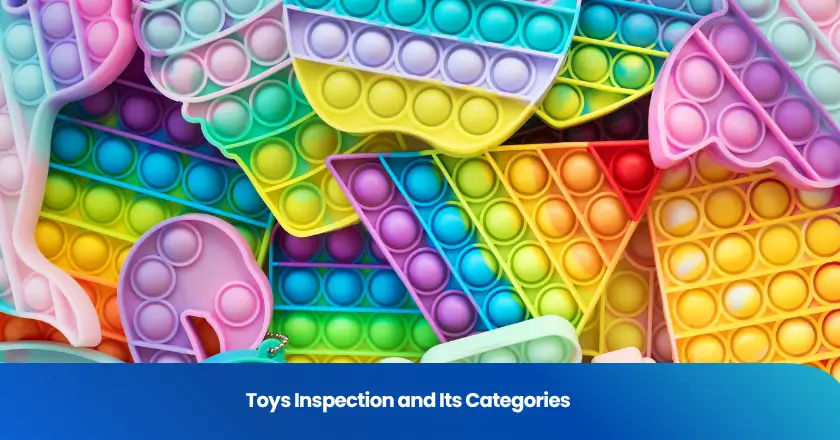
Against the backdrop of rising global child safety requirements, countries around the world continue to tighten toy safety regulations and update standard requirements year by year. As the world’s largest toy manufacturing and exporting base, China supplies more than half of the world’s toy products, and toy inspection has become a mandatory gateway for market access and supply chain risk control. Since different toy categories carry distinct hazard profiles, their corresponding inspection scopes, testing items and compliance benchmarks vary significantly. For brands, importers and cross-border e-commerce sellers sourcing from China, a clear understanding of toy inspection categories and core check items is the foundation of building an effective quality control system and avoiding product recalls and regulatory penalties.
Overview of Professional Toys Inspection
Toy inspection refers to systematic quality and safety verification conducted by independent third-party professionals against applicable standards and buyer specifications. It covers the full product lifecycle from raw material incoming to container loading, and serves as an impartial control layer separate from factory self-inspection.
Unlike general consumer goods, toys directly target children, a vulnerable user group, so safety takes absolute priority over appearance and functionality. Regulatory authorities in major markets regularly update restricted substance lists and mechanical safety thresholds to keep pace with emerging hazard research. For toy manufacturers and exporters, compliant inspection is not only a market entry requirement but also a core measure to protect child safety and brand reputation.
Classification by Product Category
Different toy materials, structures and age groups correspond to different safety risk points. The following are the most common product categories and their core inspection priorities.
| Product Category | Core Risk Focus | Key Inspection Priorities |
|---|---|---|
| Plush & Stuffed Toys | Choking from loose small parts, flammability, chemical residues in fabrics | Small part tensile & torque test, flammability performance, filling material cleanliness, stitching strength |
| Plastic Toys | Choking hazards, heavy metal migration, phthalates in soft plastics | Small part integrity, sharp edge & point check, surface coating heavy metal screening, phthalate document review |
| Wooden Toys | Sharp burrs, formaldehyde in adhesives, heavy metal coatings | Surface smoothness verification, structural impact resistance, coating safety document audit |
| Electronic & Battery-Operated Toys | Electric shock, overheating, battery leakage, small parts | Insulation performance, battery compartment safety, temperature rise test, circuit protection verification |
| Ride-On & Large Activity Toys | Tipping risk, load bearing failure, structural breakage | Stability test, static load test, impact resistance, mechanical strength verification |
| Paper & Cardboard Toys | Sharp edges, rapid flammability, toxic inks | Edge safety check, flammability rate test, printing material safety review |
| Art Materials (crayons, clay, watercolors) | Heavy metal ingestion risk, allergenic ingredients | Soluble heavy metal migration test, allergenic substance screening, labeling compliance |
| Educational & Puzzle Toys | Age grading mismatch, small parts for under-3s | Age grading accuracy, choking hazard warning labeling, assembly durability |
Classification by Production Stage
Toy inspection is also categorized by the point in the production cycle when it is conducted, allowing targeted risk control at different cost points.
Pre-Production Inspection (PPI)
Conducted before mass manufacturing begins, this stage focuses on raw materials, spare parts and initial components. Inspectors verify plastic resins, paints, fabrics, small accessories and electronic parts against approved specifications and safety requirements, catching high-risk material issues at the lowest-cost point before they enter the production line.
During Production Inspection (DPI)
When 20–30% of the order is complete, inspectors audit semi-finished and early finished units on the production line. This stage identifies recurring assembly defects, process deviations and workmanship issues early, allowing factories to adjust workflows before defects are replicated across the full batch.
Pre-shipment Inspection (PSI) / Final Random Inspection (FRI)
Performed when production is 100% complete and at least 80% of goods are packed into export cartons, this is the standard pre-shipment quality gate. Inspectors draw random samples per international AQL (Acceptable Quality Limit) standards and conduct a full end-to-end evaluation, delivering a clear pass / fail / hold recommendation for the batch.
Container Loading Supervision (CLS)
Loading supervision verifies that the correct qualified products are properly stowed, secured and sealed into the shipping container. It prevents short shipment, wrong-SKU loading and transit damage caused by poor loading practice, and creates a documented, traceable handover point between production and logistics.
Core Inspection and Testing Items
Across all categories, professional toy inspection covers four core safety dimensions, with test items calibrated to the specific product type and target market.
Physical and Mechanical Performance Testing
This is the most basic and widely applicable safety check, designed to eliminate injury risks from normal use and reasonably foreseeable abuse. Standard items include small part detachment and choking risk assessment, sharp edge and sharp point accessibility testing, tensile and torque testing for attached components, drop and impact tests, string and cord length measurement, and stability and load capacity verification for large toys. Requirements are tiered based on the target age group, with the strictest rules applying to toys for children under 3 years old.
Flammability Testing
Flammability verification applies to plush toys, fabric toys, paper toys and costume products. It measures burn rate, flame spread speed and afterglow time to ensure materials do not present rapid ignition risks, giving children sufficient time to move away in the event of contact with a fire source.
Chemical Safety Testing
Chemical non-compliance is the leading cause of global toy recalls. Standard screening covers:
- Soluble heavy metal migration (lead, cadmium, chromium, arsenic, barium, mercury, selenium and antimony) in surface coatings and substrate materials
- Phthalate content limits in soft plastic and PVC components
- Formaldehyde, banned azo dyes and allergenic fragrances in textile and plastic materials
- Toxic element limits in packaging materials
Electrical Safety Testing
For battery-operated and electronic toys, electrical safety checks verify insulation performance, battery compartment protection, wiring integrity, overheat protection and electric shock prevention under both normal use and single-fault conditions, aligned with IEC 62115 and equivalent regional standards.
Major Global Toy Safety Standards
Each major import market enforces its own mandatory toy safety framework, and inspection protocols are aligned to the applicable standards for the destination country.
- European Union: The Toy Safety Directive (2009/48/EC) is the core legal framework, supported by harmonized standards including the EN 71 series (mechanical, flammability, chemical migration) and EN 62115 for electric toys. Compliance is required for CE marking.
- United States: ASTM F963 is the mandatory consumer safety specification for toys, enforced by the U.S. CPSC under the CPSIA regulation, which also adds mandatory third-party testing and tracking label requirements for all children’s products.
- China: The GB 6675 series is the mandatory national toy safety standard, covering basic safety, mechanical properties, flammability and chemical migration limits. GB 19865 applies to electric toys sold in the domestic market.
- International & other regions: The ISO 8124 series is the global baseline toy safety standard, adopted as AS/NZS ISO 8124 in Australia and New Zealand. Canada enforces the Hazardous Products (Toys) Regulations SOR/2011-17, and Japan applies the ST 2024 toy safety standard.
TradeAider Toy Inspection Services
TradeAider provides professional third-party toy inspection services across all major toy manufacturing regions in China, including Guangdong, Zhejiang, Jiangsu and Shandong provinces.
Our local inspectors are trained in international and regional safety standards including EN 71, ASTM F963, GB 6675 and IEC 62115, with customizable checklists tailored to product category, target age group and destination market requirements. We cover the full inspection lifecycle: pre-production material verification, during-production process audits, final random inspection and container loading supervision.
Clients receive official photo-documented inspection reports within 24 hours of on-site completion. Through our online service system, buyers can also monitor inspection progress and view real-time findings, enabling timely decisions on batch acceptance, on-site rework or shipment hold. Get a free queto.
Frequently Asked Questions
Do all toy categories follow the same inspection standards?
No. While core safety principles such as small part and sharp edge rules apply broadly, specific test items, threshold limits and acceptance criteria vary by product category, material type and target age group. For example, plush toys prioritize flammability and stitching strength, while electronic toys focus on electrical safety and battery compartment design.
What is the difference between on-site inspection and laboratory testing?
On-site inspection covers physical workmanship, mechanical safety, packaging and labeling verification at the factory, using handheld tools and visual assessment. Laboratory testing conducts quantitative chemical analysis, precision flammability measurement and formal performance testing in a controlled environment. The two are complementary, and most brands combine both for full compliance coverage.
Which toy category has the strictest chemical safety requirements?
Toys intended for children under 3 years old generally have the strictest chemical limits, as infants and toddlers are more prone to oral exploration and chronic low-level exposure. Art materials such as crayons and modeling clay also have very strict soluble heavy metal migration limits due to the risk of ingestion during use.
Can one inspection cover compliance for multiple export markets?
Many core test items overlap across major standards, but each market has unique threshold limits, labeling rules and mandatory test items. Inspection and testing can be scoped to cover all applicable standards for a product in a single engagement, avoiding redundant testing costs for multi-market sellers.
Conclusion
Toy inspection is a multi-dimensional safety control system, not a single one-size-fits-all check. It is categorized by product type to target specific hazard profiles, and staged across the production cycle to maximize cost efficiency and risk control.
For businesses sourcing toys from China, understanding the full classification system of toy inspection helps allocate quality investment to the highest-risk areas, select the right inspection model for each order, and ensure every batch meets both regulatory requirements and brand safety commitments. In an environment of tightening global toy safety rules, professional categorized inspection is the most reliable way to protect child safety, reduce compliance risk and support long-term market access.
Artículos Relacionados
Haga crecer su negocio con el Servicio TradeAider
Haga clic en el botón de abajo para ingresar directamente al Sistema de Servicios TradeAider. Los pasos simples desde la reserva y el pago hasta recibir los informes son fáciles de operar.

