

A good defect rate for Amazon FBA is not one universal percentage. It depends on defect severity, product category, customer tolerance, and whether the issue affects safety, function, packaging, labels, or visible appearance. For many FBA shipments, sellers should treat critical defects as zero-tolerance, keep major defects very low, and use AQL settings to decide whether the lot is acceptable before shipment.
Amazon sellers often ask what defect rate is acceptable before sending inventory to FBA. The dangerous answer is a single number. A 1% cosmetic scuff rate on a low-cost accessory is not the same as a 1% failure rate on a baby product, electrical device, kitchen tool, or item with a warning-label requirement. Category risk changes the meaning of a defect.
AQL helps sellers avoid emotional decision-making. Instead of debating whether a defect rate feels high, the seller defines critical, major, and minor defects, chooses an inspection level, and uses the sample result to decide release, rework, hold, or reinspection. That decision should also consider Amazon-specific risks: returns, reviews, listing promise, prep compliance, and inventory health.
- Critical defects: safety, legality, severe compliance, or severe usability risk; usually zero tolerance.
- Major defects: function, saleability, barcode, label, assembly, or customer-impact issues; keep very low.
- Minor defects: limited appearance or workmanship issues; acceptable only within agreed limits.
- Amazon lens: defect tolerance should be lower when returns or reviews can damage ranking and profitability.
The Direct Answer
For Amazon FBA, a good defect-rate benchmark is category-specific: zero critical defects, strict major-defect limits, and minor-defect tolerance only when customer impact is low.
TradeAider's AQL calculator helps sellers estimate sample size and defect limits before inspection. The seller should confirm the exact AQL settings before booking, especially when the product category has safety, compliance, or customer-review sensitivity.
Amazon public guidance on FBA barcode and prep reinforces that label and packaging defects can become fulfillment problems, not just product-quality notes. See FBA barcode guidance and FBA packaging guidance.
A seller should not ask only, how many defects did we find? The better question is, what kind of defects did we find and what happens if customers or Amazon receive them? That is why AQL benchmarks must be interpreted by category.
AQL Benchmark By Amazon Product Risk
Use stricter limits when the defect affects safety, compliance, function, or review-sensitive expectations.
| FBA Category Risk | Critical Defects | Major Defects | Minor Defects | Typical Seller Stance |
|---|---|---|---|---|
| Baby, children, safety-sensitive | Zero tolerance | Very strict | Strict | Hold or rework quickly |
| Electronics or powered products | Zero tolerance | Strict function and label limits | Moderate if cosmetic only | Verify function, rating label, accessories |
| Kitchen, food-contact, personal care | Zero tolerance for safety or material mismatch | Strict | Strict to moderate | Protect compliance and reviews |
| Apparel, textile, soft goods | Zero for safety or banned materials | Strict for size, stitching, stains | Moderate by visibility | Use measurement and appearance checks |
| Home decor or simple accessories | Zero for sharp or unsafe issues | Moderate | Moderate if not customer-visible | Watch packaging and finish |
| Bundles and kits | Zero for unsafe component | Strict for missing parts | Moderate if packaging scuff only | Check completeness and set labeling |
This table is a planning framework, not a replacement for the seller's own AQL settings. The key point is that Amazon sellers should not use the same defect tolerance for every product. Customer expectation and account risk change the acceptable threshold.
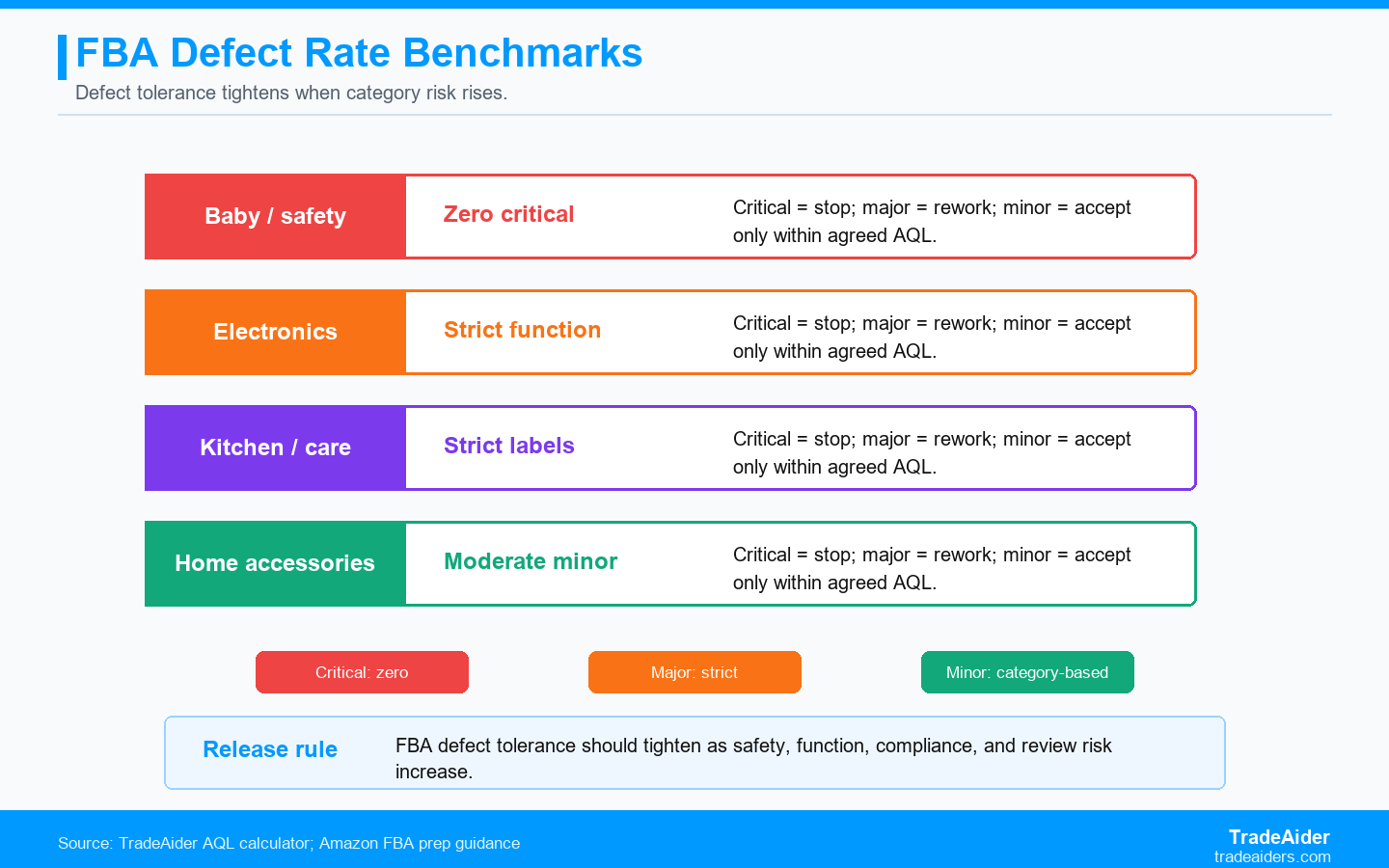
FBA defect tolerance should tighten as safety, function, compliance, and review risk increase.
Why Critical Defects Should Be Zero-Tolerance
A critical defect can make a low defect rate meaningless.
If one sampled unit has a safety hazard, wrong warning label, exposed electrical problem, sharp edge, unsafe material issue, or severe function failure, the lot may need to fail even when the overall defect percentage looks tiny. Averages hide severity. Amazon sellers should define critical defects before inspection and make them non-negotiable.
Critical defects also create bad negotiation incentives. A supplier may argue that one defect in a sample is statistically small. The seller should respond that critical defects are not priced like ordinary workmanship. The question is not whether the percentage is low; the question is whether the risk can be allowed into FBA inventory.
How To Set Major-Defect Tolerance
Major defects should be tied to customer experience and listing promise.
Major defects include failed function, missing accessory, wrong component, wrong SKU label, wrong model number, poor assembly, retail-package damage, or a visible defect likely to trigger returns. Sellers should set strict limits for these because Amazon customers do not grade defects like factory QC teams. Customers judge whether the listing promise was met.
For review-sensitive products, even a small major-defect rate can damage launch. A seller with a new ASIN may have fewer reviews and less buffer. One batch of defective units can produce early negative feedback that is harder to overcome than the cost of inspection or rework.
The seller should also consider defect concentration. Ten major defects spread randomly across a lot may mean something different from ten defects concentrated in one color, size, or production date. Concentration can make targeted sorting possible, but only if carton and SKU identity is clear.
Suggested AQL Starting Points By Risk
AQL numbers should be confirmed by the seller, but the strictness should follow category risk.
Many sellers begin with a common consumer-goods structure such as zero tolerance for critical defects and separate limits for major and minor defects. The exact AQL values should be agreed before inspection and should reflect the product's failure consequence. A decorative organizer and a powered baby product should not use the same tolerance simply because both are sold through FBA.
A practical seller can use a three-tier approach. High-risk products use the strictest limits and more product-specific checks. Medium-risk products use normal AQL but strict major-defect interpretation. Low-risk products may allow more minor cosmetic variation, but still treat barcode, set, and carton errors seriously because those affect FBA readiness.
| Risk Tier | Example Products | Critical Defect Stance | Major Defect Stance | Minor Defect Stance |
|---|---|---|---|---|
| High | Baby, electrical, personal care, food-contact | Zero tolerance | Very strict; rework or hold | Strict if customer-visible |
| Medium | Kits, home goods, tools, apparel | Zero tolerance | Strict by function and listing promise | Moderate if hidden or harmless |
| Low | Simple accessories, low-risk decor | Zero for safety issues | Moderate but document patterns | Category-based tolerance |
| Launch-sensitive | Any new ASIN with few reviews | Zero tolerance | Stricter than replenishment | Tighten visible appearance |
The point is not to create a universal TradeAider score or Amazon-approved defect rate. The point is to align inspection tolerance with business risk. Sellers should revisit the tier after each shipment based on return reasons, reviews, supplier behavior, and whether the product changed.
When Minor Defects Are Acceptable
Minor defects are acceptable only when they do not undermine customer trust.
Minor defects may include slight scuffs, small cosmetic marks, or workmanship variation that does not affect function, safety, or customer expectation. But minor does not mean irrelevant. If the product is sold as premium, decorative, giftable, or photo-led, cosmetic defects become more important because customers buy the appearance.
The seller should decide whether minor defects are visible after packaging, visible during unboxing, or visible only under inspection conditions. A tiny mark hidden inside a non-customer-facing area may be acceptable. A visible mark on the front of a gift product may not be acceptable even if the factory calls it minor.
Where TradeAider Fits In Defect Benchmarking
TradeAider fits by helping sellers convert category risk into inspection criteria and release decisions.
TradeAider can help Amazon sellers define defect classes before Pre-Shipment Inspection: critical, major, minor, FBA label defect, packaging defect, missing accessory, function defect, and cosmetic defect. Clear definitions make the report easier to act on.
If the seller has repeated defect patterns, During Production Inspection can check whether the factory is correcting the process before the final lot is packed. For Amazon-specific checks, TradeAider's e-commerce quality solutions can align inspection with FBA readiness.
The business fit is category-sensitive control. TradeAider does not need to invent a universal good defect rate. It helps the seller decide what defect rate is tolerable for this product, channel, and shipment.
SPAR Scenario: The Defect Rate Was Low But Still Failed
The seller rejected a low percentage because the severity was high.
Situation: An Amazon seller orders 3,200 rechargeable desk lamps. The supplier says the sample defect rate is low and wants shipment release.
Problem: PSI finds one unit with a loose charging port and several units with minor packaging scuffs. The overall defect percentage looks small, but the loose charging port is a critical function and safety concern.
Action: The seller treats the charging-port issue as critical, holds release, asks for root-cause analysis, requires sorting and reinspection, and accepts the minor packaging scuffs only if they remain within agreed limits.
Result: The seller avoids sending a potentially unsafe defect into FBA. The decision is based on severity, not only percentage.
Action Card: Set FBA Defect Benchmarks
Define acceptable quality before inspection day.
- Write critical, major, and minor defect definitions for the product category.
- Treat safety, legal, compliance, and severe function defects as zero-tolerance.
- Set strict major-defect limits for function, labels, accessories, assembly, and customer-visible issues.
- Allow minor defects only when they do not damage the listing promise or review expectation.
- Use AQL sample planning and category risk together before release.
After each shipment, compare inspection results with returns and reviews. If customers return a defect the seller classified as minor, reclassify it as major on the next order. Amazon customer behavior should continuously refine the inspection standard.
Sellers should also keep a defect benchmark log by ASIN. The log can record the AQL setting, sample size, failed defect types, return reasons, review complaints, and supplier corrective actions. Over time, this turns quality control from one-off inspection into a category-specific learning system.
If the supplier argues that a defect is acceptable because it is common in the factory's other orders, the seller should bring the conversation back to Amazon customer impact. A factory norm is not automatically an FBA norm. The benchmark must protect the listing promise, not the supplier's convenience.
The benchmark should also be reviewed when the listing changes. A new photo, premium positioning, bundle component, warranty promise, or marketplace expansion can make an old minor defect more serious. Inspection standards should follow the offer customers actually see.
For replenishment orders, keep the same defect language unless risk changes. Consistent wording helps suppliers understand that the seller is enforcing a standard, not renegotiating quality after every shipment.
This consistency also makes year-over-year supplier performance easier to compare, audit, explain, and improve.
If you need category-specific defect benchmarks for Amazon FBA, send TradeAider the product type, SKU list, listing promise, defect history, AQL preference, and FBA requirements. The next step is to ask TradeAider to align AQL defect classes with your Amazon category risk.
Frequently Asked Questions
Is there one good defect rate for all FBA products?
No. Defect tolerance depends on severity, category, customer expectations, compliance exposure, and return risk.
Should critical defects ever be accepted?
Usually no. Critical defects should be treated as zero-tolerance because one severe defect can outweigh a low overall defect rate.
Can minor defects still hurt Amazon sales?
Yes. Minor cosmetic defects can hurt premium, giftable, decorative, or review-sensitive products if customers notice them.
How should I update benchmarks after returns?
Use return reasons and review complaints to reclassify defects. A defect customers complain about should move from minor to major on the next checklist.

Artículos Relacionados



Haga crecer su negocio con el Servicio TradeAider
Haga clic en el botón de abajo para ingresar directamente al Sistema de Servicios TradeAider. Los pasos simples desde la reserva y el pago hasta recibir los informes son fáciles de operar.

