- Acerca de Nosotros

- Nuestros Servicios
- Su Industria
- Recursos
- Noticias y Blog
Defect Classification: Major, Minor, and Critical Defects Explained
During a third-party product inspection, an inspector does not simply count "good products" and "bad products." Because manufacturing is rarely perfect, quality standards rely on a structured system of Defect Classification.
Classifying defects is the only way to mathematically apply AQL (Acceptable Quality Limit) thresholds. Without clear classifications, a minor cosmetic scuff on a shoe box would carry the same weight as a shoe with a broken heel—which would render the inspection data useless.
This guide explains the standard definitions of Critical, Major, and Minor defects, how they affect your shipment's pass/fail result, and how to define them in your Quality Inspection Agreement.
What is Defect Classification in Quality Control?
Under international inspection standards (such as ISO 2859-1 and ANSI/ASQ Z1.4), a defect is defined as any non-conformance of a product with specified requirements.
To make sampling metrics actionable, defects are sorted into three distinct severity levels. Each level has a corresponding statistical limit (AQL percentage). Typically, the higher the severity of the defect, the lower the buyer's tolerance ( 0% for safety hazards, up to 4.0% or more for cosmetic issues).
Critical Defects (Typical AQL:0% )
A Critical Defect is the most severe classification. It is a non-conformity that fails to meet mandatory regulatory compliance, poses an immediate safety hazard, or could cause personal injury or property damage to the end-user.
In global sourcing, there is zero tolerance for critical defects. If a single critical defect is found during an inspection, the entire production batch is typically rejected immediately.
Examples of Critical Defects:
- Electrical Hazards: A live wire exposed on a household blender, or an appliance failing a basic dielectric strength (hipot) safety test.
- Physical Safety Risks: Sharp, exposed metal needles left inside a baby's garment, or a children's toy with small parts that detach easily and pose a choking hazard.
- Contamination: Mold, insect infestation, or hazardous chemical odor on textile products.
- Regulatory Violations: Missing mandatory warning labels (e.g., Suffocation warning on polybags or FCC compliance markings on electronics).
Inspect Before You Ship: Eliminate Quality Risks on Site. Eliminating quality risks before your cargo leaves the factory floor. ➔ Book an Inspector
Major Defects (Typical AQL: 2.5%)
A Major Defect is a non-conformity that reduces the product's usability, performance, or commercial value. While it does not pose a physical safety hazard, it is serious enough that an end consumer would likely return the product, request a refund, or leave a highly damaging 1-star review.
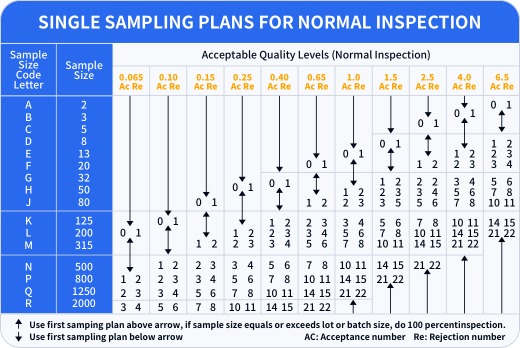
The industry default AQL for major defects is 2.5% . This means that in a sample size of 125 units, finding 8 or more major defects will fail the inspection.
Examples of Major Defects:
- Functional Failures: A smart watch that refuses to connect to Bluetooth, or an electric kettle that leaks water during testing.
- Structural Defects: A suitcase zipper that jams repeatedly, or a chair frame that wobbles due to uneven legs.
- Severe Aesthetic Issues: Deep scratches on the front display of a premium television, or a prominent logo printed completely upside down.
- Dimension Discrepancies: A garment that measures two sizes smaller than the approved spec sheet, preventing the consumer from wearing it.
Minor Defects (Typical AQL:4.0% )
A Minor Defect is a cosmetic deviation from the approved standard. It does not affect the product’s safety, mechanical function, or structural integrity. Most consumers will still buy and use the product, although highly observant buyers might notice the flaw.
Because minor defects are purely cosmetic, importers have a higher tolerance for them, usually set at an AQL of 4.0% (though luxury brands often tighten this to 1.5% or 2.5% ).
Examples of Minor Defects:
- Cosmetic Blemishes: Small, removable dirt marks on the underside of a plastic casing, or minor scuffs on a product's cardboard packaging.
- Fabric/Sewing Imperfections: A few uncut thread ends (less than 1 cm) inside a jacket pocket, or slightly uneven stitching on an interior lining.
- Slight Color Variation: A shade difference in the lining material that is only visible under specific laboratory lighting.
- Minor Bubbles or Dust: Tiny air bubbles in a glass ornament that do not compromise the structure.
Setting up Your Defect Classification List (DCL)
To prevent misunderstandings on the factory floor, do not leave defect classification up to the inspector's or the manufacturer's subjective opinion.
Before production begins, compile a Defect Classification List (DCL) and embed it directly into your Purchase Order (PO) or Proforma Invoice (PI). A standard DCL should look like this:
| Product Component | Specific Defect | Classification |
|---|---|---|
| All Parts | Sharp metal burrs or edges | Critical |
| Power Cable | Cable sheath is cracked or damaged | Critical |
| USB Port | Port is loose, off-center, or cannot charge | Major |
| Plastic Casing | Severe scratch/abrasion on front face (> 10mm) | Major |
| Plastic Casing | Micro-scratch on the back face (< 5mm) | Minor |
| Gift Box | Minor crush or dent on the corner | Minor |
Conclusion: Objective Standards Drive Quality
A structured DCL backed by the ANSI/ASQ Z1.4 tables removes the emotion from quality disputes. When an inspection report comes back with a "Fail" score, having mathematically classified defects gives you the exact leverage you need to demand that the supplier sort, rework, or reproduce the batch before you release the final balance payment.
Related Knowledge Base
TradeAider