
- About Us

- Our Services
- Your Industry
- Resources
- News & Blog
FCC and UL are not competing versions of the same certification for electronics exported to the US. FCC equipment authorization is about radiofrequency and electromagnetic-compliance requirements for devices marketed or imported into the United States, while UL is a safety certification mark and testing pathway often requested by buyers, retailers, insurers, or workplace-use requirements.
The FCC says radio frequency devices must be properly authorized before being marketed or imported into the United States. That is the first boundary importers need to understand: if the product is an RF device or contains RF-emitting electronics, the compliance path must be clarified before shipment.
47 CFR Part 15 covers conditions for intentional, unintentional, and incidental radiators. For importers, this means a Bluetooth speaker, Wi-Fi camera, LED controller, charger with digital circuitry, remote, sensor, or smart device may need more than a supplier statement.
UL belongs to a different decision layer. OSHA explains that its Nationally Recognized Testing Laboratory program recognizes private-sector organizations to test and certify certain products for OSHA electrical-safety purposes. UL can be one such recognized lab, but a UL mark is not a substitute for FCC authorization.
- FCC is not optional for covered RF devices: authorization must fit the product type and marketing path.
- UL is safety evidence, not an FCC replacement: buyers may require it, but it answers a different question.
- Model identity matters: reports, labels, manuals, adapters, PCB versions, and cartons must match the actual shipment.
- Inspection should verify visible evidence: product labels, manuals, packaging, warnings, power ratings, and document references should match the compliance file.
What Is the Difference Between FCC and UL for US Electronics?
FCC authorization focuses on whether a radiofrequency or electronic device is legally authorized for marketing or import into the United States, while UL certification focuses on product safety testing and mark evidence. Many electronics need an FCC path, some also need or benefit from UL or another NRTL safety certification, and neither one automatically replaces the other.
The FCC authorization procedure depends on the device and rule part. FCC equipment authorization procedures include Certification and Supplier's Declaration of Conformity pathways. The buyer should know which procedure applies before production labels and manuals are finalized.
The FCC also explains that RF devices include electronic-electrical products capable of emitting RF energy. That matters because importers sometimes focus only on wireless products and miss unintentional radiators or bundled electronics that still need authorization review.
For safety certification, OSHA lists UL recognition under the NRTL program, and UL Solutions describes certification as product testing to applicable standards. The shipment decision should therefore ask two separate questions: is the FCC evidence right for the model, and is the safety mark or report claim supported by the correct product file?
FCC vs UL Importer Decision Table
Use this table before approving labels, manuals, packaging, or shipment release.
| Question | FCC | UL / NRTL Safety | Inspection Evidence |
|---|---|---|---|
| Main purpose | RF/EMC authorization for marketing/import | Safety certification to applicable standards | Keep paths separate |
| Who controls it | Federal Communications Commission rules | Private certification body; OSHA NRTL context for workplace products | Verify claim source |
| Typical evidence | Grant, SDoC, test report, FCC ID, manual statements | Listing, mark authorization, safety report, label rules | Match model and label |
| Common mistake | Supplier sends wrong FCC ID or old report | Supplier uses mark without product coverage | Check current model and factory |
| Inspection role | Verify label, model, packaging, manual, report references | Verify mark, label, adapter, warnings, document match | Do not replace lab review |
| Release action | Hold if evidence does not match product | Hold if mark or safety claim is unsupported | Escalate before shipment |
The table is not legal advice. It is a buyer control map. The importer or compliance owner still needs the correct regulatory review, testing lab, certification body, and destination-market documentation.
The practical inspection point is model identity. If the product label, PCB version, adapter, manual, packaging, barcode, or carton does not match the compliance file, the shipment may carry the wrong evidence even when a document exists.
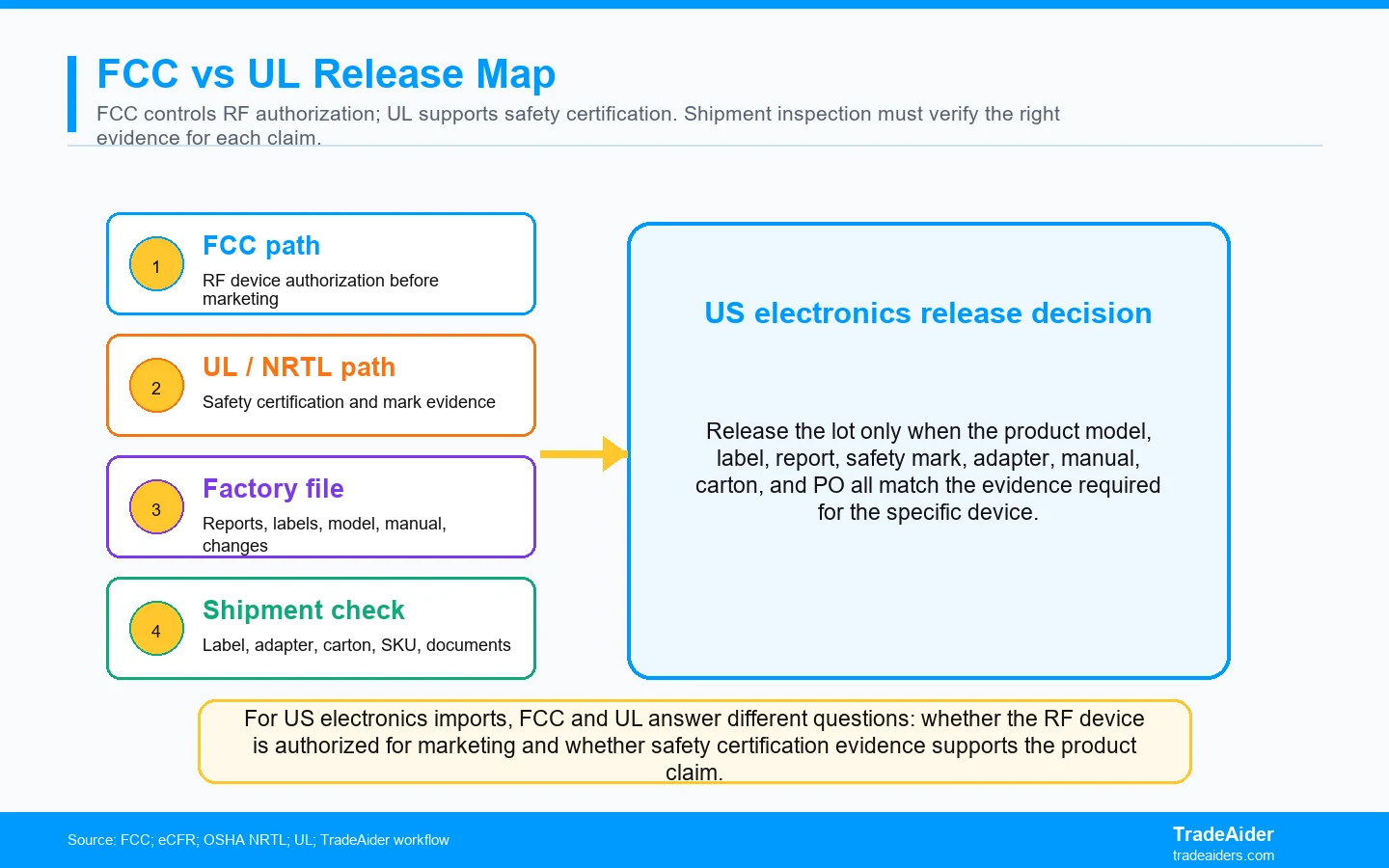
For US electronics imports, FCC and UL answer different questions: whether the RF device is authorized for marketing and whether safety certification evidence supports the product claim.
FCC and UL Answer Different Buyer Questions
The most dangerous electronics compliance mistake is treating one mark as proof of everything.
FCC asks whether the device can be marketed or imported
For US electronics, the FCC path should be clarified during sourcing, not after packing. The buyer should confirm whether the product is an intentional radiator, unintentional radiator, or another covered device, and whether Certification or SDoC applies.
Inspection can verify visible evidence such as FCC ID, model number, label location, manual statements, power rating, and carton identity. It cannot decide the legal authorization path from scratch at the factory. That decision belongs in the compliance file before mass production.
UL asks whether a safety certification claim is supported
A UL mark or safety certification claim should be treated as controlled evidence. The buyer should verify that the mark belongs to the correct product, model, factory, construction, power rating, and scope. A supplier screenshot, old certificate, or similar-looking product is not enough.
For many consumer electronics, retailers, insurers, or enterprise buyers may ask for UL or another NRTL mark even when the legal trigger is not the same as FCC. The importer should separate buyer-required safety evidence from FCC authorization evidence so neither claim is overstated.
Inspection Should Check the Product Against the Compliance File
Electronics inspection is most useful when it verifies that the shipped goods match the approved compliance evidence.
Model, label, and manual mismatches are release risks
Check the product model, FCC ID or SDoC reference, safety mark, electrical rating, warning label, adapter, plug type, manual statements, barcode, and carton marks against the compliance file. If the factory changes a PCB, wireless module, adapter, enclosure, firmware, or power supply, old documents may no longer support the shipment.
The report should photograph labels, rating plates, manuals, accessories, adapters, packaging, and sample product details. That evidence helps the buyer decide whether the lot can ship, needs document review, or must be held for correction.
Factory substitutions are a hidden compliance threat
Supplier substitutions often look harmless: a new adapter brand, alternate wireless module, changed PCB layout, different enclosure, new cable, or updated firmware. For electronics exported to the US, those changes can affect FCC or safety evidence.
A practical buyer rule is to freeze the approved compliance bill of materials before mass production. If any compliance-relevant component changes, the buyer should trigger document review before final inspection, not after the shipment is booked.
Scenario Estimate: One Wrong Adapter Can Put the Whole Lot on Hold
Electronics compliance problems often concentrate in a small component that affects every unit.
Assume a 5,000-unit electronics order ships with an unapproved adapter substituted late in production. If every retail box contains that adapter, the defect concentration is 100% even if product appearance, function, and packaging pass inspection.
If correction requires opening cartons, replacing adapters, relabeling boxes, and reinspecting 5,000 units, the cost is not the price of one component. It is labor, delay, rework, freight schedule risk, and possible retail launch disruption.
This scenario estimate shows why electronics inspection should include compliance-linked accessories, not only the main device. A small part can control the shipment decision when it is tied to safety, FCC, or buyer certification evidence.
What the Factory Inspection Should Not Decide
The inspector can verify shipment evidence, but the compliance owner must decide whether that evidence is legally sufficient.
Do not turn the factory visit into legal clearance
A factory inspection can photograph labels, manuals, packaging, adapters, model numbers, FCC IDs, safety marks, and document references. It can also flag mismatches between the packed goods and the approved file. It should not decide whether a new radio module, firmware change, antenna design, or power-supply substitution still fits the original FCC or safety certification scope.
That boundary protects the buyer. If the inspector tries to solve compliance at the factory, the report can create false confidence. If the inspector records the mismatch clearly, the importer can send the evidence to the compliance owner, test lab, certification body, or importer of record before release.
Document control should be part of supplier management
The buyer should keep a controlled file for each model: report numbers, authorization path, safety mark scope, label artwork, adapter list, manual language, factory name, model variants, and approved components. When the supplier changes a component, the change should trigger document review rather than being treated as an ordinary production substitution.
This file also helps with inspections over time. A repeat order can be checked against the same approved evidence, while a changed order can be separated as a new version. That prevents old reports and labels from drifting into new products without review.
Release Rules for FCC or UL Evidence Mismatches
The buyer should define hold rules before cartons are sealed.
Some mismatches should stop shipment immediately: a missing FCC ID where one is required, a safety mark used without product coverage, a different wireless module, an unapproved adapter, a changed power rating, or a manual that omits required statements. These are not cosmetic report notes; they can change whether the product evidence still supports the lot.
Other gaps may be handled through document correction if the physical product still matches the approved design. For example, a manual file may need updated wording, a carton may need corrected SKU identity, or the buyer may need the supplier to provide the current authorization record. The important point is that the release rule should name who can clear the gap and what evidence proves closure.
For importers, the safest workflow is simple: inspect visible shipment evidence, hold mismatched lots, send clear photos and model details to the compliance owner, then release only after the compliance file and the physical goods match again.
Where TradeAider Fits in US Electronics Export Checks
TradeAider can help electronics importers verify that the physical shipment matches the FCC, safety, label, adapter, manual, and packing evidence already approved in the compliance file.
Before production, Pre-Production Inspection can verify labels, adapters, packaging artwork, manuals, and compliance-related components before mass production locks them in.
During production or before shipment, During Production Inspection and Pre-Shipment Inspection can check model identity, function, labels, accessories, cartons, and report evidence against the approved file.
When lab evidence or retesting is needed, TradeAider can coordinate product testing services instead of letting visual inspection overclaim FCC, UL, or safety status.
SPAR Scenario: The FCC Report Was Correct, but the Shipped Model Was Not
The buyer held the lot because the product no longer matched the compliance file.
Situation: A buyer ordered 8,000 smart LED controllers for the US market.
Problem: The supplier provided an FCC report, but final inspection found a different wireless module and a changed adapter brand in the packed goods.
Action: The buyer asked TradeAider to photograph model labels, PCB markings, adapter ratings, manuals, and carton identity for compliance review.
Result: The buyer delayed release for five days, replaced adapters across the 8,000-unit lot, updated the compliance file, and reinspected the packed goods before shipment.
US Electronics Compliance File Before Inspection
Prepare this file before electronics inspection or shipment release.
- FCC authorization path, FCC ID or SDoC evidence, and report references.
- UL, NRTL, or safety certification evidence when claimed or required.
- Approved model, PCB, wireless module, adapter, plug, cable, and firmware version.
- Rating label, warning label, manual language, barcode, and packaging artwork.
- SKU, carton, PO, production-date, and sample-spread map.
- Release rule for mismatch, missing mark, wrong adapter, or document gap.
The buyer should not ask the inspector to invent compliance at the factory. The inspector's role is to compare the physical lot against the approved file and show evidence when something does not match.
If the product has no valid file, pause the shipment decision and involve the compliance owner, test lab, certification body, or importer of record before release.
If your electronics shipment has FCC, UL, adapter, label, or model-matching risk, send TradeAider the product model, FCC evidence, safety certificate, label artwork, adapter list, and production status. The next step is to verify your US electronics shipment evidence before cargo leaves supplier control.
Frequently Asked Questions
Is FCC the same as UL certification?
No. FCC authorization addresses radiofrequency or electromagnetic-compliance requirements for covered electronics, while UL certification addresses product safety testing and mark evidence.
Do all electronics exported to the US need FCC?
Many RF and electronic devices need an FCC authorization path, but the exact procedure depends on the device. Importers should confirm the path before production labels and manuals are finalized.
Is UL legally required for every US electronics product?
No. UL is not a universal legal requirement for every consumer electronics import, but buyers, retailers, insurers, or workplace-use rules may require UL or another NRTL safety mark.
What can an inspection verify for FCC or UL?
Inspection can verify model identity, labels, manuals, adapters, packaging, markings, and document references against the approved file. It cannot replace testing or regulatory review.
When should electronics be held before shipment?
Hold the lot when the model, module, adapter, label, manual, mark, or certificate does not match the approved compliance file, or when required evidence is missing.

Related Articles


Grow your business with TradeAider Service
Click the button below to directly enter the TradeAider Service System. The simple steps from booking and payment to receiving reports are easy to operate.

