
- About Us

- Our Services
- Your Industry
- Resources
- News & Blog
FBA prep and quality inspection are often booked in the same hectic week before inventory moves to Amazon. That timing makes them look interchangeable. They are not. FBA prep is about making a unit and its shipment information ready for Amazon's inbound workflow. Quality inspection is about deciding whether a finished lot matches the buyer's agreed product, packaging, and presentation requirements well enough to accept, hold, rework, or recheck.
The useful distinction is not who performs the task. It is the question the resulting record can answer. A carton label may scan perfectly while a retail set has a missing component. A sample may support a hold or release decision while the accepted cartons still need their unit labels and shipment details finalized. Treating those records as two gates keeps the handoff clear.
A Buyer's Decision Summary
Fulfillment by Amazon (FBA) is an Amazon fulfillment program for inventory handling: it receives, stores, and ships eligible inventory. FBA prep can make that inventory ready for Amazon handling, while quality inspection can support a bounded decision about the finished lot. Neither record automatically performs the other's job. A prep completion record can show that agreed labels and cartons were handled; it cannot silently become proof that the product met an unperformed specification check.
Use two separate release questions. First: Is the identified product lot acceptable under the agreed criteria? Second: Are the accepted units ready for Amazon receiving under the agreed prep scope? The first answer produces a product disposition. The second produces receiving-readiness evidence. This is a buyer control model, not an Amazon rule or a guarantee against future claims, but it prevents a common handoff error: treating a completed prep task as the final release event while a product question remains open.
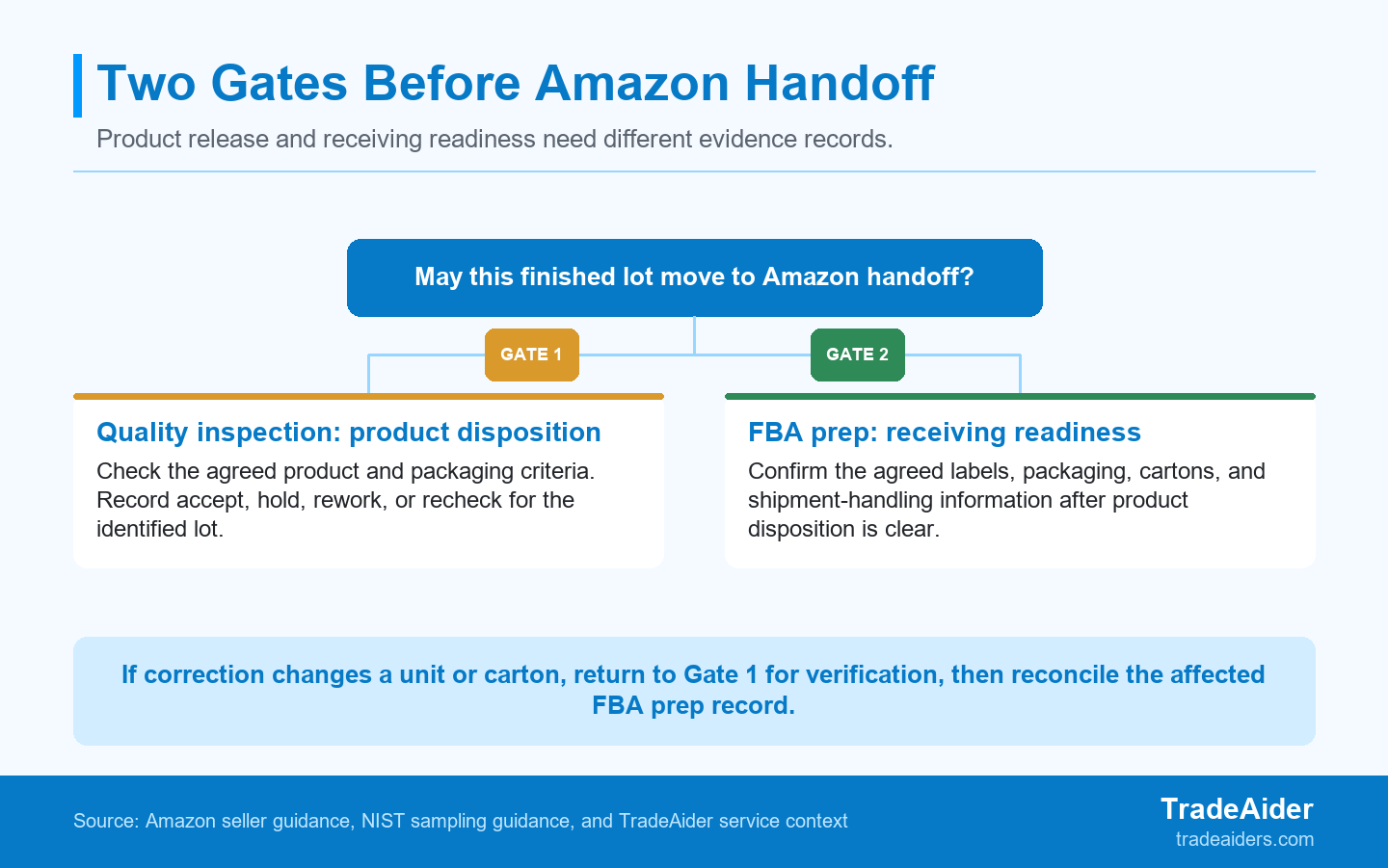
Quality inspection closes the product-release question. FBA prep closes the receiving-readiness question. If correction changes the unit or carton, verify the product scope again before reconciling prep records.
- Book quality inspection when the buyer still needs evidence for an accept, hold, rework, or recheck decision.
- Book FBA prep when the accepted units need correct handling, labeling, carton, and shipment preparation.
- When correction changes a unit or carton, verify the corrected product scope before reconciling the affected prep record.
- When one provider coordinates both, require separate checks, records, and release owners in writing.
The Evidence Each Gate Produces
Amazon's FBA preparation guidance frames the work around barcodes and labels, packaging, and product-specific prep. An FNSKU is the barcode identifier that matches an Amazon-bound unit to its listing inventory. That makes FBA prep valuable: it creates evidence that the agreed inbound-handling tasks were completed. The boundary matters because a label that identifies a unit does not, by itself, evaluate whether the unit has the correct component count, finish, function, or approved configuration. Sellers who need an order-specific scope can use TradeAider's Amazon FBA inspection scope to clarify product, packaging, and labeling checks before work begins.
NIST distinguishes using a sample for a decision about a named lot from estimating the overall quality level of that lot. That is the appropriate boundary for an inspection result: useful evidence for a named decision under stated conditions, not a guarantee about every unit or an implied certification. The trade-off is clear: a sample can support a timely release decision, but its decision value depends on defined criteria, accessible goods, and a response plan. The table below makes the two records easier to separate before anyone schedules work.
| Comparison Point | Quality Inspection | FBA Prep |
|---|---|---|
| Governing question | Does this identified lot meet the agreed inspection criteria well enough for the buyer's next decision? | Are the accepted units and cartons prepared for the agreed Amazon inbound workflow? |
| Primary evidence | Inspection observations, sample-plan result, specification comparison, and stated disposition. | Unit labels, packaging condition, carton information, and shipment-preparation records. |
| Best timing | When finished goods are available and a correction or hold can still change the release decision. | After the buyer knows which units may move forward, or under a written re-prep rule after correction. |
| Decision supported | Accept, hold, rework, recheck, or escalate a defined lot. | Confirm receiving readiness for the agreed units and shipment data. |
| What remains open | Amazon-specific labels, carton data, and prep work may still be incomplete. | Unperformed product, count, cosmetic, functional, or specification checks remain unproven. |
For a planned sample, agree the inspection level, AQL values, defect classes, lot identity, and response owner before selection begins. TradeAider's AQL calculator can help prepare the plan, but the calculator cannot supply the buyer's product criteria or decide what a supplier must correct after a finding.
What Quality Inspection Can Establish
Quality inspection starts with a standard the buyer can explain: approved sample or images, construction points, dimensions or functional checks where applicable, retail-pack contents, packaging details, defect definitions, and the response if the result is not acceptable. NIST's sampling-plan overview shows why the response path belongs in the plan; some plan structures can require further sampling rather than an immediate final decision. In practical terms, acceptance sampling means selecting a defined sample from a lot to support a lot decision: accept, reject, hold, or further review. It does not turn a visit into a universal product guarantee.
What FBA Prep Can Establish
FBA prep deals with the accepted product as an inbound unit. Amazon's shipment-creation workflow uses information about box content, preparation, and labels, which is why prep records matter at the handoff. A useful completion record identifies what was handled: the unit label requirement, carton label, carton count, packaging action, and shipment information in scope. It may also flag exceptions, such as a damaged carton replaced during prep or a label reapplied after correction.
That record should be read narrowly and confidently. It is good evidence that the listed fulfillment tasks were completed for the identified inventory. It is not a substitute for an inspection report unless the provider's written scope separately names product checks, the criteria used, the sample or coverage method, the findings, and the buyer's disposition rule.
Use Quality Release Before Final FBA Handoff
When a finished lot still has an open product question, close that question before treating final FBA prep as the release event. Here, lot disposition means the documented decision about what happens to an identified production lot after review. Amazon describes FBA as a fulfillment service for storage, pick, pack, shipping, customer service, and returns. That operational role is exactly why a buyer should maintain a separate product-disposition record if rework, count correction, or a focused recheck remains possible.
- Freeze the reference. Identify the purchase-order revision, approved product details, lot or carton range, and the current packing state.
- Inspect for product disposition. Record the agreed checks and decide whether the named lot can move, must be held, or needs correction and verification.
- Prepare accepted units for FBA. Apply or confirm the agreed labels, packaging actions, carton information, and shipment data.
- Reconcile changes. If correction altered a retail pack, unit, or carton, verify the product scope first, then update the prep record only for the affected inventory.
A final-stage pre-shipment inspection service fits the first gate when completed goods are accessible and the buyer still needs a release decision. The sequence is conditional, not ceremonial. If a supplier corrects a defect after prep has begun, the practical answer may be a focused recheck followed by controlled re-prep, not an assumption that the earlier labels still describe the corrected cartons.
When One Provider Can Coordinate Both Gates
One provider can coordinate inspection and FBA prep. That can reduce handoffs, but only if the scope makes the two gates visible. Ask for two check lists, even when they appear in one work order: product and packaging criteria for the inspection gate; label, carton, and shipment-handling tasks for the prep gate. Then ask for two records or a report that clearly separates the result of each gate. The seller should know which record proves a correction was verified, which record identifies the cartons prepared for shipment, and who may release the order to the next step.
Treat a task missing from the written scope as unconfirmed. A phrase such as "FBA inspection and prep" is a service category, not a complete acceptance rule. Before work starts, confirm the lot identifier, inspection criteria, coverage method, prep tasks, exception path, report format, and release owner. That small amount of specificity keeps a prep completion record from being read as a broad approval and makes a correction traceable to the affected inventory. If the same packing or assembly concern appears repeatedly before final inspection, it may also be worth moving the control upstream through a during-production inspection service, where the buyer can investigate the process before a finished lot reaches the handoff stage. That is a different decision from simply adding more final labels.
Illustrative Scenario: Correct Labels, Incomplete Sets
The following is an illustrative scenario. It shows how a correct label record and a product finding can both be true at the same time. The point is not that labels are unreliable; the point is that they answer a different question from a retail-pack inspection.
Why the Decision Is a Hold, Not a Verdict on Every Carton
The case uses the records available to hold and verify a defined scope, not to prove that every remaining carton is defective. The full Amazon handoff pauses because the product conflict is unresolved, while the correction effort begins with the carton range that the packing records can identify.
An Amazon seller is preparing an illustrative 7,200-set order of modular drawer organizers from a China supplier for FBA replenishment.
The order is packed in 300 cartons at 24 retail sets per carton. Ninety-six cartons were packed across two documented shifts after a component-bin change.
The prep team has applied FNSKU labels and recorded that carton labels scan. The seller has not yet authorized the delivery handoff because the product-disposition check is still open.
During the agreed sample review, seven of 125 sealed retail sets contain eleven organizer pieces even though the approved pack specification calls for twelve.
The FNSKU labels scan and the carton labels match the shipment plan, so the prep record is internally consistent. The packing record identifies the two shift windows but does not show whether the component-bin change was limited to the sampled cartons.
The label record supports the inbound-handling side of the order. The sample creates a document-product conflict: the approved pack specification and the physical retail set do not match. The seller therefore has evidence to pause release, not evidence to declare every set defective or to discard completed prep work.
The seller holds the Amazon handoff for the full order while isolating the 96-carton shift-window population for a targeted component count and repack. The remaining cartons stay out of the handoff until traceability establishes whether the scope can be narrowed.
The supplier segregates the identified cartons, recounts each retail set, repacks corrected units, and returns a carton-level correction record. The prep team then reconciles FNSKU and carton labels for the cartons that actually changed.
Release the corrected range only after the seller receives the correction record, a focused verification sample against the twelve-piece specification, and a separate prep reconciliation for the affected cartons.
This example does not prescribe a universal sample size, hold scope, or defect rule. Its decision logic is deliberately narrow: use the available records to define the hold, then use correction and verification evidence to decide what may move forward.
Build a Two-Gate Release Brief Before Booking
A short release brief prevents an ambiguous request from becoming an ambiguous report. Start with the named lot and the criteria that determine product disposition. If the buyer uses AQL-based sampling, state the intended plan rather than treating AQL as a standalone promise. ISO's ISO 2859-1 overview describes acceptance-sampling plans for inspection by attributes and their accept-reject criteria. It does not select the right plan for a specific order, so the buyer must connect the plan to the actual product and release rule.
Next, state the FBA preparation tasks and the handoff record separately. Use TradeAider's inspection standards guide to help turn broad language such as "check quality" into visible criteria. The brief should also say what happens if correction changes a unit, retail pack, carton, or label after the first preparation pass.
The Six Fields That Keep the Handoff Clear
The six fields make the product-release and receiving-readiness responsibilities visible before work begins:
- Lot identity: purchase-order revision, production date or carton range, and packing status.
- Acceptance criteria: the current product, packaging, and retail-pack requirements that determine disposition.
- Sample and response: the agreed inspection approach and the accept, hold, rework, or recheck path.
- Prep tasks: the specific unit-label, packaging, carton, and shipment-information actions required.
- Deliverables: the inspection findings, correction evidence, and prep completion or reconciliation record.
- Release owner: the person authorized to approve product release and the person authorized to hand inventory to Amazon.
Before a provider begins, confirm which revision of the product specification controls the review and who can approve a release after an exception. Keep any correction record tied to the unit, retail pack, or carton range it changed. That makes the final reconciliation practical: the inspection report explains the product decision, while the prep record explains the inbound preparation completed for the inventory that actually moves forward.
With those fields in place, a seller can request one coordinated workflow without asking either record to do more than its scope supports. Schedule your inspection.
Frequently Asked Questions
The following answers keep the same distinction in place: a handling record is valuable for the work it documents, and a product-acceptance decision requires its own agreed evidence.
Can FBA prep replace a product quality inspection?
Usually no. FBA prep and quality inspection create different evidence and support different decisions. Prep can confirm that the agreed labels, cartons, packaging actions, and shipment information were handled. Quality inspection can evaluate a defined sample or coverage against agreed product and packaging criteria. A provider may coordinate both, but the written scope should still identify each check and deliverable separately.
Should quality inspection happen before FBA prep?
When the finished lot still needs a product disposition, decide that question before final FBA handoff. This reduces the chance that a correction will force unclear relabeling or carton reconciliation later. The exception is a controlled workflow that expressly anticipates re-prep after correction. In that case, the scope should state who verifies the correction and who updates the affected prep record.
What records should an FBA prep provider return?
Ask for records that identify the units, labels, cartons, packaging actions, and shipment information actually handled. The exact format can vary, but the buyer should be able to trace a preparation action to the relevant inventory. If the provider also performs inspection, request a separate section or report for the product criteria, coverage method, findings, and product disposition rather than relying on a prep confirmation alone.
Do scannable labels prove an FBA shipment is acceptable?
No. Scannable labels support identification and receiving readiness for the agreed workflow. They do not prove that every retail set has the correct contents, that a functional requirement was met, or that an inspection plan was completed. The practical test is simple: ask whether the record names the product criteria and disposition decision. If it does not, it is not the product-release record.

Related Articles



Grow your business with TradeAider Service
Click the button below to directly enter the TradeAider Service System. The simple steps from booking and payment to receiving reports are easy to operate.

