
- About Us

- Our Services
- Your Industry
- Resources
- News & Blog
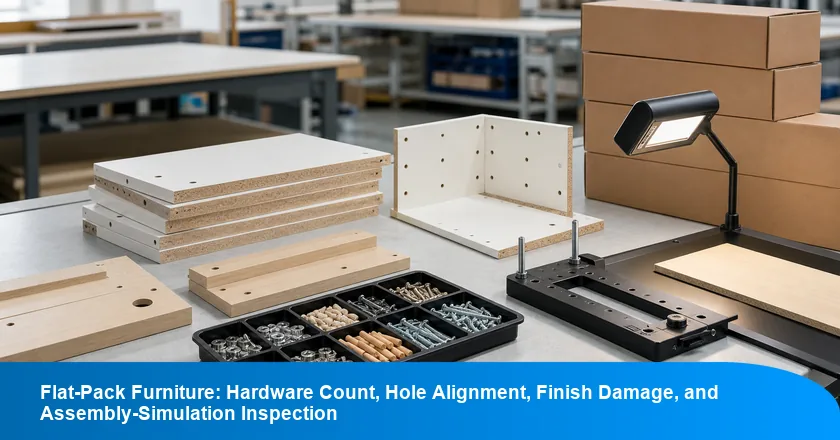
A flat-pack furniture inspection checklist becomes release evidence only when the hardware, hole alignment, finish, carton, and assembly records identify the same current carton group. A carton of panels may look complete while its bag of cam locks belongs to a later revision, its holes require force to mate, or its corner protection no longer matches the packing plan. The release question is therefore not “Did one sample assemble?” but “Which packed cartons does this result actually clear?”
Use the checklist before a pre-shipment decision to make evidence portable: a buyer, factory, and inspection team should be able to point to the same kit code, panel pair, finish reference, and carton label without reconstructing the story from photographs. That reduces the cost of a late clarification because the disputed subset is already named.
Key Takeaways
Decision: release only the carton group that the records can identify. Hardware: verify the BOM, kit code, and count before the build, then record how the current parts mate. Assembly: a controlled build proves a defined sample and configuration, not every carton by default. Boundary: keep visual inspection, package-route evidence, and any required formal test or regulatory evidence as separate decisions.
- Map first: label the checked carton subset before sampling.
- Build second: use current parts, panels, instructions, and packing evidence.
- Hold precisely: isolate an unmapped revision instead of averaging it into a pass.
- Escalate correctly: name any formal test or compliance evidence that remains outside inspection.
Build the Four Records + One Build Result Framework
Release confidence is limited by the least traceable gate. The original framework here is Four Records + One Build Result: hardware-kit identity, mating geometry, finish condition, and carton condition must point to one packed group; then a controlled build shows what that defined combination did under the stated assembly sequence. This trade-off matters: a quick pass on one carton is less useful than a slightly slower check that identifies exactly which cartons it clears. If one record refers to an unknown revision or an unlabelled subset, treat the chain as incomplete for that subset.
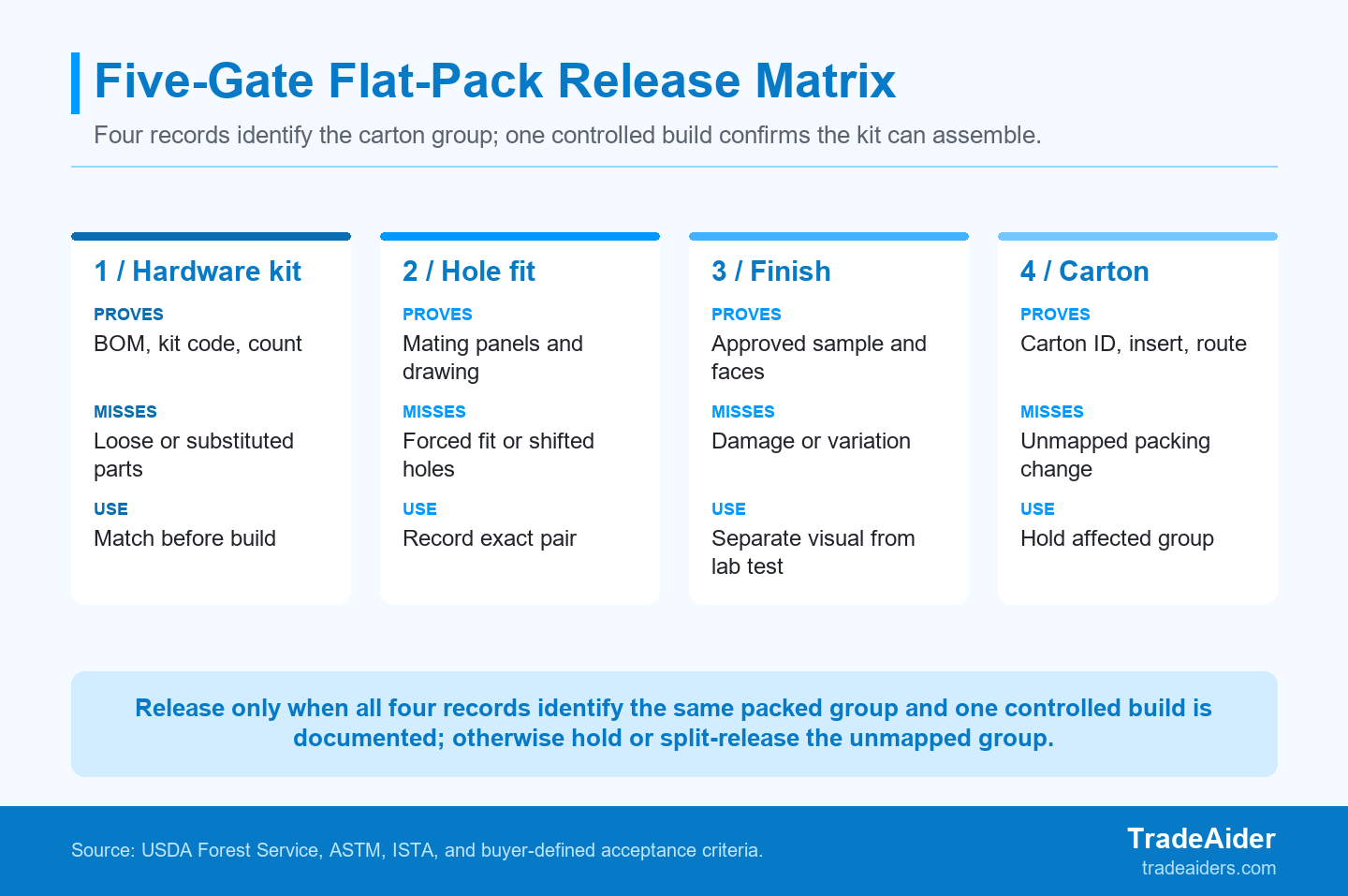
Four records define the checked packed group; the controlled build is the decision result, not a substitute for applicable formal testing.
A hardware BOM is the approved list of each screw, cam lock, dowel, bracket, and kit component, including the part code and quantity. It supports an identity and completeness check, but it is not a performance conclusion. The USDA Forest Service’s fastening guidance explains why fastening and joint design affect wood-product strength and stability; record the parts and the mating result separately rather than inventing a universal torque or load limit.
A carton group is the identifiable set of packed cartons sharing documented components and packing configuration. Put that identity on the release record: factory date or shift, carton label or range, kit code, panel revision, packing configuration, and the sample taken for the build. That one line turns a collection of observations into a defensible boundary. It also lets the buyer compare a containment cost—segregating a known subset—with the larger cost of recalling an indistinguishable mixed group.
Map the Five Checks to Evidence, Not Just Observations
A useful inspection sheet says what was checked, against which approved record, what was observed, and what changes the release decision. The matrix below is not a universal acceptance standard; it is a way to make buyer-defined limits auditable. Before adapting it, teams can review the inspection-standard framework and add the furniture-specific records that the order requires. TradeAider can use the same fields when an importer needs a product-specific on-site inspection scope.
| Check | Compare with | Record to retain | Release effect |
|---|---|---|---|
| Hardware kit | Approved BOM, kit code, quantity | Count sheet, labelled kit, photo | Hold any unapproved substitution or unmapped code |
| Mating holes | Drawing revision and named panel pair | Build sequence, force or adjustment note | Escalate forced fit, shifted holes, or repeatable mismatch |
| Finish and edges | Approved finish sample and edge requirement | Before-and-after build photos | Contain damaged or variant cartons |
| Carton protection | Packing specification and route assumption | Carton label, inserts, corners, packed product | Hold a packing change until its scope is known |
| Controlled build | Instructions, included tools, functional outcome | Assembly log and final-condition record | Clear only the mapped carton group |
For hole fit, record the observed pair, drawing revision, and visible condition before assigning a root cause. Wood exchanges moisture with its environment, as the USDA Forest Service’s wood-moisture reference explains, so one tight joint or gap does not by itself prove why it occurred. The inspection record should preserve the evidence needed for the factory and buyer to investigate it.
Hardware Count: Verify Kit Codes, Then Prove Mating Geometry
Start by placing the current kit next to the approved BOM. Count hardware by part code, not merely by total pieces; a bag with the correct total can still contain the wrong cam lock, screw length, or bracket. Then select the panels identified on the drawing and follow the supplied assembly sequence. The fastening reference is a reminder that fastening and joint design affect wood-product strength and stability. Record whether dowels seat normally, cam locks engage at the intended orientation, holes meet without forcing, and the completed unit closes, stands, or levels as the buyer requires.
Use plain failure language: “left side panel, revision B, cam-lock bag K17, rear lower hole offset; assembly required adjustment” is actionable. “Alignment issue” is not. The build may reveal an instruction error, an unlabelled panel revision, or an intermittent drilling problem; do not classify those possibilities as a single cause until the contained group is checked.
Finish and Cartons: Inspect Before and After the Assembly Route
Compare exposed panels, edge banding, corners, and high-contact faces against the approved finish reference before assembly and again after the build and repack. Note scratches, sheen variation, edge lifting, chips, or abrasion at the exact location. A visual rub or scratch observation is not a formal coating-adhesion conclusion: ASTM D3359 highlights that adhesion conclusions depend on method and substrate scope.
Inspect the carton as a packed system: carton ID, dividers, foam or paper inserts, corner protection, panel orientation, and any void that lets faces contact. ASTM D4169 frames distribution evaluation around a shipping unit and a sequence of hazards, rather than an empty box alone. If the specification needs a formal method, TradeAider can help a buyer match an agreed furniture test plan to the inspection scope; keep that work separate from a visual release observation.
Run Assembly Simulation as a Controlled Test
Assembly simulation should reproduce the buyer’s intended evidence path, not become a demonstration with substitute parts or improvised tools. Pull the panels and kit from a labelled carton group, use the provided instructions and included tools where applicable, and document the sequence. Capture the point of first resistance, any rework, tool change, missing instruction step, visible damage created during assembly, and the final functional outcome.
The carton record should also name the anticipated distribution route. ISTA’s procedure training distinguishes individual parcel-delivery conditions from less-than-truckload shipment conditions, so a buyer should not assume one package procedure fits every flat-pack order. A controlled build confirms the defined assembly evidence; route-specific packaging validation, when needed, is a separate scope.
Finish the log with a decision sentence: “built from carton group C14–C22 with kit K17 and panel revision B; passes the buyer’s stated assembly checks,” or “hold carton group C23–C30 pending kit mapping and reassembly.” That wording makes the evidence transferable to the release meeting.
Treat a Mismatch as a Containment Decision
Some product boundaries cannot be cleared by a visual or assembly check. For example, if a ready-to-assemble dresser or cabinet falls within the relevant U.S. clothing-storage-unit scope, the current eCFR Part 1261 sets separate requirements for covered units. This does not apply to all flat-pack furniture; it means the release brief should identify an in-scope product and escalate the applicable compliance evidence rather than treating a smooth assembly as a substitute.
Illustrative Scenario: A 300-Unit Kit Revision Without Carton Mapping
A build result cannot be extended to an unmapped revision.
An importer is preparing a 1,200-unit flat-pack storage-cabinet order for a multi-channel launch. The order is packed as four 300-unit carton groups. The panel design is intended to be the same, but the supplier used a late hardware-kit revision for one limited group. The factory has completed the order, and a cabinet built from the original kit code assembled cleanly. However, the packing list names carton quantities without identifying which cartons received the revised kit.
The sampled cabinet builds cleanly with the original kit code. A later carton group contains a cam-lock bag with an unrecorded supplier code. The packing list identifies carton quantities but not which cartons received the revised kit. The original build is useful evidence for the original-kit sample, but the changed kit breaks the common identity required for an extended release. The unanswered question is not whether the cabinet looked acceptable once; it is which cartons still share the checked kit and assembly condition.
Release only any carton group that can be tied to the original kit and passed build. Hold the unmapped 300-unit group for segregation, BOM reconciliation, and a focused build using the revised-kit carton. The factory separates cartons by kit code, records the revised bag against the BOM, and rebuilds a unit from that identified group using the approved instructions.
The held group can re-enter the release decision only when the kit code, panel batch, build record, and carton group are linked in the same evidence packet. This is an illustrative procurement scenario, not a reported TradeAider client case or a universal defect-rate estimate.
Turn the Result Into an Executable Inspection Brief
A release brief makes the boundary, owner, and follow-up explicit. Before the visit, send the approved assembly drawing, hardware BOM, instruction revision, approved finish sample or reference, carton specification, expected distribution route, buyer-defined functional limits, and any market-specific testing or compliance requirement. Ask the factory to keep the named carton group accessible until the decision is recorded.
A PSI is conducted when 100% of the order quantity is completed and at least 80% is packed for export. This final factory quality check should use the current packed group, not a convenient loose component sample. With the evidence packet ready, a buyer can book a furniture Pre-Shipment Inspection with an assembly-simulation brief that states the exact kit, panel, finish, carton, and hold boundary to verify.
TradeAider can translate those inputs into an on-site inspection scope and a release report that distinguishes pass, hold, evidence gap, owner, and required recheck. To turn an active order into a scoped request, request a furniture inspection brief review.
Who Is TradeAider?
TradeAider provides inspection and QA support across Guangdong, Zhejiang, Jiangsu, Shandong and Fujian, with real-time reporting through its nationwide service network. Its published pricing states $199/man-day all-inclusive for Inspection & QA Services. TradeAider is an Amazon Service Provider Network (SPN) partner. Client testimonials published on the TradeAider website report an 18% reduction in defect rates and a 23% faster inspection process; these are client-reported figures, not universal outcomes.
Frequently Asked Questions
How many flat-pack furniture units should be assembled?
The assembly sample size should follow the buyer’s risk plan, but one successfully built unit never proves every carton in the lot is identical. Define the sampled carton group first, then increase or focus the build scope when kit codes, panel revisions, finish batches, or packing configurations change. The record should show why each additional unit was selected and which cartons its result may legitimately clear.
Can a hardware count replace an assembly test?
No. A hardware count confirms presence and quantity against the approved BOM. Assembly testing shows whether the supplied parts mate with the current panels and instructions, whether the sequence can be completed, and whether the stated function is achieved without an unrecorded workaround. Keep the count sheet and the build log together so a later kit change cannot be hidden behind a previously correct total.
What should cause a furniture lot hold?
Hold the affected cartons when a defect repeats, is safety-relevant, conflicts with the approved record, or cannot be traced to a bounded and rechecked subset. A hold is particularly useful when a late component or packing change makes a previously passed sample no longer representative. State the group, missing record, owner, and recheck needed so the hold does not become an indefinite factory instruction.
When does furniture inspection need lab testing?
Use a separate testing scope when a buyer, marketplace, contract, or regulation requires a named method, measured performance result, or conformity document. Inspection can record the current product and packaging condition; it should not be described as a laboratory result unless the specified method and evidence have been completed. Put that open requirement in the release brief before sampling, along with the correct product version and route assumption.

Related Articles


Grow your business with TradeAider Service
Click the button below to directly enter the TradeAider Service System. The simple steps from booking and payment to receiving reports are easy to operate.

