
- About Us

- Our Services
- Your Industry
- Resources
- News & Blog
The FOB inspection point is the last practical quality gate before goods are loaded on board the vessel at the named port of shipment. FOB can shift risk of loss or damage at the loading point, but product-quality responsibility after FOB depends on the purchase contract, specification, acceptance terms, warranties, governing law, defect evidence, and whether the problem existed before loading.
This article is commercial guidance for importers, not legal advice. The legal answer to a defect dispute can depend on contract wording, jurisdiction, documents, product category, warranty terms, consumer protection law, and available evidence. The operational answer is clearer: inspect before FOB loading because the buyer's practical leverage is strongest before the goods leave the supplier's correction environment.
Many buyers ask the wrong question: "If goods are FOB, is the supplier still responsible for quality?" A better question is: "What evidence proves whether the goods matched the purchase order before they crossed the FOB handoff?" If that evidence is missing, both sides may argue after the shipment is already on the water.
- FOB risk handoff: tied to delivery on board at the named port under the Incoterms rule.
- Quality acceptance: tied to product specification, inspection result, contract terms, and evidence.
- Hidden defects: require evidence of when the defect existed and what the contract promised.
- Best practice: inspect before FOB loading and document release conditions in the PO.
The Direct Answer
After FOB, risk of loss may have shifted, but product-quality responsibility is not automatically solved by the Incoterm; it depends on contract terms and evidence.
TradeAider treats FOB as an evidence-timing problem: the buyer should separate product acceptance from vessel loading so later quality questions do not depend only on freight documents.
The ICC Incoterms rules help sellers and buyers define delivery responsibilities in international trade. Under FOB, the handoff is connected to goods being delivered on board the vessel at the named port of loading. That is highly relevant to logistics risk. It does not by itself answer every question about nonconforming goods, latent defects, product warranties, recall exposure, or importer obligations in the destination market.
The International Trade Administration advises businesses to use due diligence and legal counsel as appropriate when selecting and applying Incoterms. That caution matters because buyers sometimes use "FOB" as if it were a complete contract. It is not. A complete quality arrangement should name the approved sample, specification, acceptable quality limits, inspection timing, payment milestone, rework rights, claim window, document evidence, and what happens when inspection fails.
For product quality, the strongest position is to create evidence before loading. If inspection shows the product matched the specification before FOB loading, the supplier has release evidence. If inspection shows defects before loading, the buyer has leverage to require rework, sorting, relabeling, or shipment hold. If there is no inspection, the later dispute may turn into a document fight.
FOB Risk Transfer vs Product Quality Responsibility
FOB tells the parties where delivery risk changes; the quality clause tells them whether the goods were acceptable.
The table separates four questions that are often mixed together in FOB disputes. It is intentionally conservative because the exact legal answer can vary. The point is to show which questions an inspection report can help answer before the handoff.
| Question | What FOB Helps Define | What Quality Terms Must Define | Inspection Evidence Needed |
|---|---|---|---|
| Who bears transit loss or damage risk? | The delivery and risk handoff at vessel loading | Insurance, packing duty, claim process, carrier evidence | Carton condition, loading photos, seal, container condition |
| Were goods acceptable before loading? | Not enough by itself | Spec, sample, AQL, label, packaging, compliance file | PSI report, sample match, photos, measurements, function checks |
| Who handles hidden defects? | FOB does not fully answer latent defect responsibility | Warranty, claim window, defect definition, evidence threshold | Pre-shipment baseline plus post-arrival defect evidence |
| Can buyer hold payment? | Only if contract/payment terms allow it | Payment milestone tied to inspection acceptance | Clear pass/fail criteria and supplier response record |
| Who pays for rework? | FOB alone is not a rework policy | Defect responsibility, cost allocation, reinspection rule | Defect photos, quantity estimate, rework verification |
The difference is practical. FOB can say when the goods were delivered for risk purposes. The quality file says whether the goods should have been delivered at all.
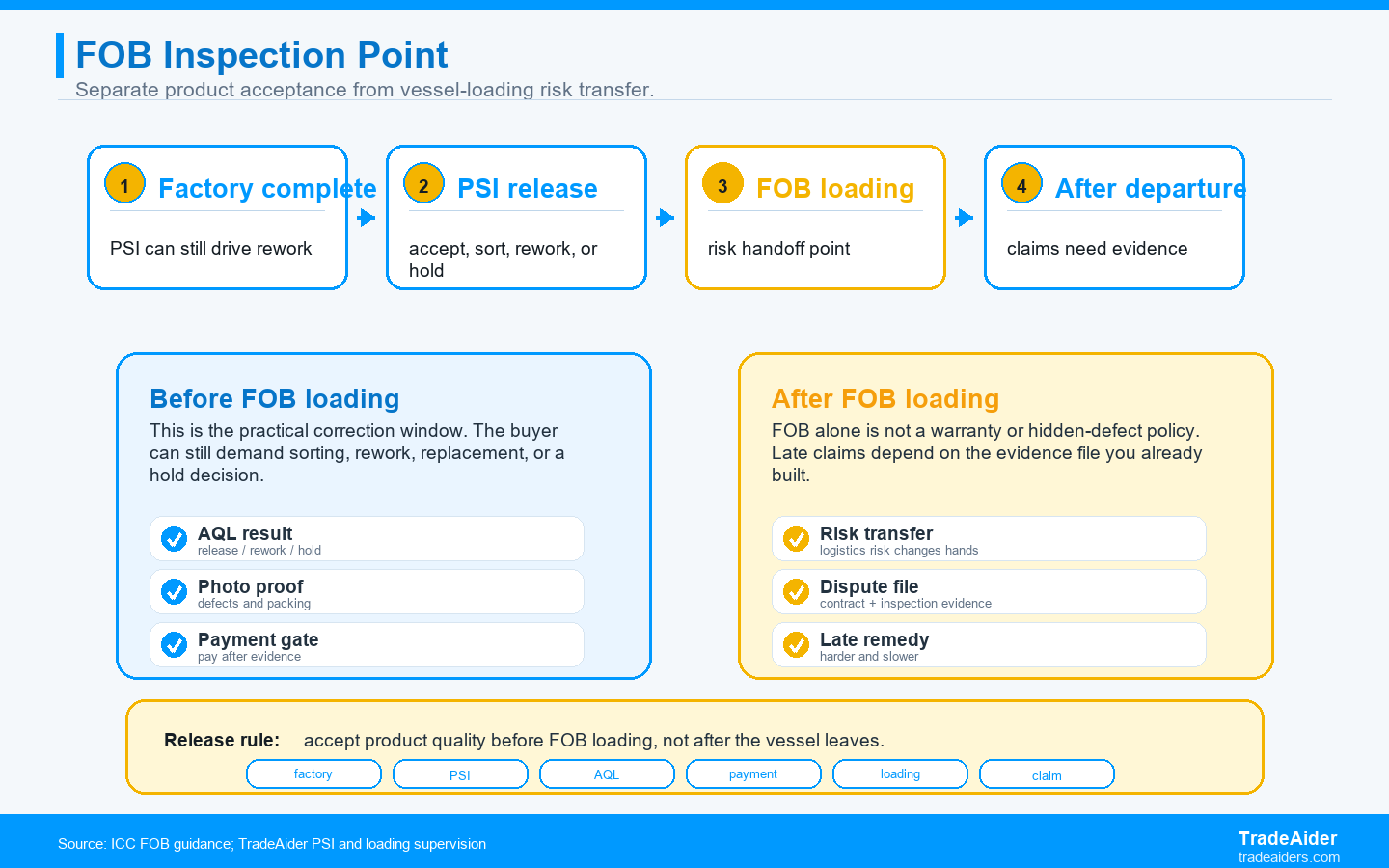
FOB risk handoff should not be confused with product-quality acceptance; inspection evidence belongs before loading.
Why The FOB Inspection Point Matters
The FOB inspection point matters because the factory can still fix problems before loading in ways that become expensive after loading.
Before FOB loading, the goods are usually close to the factory's labor, replacement parts, spare packaging, label printers, carton stock, production records, and managers. After loading, a defect may require warehouse handling, import-side rework, re-export, discount sale, disposal, or customer-service intervention. Even if the supplier later agrees to help, the practical cost has already changed.
The ICC Academy discussion of FOB highlights that the seller's loading obligation and buyer instructions matter at the port. For inspection, that means the buyer should not wait until the port stage to make product-quality decisions. The closer the shipment gets to loading cut-off, the harder it becomes to ask for sorting or rework without schedule penalties.
The inspection point should be named in the purchase order. For example: final payment and FOB shipment release are conditional on an acceptable PSI report, with reinspection required after rework if major or critical defects exceed the agreed threshold. That language does more than schedule an inspector. It tells the supplier that quality acceptance is a condition of release, not a conversation after goods are already on board.
Hidden Defects Need Evidence From Both Sides Of The Handoff
A hidden defect is harder to resolve when there is no pre-shipment baseline.
Some defects are not visible during ordinary inspection. A hidden electrical weakness, chemical issue, internal component substitution, coating failure, or durability problem may appear only after use. FOB does not make those questions disappear. The buyer still needs a contract that defines warranty terms, supplier obligations, product specification, and evidence standards. The seller may argue the goods were delivered under FOB; the buyer may argue the defect existed before loading. Without a pre-shipment baseline, both sides have less evidence.
Testing and inspection serve different roles here. Product testing can support invisible or compliance-related questions before shipment. PSI can record visible workmanship, function checks, labeling, packaging, quantity, sample match, and carton condition. Container Loading Supervision can record whether accepted goods were loaded correctly. None of these steps guarantees that no hidden defect exists, but together they create a timeline of evidence.
That timeline matters if a claim arises later. If the buyer has lab evidence, PSI photos, carton marks, loading photos, and arrival records, the discussion can focus on where the failure likely entered the chain. If the buyer has only a freight document and a complaint, the claim becomes much harder to prove.
Where TradeAider Fits Before And At FOB Loading
TradeAider fits by separating product-quality release from loading execution evidence.
TradeAider's Pre-Shipment Inspection is the main product-quality gate before FOB loading. A PSI is conducted when 100% of the order quantity is completed and at least 80% is packed for export, which means the inspector can examine a shipment-ready lot while goods are still reachable for rework or sorting. The report can support release, rework, sort, relabel, or hold decisions before the handoff.
Container Loading Supervision fits at the loading stage. It can record container condition, carton condition, quantity loaded, loading sequence, seal number, and visible handling issues. It is valuable evidence for logistics execution, but it should not be asked to do the job of PSI after the quality decision has been skipped.
The business fit is strongest when the buyer writes the two gates into the FOB process: PSI decides whether the product may be released, and loading supervision documents how the released goods entered the container. That separation prevents a common mistake: treating a clean loading photo as proof that the products inside the cartons meet specification.
How To Write FOB Quality Terms Into The PO
The purchase order should say what FOB does not say about product quality.
A FOB purchase order should not only name the port. It should name product specification, approved sample, material, dimensions, workmanship standard, packaging file, label requirements, barcode, country-of-origin mark, compliance evidence, acceptable quality limits, inspection timing, rework rights, reinspection responsibility, payment milestone, and claim window. The more specific the quality terms, the less room there is for a later argument about what "acceptable" meant.
The payment clause matters. If the supplier receives full payment before inspection, the buyer's leverage is reduced. If the contract states that final balance or shipment release depends on inspection acceptance, the supplier has a stronger reason to correct findings before FOB loading. The buyer should also state what happens after a failed inspection: who pays reinspection, how long rework may take, whether partial shipment is allowed, and who approves relabeling or sorting.
Do not write impossible clauses. A supplier cannot promise that no unit will ever fail in use. The practical clause is evidence-based: the shipment must match the approved sample and specification; critical defects trigger hold; major defects above agreed limits require rework or sorting; labels, barcodes, and compliance marks must match the approved file; and shipment release requires written acceptance after inspection.
SPAR Scenario: The FOB Claim That Needed Pre-Loading Evidence
The buyer did not avoid a dispute by inspecting; the buyer made the dispute solvable.
Situation: An importer buys 5,200 metal storage racks under FOB Shenzhen. The PO includes coating thickness, carton strength, barcode placement, hardware count, and PSI before final payment.
Problem: PSI finds that 9% of sampled units have shallow coating on welded corners and 6 cartons have mixed screw packs. The supplier argues that the goods are ready and the vessel cut-off is approaching. Without inspection, those defects would likely appear only after warehouse receiving or customer assembly.
Action: The buyer holds final payment, requires sorting of screw packs, adds corner coating touch-up on affected units, and schedules reinspection before release. At loading, a separate supervision visit records carton count, container condition, and seal number.
Result: The shipment moves one week later. The buyer pays for a changed vessel plan, but avoids receiving mixed hardware at destination. More importantly, the PO, PSI report, reinspection photos, and loading record now form one evidence chain. If a later claim appears, both sides can see what was accepted before FOB loading and what happened after.
Action Card: FOB Inspection Point
FOB quality control works best when product acceptance happens before loading and logistics evidence happens during loading.
- Do not rely on FOB alone to define product-quality responsibility.
- Write specification, sample, inspection timing, AQL, rework, reinspection, and payment release terms into the PO.
- Schedule PSI before FOB loading, not after goods reach port pressure.
- Use loading supervision for container, quantity, carton, and seal evidence after product acceptance.
- Keep lab evidence, PSI report, rework record, reinspection photos, and loading photos in one shipment file.
Before the next FOB shipment leaves the factory, send TradeAider the PO, product specification, approved sample record, payment terms, named port, packing status, and planned loading date. The next step is to schedule a TradeAider FOB release inspection before loading so product acceptance evidence exists before the risk handoff becomes a dispute.
Frequently Asked Questions
Does FOB transfer product quality responsibility to the buyer?
No. FOB can affect delivery and risk of loss, but product-quality responsibility depends on contract terms, evidence, warranties, and applicable law.
Can the buyer claim defects after FOB?
Possibly, but the strength of the claim depends on contract language and evidence showing whether the defect existed before loading or arose later.
Is PSI still needed if the supplier offers FOB terms?
Yes. PSI is often more important under FOB because it creates product-quality evidence before the loading handoff.
Can loading supervision replace PSI?
No. Loading supervision documents loading execution. PSI checks whether the product itself should be released.
What should I do before the next FOB shipment?
Add a clear inspection and acceptance clause to the PO, then schedule your FOB release inspection before loading.
Related Articles

Grow your business with TradeAider Service
Click the button below to directly enter the TradeAider Service System. The simple steps from booking and payment to receiving reports are easy to operate.

