
FOB, EXW, and CIF affect quality inspection responsibility because they change where delivery, cost, risk, transport control, and buyer leverage sit in the shipment process. They do not replace the purchase order, product specification, warranty, acceptance terms, or compliance obligations. They tell you where the commercial handoff is; they do not prove the goods are acceptable.
Importers often discuss Incoterms as freight terms, but they also shape inspection timing. Under EXW, the buyer may need to control pickup and export steps earlier. Under FOB, the buyer usually has a practical inspection window before goods are loaded on board at the port. Under CIF, the seller arranges carriage and insurance to the destination port, but the buyer still needs quality evidence before goods move beyond factory leverage.
The inspection question is not "Which Incoterm is best?" The useful question is: where can the buyer still stop, sort, rework, relabel, or hold the shipment if the product fails? The answer depends on Incoterm, product risk, payment milestone, packing status, and how clearly the contract defines acceptance.
- EXW: buyer control starts early, but so do pickup and export complications.
- FOB: inspection should finish before port loading because risk transfer is tied to the vessel loading point.
- CIF: seller arranges freight and insurance, but quality acceptance should still happen before shipment leaves China.
- Quality rule: put the inspection gate before the point where correction becomes expensive.
The Direct Answer
Incoterms define delivery, cost, and risk responsibilities, while quality inspection defines whether the goods match the buyer's specification before the handoff becomes expensive to unwind.
TradeAider enters the Incoterms decision at the inspection handoff: EXW, FOB, and CIF change logistics responsibility, while inspection evidence decides whether the goods should move at all.
The International Chamber of Commerce publishes the Incoterms rules, and the International Trade Administration overview describes Incoterms as rules that define responsibilities of sellers and buyers in international sale of goods. That wording is important. Incoterms allocate responsibilities for delivery, transport, cost, risk, and documents. They are not a substitute for a product specification or acceptance clause.
Quality inspection responsibility therefore has two layers. The first layer is logistics: who controls the goods at each point, who pays for which transport step, and when risk of loss or damage shifts. The second layer is quality evidence: what proof shows the product, packaging, label, carton, barcode, document, and compliance file match the purchase order. A buyer can lose practical leverage even if a later contract claim still exists. Shipping a defective product and then arguing responsibility is usually weaker than preventing release while the goods are still at the factory.
FOB, EXW, and CIF each create a different inspection window. The buyer should choose the inspection point before final payment, before export packing is no longer accessible, before port cut-off pressure, and before the Incoterm handoff reduces the supplier's practical ability to correct the lot.
FOB vs EXW vs CIF Inspection Responsibility Compared
The right inspection point is the last point where the buyer still has usable leverage over the goods.
This comparison focuses on quality control, not freight pricing. It assumes the buyer is sourcing finished consumer goods from China and wants to avoid discovering defects after the shipment is already moving.
| Term | Commercial Handoff Logic | Best Inspection Point | Buyer Risk If Inspection Is Late | Release Rule |
|---|---|---|---|---|
| EXW | Seller makes goods available, often at seller premises | Before buyer-arranged pickup | Buyer may inherit problems before export logistics even start | Inspect before truck dispatch |
| FOB | Seller delivers on board vessel at named port of loading | After goods are complete and before port loading | Quality dispute starts after the handoff and port pressure rises | PSI before FOB loading |
| CIF | Seller arranges cost, insurance, and freight to destination port | Before seller books final shipment release | Freight may be arranged while quality evidence remains weak | Approve goods before shipment moves |
| Any term | Incoterm does not replace quality acceptance terms | Before final payment or shipment release | Buyer may pay for goods that are harder to correct | Tie payment to acceptance evidence |
The practical lesson is that Incoterms should be translated into inspection timing. If the goods are not inspected before the point of low leverage, the buyer may still have legal arguments, but the commercial fix becomes slower and more expensive.
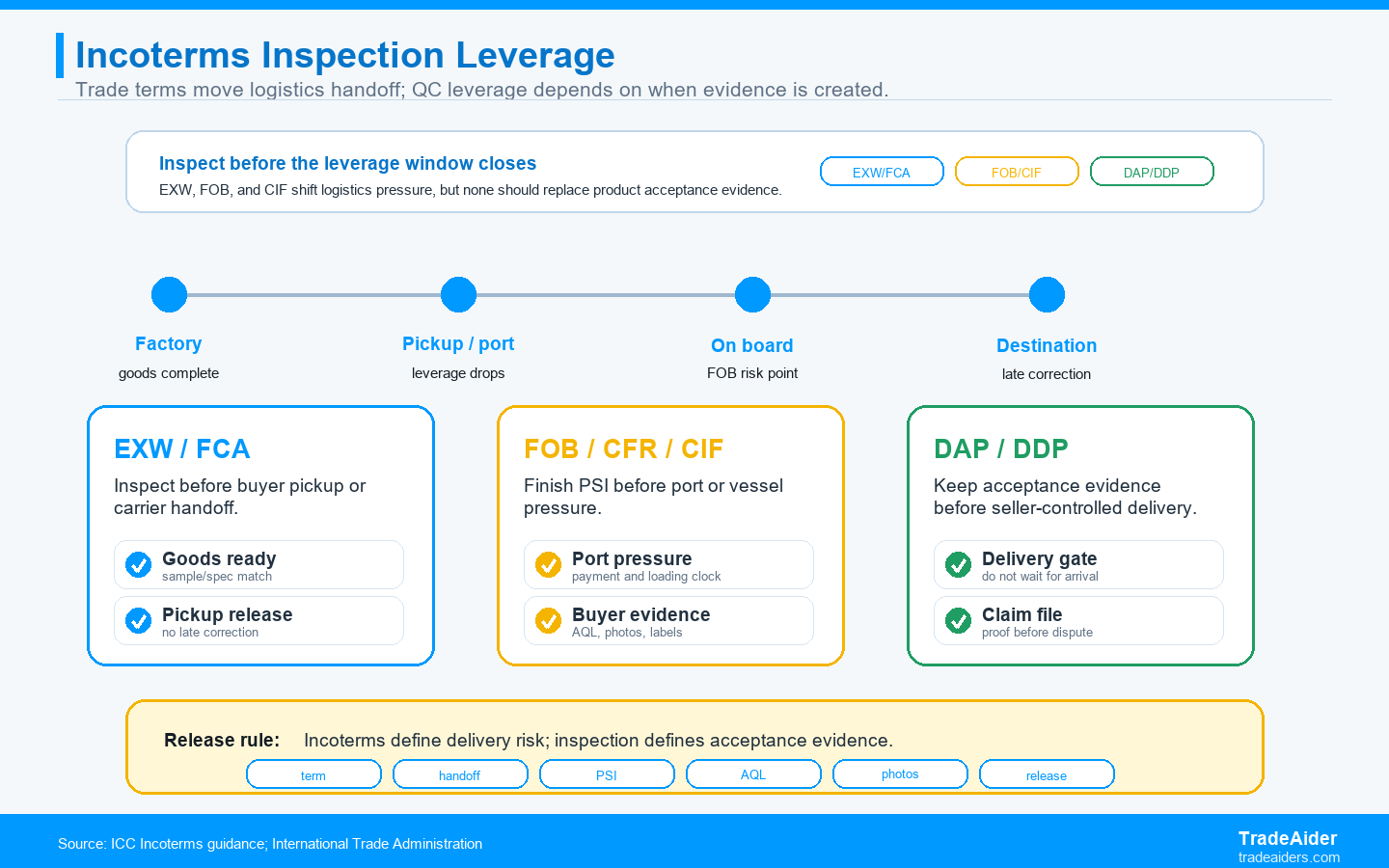
FOB, EXW, and CIF change logistics responsibility, but quality release still needs evidence before buyer leverage falls.
EXW Gives Early Control But Also Early Exposure
EXW can pull the buyer into responsibility before the buyer has enough quality evidence.
The ICC Academy discussion of EXW explains that EXW generally places limited obligations on the seller and can create complications in international use. From a quality perspective, that means the buyer should be careful about taking logistics control before inspection is complete. If the buyer's forwarder picks up goods from the factory and defects are discovered later, the goods may already be outside the supplier's normal production environment.
EXW can work when the buyer has strong local logistics control, a trusted supplier, a clear acceptance process, and the ability to inspect before pickup. It is risky when the buyer treats EXW as a cheap freight quote while leaving quality acceptance vague. The buyer may end up coordinating truck pickup, export clearance support, warehouse transfer, and defect disputes at the same time.
Under EXW, the inspection gate should happen before the buyer-arranged truck leaves the factory or warehouse. The inspector should verify product conformity, packaging, labels, barcodes, carton marks, quantity, and visible damage. If the product has compliance evidence, the physical lot should match the evidence file before pickup. The buyer should not rely on the idea that defects can be handled later because later may mean another warehouse, another forwarder, and fewer correction options.
FOB Creates A Natural Pre-Loading Inspection Gate
FOB is the term most buyers associate with China sourcing because it creates a clear port-loading handoff.
FOB is often easier for importers to understand because the named port of loading creates a visible handoff point. The seller is responsible for getting goods on board the vessel at that port, while the buyer typically arranges main carriage. The ICC Academy FOB discussion emphasizes the vessel-loading obligation and the need for timely buyer instructions. For inspection, the key point is that quality evidence should be settled before loading pressure begins.
A FOB order should not wait until the container is at the terminal to discover wrong labels, missing accessories, weak packaging, mixed SKUs, or nonconforming workmanship. The factory still has people, materials, spare cartons, barcode printers, and rework space before goods leave. At the port, the buyer has far less room to repair a quality problem without storage, demurrage, schedule loss, or customs complications.
For FOB, the strongest practical sequence is sample approval, production monitoring if needed, PSI when goods are complete and at least 80% packed, release decision, then loading. Container Loading Supervision can verify loading execution, carton condition, container condition, quantity, and seal details, but it should not be treated as the main product-quality inspection. The product should already be accepted before loading starts.
CIF Can Hide Quality Risk Behind Seller-Arranged Freight
CIF may feel convenient because the seller arranges freight and insurance, but convenience is not quality acceptance.
Under CIF, the seller arranges cost, insurance, and freight to the named destination port. The ICC Academy explanation of C rules notes that risk can transfer earlier than the destination named in the term, depending on the rule and shipment point. Importers sometimes miss this distinction because the seller's freight responsibility makes the shipment feel seller-controlled until arrival.
The quality risk is that CIF can make buyers passive. The supplier says freight is arranged, the forwarder schedule looks smooth, and the buyer assumes the shipment is under control. But if inspection has not happened before the seller releases goods into the freight chain, the buyer may discover defects only when the container is already moving or arriving. Insurance is not a substitute for product conformity; it is not designed to make a wrong label, failed function, missing accessory, or compliance defect acceptable.
For CIF orders, the buyer should still require a pre-shipment release gate before the seller completes shipment release. The purchase order should name the approved sample, specification, packaging file, labeling requirements, acceptable quality limits, and document evidence. The seller's freight arrangement should start after quality acceptance, not before it.
Where TradeAider Fits Around The Incoterms Handoff
TradeAider inspection services fit the moment before the Incoterm handoff reduces practical leverage.
TradeAider's Pre-Shipment Inspection is the core fit for EXW, FOB, and CIF because it checks the finished lot before the buyer allows pickup, port loading, or seller-arranged freight release. A PSI is conducted when 100% of the order quantity is completed and at least 80% is packed for export. This timing is especially useful for FOB and CIF orders because it allows the buyer to decide release, rework, sort, relabel, or hold before port and vessel pressure dominate the decision.
Container Loading Supervision fits after product acceptance, when the buyer wants to verify loading quantity, carton condition, container condition, loading sequence, and seal number. It is not a replacement for PSI. It is the final logistics evidence layer after the product-quality decision has already been made.
The business fit is practical: Incoterms define the shipment handoff, while TradeAider helps collect the evidence needed before that handoff. For a buyer negotiating EXW, FOB, or CIF, the inspection clause should name not only who pays for inspection, but also when findings must be resolved and whether final payment depends on acceptance.
SPAR Scenario: The FOB Shipment That Needed Inspection Before Port Cut-Off
The buyer's leverage was strongest before the cartons left the factory, not after the vessel cut-off date appeared on the schedule.
Situation: A US importer buys 4,800 home organizers from a Ningbo supplier under FOB Ningbo. The purchase order requires barcode labels, color assortment, carton drop-tested packaging, and a release inspection before final payment.
Problem: The factory asks to skip PSI because the vessel cut-off is close. The buyer insists on inspection while the goods are still at the factory. The inspector finds that 17% of sampled retail boxes have the wrong color variant barcode, and two export cartons show weak corner crush after light handling.
Action: The buyer holds release, asks the factory to relabel affected retail boxes, reinforce export cartons, and recheck barcode scans before goods move to port. Container loading is rescheduled for the next available slot.
Result: The shipment misses the original vessel, adding freight schedule pressure. The trade-off is acceptable because the defect would have been much harder to fix after FOB loading. The buyer also updates the next PO to state that PSI completion is required before the supplier books the final port delivery window.
Action Card: Match Incoterms To Inspection Timing
The inspection clause should turn a trade term into a release process.
- For EXW, inspect before buyer-arranged pickup leaves the factory or warehouse.
- For FOB, complete PSI before goods are delivered for vessel loading at the named port.
- For CIF, approve product quality before the seller releases goods into the freight chain.
- Use loading supervision for logistics evidence after product quality has already been accepted.
- State in the purchase order that final payment and shipment release depend on acceptable inspection findings.
If your PO uses EXW, FOB, or CIF but inspection timing is still vague, send TradeAider the Incoterm, named place or port, payment milestone, production status, packing status, and loading plan. The next step is to ask TradeAider to place PSI or loading supervision at the right handoff point before logistics pressure replaces quality leverage.
Frequently Asked Questions
Does FOB mean the supplier is responsible for product quality until arrival?
No. FOB is a delivery and risk allocation term, not a full product-quality warranty. Product quality responsibility should be defined in the purchase order and acceptance terms.
Is EXW bad for importers?
EXW is not automatically bad, but it gives the buyer early logistics responsibility and can be complicated internationally. Inspect before pickup if using EXW.
Does CIF insurance cover product defects?
CIF insurance is not a substitute for product conformity. It does not make a wrong label, missing accessory, or failed function acceptable.
When should PSI happen under FOB?
PSI should happen before port loading, when 100% of the order quantity is completed and at least 80% is packed for export.
Can TradeAider help with both inspection and loading checks?
Yes. Use PSI for product release and loading supervision for container-loading evidence.

Related Articles
Grow your business with TradeAider Service
Click the button below to directly enter the TradeAider Service System. The simple steps from booking and payment to receiving reports are easy to operate.

