
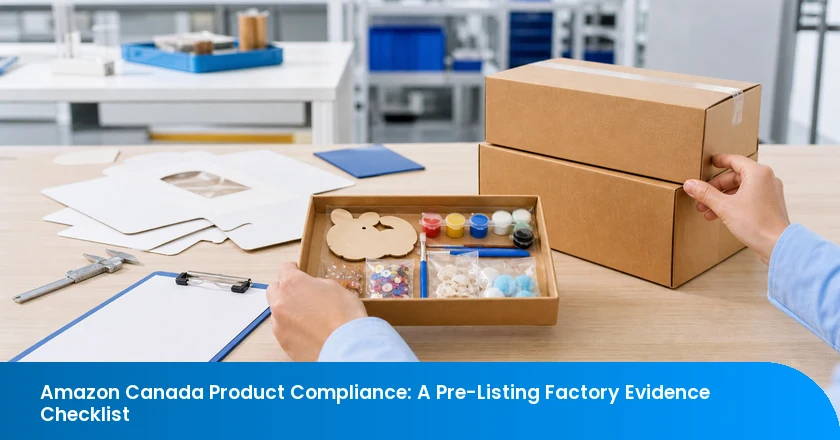
A factory document pack is not ready for an Amazon Canada listing because it contains certificates; it is ready to review only when every document can be tied to the current product, consumer package, and identifiable finished goods. The Canada Consumer Product Safety Act is the federal framework behind many consumer-product safety duties. Treat the file as evidence for a product-specific decision, not as a universal approval certificate.
What Must Match Before a Canada Listing File Can Be Reviewed?
The useful question is not “Do we have documents?” It is “Do these documents identify this offer?” A reviewable pack connects a current SKU or model, the actual retail package, the applicable Canadian rule question, the supplier record, and the named lot or cartons. That chain matters because an otherwise valid report can become hard to rely on when the pack, material, selling claim, or factory source has changed.
- Classify the product before asking for a test, label, or certificate.
- Match every document to the current product and consumer-facing package.
- Use a change as a review trigger, not as a clerical update.
- Name the cartons or units covered by the final release decision.
These checks do not determine legal applicability or an Amazon outcome. They make the factory evidence specific enough for the seller, importer, and relevant advisers to see what is known, what changed, and what still needs confirmation.
Classify the Product Before You Request Factory Documents
Start with the product itself, not the document format. The Canada Consumer Product Safety Act (CCPSA) is Canada’s federal consumer-product safety law for many consumer products. Under the CCPSA, “consumer product” can include a component, part, accessory, or packaging that a person may reasonably obtain for non-commercial use, while some categories are excluded under Schedule 1. The Act’s incident provision also shows why records should identify the item and supply-chain actors clearly if an event later has to be assessed.
The category question should come before the evidence request because Canadian obligations are not a single certificate list. For example, the CCPSA’s general prohibition is only a starting point; the exact product, claims, age group, materials, and applicable regulations may change what needs checking. Put the category, intended consumer use, and any special product features in the factory brief before selecting test or label evidence.
Build a Pre-Listing Evidence Pack Around the Actual Product
Use six fields to organize the pre-listing pack: product classification, current identity, package and label, evidence scope, supply-chain trace, and finished-lot boundary. A finished lot means the identifiable completed units or cartons covered by one release decision. The purpose is not to create another administrative checklist. It is to reveal the first broken link between a Canadian listing, the factory’s records, and the goods that may be released.
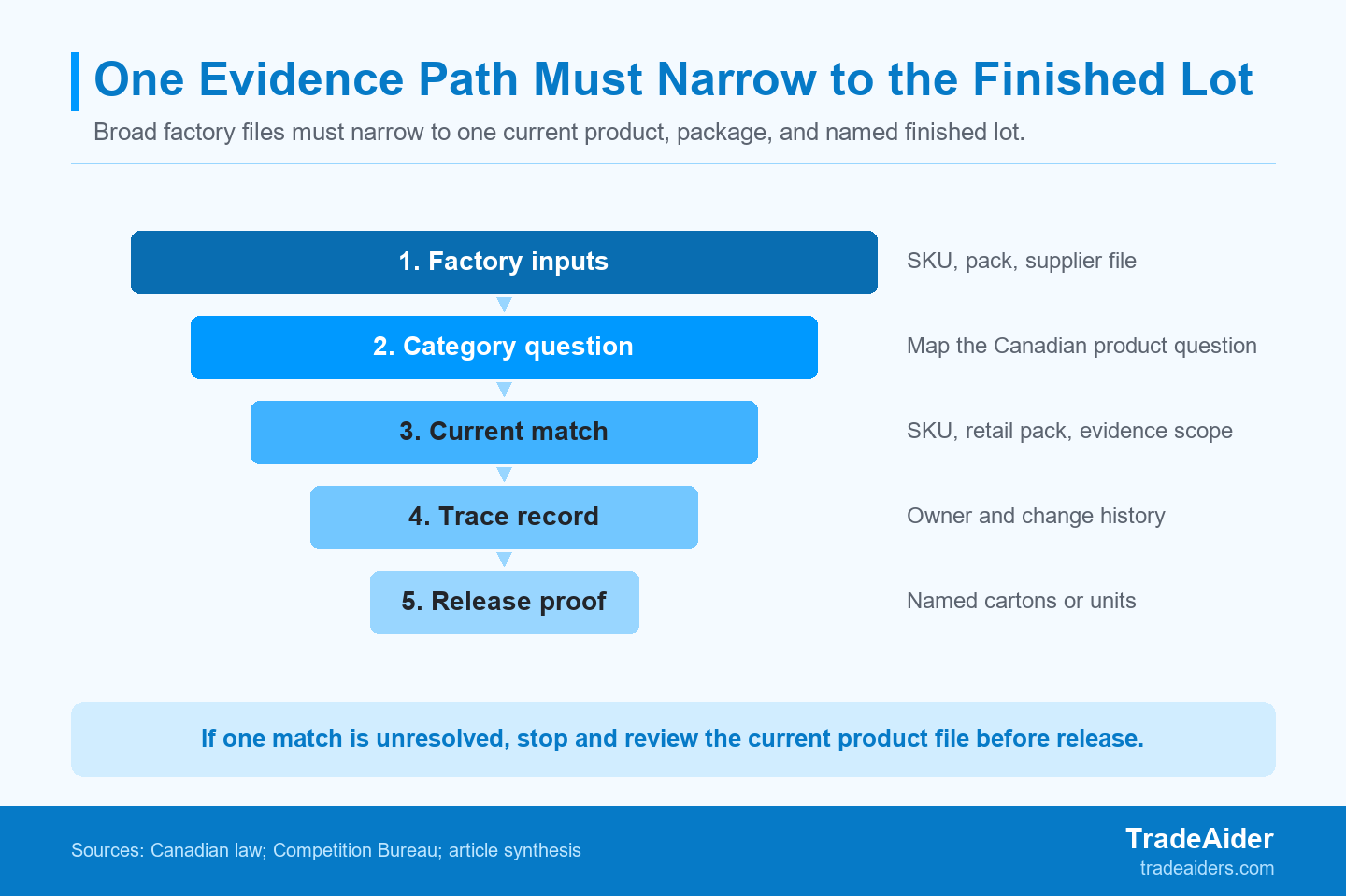
Factory files become release evidence only after they narrow to the current product, current pack, and named finished lot.
| Evidence field | What must match | Review question |
|---|---|---|
| Product classification | Product purpose, user, claims, and category | Which Canada requirements need to be considered? |
| Current identity | SKU, photos, materials, and configuration | Does every file describe one version? |
| Package and label | Retail artwork and pack components | Is the consumer-facing pack current? |
| Evidence scope | Report, declaration, specification, or review | Does it cover the present configuration? |
| Supply-chain trace | Seller, supplier, and record owner | Who can explain a mismatch? |
| Finished-lot boundary | Production dates, cartons, or units | Which goods does the decision cover? |
Where the current version needs additional evidence, a seller can review a product-testing scope for the current version with TradeAider. That is useful only after the factory has supplied the actual SKU, materials, pack file, and change history; a testing scope cannot repair an unidentified product configuration.
Match the Product, Pack, and Listing Reference
Build one identity bundle before collecting attachments. It should show a product photo, SKU or model, material or component description, retail-package artwork, and the listing reference that the seller plans to use. Add the revision date or file code where the supplier uses one. Use the seller’s same file identifier on the release record. If a report names a previous model, a listing photo shows a revised component, or the carton label carries another SKU, mark the file as unresolved. The document may still be useful, but it no longer proves the current configuration without a clear bridge.
Review Consumer-Packaged Label Evidence Separately
A translated Amazon detail page is not a substitute for reviewing the retail pack. A prepackaged non-food product is a non-food consumer item sold in a package before the buyer receives it. For that category, the Competition Bureau’s packaging and labelling guidance explains that mandatory information must be accurate and meaningful, with bilingual and other requirements depending on the product and rule. Store final images from each package face in the same record. Keep the current artwork, package photos, and any relevant label review together so the evidence file describes what the consumer will receive.
Make Sure Factory Evidence Still Describes Production
The factory evidence needs a production link, not just a technical title. Ask what version was reviewed, what material or component was used, when the record was created, and which production population it covers. This turns a loose “certificate” into a usable record: someone can compare it with the bill of materials, packaging revision, supplier identity, and shipment mapping when a question arises.
A reliable request also assigns owners. The seller or importer owns the marketplace and product decision; the factory should provide current product and production information; the inspection or testing provider can verify agreed observable attributes or scope. Keeping those roles separate prevents a factory document from being described as a platform approval or legal conclusion.
Treat a Material or Pack Change as an Evidence Trigger
A change log should flag material substitutions, new suppliers, artwork revisions, age-grade changes, revised product claims, and packaging changes. Each can change what the earlier evidence actually represents. The practical control is simple: compare the previous evidence inputs with the current configuration, then record whether the difference is outside the old scope, needs clarification, or leaves the record aligned. Include the date, person who approved the change, and affected SKU so the comparison can be recreated later. Attach the revised supplier confirmation. A clean file should make that comparison possible without relying on memory or email fragments.
Name the Finished-Lot Boundary Before Release
For release, name that finished lot before deciding what may move. If a package revision affects only cartons C19–C30, a focused hold can protect the decision better than clearing or rejecting the whole order by assumption. The carton map, SKU, pack version, and final check must point to the same population. Record the boundary in a form the seller, factory, and inspector can all read. When a buyer needs an agreed finished-goods check against that boundary, they can verify the finished lot before shipment with a defined inspection scope.
Use Product-Specific Rules Instead of a Universal Certificate List
Children’s products show why classification cannot be skipped. Canada’s Toys Regulations are product-specific. A craft kit may require the team to examine the actual design, components, construction, age-related presentation, and package information rather than treating a report from another toy or a generic factory declaration as interchangeable evidence.
The same discipline applies outside toys. Textile, infant-product, electrical, cosmetic, food, medical, and other categories can sit under different rules or regulators. The factory brief should therefore ask: What product is this? Who will use it? What claims appear on the item, package, or listing? What evidence was created for this exact configuration? Those questions produce a narrower, more defensible request than “send all compliance documents.”
Keep Records for Traceability Beyond the Listing Stage
A listing file should survive beyond launch. Section 13 of the CCPSA requires covered commercial parties to prepare and maintain prescribed product documents and generally retain them for six years after the end of the relevant year, subject to the Act and any prescribed period. The operational lesson is to preserve the matching record set, not only the final PDF that was uploaded.
Traceability also reduces the time needed to understand a later safety question. Keep the supplier name, production date, SKU, artwork revision, carton range, and evidence version in one retrievable record. Post-sale incident duties are separate from the listing file and depend on the facts of the event. Clear records simply make it easier to identify the product and supply-chain facts if an event must be assessed.
Separate an Amazon Document Request From a Regulatory Conclusion
Amazon Canada notes that photos showing all sides of a product or its packaging can help document a requirement and reduce approval delays. Put those Amazon Canada documentation images beside the current artwork and SKU file, rather than treating them as stand-alone proof. This gives the reviewer a direct comparison between the physical pack, the listing reference, and the supporting record.
An Amazon request is a platform evidence process. It does not replace the responsible business’s need to identify applicable Canadian product requirements, and it does not turn an inspection result into a legal opinion. If Amazon asks for a document that does not match the actual retail package, correct the identity problem first; uploading a mismatched file can create delay without resolving the underlying question.
Illustrative Scenario: Revised Packaging Breaks the Evidence Link
The highest-risk mismatch is often small enough to be dismissed as artwork housekeeping. It should not be. When packaging changes, the seller needs to know whether the new consumer-facing information, product identity, and supporting evidence still describe the same offer. The following is an illustrative example, not a TradeAider client case or a legal conclusion.
Compare, Contain, Then Recheck the Changed Pack
A marketplace seller is preparing a Canadian listing for 1,200 children’s craft kits. The factory has separated the order by SKU and carton range, and the finished cartons can still be identified as either the original retail-package version or a revised one. That traceability matters because the buyer can make a targeted decision rather than treating every carton as identical.
During the file review, cartons C19–C30 are found to carry revised package artwork while the evidence file and listing images still show the earlier version. The carton map isolates 360 revised kits from 840 unchanged kits. The change affects information presented to the consumer, but the record pack does not say whether the earlier label and evidence review applies to the revised package.
The practical problem is not that the 360 kits are automatically non-compliant. It is that the evidence link is unresolved for a known population. The buyer holds C19–C30, keeps the 840 unchanged kits separately identifiable, and asks for the revised artwork, component information, and confirmation of whether the earlier evidence scope remains valid. This avoids both an unsupported full release and an unnecessarily broad order-wide conclusion.
The revised cartons may move only after the current pack, SKU, applicable evidence scope, and carton range identify the same configuration. The result is a verifiable before-and-after condition: before review, the file described the old package; after correction, the affected 360 kits are tied to the updated record. This is an illustrative example, not a TradeAider client case or a legal conclusion; product-specific applicability should be checked with the appropriate qualified adviser where needed.
Send a Factory Brief That Makes the Canada Check Verifiable
Before requesting files, send one brief that names the Canada product category, current SKU or model, package and label revision, evidence to reconcile, factory and seller record owner, finished-lot boundary, change trigger, and release owner. The brief should also state what happens if one field cannot be matched: hold the named population, clarify the difference, then recheck the current configuration. For a marketplace order that needs an operational product-and-package scope, you can request an e-commerce inspection scope for your Canada listing file from TradeAider.
Frequently Asked Questions
Does Amazon Canada approve consumer products before listing?
Amazon may ask for documents or images for a listing, but that request is not a blanket compliance approval. The seller or importer still needs to identify the exact product, its current package, the applicable Canadian requirements, and the evidence that supports the current configuration. A document review can make those relationships visible; it cannot replace a product-specific legal or marketplace decision.
Which factory records help a Canada listing file most?
Prioritize records that identify the seller or supplier relationship, current SKU or model, product photos, materials or components, retail-package version, relevant evidence scope, change history, and the cartons or units being released. A short, connected set of current records is more useful than a large folder of certificates that cannot be matched to the product on hand.
Do labels for Canadian consumer products always need English and French?
Many mandatory label requirements for prepackaged non-food consumer products involve bilingual presentation, but the exact obligation and any exemptions depend on the product and the applicable rules. Review the actual consumer package rather than relying only on a translated listing page. If a package changes, keep the revised artwork with the evidence used to assess that version.
When should an old test report be reviewed again?
Review it when the product, material, component, supplier, package, label, consumer claim, or relevant rule changes enough that the tested configuration may no longer represent the current offer. The right next step is not always a new test. First compare the prior scope with the present configuration, then determine what clarification, review, or additional evidence is needed.
Can a pre-shipment inspection replace Canada compliance work?
A pre-shipment inspection cannot replace Canada compliance work. It can verify agreed finished-goods, package, quantity, or workmanship attributes against a defined scope. Compliance assessment depends on the specific product and applicable Canadian requirements. Used together, the evidence file identifies what the product should be, while the finished-lot check can help confirm which physical goods match that defined scope.
Articles Connexes

Développez votre entreprise avec le Service TradeAider
Cliquez sur le bouton ci-dessous pour accéder directement au Système de Service TradeAider. Les étapes simples de la réservation et du paiement à la réception des rapports sont faciles à utiliser.

