

A washing machine pre-shipment inspection, or PSI, needs more than finished goods and an electrical outlet. Confirm the actual model’s water supply, drainage, rated power, installation and test-program requirements before the visit. Then record which operating stages were completed under the agreed conditions. If a required condition is missing, identify the affected checks as not performed or incomplete and arrange the specific follow-up. A display that turns on cannot establish that the washer fills, washes, rinses, drains and spins correctly.
What to settle before the washer inspection
- Match the model, approved references and goods presented for inspection.
- Confirm utilities, installation, program, load and safe operating resources.
- Preserve unfinished stages and their follow-up in the report.
Define the washer, references and inspection scope
A washing-machine inspection starts with the exact product configuration. Identify whether the order contains front-load, top-load or twin-tub models, the relevant variants and the destination version. Match the model code, declared capacity, rated voltage and frequency, plug, controls and supplied accessories to the approved files. A shared cabinet or family name does not show that two versions use the same program, water connections or test conditions.
The International Electrotechnical Commission, or IEC, publishes IEC 60335-2-7:2024 for household and similar washing-machine safety. Its public scope identifies the product-safety subject, not a complete procedure for a factory visit. Confirm the applicable adopted requirements and current technical documents for the actual destination and build. A citation to the standard cannot establish that this shipment has passed its requirements.
Provide the purchase order, current specifications, approved sample or drawings, rating and warning artwork, operating instructions, accessory list and packing specification. Agree the functional checks, programs, load, observation period, quantities and acceptance criteria. Distinguish ordinary operating observations from electrical measurements, performance tests or document checks that require different resources. If a reference conflicts with the product presented, ask the responsible buyer or technical owner to resolve it before the affected test.
For TradeAider PSI, the order quantity is 100% complete and at least 80% packed for export. The packing threshold does not allow production to be only 80% complete. Identify the accessible inspection lot and variants before selection. The inspection sampling reference helps frame that sampling discussion; it does not decide how many machines receive each separate functional or special test.
Confirm water, drainage, power and site access
Water, drainage, power and stable installation are prerequisites for meaningful wet checks. Electrolux’s UK washing-machine installation guide places hose connection, removal of transit bolts, leveling and power connection before a rinse-and-leak check. That sequence explains the dependencies. Use the actual washer’s instructions for inlet requirements, drainage arrangement and electrical supply; a UK domestic guide is not a universal factory test specification.
Ask the factory coordinator to confirm the following points before attendance. For each row, record the actual arrangement, reference revision, person confirming it and unresolved gap. Photographs can explain the station layout, but the inspector still needs to check the conditions actually available on arrival. Do not treat a photograph of a water tap as evidence that the required connection or supply is usable.
| Preparation item | Reference and ready condition | Confirmation to retain |
|---|---|---|
| Water supply | Model-required inlet connections, suitable supply and compatible hoses/seals available | Actual source and connection; factory contact |
| Drainage | Hose routing, outlet arrangement and discharge capacity follow the model instructions | Outlet location and hose arrangement; unresolved restriction |
| Power | Rated voltage/frequency, suitable connection and required protection available | Supply/setup reference; competent responsible person |
| Floor and access | Suitable stable surface, space for hoses and safe access to selected goods | Station location, accessible quantity and handling support |
| Test resources | Agreed program, load, operator, equipment and criteria ready | Method/reference revision and missing resource |
| Time and restoration | Enough station time for agreed stages, draining and repacking | Workload arrangement, restoration owner and expected readiness |
Plan the workload around the actual station capacity and agreed cycle coverage. Several washers connected at once need suitable utility and drainage capacity; available floor space alone does not establish that capacity. Confirm safe handling assistance and access to selected cartons. If the supplier offers only a brief demonstration area, resolve whether the required checks can be completed there before confirming the visit’s scope.
For sampled workmanship assessment, agree the lot, inspection level, defect classifications and acceptance quality limit, or AQL, where that scheme is used. AQL is an index for a sampling scheme, not a permitted shipment defect percentage. Use the AQL sampling calculator after choosing those inputs. Keep workmanship selection separate from the quantities and elapsed time needed for the agreed washer function checks.
Prepare the selected machines for the agreed program
Prepare each selected washing machine before interpreting its operating behavior. Check the cabinet, door or lid, seal, drum or tub, controls, feet, hose fittings and accessible cord for damage or missing parts. Confirm the correct accessory kit and model instructions. Record the initial condition and unit identity before adjustments so a setup correction does not erase evidence of how the machine was presented.
Have competent personnel follow the model’s installation instructions, including any transport restraints that must be removed for operation. Keep removed parts identifiable for later restoration. Check leveling and foot contact, secure the hose connections and route hoses without pinching or kinks. Use the specified drainage arrangement. Do not invent a drain height or substitute an improvised connection merely because water appears able to reach a nearby outlet.
The correct test load depends on the actual mode and model. For example, LG’s US top-load installation-check guidance requires an empty tub for that mode and says some models need the check before first use. That instruction does not establish an empty-load rule for every washer test. Record the required program, load material and mass where applicable, and any initialization or calibration procedure specified for the actual machine.
A door or lid interlock is a protective system that controls access during operation. Check its normal behavior only through the approved procedure. Never defeat the lock, hold a switch closed or reach into a moving drum to complete an inspection. If a machine cannot safely start, stop the affected work and obtain competent review. A locked-door indication alone also does not establish that every safety function has been validated.
Keep the unit identities, setup photographs and controlling file revisions attached to the inspection instructions. Identify the intended report user and agree how unavailable checks and incomplete tests will be recorded.
Observe filling, washing, rinsing, draining and spinning
A washing-machine function check should identify the stages actually observed, rather than record a single “power on” result. Follow the agreed program and load. For an automatic washer, distinguish filling, washing action, rinsing, drainage and spinning where included. For a twin-tub design, follow its separate wash and spin instructions and any required transfer procedure. Do not force another design’s operating sequence onto it.
LG’s US front-load installation test-cycle guide checks filling, excessive movement and drainage using a specified loaded cycle. It directs the user to stop if leakage or excessive vibration occurs. Read alongside the empty-tub installation-mode example above, this shows why the program and load belong in the record. Neither guide supplies a universal PSI recipe or proves the performance of a different model.
During filling, observe whether water enters through the intended route and whether the accessible connections remain free of leakage. During washing and rinsing, compare the control response and drum or agitator action with the model reference. If water appears, identify the stage and apparent source without reaching into an operating machine or removing a live panel. Distinguish a connection spill from a leak observed while running, and record uncertainty rather than guess at the cause.
During drainage, check the intended discharge route and whether the hose remains secure. During spinning, observe acceleration, movement, unusual mechanical noise and the normal completion sequence against the approved criteria. Stop for unsafe leakage, excessive movement, smoke or another unsafe condition under the site procedure. An uneven installation or incorrect load may need correction before a mechanical conclusion is justified; preserve the original observation and any repeated result.
Record the unit, program, load, actual supply/setup, stages completed, error messages, elapsed observation and relevant photos or video. If the visit ends before an agreed stage, identify that stage as unobserved. If only a shortened sequence was agreed, name that coverage rather than describe a complete wash-cycle test. Measurements need their actual method and equipment references, not just a number copied from the display.
Discuss this workload through Pre-Shipment Inspection services with the model instructions and readiness checklist. Agree which visual, functional, label and packing checks are feasible and how limitations will be reported. This gives the team a concrete assignment without assuming that ordinary operation substitutes for every electrical or performance test.
Keep field observations separate from performance and safety tests
Watching a washer complete a cycle is different from measuring its cleaning or consumption performance. IEC 60456:2024 defines methods for measuring household washing-machine performance. Its public scope also points acoustic-noise measurement to other standards. An ordinary factory run therefore cannot establish a standardized cleaning result, energy or water rating, or acoustic performance merely because the machine appears to operate.
If the buyer requires power, current, speed, temperature, water use, time or noise measurements, agree the applicable method, operating condition, instrument, measurement position and acceptance criteria. Record the supply and program/load conditions that affect interpretation. A phone video of spinning does not establish a measured speed, and a sound reading without its environment and measurement arrangement cannot support a standardized noise claim. Do not apply one model’s wattage or speed to another version.
Electrical safety work needs an applicable procedure, suitable equipment, competent operators and safe isolation arrangements. Confirm the tests and criteria required for the actual construction. Do not improvise high-voltage, insulation or protective-earth tests to fill an empty report field, or bypass protection to keep a cycle running. Where the required work exceeds the site’s capability, identify the separate testing or documentary evidence needed and who will arrange it.
Match any supplied laboratory report to the relevant model, construction and test scope, including later changes. Check the actual destination requirements and recipient’s evidence expectations. A supplier’s routine production record and an independently witnessed site result have different origins; label them accordingly. The PSI report should show the checks agreed and performed, without presenting itself as a complete safety evaluation, durability test or certification decision.
Drain and restore tested machines before packing
Wet testing leaves a washing machine in an operating configuration that may differ from its shipping configuration. Bosch’s UK moving guidance addresses switching off and disconnecting the appliance, draining water from hoses and refitting transit bolts for long-distance transport. For factory inspection, use the actual model’s draining and transport instructions together with the approved export-packing method. The domestic moving guide does not specify the correct restraints for every washer.
Assign the factory a competent person to complete shutdown, isolation and draining safely. Allow for hot water or delayed unlocking where the model instructions require it. Remove the test load and account for loose items. Check the accessible cabinet, base area, hoses and packaging for water, contamination or damage found during the work. Record the actual condition; do not promise that every internal water path is completely dry after a simple external check.
Restore the required transport restraints and hose or cord retention using the correct parts and instructions. A restraint removed for operation should not be left loose in the carton when the approved packing method requires it installed. Conversely, do not leave shipping restraints fitted for a later operating recheck. Make the unit’s current state clear when responsibility passes between the testing area and packing team.
Recheck supplied hoses, seals, fittings, tools and manuals against the accessory list. Confirm inserts, product orientation, restraint, carton marks and closure match the approved pack. Keep examined units traceable through restoration and record any damage or missing parts separately. If a package test is required, settle the actual method and safe handling resources for this heavy product in advance; visual repacking inspection does not establish transport-test performance.
Record incomplete checks and arrange the follow-up
A washer inspection report should keep completed observations separate from an incomplete or unperformed check. State the required condition, what actually happened, which stages remain unobserved and the follow-up owner. A check that could not be validly run is not automatically a product failure, but it is also not a passed test. The buyer needs the open requirement when deciding what evidence remains necessary.
Illustrative scenario: A selected washer’s display responds, and its labels and external condition can be checked, but the station has no suitable water connection. These are hypothetical conditions, not a TradeAider client case. Retain the valid findings. Record the required wet check as “not performed: suitable water supply unavailable,” listing filling, washing, rinsing, drainage and spinning as unobserved under that planned sequence. The factory coordinator must confirm a suitable station; the inspection coordinator and buyer then agree the follow-up. Do not turn the display response into a completed function result or assume a motor defect.
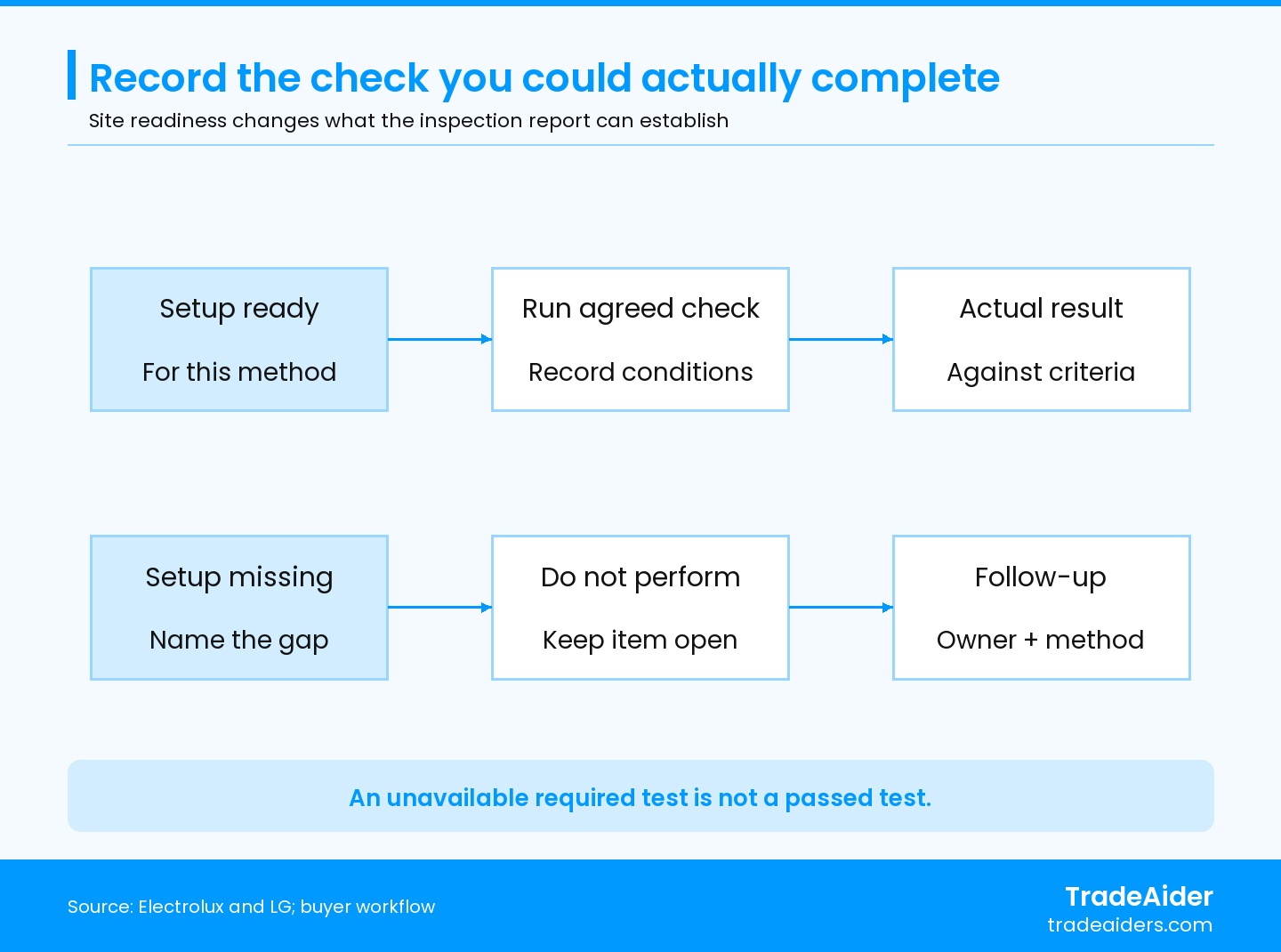
Site readiness applies to each agreed check. If a required condition is missing, keep that check unperformed and identify its follow-up; valid independent observations can still be reported. A powered display does not replace the wet operating stages that were not observed.
| Record field | Enter the actual information | Action or decision supported |
|---|---|---|
| Unit and requirement | Model/build, sample/carton, check and reference revision | Identify the goods and requirement still at issue |
| Status and coverage | Performed, partly completed, not performed, or genuinely not applicable; stages observed | Keep a missing result separate from a verified nonconformity |
| Finding and conditions | Observation/reading, program/load, supply/setup, time and evidence reference | Show what the result can actually establish |
| Gap and owner | Missing resource, refusal, interruption or unsafe condition; responsible contact | Arrange the specific prerequisite or correction |
| Follow-up and review | Agreed method, goods/quantity, evidence recipient and next review point | Retain the open requirement until the required evidence is reviewed |
For a partly completed run, preserve its completed stages and identify the remainder. For a defect observed under valid conditions, retain the finding, corrective action and verification of the affected stage; repeating only an unrelated stage cannot establish the correction. Do not use “not applicable” to hide missing equipment. Confirm the person authorized to accept evidence or an exception, and record that decision without rewriting the original inspection history.
To prepare an assignment or clarify unfinished checks, contact the TradeAider team with available model, order, factory, destination and timing details. An inquiry can begin before every technical file is ready. Before execution, agree the current references, utilities, programs, loads, safe resources, criteria and final report recipient’s language and format. The inspection report should identify the goods covered, actual findings and remaining limitations.
FAQ
Must every washing program be run during one PSI?
The visit covers the programs and checks agreed for the assignment. List the required modes and relevant variants before the workload is confirmed. If the buyer needs several complete programs, include their station time and resources explicitly. A short agreed check of one program does not demonstrate every other program or option, even when the control panel offers them all.
Can the factory’s earlier test video replace a missed witnessed check?
Only if the buyer and intended recipient explicitly accept that evidence for the named requirement. Check the unit identity, date, program, load, conditions and stages visible. Describe the video as a supplier-provided record, rather than a check witnessed during the current visit. An old clip of a similar machine cannot close a requirement for identifiable current goods and independently witnessed results.
What if the supplier changes the control software after inspection?
Review the affected function checks before relying on the earlier results. Obtain the actual software version and change description, then ask the technical owner which programs, controls or protective behavior may be affected. Agree the verification needed for the changed goods. Preserve the earlier report and link the change assessment and follow-up; an unchanged model name does not establish unchanged operation.

Articles Connexes


Développez votre entreprise avec le Service TradeAider
Cliquez sur le bouton ci-dessous pour accéder directement au Système de Service TradeAider. Les étapes simples de la réservation et du paiement à la réception des rapports sont faciles à utiliser.