
A third-party inspection report is necessary when an applicable rule, customer agreement, tender, payment condition or project program requires that evidence. A buyer may also commission independent findings to support a quality or dispute decision. Start with the actual requirement, then identify the document and scope it calls for. An inspection report, laboratory test report and certification document serve different purposes. The useful question is which evidence is needed for this product or activity, who will use it and when it must be available.
Find the Requirement Behind the Report Request
- Identify whether the request comes from a rule, an agreed commercial condition or the buyer’s own risk decision.
- Match the deliverable to the activity, such as order inspection, laboratory testing or a certification procedure.
- Review an existing report against the current product, scope and applicable requirements.
- Agree the covered goods or activity, recipient, deadline and follow-up before commissioning work.
Identify the document the request actually requires
An inspection report is a record of an examination and its findings for an identified scope. It helps the reader understand what was checked, against which references and under what conditions. Its value comes from that connection to the intended decision. A report covering shipment quantity and visible workmanship answers a different question from a chemical test on a submitted sample.
Inspection and testing are distinct conformity-assessment activities. ILAC describes testing-laboratory accreditation using ISO/IEC 17025 and inspection-body accreditation using ISO/IEC 17020. Its explanation emphasizes competence for specific activities. Use the activity requested to identify the appropriate document and technical scope. ILAC’s description of accreditation activities.
- Order inspection report. Records agreed observations or checks on identified goods at a defined stage. The buyer can use those findings when deciding release, correction or further examination.
- Laboratory test report. Records results for the submitted specimen or defined test object, using stated methods and conditions. Connect that scope to the product requirement being assessed.
- Certification document. Relates to the decision and requirements of a particular certification or conformity procedure. Identify the required issuer and underlying evidence from that procedure.
When a request simply says “third-party report,” ask which of these outputs is intended. Resolve that wording before ordering a service. This is especially important when a purchasing team needs shipment observations while its technical team needs test evidence for a product rule.
When a customer, contract or payment condition requires a report
A customer’s actual contract or purchasing program may make an independent report a condition of acceptance or shipment. Read the purchase order, attached quality agreement and any tender requirements together. Identify the required report, its covered scope, the recipient and the due date. If the wording is ambiguous, agree the meaning with the party responsible for the requirement before work starts.
A buyer can also request inspection as a risk-control measure before agreeing an order. A new supplier, an earlier quality problem or limited visibility of finished goods may justify that decision. State the required checks and resulting report in the agreement so the supplier can prepare the goods and access. The report then supports the buyer’s decision using the scope actually examined.
| Trigger | What to identify | Evidence to arrange |
|---|---|---|
| Customer or purchase contract | Agreed inspection stage, checks and acceptance condition | The specified order inspection report and disposition |
| Tender or payment condition | Exact document wording, issuer requirements and deadline | The document stipulated for that transaction |
| Product rule or conformity procedure | Product, market, applicable procedure and exceptions | Required test results, technical records or certification documents |
| Permit, claim or project program | Covered activity, method, reporting period and responsible party | The records required by that specific program |
| Complaint or dispute | Question to establish, condition of goods and applicable evidence process | Scoped findings and any separately required expert evidence |
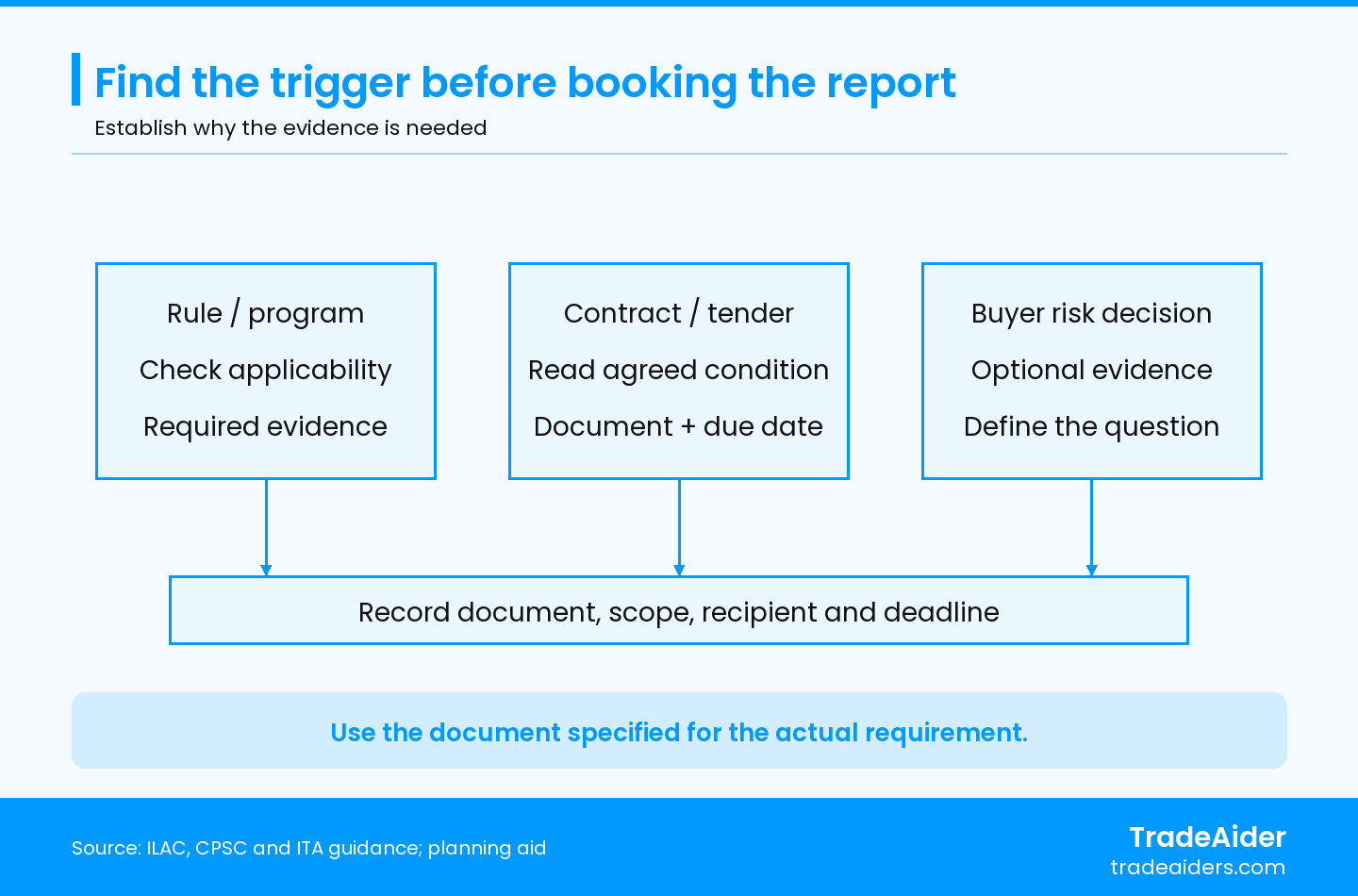
Planning aid. Identify the applicable requirement or buyer decision, then record the needed document, covered scope, recipient and deadline.
A letter of credit, or LC, creates a separate documentary condition for payment. The International Trade Administration explains that payment depends on the specified documents complying with the LC terms. Banks examine documents and leave the underlying goods-quality determination to the relevant parties. Where an LC stipulates an inspection document, align its wording and timing with the bank and transaction team before commissioning it. ITA’s Letters of Credit guidance.
For completed goods, TradeAider’s pre-shipment inspection service provides agreed order checks and a formal report. Pre-shipment inspection, or PSI, takes place when the order quantity is 100% complete and at least 80% packed for export. Build that readiness condition into the schedule when the buyer needs the findings before shipment.
When product rules or conformity procedures require evidence
A regulatory requirement depends on the product, destination and applicable procedure. Start with the actual rule and determine the evidence it calls for. The same product description can cover different constructions, age groups or intended uses, so a general statement that a product is “for export” leaves the requirement unresolved.
For covered US children’s products, CPSC guidance requires the responsible domestic manufacturer or importer to issue a Children’s Product Certificate, or CPC. The applicable testing basis is results from a third-party, CPSC-accepted laboratory. The guide also identifies exemptions, exceptions and determinations that can affect testing or certification. The CPC and supporting test reports have separate roles in this process. Determine the applicable children’s product safety rules before deciding which documents are needed. CPSC’s CPC guidance.
For EU CE marking, the applicable product legislation and conformity procedure determine whether a notified body is involved. A notified body is an organization authorized for particular conformity-assessment activities. Some procedures allow self-assessment, while others require independent involvement. Check the applicable procedure and the body’s authorized scope where that involvement is required. Your Europe’s CE-marking guidance.
These examples show why the document should follow the requirement. Ask the technical owner to name the applicable rule, the required assessment and the evidence needed for the actual configuration. For a regulator’s market-surveillance request, preserve the notice and its product identification, requested records and response deadline. Coordinate the response around that specific request.
When a claim, permit or project program calls for records
Performance claims and sector programs can create their own evidence requirements. A fire-performance classification may involve a specified tested construction and classification document. An organic claim may involve a certification scheme and its required records. Identify the actual scheme, claim and covered product or activity before deciding what independent evidence to commission.
Environmental reporting follows the applicable permit or program. In the United States, EPA explains that a National Pollutant Discharge Elimination System, or NPDES, permit includes discharge limits, monitoring and reporting requirements tailored to the permitted operation. Read the actual permit to identify the required parameters, reporting and responsibility for the work. Whether an independent laboratory or other specialist is required needs its own applicable basis. EPA’s NPDES permit basics.
For engineering and construction work, identify the project specification, inspection stage and authority that requests the record. A foundation inspection, a material test and an installed-system check can cover different objects and stages. For agricultural, aquaculture or forestry activities, identify the relevant environmental, production or certification program and its conditions. Keep the required evidence connected to the specific operation and reporting period.
The practical step is to obtain the requirement itself. Preserve the permit clause, scheme provision, tender attachment or project instruction, then ask the responsible technical party which examination and document will address it. This prevents a broadly titled report from leaving the actual condition unanswered.
When independent evidence is needed for a dispute
An independent examination can help establish the condition of goods, the observed discrepancy and the scope affected by a complaint. Define the question before arranging it. Preserve product identification, relevant records and the condition of the items so the findings can be understood in context. Distinguish observations from conclusions about cause or responsibility.
A proceeding may impose separate expert-evidence requirements. In England and Wales, CPR35 restricts expert evidence to what is reasonably required, gives experts an overriding duty to the court and requires court permission to put in an expert report. Use the applicable dispute process to determine the required role and form of evidence. Civil Procedure Rules Part35.
For a commercial complaint, agree what the examiner should document and how access, sampling and item identification will be handled. Where litigation or arbitration is contemplated, have the responsible adviser define the evidence needs before commissioning a report for that purpose. The inspection findings and the decision about responsibility should remain separately identifiable.
When an existing report needs review or replacement
Review a report’s continued usefulness against its scope and the current requirement. The issue date is one input. Also consider the tested or inspected item, production configuration, applicable references, changes and any period specified by the customer or program. A report remains a record of the work performed under its stated conditions. Its usefulness for a new decision needs that connection to be established.
Some programs prescribe further testing after changes or during continued manufacture. CPSC guidance says a material change to a children’s product after initial certification requires retesting for the affected rules and a new CPC based on passing results. It also describes periodic testing for children’s products in continuous manufacture. Apply those requirements within their product scope when reviewing older evidence. CPSC’s third-party testing guidance.
That review should also preserve program-specific conditions. CPSC explains that testing each batch or lot is not necessarily required after initial testing and certification. The subsequent testing frequency depends on the applicable factors, with attention to material changes. Determine the actual testing obligation from the relevant program. CPSC’s batch-testing FAQ.
For an order inspection, compare the report’s identified goods and inspection stage with the current shipment decision. Rework, additional production or a changed packing condition may create a new examination question. Record what changed and ask the requirement owner whether additional checks, updated documentation or replacement evidence are needed. Keep the earlier record so the sequence remains understandable.
Illustrative scenario. A sample report misses the shipment condition
In this hypothetical example, a buyer’s purchase order requires an independent inspection report on the completed shipment before release. The supplier sends a laboratory report for a submitted product sample. That report may support the specific tests it records, while the agreed shipment condition still requires findings on the completed order.
The buyer copies the purchase-order clause into the request record and identifies the finished goods, quantity, inspection stage and checks. The supplier confirms readiness and provides access. The examiner performs the agreed order inspection and reports the checks, findings and any limitations. The buyer then evaluates that report against the contractual release condition.
If the order is still partly in production, the buyer records the readiness gap and agrees the next inspection date or a documented change to the plan with the responsible parties. If the clause only says “third-party report,” the buyer first resolves the document and scope required. These actions close the ambiguity before spending time on an examination that may answer a different question. The scenario illustrates the process and contains no actual client results.
Record the report requirement before commissioning work
Use a short requirement record before commissioning the document. Copy the actual requirement and connect it to the covered goods or activity, needed checks, recipient and deadline. Mark unresolved points as pending and assign them to the party who can clarify the requirement.
| Record field | Complete for this request | Question to resolve |
|---|---|---|
| Requirement source | Rule/contract/program ___ Clause or instruction ___ | Who requires the evidence and for which decision? |
| Document and activity | Report/certificate ___ Examination or test ___ | Which deliverable and issuing role are specified? |
| Covered scope | Product/activity ___ Model/lot/location ___ Stage/period ___ | What must the findings actually represent? |
| Technical references | Methods/criteria ___ Current version ___ Known changes ___ | Which references and conditions govern the work? |
| Delivery and follow-up | Recipient/format ___ Due date ___ Pending item/owner ___ | What happens if evidence is incomplete or the condition is unmet? |
When the report arrives, compare it with this record. Confirm that it identifies the agreed scope and contains the expected findings, references and limitations. Send any unresolved difference to the requirement owner and retain the resulting decision with the report. This keeps the need for evidence connected to the action it was commissioned to support.
Start with the requirement and available order information
Begin a TradeAider inquiry with the available product and order information, the factory, destination, timing and the actual report request. Share relevant specifications and any existing report, and identify the intended recipient. Before inspection, agree the feasible checks, references, covered scope and reporting needs. Contact our team to discuss the order inspection and report needed for your decision.
Frequently Asked Questions
What if the report is still pending at the shipping deadline?
Record the report as pending and refer the shipping decision to the party responsible for the applicable requirement and release condition. Identify the outstanding work, expected timing and any effect on the agreed schedule. Ask that party to document the next action. Keep a regulatory obligation, a customer condition and an internal planning preference separately identified when considering changes to the shipment plan.
Can photographs alone satisfy a request for an inspection report?
Photographs can support a report, but their acceptability as the complete deliverable depends on the actual request and its required findings. Images need product identity, context and a connection to the reported observation. A request may also require measurements, methods, sampling information or an evaluation. Clarify those deliverables before the examination so the inspector can capture the records needed for the decision.
Who pays for a report requested after the order is signed?
Check the agreed contract terms, then document any additional inspection scope, charges and timing with the parties responsible for the order. Identify whether the request implements an existing obligation or adds new work. Obtain the relevant agreement before commissioning the additional service. Retain the agreed change with the order records so the required deliverable, schedule and commercial responsibilities remain clear.
Articles Connexes

Développez votre entreprise avec le Service TradeAider
Cliquez sur le bouton ci-dessous pour accéder directement au Système de Service TradeAider. Les étapes simples de la réservation et du paiement à la réception des rapports sont faciles à utiliser.