

The most common furniture quality defects found before shipment are visible finish damage, weak structure, poor assembly fit, missing or wrong hardware, upholstery defects, drawer and door misalignment, unstable legs, odor or moisture issues, label errors, and weak packaging. The buyer should classify these defects by product type because a minor mark on a hidden surface can be far less serious than the same mark on a tabletop, sofa front, or cabinet door.
Furniture defects are expensive because furniture is bulky, visible, and costly to return. A small defect that might be tolerable in a low-cost accessory can become a major problem on a dining table, sofa, or cabinet. Customers expect furniture to look good, assemble correctly, feel stable, and arrive without damage. Inspection must be built around those expectations.
China-made furniture can be produced very well, but the buyer must control the details. Many failures come from rushed finishing, inconsistent materials, weak packaging, missing hardware, poor assembly fit, or late supplier substitutions. The best inspection plans use product-specific defect lists, not generic quality language.
- Sofa defects: upholstery shade variation, seam problems, frame noise, cushion deformation, loose legs, and label issues.
- Table defects: tabletop scratches, wobble, wrong dimensions, poor edge finish, weak joints, and hardware mismatch.
- Cabinet defects: drawer gap, door alignment, hinge failure, missing anti-tip parts, odor, and panel damage.
- Packaging defects: weak cartons, poor corner protection, rubbing damage, missing instructions, and wrong carton marks.
The Direct Answer
Furniture inspection should focus on the surfaces customers see, the structures customers rely on, and the packaging that protects bulky goods in transit.
CPSC clothing storage unit guidance explains the US mandatory rule for defined clothing storage units and highlights stability-related requirements under 16 CFR part 1261. Source: CPSC clothing storage units guidance.
CPSC upholstered furniture guidance explains US flammability requirements under 16 CFR part 1640 for upholstered furniture. Source: CPSC Flammable Fabrics Act guidance.
CPSC also marked ten years of its Anchor It campaign in 2025 and noted the importance of addressing furniture and TV tip-over hazards. Source: CPSC Anchor It campaign release.
These safety references are not a complete compliance program for every furniture item. They show why furniture inspection cannot be limited to scratches. Some furniture risks are customer safety, stability, flammability, or labeling issues, and the buyer must decide which rules apply to the product and destination.
Top Furniture Defects By Product Type
The same defect can carry different severity depending on product type and visible location.
| Product | Common Defects | Why They Matter | Inspection Control |
|---|---|---|---|
| Sofas | Fabric shade, seam, loose thread, cushion deformation, frame noise, leg attachment | Customer sees and feels defects immediately | Inspect upholstery, sit test, frame noise, leg fit, labels |
| Tables | Top scratches, uneven legs, wobble, poor edge finish, wrong dimensions, weak joints | Visible surface and stability drive complaints | Check tabletop, level, dimensions, load points, hardware |
| Cabinets | Drawer gap, door misalignment, hinge issue, missing anti-tip kit, panel crack, odor | Assembly and safety failures create returns | Check fit, glide, hinge, stability, parts, smell |
| Packaging | Weak carton, poor corner protection, rubbing damage, missing instruction, wrong mark | Bulky goods are damaged easily in transit | Open cartons, check protection, carton marks, hardware bags |
A furniture checklist should not classify defects only by physical size. The defect location matters. A 10 mm scratch under a tabletop may be minor. The same scratch on the tabletop center may be major. A slight hidden scuff on an inner cabinet panel may be tolerable. A visible door scratch on premium furniture may fail the lot.
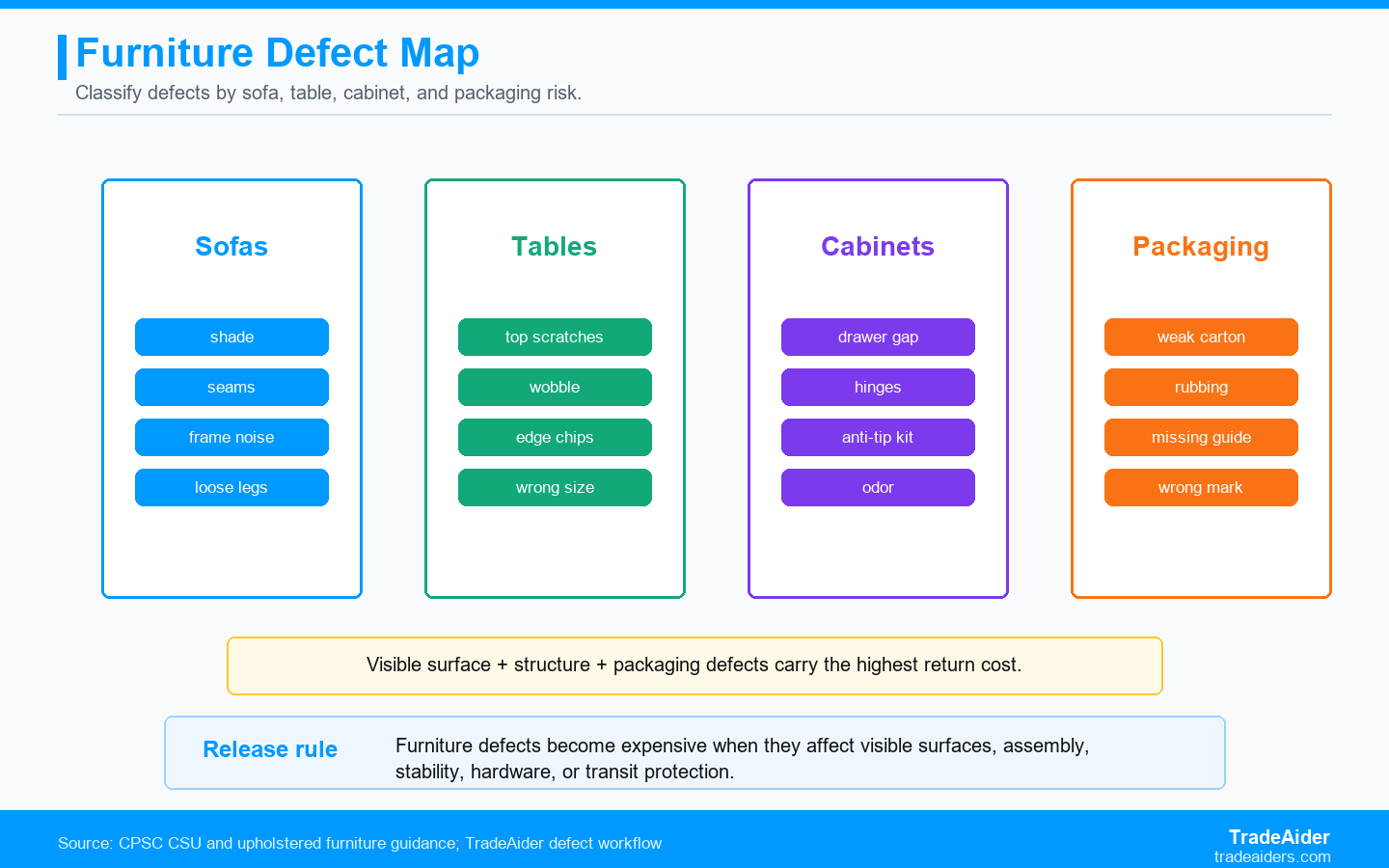
Furniture defects become expensive when they affect visible surfaces, assembly, stability, hardware, or transit protection.
Sofa Defects Inspectors Often Find
Sofas combine upholstery, frame, hardware, comfort, and labeling risks.
Sofa inspection should start with visible upholstery. Fabric shade variation, stains, loose threads, poor seam alignment, weak stitching, zipper failure, exposed staples, cushion deformation, fabric damage, and uneven tufting can all become customer complaints. The inspector should compare sampled sofas with approved fabric swatches and sample photos under practical lighting.
Structural checks matter too. A sofa frame can look fine but make noise, flex under sitting pressure, or have loose legs. The inspector should check leg attachment, screw tightness, frame stability, cushion support, backrest alignment, and any moving mechanisms. Recliners, sofa beds, and modular sofas need extra function checks.
Label and compliance files should not be ignored. Upholstered furniture may need flammability labeling or compliance documentation depending on the market. Inspection can verify visible labels and product version, while lab or legal compliance evidence must be handled separately where required.
Table Defects Inspectors Often Find
Tables are judged by visible surface quality and stability.
Tabletop defects are usually high-severity because the customer sees them first. Scratches, dents, color mismatch, coating bubbles, edge chips, glue marks, uneven gloss, veneer lifting, cracks, and stains should be classified by location and visibility. A premium dining table needs stricter cosmetic standards than a hidden support rail.
Stability and assembly checks are equally important. Inspectors should check leg alignment, hole position, screw fit, tabletop flatness, wobble, load points, and hardware completeness. Knock-down tables should be assembled or at least checked at critical fit points because misaligned holes may only appear when the customer tries to build the item.
Packaging should protect the tabletop separately from legs, hardware, and metal brackets. One common defect is internal rubbing during transport, where the product was perfect at the factory but damaged inside the carton because parts were not separated well enough.
Cabinet Defects Inspectors Often Find
Cabinets fail through alignment, hardware, odor, stability, and missing parts.
Cabinets and storage furniture require fit and function checks. Doors should align, drawers should glide, hinges should hold, handles should be secure, shelves should fit, and panels should not be cracked or warped. Gap consistency matters because customers see uneven doors and drawers as poor workmanship.
For furniture with drawers or hinged doors, stability and anti-tip requirements may matter depending on product type and market. The inspector should check whether anti-tip kits, instructions, warning labels, and required hardware are present when the buyer has specified them. The buyer should not assume the supplier included them correctly.
Odor and moisture issues are also common. Strong chemical smell, mold, damp cartons, swelling panels, or rusty hardware can indicate storage or material problems. These issues should be documented immediately because they can worsen during ocean transit.
Where TradeAider Fits In Furniture Defect Control
TradeAider fits by turning common defect patterns into product-specific inspection checkpoints.
TradeAider can use Pre-Shipment Inspection to check sofas, tables, cabinets, and packed furniture against approved samples, drawings, defect classes, AQL plans, packaging files, and label requirements.
If defects are likely to come from production process, During Production Inspection can catch frame, panel, finish, upholstery, hardware, or packing issues before the whole lot is packed. For repeated defects, factory audit service can review supplier systems.
The business fit is defect memory. TradeAider helps buyers carry previous complaints into the next inspection checklist so the same sofa, table, or cabinet defect is not rediscovered after arrival.
SPAR Scenario: The Cabinet Defect Was Not Cosmetic
A small-looking alignment issue pointed to a bigger production control problem.
Situation: A buyer orders knock-down cabinets from a China factory and asks for a standard PSI before shipment.
Problem: Inspectors find uneven drawer gaps, missing anti-tip hardware in some cartons, and panels with strong odor. The supplier calls these small issues because the furniture can still be assembled.
Action: TradeAider classifies missing anti-tip hardware and poor drawer fit as major defects, documents affected cartons, and asks the supplier to sort hardware kits, adjust the drawer jig, and hold damp cartons for review.
Result: The buyer avoids a shipment that would have caused customer assembly complaints and possible safety concerns. The next order adds DPI checks for drawer alignment and hardware packing.
Action Card: Furniture Defect Checklist
Make the defect list visible before production finishes.
- Define customer-facing surfaces and classify visible defects strictly.
- Check dimensions, assembly fit, hardware completeness, and moving parts.
- Inspect sofas for upholstery shade, seams, frame noise, cushion shape, and leg attachment.
- Inspect tables for tabletop finish, wobble, edge quality, leg alignment, and hardware.
- Inspect cabinets for drawer glide, door gap, hinge fit, anti-tip parts, odor, and panel damage.
- Inspect packaging for edge protection, internal rubbing, carton marks, instructions, and moisture.
The buyer should also keep a defect photo library. A written phrase like small scratch is not enough. Photos show whether the scratch is hidden, visible, deep, shallow, central, or edge-located. A photo library also trains suppliers and inspectors to classify defects consistently.
For furniture, the cost of poor inspection often appears after arrival. Returns are expensive. Repacking is slow. Replacement parts may not match color or finish. Retailer chargebacks can exceed the unit cost. That is why furniture inspection should be practical, visual, and strict where the customer will notice the defect.
How To Classify Furniture Defect Severity
Severity should follow customer use, visible location, safety risk, and rework cost.
A critical defect should be reserved for safety, legality, or complete-use risk. Examples may include severe instability, sharp metal burrs, missing required warning, exposed hazardous hardware, or a condition that could injure the user. These findings should not be negotiated as ordinary appearance issues.
A major defect affects saleability, assembly, function, visible appearance, or customer acceptance. Wrong dimensions, missing hardware, failed drawer glide, visible tabletop damage, broken leg, severe fabric stain, wrong label, or poor carton protection can all be major because the customer cannot reasonably ignore them.
A minor defect is lower-impact, usually hidden or cosmetic, but it still matters in volume. Small underside scuffs, slight hidden rub marks, or minor packaging blemishes may be acceptable at low frequency. If the same minor defect appears across many units, it may point to process drift and should be escalated in the next inspection plan.
The buyer should document severity decisions in a defect log. The log should include product type, defect photo, location, severity, affected quantity, supplier response, and next-order control. Over time, the log becomes more useful than memory because it shows which factory problems repeat and which controls actually worked.
The log should also connect each defect to a likely factory owner. Finish defects may belong to sanding, coating, curing, or packing. Hardware defects may belong to purchasing, kitting, or final packing. Alignment defects may belong to jigs, drilling, or assembly training. This ownership makes supplier CAPA more practical.
The buyer should revise defect priorities after every shipment. If customers complain about assembly, inspect fit and hardware more deeply. If customers complain about transit damage, inspect packaging. If customers complain about odor, inspect material storage and carton moisture before shipment.
If your furniture program has recurring sofa, table, cabinet, or packaging defects, send TradeAider the product photos, prior reports, return data, and supplier history. The next step is to ask TradeAider to build a furniture defect checklist for the next shipment.
Frequently Asked Questions
Are furniture scratches major or minor defects?
It depends on location, depth, visibility, product grade, and customer expectation. Visible customer-facing scratches are often major; hidden small marks may be minor.
Should sofas be tested during inspection?
Yes. Sampled sofas should be checked for upholstery, frame noise, leg attachment, cushion shape, label, packaging, and any moving mechanism where relevant.
Why are missing hardware bags serious?
Missing hardware can make knock-down furniture unusable and can create customer returns even when panels and surfaces look good.
Can packaging defects fail a furniture inspection?
Yes. Weak packaging can cause transit damage, especially for bulky furniture. Packaging should be part of the release decision.
Related Articles



Grow your business with TradeAider Service
Click the button below to directly enter the TradeAider Service System. The simple steps from booking and payment to receiving reports are easy to operate.

