
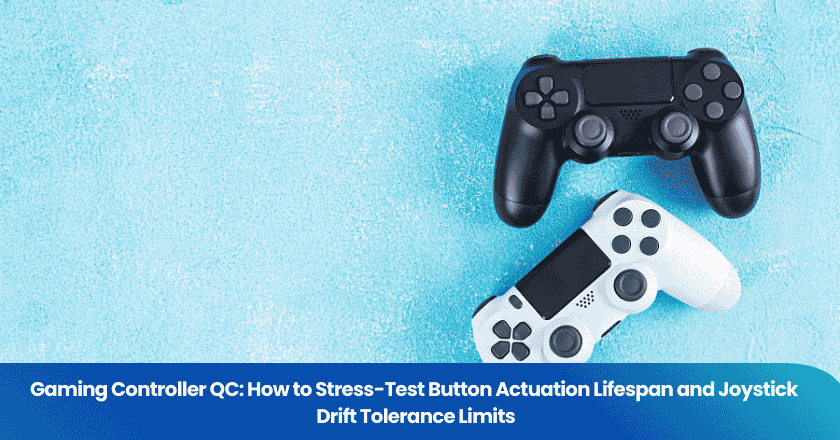
A gaming controller that develops stick drift after 90 days is not a defective unit that slipped through a random quality lapse — it is, in many cases, the predictable outcome of using low-grade potentiometer modules with inadequate lifecycle ratings, or of shipping units where factory joystick calibration was not properly verified. Button failures follow the same pattern: cheap tactile switches rated for far fewer cycles than the product's intended lifespan, or contaminated membrane pads that start double-registering inputs within weeks of first use. For buyers sourcing gaming controllers from Chinese manufacturers, these are not edge cases — they are the central quality risk that distinguishes a private label controller brand that builds customer loyalty from one that spends its first year drowning in warranty returns. This article explains what to test, what specifications to demand, and how to structure pre-shipment inspection to catch both failure modes before a single unit reaches a customer's hands.
Key Takeaways
- Industry-standard button actuation lifespan for gaming controllers is 2 million press cycles; premium tactile microswitches are rated for 5 million cycles; buyers should demand component datasheets confirming the actual switch rating used in their product, not just a verbal assurance from the factory.
- Joystick drift tolerance: a healthy potentiometer-based stick at factory calibration should show neutral axis deviation within ±0.05 (5%); values above ±0.15 indicate potentiometer wear or assembly defect and require investigation.
- Hall-effect joystick modules eliminate the primary drift mechanism (friction wear on carbon tracks) — buyers specifying Hall-effect sticks in their product should include incoming quality checks to verify the correct module type was actually installed, not a potentiometer substitute.
Why Button and Joystick Failures Dominate Gaming Controller Returns
The Button Lifespan Problem
Consumer electronics products have a button press lifecycle expectation that is directly tied to their intended use pattern. A gaming controller is one of the most mechanically demanding consumer devices in this regard. Controller Guide's durability analysis notes that competitive players can press buttons 200+ times per minute, and that industry testing standards specify a quality controller should withstand 2 million button presses before failure. At 200 presses per minute, that is approximately 167 hours of continuous competitive play before reaching the rated cycle limit on a budget-spec switch.
The component that determines this threshold is the tactile switch or membrane dome under each button. Design News' technical guide on switch lifecycle confirms that quality tactile switches offer rated lifespans from 100,000 to over a million cycles, with the specific number available on each component's datasheet. Budget switch suppliers routinely use lower-spec components — switches rated at 100,000–300,000 cycles — that meet the product's cost target but fail within a year of normal use. Buyers who do not specify minimum switch cycle ratings in their product specification and do not verify component compliance during inspection have no visibility into this risk until returns arrive.
The Joystick Drift Mechanism
Joystick drift is the single largest source of returns and negative reviews for gaming controllers. Understanding the mechanism is essential for writing an effective QC specification. iFixit's technical breakdown of joystick mechanisms explains that most controllers — including flagship Sony, Microsoft, and Nintendo products — use potentiometer-based analog sticks. A potentiometer is a variable resistor: as the stick moves, a conductive wiper slides across a resistive carbon-film track, varying the voltage output that the controller reads as stick position. Potentiometers are not super accurate, so calibration is done at the factory — the controller is programmed to interpret a specific center voltage (typically 0.5V on a 0–1V range) as the neutral position.
The failure mode is mechanical: repeated friction between the wiper and the carbon track erodes the track over time, creating inconsistent resistance readings. Once track wear introduces noise above the firmware's dead zone threshold, the controller reports phantom stick movement — drift — even when untouched. PC Gamer's analysis of the DualSense controller lifecycle established that the ALPS potentiometer modules used in virtually all major branded controllers are rated for 2,000,000 cycles — and that at 80 joystick rotation cycles per minute during typical gameplay, this limit is reached in approximately 417 hours. For budget controllers using lower-rated potentiometer modules, the effective lifespan is often dramatically shorter.
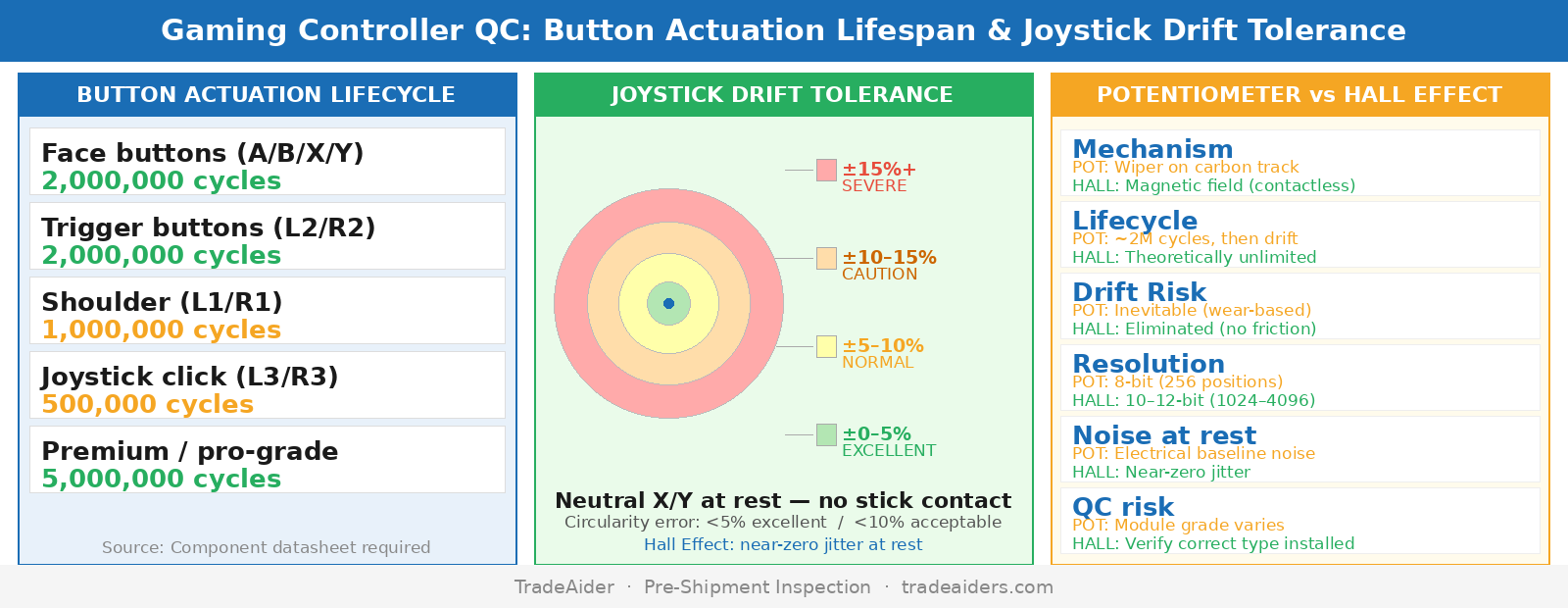
Gaming controller QC: button actuation cycle specifications, joystick drift tolerance zones, and potentiometer vs. Hall-effect lifecycle comparison.
Button Actuation Testing: What to Specify and How to Verify
Component Specification: What Datasheets to Request
The starting point for button lifecycle quality control is the component specification, not the finished product test. Every tactile switch has a published datasheet from the manufacturer specifying rated cycle life, actuation force, travel distance, contact resistance, and operating temperature range. Buyers should require their factory to provide the component datasheet for every switch type used in the controller — face buttons (A/B/X/Y or equivalent), trigger buttons, shoulder buttons, menu buttons, and the joystick click function.
Key minimum specifications to enforce by product tier: for budget controllers, no switch below 1 million cycle rating; for mid-range and premium controllers, face and trigger buttons should use switches rated at 2 million cycles minimum, with premium options at 5 million cycles. Turtle Beach's engineering documentation confirms that professional-grade tactile microswitches are rated at 5 million click lifecycles — the target for products marketed to competitive or heavy-use audiences. Conventional triggers in the same product category may require recalibration or replacement after six to twelve months of intensive use, even when the switches meet basic cycle specifications.
On-Site Button Test During Pre-Shipment Inspection
Factory-level button testing during pre-shipment inspection covers three layers. First, a functional verification: every button on every sampled unit is pressed and confirmed to register correctly via a connected test device or controller diagnostic software. Any button that fails to register, double-registers (debounce failure), or requires excessive force is classified as a defect. Second, a tactile consistency check: buttons across the batch are compared for actuation force uniformity — a button that feels noticeably stiffer or softer than the golden sample indicates switch supplier substitution or installation variance. Third, on higher-value orders, a spot-check accelerated cycle test: a small number of units (typically outside the AQL sample, not consuming sellable stock) are run through a high-cycle actuation rig to confirm switch behavior at elevated cycles shows no early degradation signal.
| Button Type | Minimum Cycle Rating | Inspection Check | Key Failure Mode |
|---|---|---|---|
| Face buttons (A/B/X/Y) | 2,000,000 cycles | Register check + force compare vs. golden sample | Double-register / no register |
| Trigger buttons (L2/R2) | 2,000,000 cycles | Full analog travel range + click point check | Analog drift / premature actuation |
| Shoulder buttons (L1/R1) | 1,000,000 cycles | Register check + housing flex check | Housing crack under load |
| Joystick click (L3/R3) | 500,000 cycles | Click register + actuation force | Premature failure from downward load |
| D-pad directions | 1,000,000 cycles | All 4 directions + diagonal register | Missed inputs / wrong direction |
TradeAider's pre-shipment inspection for consumer electronics includes customizable functional test parameters. For gaming controller orders, buyers can specify button register verification and golden-sample tactile comparison in the product checklist before the inspection date. See how TradeAider's pre-shipment inspection works →
Joystick Drift Testing: Tolerance Limits and Inspection Protocol
Potentiometer Drift: Factory Calibration Standards
A correctly calibrated potentiometer joystick at the time of manufacture should report neutral axis values very close to zero on both the X and Y axes when untouched. The industry consensus thresholds for stick drift severity are well-established: values within ±0.05 (5% of full scale) represent normal factory tolerance; values around ±0.10 indicate minor drift warranting dead zone adjustment; values exceeding ±0.15 indicate potentiometer wear or a calibration defect requiring investigation. For factory pre-shipment inspection, any unit with neutral axis deviation exceeding ±0.05 on either axis should be flagged as a potential defect, since this indicates either a poorly calibrated potentiometer module or a unit with below-spec components that are already showing initial wear.
The circularity test — rotating the joystick through its full range and measuring how closely the output traces a circle rather than a distorted shape — provides a complementary data point. A circularity error under 5% is considered excellent; under 10% is acceptable for most purposes. Official controllers from major brands typically target 8–12% error to ensure the stick can reach square corners of the input gate; precision-tuned aftermarket Hall-effect sticks often achieve 0–1% error. For quality inspection, the acceptance criterion should match the product specification: a controller marketed as "high precision" should show circularity error matching the golden sample within a defined tolerance.
Hall-Effect Modules: Verification That the Right Component Was Installed
Hall-effect joystick modules eliminate the primary drift mechanism by replacing physical contact with contactless magnetic field sensing. iFixit's technical analysis notes that whereas a potentiometer is nearly guaranteed to fail eventually, a Hall-effect joystick could hypothetically last the entire lifetime of the controller. Lab testing shows Hall-effect sensors maintain precision for over 1 million cycles, compared to conventional potentiometers which typically develop drift within 1.5–3.5 years of regular use.
For buyers specifying Hall-effect modules in their product: the inspection protocol must include verification that the correct module type was actually installed. Substitution of lower-cost potentiometer modules during production runs — particularly in budget product segments — is a documented risk. Visual inspection of the disassembled joystick mechanism can confirm module type. Additionally, a Hall-effect stick will show notably lower baseline axis noise at rest (near-zero jitter) compared to a potentiometer, which always exhibits some electrical noise from the resistive track — this difference is measurable with a connected diagnostic tool. Hall-effect modules also offer higher resolution — 10-bit (1,024 positions) or 12-bit (4,096 positions) compared to a potentiometer's 8-bit (256 positions) — which is detectable in the smoothness of the stick's output trace during a circular sweep test.
Deadzone Specification: Factory Setting vs. Intended Product Spec
The factory deadzone setting — the firmware threshold below which stick input is ignored — is a separate but related inspection point. ELO Esports' joystick engineering guide identifies dead-zone tuning, spring weight, and build quality as the variables that determine how a joystick feels in use, independent of the underlying sensor type. A controller with an oversized factory deadzone will feel unresponsive to precision inputs; one with an undersized deadzone will register false movement from normal stick return imprecision. Buyers should specify the acceptable deadzone range in the product checklist and verify it against the golden sample during inspection using a diagnostic device.
Additional QC Checks for Gaming Controllers
Connectivity, Vibration, and Wireless Range
Beyond buttons and joysticks, a complete gaming controller inspection checklist should cover Bluetooth pairing stability and connection range (for wireless controllers), vibration motor function and tactile feedback intensity, trigger analog travel accuracy across the full range, USB-C charging function, battery life under continuous use load, and LED indicator behavior. For controllers with audio jacks, 3.5mm output connectivity should be verified. For controllers marketed as compatible with specific platforms (PlayStation, Xbox, Nintendo Switch, PC), explicit platform compatibility testing on the specified device is a critical QC step — many Chinese-manufactured third-party controllers pass basic functional tests but have intermittent input recognition issues on one or more platforms that only appear with a connected device test.
Packaging and Regulatory Compliance for E-Commerce
For Amazon FBA sellers importing gaming controllers, regulatory compliance is an additional inspection layer that must not be overlooked. Controllers with wireless functionality require FCC (US), CE (EU), or other regional radio frequency certifications. These certifications must be confirmed on the physical device label and in the test report documentation — importing uncertified wireless devices is a compliance violation that can lead to listing removal or customs seizure. As an official Amazon SPN partner, TradeAider's inspection service for electronics verifies both product function and FBA packaging compliance in a single visit, eliminating the need for a separate compliance check. See TradeAider's Amazon FBA inspection solutions →
Frequently Asked Questions
What button cycle rating should I specify for gaming controllers sourced from China?
The minimum acceptable standard for gaming controller face buttons is 2 million actuation cycles, which is the industry-wide benchmark used by major platform holders including Sony and Microsoft. Premium or professional-grade controllers should use tactile microswitches rated for 5 million cycles. Joystick click switches (L3/R3) have a lower cycle rating threshold — 500,000 cycles is standard — because the downward press action involves a different mechanical load than face button actuation. Always request the component datasheet for each switch type from your factory before confirming your first production run, and specify the minimum rating as a contractual requirement in your purchase order.
How do I verify joystick drift tolerance during pre-shipment inspection?
Joystick drift verification requires a computer or diagnostic device with a controller input display tool. Connect each sampled unit, leave both joysticks completely untouched, and observe the axis values for both X and Y axes on each stick. Acceptable factory calibration shows neutral axis deviation within ±0.05 (5%). Any unit showing deviation above ±0.10 on any axis at rest should be classified as a defect requiring investigation. Additionally, run a full-range circular sweep and compare the path shape to the golden sample — significant deviation from a circle, or a square-shaped path, indicates potentiometer nonlinearity or an incorrect deadzone configuration.
What is the difference between potentiometer and Hall-effect joystick modules for QC purposes?
Potentiometer joystick modules use a physical wiper-on-carbon-film mechanism that wears with use and is rated at approximately 2 million cycles. Hall-effect modules use contactless magnetic sensing with no mechanical wear, effectively eliminating the primary drift mechanism and offering significantly longer functional lifespan. For buyers specifying Hall-effect modules: the key inspection risk is substitution — factories may install lower-cost potentiometer modules in production units after golden-sample approval. Verification requires either visual inspection of the disassembled module or diagnostic confirmation of the lower electrical noise profile and higher resolution output characteristic of Hall-effect sensors.
Can a gaming controller pass pre-shipment inspection but still develop drift within weeks?
Yes, and this is why the inspection specification matters as much as the inspection itself. A controller with a substandard potentiometer module may pass a basic functional check on day one — the stick registers correctly, the circularity trace looks acceptable, the neutral axis deviation is within range — but the component's rapid wear rate means it will exceed drift tolerance thresholds within 50–100 hours of use. The only reliable protection against this outcome is specifying the component quality standard (minimum cycle rating) in the purchase order and verifying component compliance through datasheet documentation and spot-check disassembly during inspection, rather than relying on powered-on functional tests alone.
Related Articles


Grow your business with TradeAider Service
Click the button below to directly enter the TradeAider Service System. The simple steps from booking and payment to receiving reports are easy to operate.

