
 Standards.png)
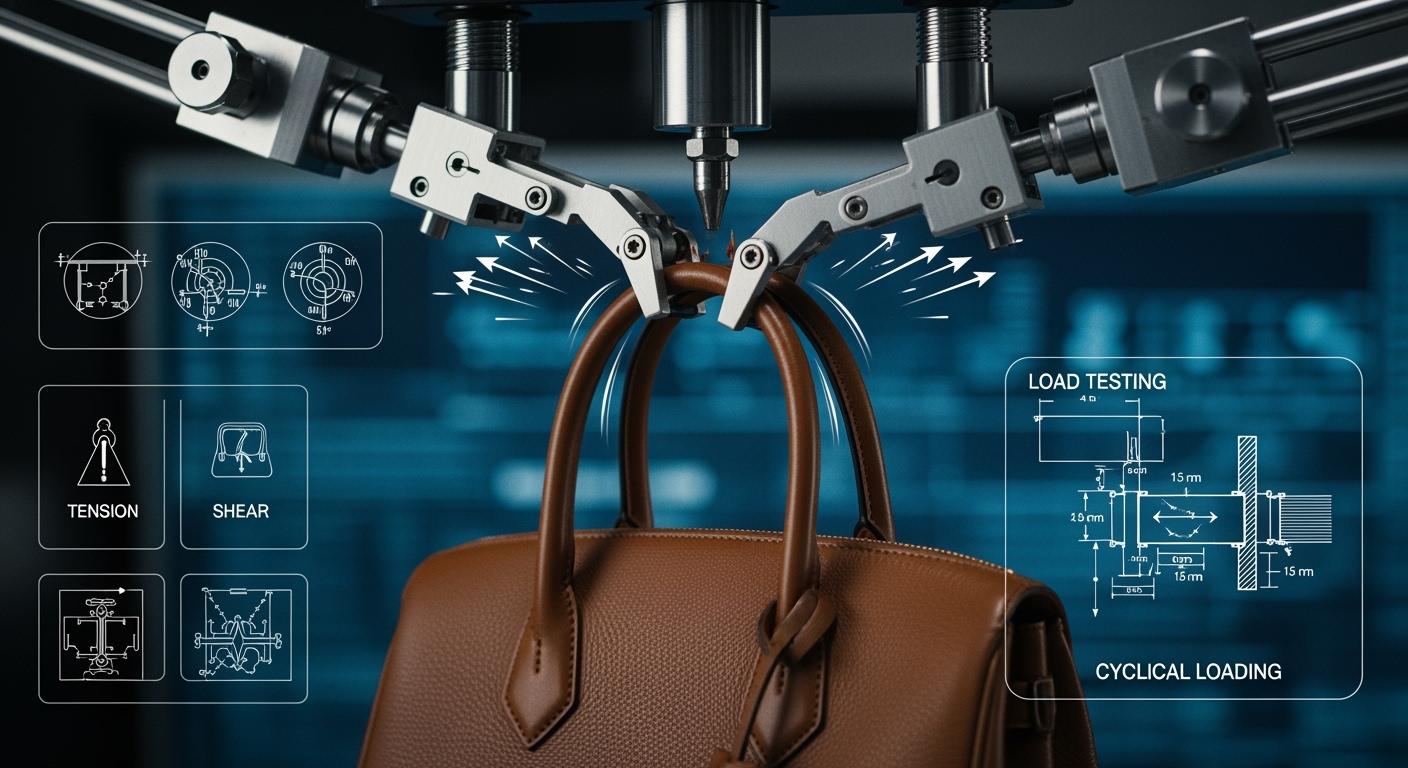
In the technical domain of Softline fashion accessories, structural fidelity is the primary determinant of a product's lifecycle and consumer safety. For high-end handbags and travel gear, the assembly interface between the handle and the bag body is subjected to intense dynamic mechanical stress during every use. Handbag load testing—specifically the Handle Jerk or Oscillation Test—provides the definitive metrological validation of this interface. By simulating erratic inertial loads and dynamic gravitational stress, manufacturers can identify latent structural weaknesses, such as seam pull-out or hardware fatigue, before products reach the global market. Adhering to international benchmarks like QB/T 1333 or ISO protocols is essential for ensuring that aesthetic designs do not compromise operational durability or user safety.
Key Takeaways
- The Handle Jerk Test quantifies the endurance of the handle assembly under cyclic gravitational impact.
- Oscillation standards like QB/T 1333 specify a load-based cycle count (typically 2,500) to ensure structural longevity.
- Failure modes include 'Stitch Migration' and 'Adhesive Delamination,' which indicate inadequate internal reinforcement.
- Mechanical load limits must be tailored to the bag's intended capacity—standard handbags carry 1-5kg during validation.
- Professional quality checks must identify latent defects such as metal fatigue in D-rings or rivets.
- Digital real-time reporting via quality assurance protocols ensures traceability across the supply chain.
The Physics of Oscillation: Dynamic Stress on Bag Assemblies
Technical evaluation of a handbag's load-bearing capacity requires an understanding of kinetic energy transfer. When a user lifts a loaded bag with a sudden 'jerk' motion, the force applied to the handle attachment points is significantly higher than the bag's static weight. This is known as a 'Shock Load.' In accessories quality inspection, the oscillation test replicates this by dropping the bag from a fixed height of 100mm (approx. 4 inches) while it is suspended by its handle.
Metrology of Impact Displacement
High-quality handbag engineering focuses on the displacement of energy. If the handle attachment is too rigid, the energy of the jerk will cause the stitching to pierce the leather or PU material (Needle Cutting). Conversely, if the assembly is too flexible, the bag will permanently deform or 'stretch out.' Industrial testers apply these loads at a frequency of 30 cycles per minute to simulate the rhythmic cadence of a walking gait.
| Performance Metric | Technical Objective | Industrial Benchmark |
|---|---|---|
| Handle Jerk Cycles | Simulate erratic daily lifting stress | 2,500 Cycles (QB/T 1333) |
| Impact Height | Quantify gravitational shock load | 100mm +/- 2mm |
| Load Mass | Verify structural factor of safety | 1kg to 5kg (Bag Volume Dependent) |
| Post-Test Deviation | Measure permanent material elongation | < 5% of total handle length |
The Mechanics of Handle Attachment: Preventing Seam Failure
Handle-to-body assembly is a complex mechanical challenge. Modern handbags utilize a combination of 'Stitch-and-Turn' seams, industrial rivets, and heat-activated adhesives. To achieve a permanent bond, the internal 'Handle Seat' must be reinforced with high-density non-woven fabrics or nylon mesh. This prevents the 'Tearing Force' from concentrating on a small surface area of the exterior material.
Stitch Density (SPI) and Tensile Strength
The technical efficacy of the bond is highly dependent on the Stitches Per Inch (SPI). If the SPI is too high, the needle punctures essentially 'perforate' the leather like a postage stamp, making it easy to tear. If too low, the clamping force is insufficient. During quality assurance audits, inspectors verify that the SPI is optimized for the material's tear strength (governed by ASTM D2261).
Technical Insight: For premium leather handbags, the use of 'D-ring Anchoring' is a mandatory technical control. The D-ring distributes the rotational torque of the handle, reducing the shear stress on the stitching and significantly extending the fatigue life of the bag.
| Assembly Component | Technical Function | Common Failure Mode |
|---|---|---|
| Internal Reinforcement | Distribute tensile load across wider area | Material blowout around rivets |
| Bobbin Thread Tension | Ensure secure loop formation in seams | Thread 'Grinning' or seam separation |
| Metal D-Ring / Rivet | Act as mechanical pivot and anchor | Corrosion or metal fatigue fracture |
| Edge Paint / Wax | Seal raw material edges from moisture | Cracking and peeling during flex cycles |
Industrial Testing Standards for Global Compliance
Reliability in accessories is verified through a tiered testing approach. Depending on the target market (US, EU, or Asia), different standards apply. The most prevalent standard for manufacturing hubs is the **QB/T 1333**, which provides specific load and cycle requirements for handbags. For travel-specific gear, **QBT 2155** adds requirements for whole-bag drops and wheel abrasion.
Key technical benchmarks for industrial certification include:
- Static Load Persistence: Hanging the bag with 2x the rated weight for 4 hours to check for handle de-threading.
- Dynamic Oscillation: The standard 2,500 cycle jerk test at 30 strokes per minute.
- Hardware Pull-Out: Measuring the force in Newtons required to physically extract a rivet or buckle from the substrate.
- Color Fastness (Rub Test): Ensuring the handle dyes do not migrate to the user's hand or clothing during use (ISO 105-X12).
Integrating QC into the Manufacturing Lifecycle
Consistency is achieved by building quality into the 'Pre-Production' and 'In-Line' phases. Relying solely on a final audit is a high-risk strategy for high-value Softline goods. Professional quality assurance implementation should involve:
- PPI (Pre-Production): Validating the 'Tensile Strength' of the raw leather or PU batch *before* it is cut.
- DPI (During Production): Pulling random handles from the assembly line after stitching to check for needle damage or thread tension errors.
- PSI (Pre-Shipment): Final random sampling (AQL 1.5 or 2.5) for whole-bag oscillation durability to confirm assembly integrity.
Furthermore, market-ready sellers must maintain digital logs of these tests to prove compliance in the event of consumer protection audits or insurance claims.

Conclusion: Scientific Validation for Consumer Peace of Mind
The perceived quality of a handbag is technically a function of its mechanical endurance. A bag that remains structurally sound after years of daily oscillation builds brand loyalty that visual design alone cannot achieve. By integrating standardized quality inspection methods with real-time digital reporting, manufacturers can deliver high-performance products that meet global safety expectations. Transparency in these technical processes reduces the financial burden of returns and fosters a reliable supply chain built on engineering excellence.
Frequently Asked Questions (FAQ)
What is the difference between a static load and a dynamic jerk test?
A static load test hangs a weighted bag to check if the handle snaps under constant pressure. A dynamic jerk test (oscillation) simulates the 'G-force' of sudden movements, which is technically much more damaging to the stitching and hardware than a static load.
Why is 2,500 cycles the standard for most handbags?
Through industrial research, 2,500 cycles have been identified as the threshold representing roughly one year of intensive 'High-Frequency' daily use. If a bag survives this concentration of stress, it is technically expected to remain stable for its commercial lifecycle.
Can I perform a handle jerk test without a machine?
While you can perform a manual 'Pull-Test' to check for immediate failures, you cannot replicate the 'Constantcadence' or standardized impact displacement of a machine. A machine ensures every cycle is identical, which is the only way to get a legally defensible 'Pass/Fail' result.
What is 'Hardware Pitting' and does testing prevent it?
Pitting is the localized corrosion of metal hardware. While load testing verifies strength, 'Salt Spray Testing' (ISO 9227) is required to prevent pitting. Professional quality control must include both mechanical (Load) and chemical (Corrosion) audits for a complete durability profile.
How does bag material (Leather vs. PU) affect test results?
Genuine leather has an intertwined fibrous structure that 'grips' the thread, offering naturally high pull-out resistance. PU (Polyurethane) is a layered laminate; if the backing fabric is weak, the thread can easily 'Slice' through the plastic layer under oscillation, necessitating the use of specialized 'Reinforcement Tapes.'
Related Articles
Grow your business with TradeAider Service
Click the button below to directly enter the TradeAider Service System. The simple steps from booking and payment to receiving reports are easy to operate.

