
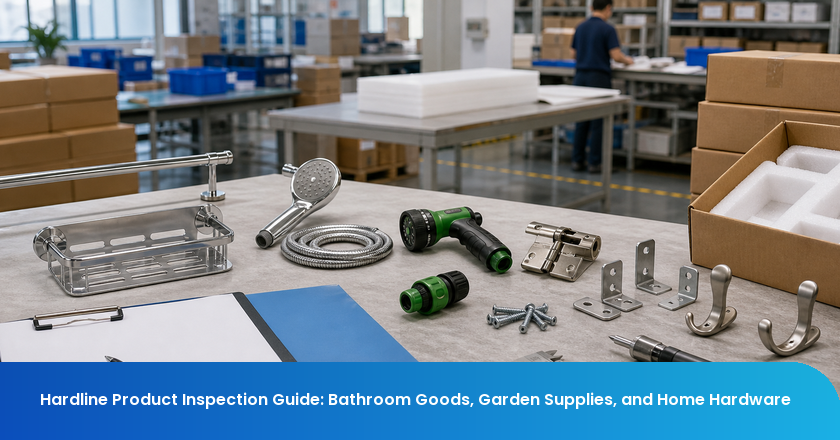
Hardline product inspection should combine AQL sampling with product-specific checks for structure, finish, sharp edges, assembly, function, corrosion, leak risk, load-bearing parts, labels, hardware, and packaging. Bathroom goods, garden supplies, and home hardware may look simple, but small defects can create customer injury risk, installation failure, water damage, corrosion complaints, or high return costs.
Hardline is a broad sourcing category. It can include bathroom organizers, shower accessories, faucets, towel racks, garden tools, hoses, planters, outdoor storage, brackets, hooks, locks, knobs, hinges, fasteners, and home hardware. These products are often durable goods, but that does not mean the inspection is simple. Many hardline defects appear after installation, assembly, load use, water exposure, or shipping vibration.
A generic visual inspection may catch scratches and wrong labels, but hardline products need more than a surface check. The buyer should define how the item is used, what can fail, what surfaces are customer-facing, what hardware must be included, what function must be tested, and what packaging must protect the item during transit. The checklist should be built from actual product risk, not only from a standard template.
- Bathroom goods: check finish, corrosion, installation parts, water contact risk, adhesive or suction performance where relevant, labels, and packaging.
- Garden supplies: check strength, sharp edges, coating, weather exposure, handle attachment, moving parts, and carton protection.
- Home hardware: check dimensions, fit, thread, torque, plating, burrs, sharp edges, lock or hinge function, and part completeness.
- Decision rule: use AQL for sampling, then add special checks for the way the product is installed, used, and shipped.
The Direct Answer
A good hardline inspection plan starts with AQL, then adds category-specific tests for bathroom, garden, and hardware risks.
ISO 2859-1:2026 is the current ISO standard for AQL-indexed sampling procedures for lot-by-lot inspection by attributes. Source: ISO 2859-1:2026.
CPSC guidance for general use products explains that manufacturers and importers of certain non-children's products subject to CPSC rules must issue a General Certificate of Conformity based on testing or a reasonable testing program. Source: CPSC general use products certification and testing.
CPSC's General Certificate of Conformity page provides model GCC information for covered general-use products. Source: CPSC General Certificate of Conformity.
Not every bathroom product, garden tool, or home hardware item requires the same regulatory file. The point is that hardline buyers should not confuse inspection with compliance testing. Inspection verifies the physical shipment. A compliance file, testing program, or certificate may be needed separately when a safety rule applies.
Hardline Inspection Matrix
Each hardline subcategory has a different failure mode.
| Category | Common Product Risk | Inspection Focus | Release Risk |
|---|---|---|---|
| Bathroom goods | Rust, finish peeling, wrong mounting parts, weak adhesive, water exposure, sharp edges | Finish, corrosion clues, installation kit, dimensions, label, pack protection | Returns, water damage complaints, installation failure |
| Garden supplies | Weak handle, sharp edge, cracked plastic, coating failure, loose moving parts, poor outdoor protection | Load points, handles, coating, burrs, function, carton strength | Injury risk, breakage, weather complaints |
| Home hardware | Wrong thread, poor plating, loose hinge, missing screws, misfit, burrs, wrong size | Dimensions, fit, thread, torque, part count, finish, barcode | Installation failure, retailer rejection, customer frustration |
| Shared packaging | Internal rubbing, weak carton, wrong mark, missing instruction, mixed parts | Open cartons, part separation, labels, hardware bags, carton marks | Transit damage, missing parts, receiving errors |
The matrix shows why the buyer should not inspect all hardline products in the same way. A towel rack and garden pruning tool may both be hardline, but one depends on mounting parts and finish, while the other depends on sharpness control, handle strength, and safe packaging.
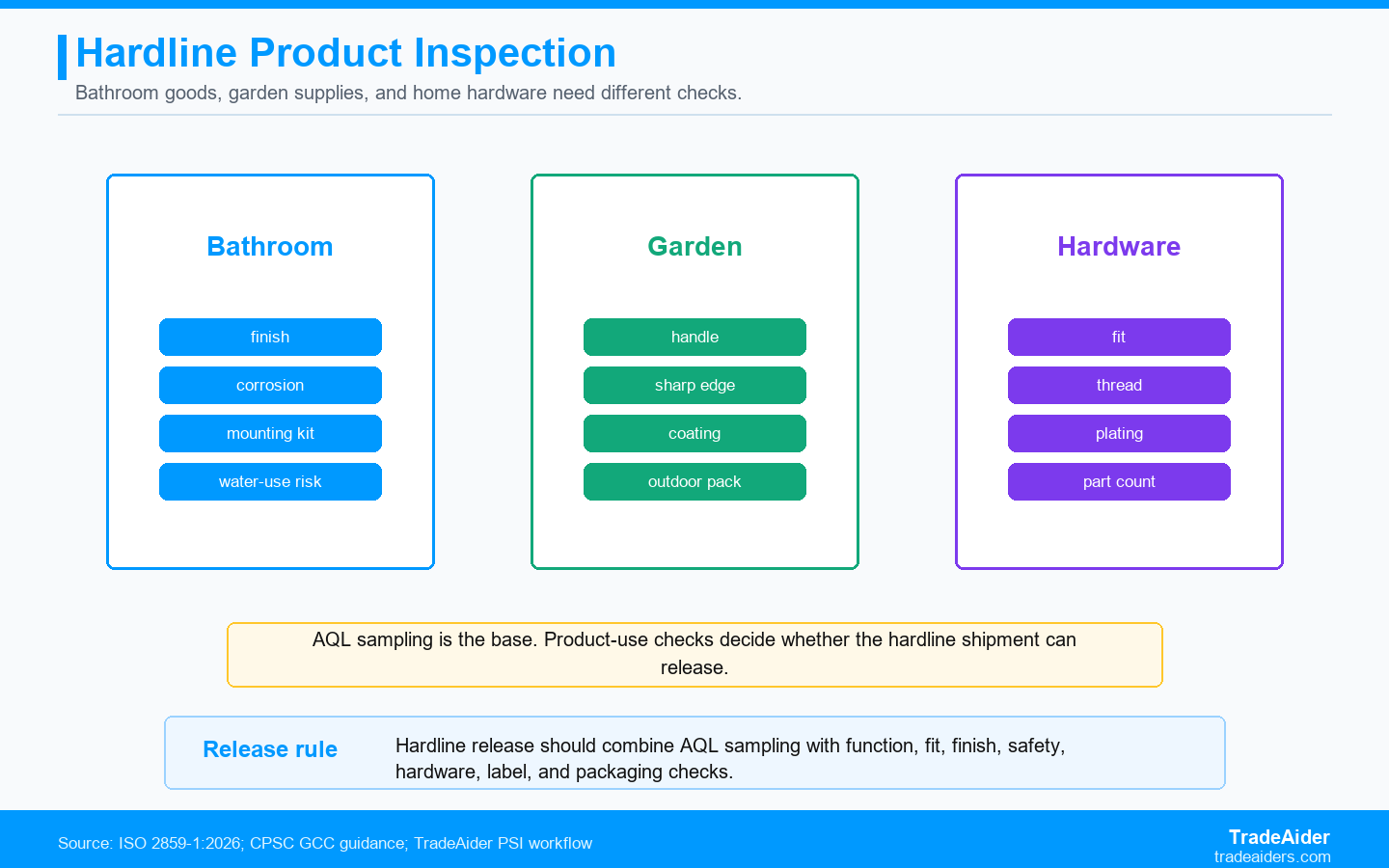
Hardline release should combine AQL sampling with function, fit, finish, safety, hardware, label, and packaging checks.
Bathroom Goods: What To Check
Bathroom goods often fail through finish, corrosion, installation, and moisture-use assumptions.
Bathroom products may be exposed to water, humidity, cleaning chemicals, and repeated handling. The inspector should check visible finish, coating, plating, color consistency, rust spots, sharp edges, burrs, weld quality, suction cups, adhesive pads, mounting screws, anchors, brackets, and instruction sheets. If the item is designed to hold weight, the buyer should define a reasonable function or load check before inspection.
Installation kits are a common failure point. A towel rack, shower shelf, toilet paper holder, hook, drain accessory, or mirror hardware can look acceptable but become unusable if screws, anchors, pads, brackets, or templates are missing. The inspector should open sampled retail packs and compare every part with the instruction sheet.
Packaging matters because many bathroom products have polished or plated surfaces. Metal parts can scratch each other inside the carton. The inspection should verify inner bags, separators, corner protection, retail-box condition, barcode, carton mark, and whether wet or humid storage has affected the goods.
Garden Supplies: What To Check
Garden products need checks for strength, edges, coatings, moving parts, and outdoor exposure.
Garden supplies can include tools, planters, hoses, storage, watering accessories, stakes, ties, outdoor hooks, and small hardware. Inspectors should check handle attachment, molded plastic cracks, metal burrs, sharp edges, coating damage, rust, moving parts, fasteners, hose fittings, caps, seals, and product dimensions. If the item has a blade or pointed part, packaging must protect users during unpacking.
Outdoor products often receive rougher treatment than indoor products. The buyer should check whether the supplier used the approved material, coating, thickness, and construction. A weak handle or loose connection may not be obvious in a static photo. Simple functional checks should be defined when the buyer expects load, pull, twist, bend, or repeated opening and closing.
Garden packaging should protect heavy and sharp items. Internal separation is important because metal tools can damage plastic handles or retail boxes. Cartons should be strong enough for the weight, and the inspector should record carton condition, gross weight, and obvious compression risk.
Home Hardware: What To Check
Hardware inspection is about fit, dimensions, finish, and completeness.
Home hardware often fails because one small dimension is wrong. Hinges, brackets, knobs, locks, fasteners, hooks, rails, and connectors should be checked against drawings, samples, and gauges where available. Threads, hole positions, hole diameter, plating, burrs, screw count, key function, lock function, and part pairing can all decide whether the product is usable.
The buyer should avoid inspecting hardware only by appearance. A shiny hinge can still bind. A bracket can look correct but have wrong hole spacing. A lock can open in the factory sample but fail across the lot. The inspector should perform practical fit and function checks on sampled units based on buyer files.
Hardware packaging should prevent mixing. Small screws, washers, keys, pins, and brackets should be bagged, counted, and labeled. Missing one small part can make the whole kit fail for the customer. For multi-part kits, the inspector should photograph opened kits and count components.
Where TradeAider Fits In Hardline Inspection
TradeAider fits by turning hardline use risk into an inspectable checklist.
TradeAider can use Pre-Shipment Inspection to verify hardline products against AQL sampling, approved samples, drawings, dimensions, function checks, hardware count, labels, packaging, and carton marks before release.
For production-stage risk, During Production Inspection can check material, plating, assembly, molding, finishing, and packing process before the whole lot is completed. If supplier capability is uncertain, factory audit service can review production controls and records.
The business fit is practical risk control. TradeAider helps hardline importers avoid shallow inspections that miss installation, part-count, fit, and packaging failures.
SPAR Scenario: The Bathroom Shelf Failed Because Of A Missing Part
The product looked fine, but the installation kit failed the customer experience.
Situation: A buyer orders bathroom shelves from China. The product is polished, boxed, and ready for shipment.
Problem: PSI finds acceptable finish on most samples, but some retail packs are missing wall anchors and the instruction sheet shows a different bracket. Several shelves also rub against metal screws inside the retail box.
Action: TradeAider classifies missing installation parts as major, asks the supplier to sort all kits, correct the instruction sheet, and separate screws from the polished shelf surface. Reinspection verifies opened kits and packaging protection.
Result: The buyer prevents a shipment that would have produced installation complaints and visible surface damage.
Action Card: Hardline Inspection Checklist
Write the checklist from how the customer uses the product.
- Define AQL sampling level, defect classes, and release rule before inspection.
- Check dimensions, fit, thread, hole position, load points, and functional movement where relevant.
- Inspect finish, plating, coating, burrs, sharp edges, cracks, rust, and visible surface defects.
- Open sampled packs and count all screws, anchors, keys, brackets, washers, seals, and instructions.
- Check packaging for internal rubbing, carton strength, retail box condition, barcode, and carton marks.
- Separate compliance testing from shipment inspection when the product is subject to safety rules.
Hardline buyers should build a defect photo library by product type. A burr on a garden tool, a scratch on a bathroom finish, and a thread mismatch on hardware should not be described with the same vague wording. The photo library helps suppliers understand what must be corrected before inspection.
The buyer should also track defect ownership. Finish problems may belong to polishing or coating. Missing parts may belong to kitting. Misfit may belong to tooling. Carton damage may belong to packaging design. When ownership is clear, supplier CAPA becomes more useful.
For repeat orders, review customer complaints before every inspection. If customers complain about rust, add corrosion-related visual checks and packaging moisture review. If customers complain about installation, check hardware kits and instructions more deeply. If customers complain about breakage, inspect load points and carton protection.
Special Checks That Should Not Be Hidden Inside AQL
Some hardline risks need targeted checks even when the sampled lot passes ordinary defect counting.
Hardline products often need special checks because the defect may be low-frequency but high-impact. A lock may fail because one keyway is wrong. A wall hook may fail because one screw type is missing. A garden tool may be dangerous because one edge is unprotected. These risks should be written as special checks with clear sample counts or zero-tolerance rules instead of disappearing inside a broad minor-defect category.
The buyer should decide which checks need 100 percent review at carton or kit level. Barcode, carton mark, shipping label, warning label, and hardware-bag presence may need broader verification than ordinary product appearance. When a missing part makes the product unusable, checking only a few units may not be enough for a high-value or launch-critical order.
Special checks should also consider how the product is installed. If the end user must drill, mount, lock, tighten, seal, hang, or assemble the item, the inspection should verify that the required parts and instructions are present. A polished product without installation parts is still a failed customer experience. This should be visible in the report.
If you source bathroom goods, garden supplies, or home hardware from China, send TradeAider the drawings, samples, part list, packaging file, and defect history. The next step is to ask TradeAider to build a hardline inspection checklist before shipment.
Frequently Asked Questions
Are hardline inspections only visual?
No. They should include visual checks, dimensions, fit, function, part count, packaging, labels, and product-specific risks.
Does AQL work for hardline products?
Yes for attributes sampling, but AQL should be paired with special checks for fit, load, function, sharp edges, hardware, and packaging.
Can inspection replace safety testing?
No. Inspection verifies the shipment. Safety testing, certificates, or compliance files may still be needed when rules apply.
What is the biggest hardline inspection mistake?
Inspecting appearance while ignoring installation parts, functional fit, sharp edges, and packaging protection.

Related Articles

Grow your business with TradeAider Service
Click the button below to directly enter the TradeAider Service System. The simple steps from booking and payment to receiving reports are easy to operate.

