
- About Us

- Our Services
- Your Industry
- Resources
- News & Blog
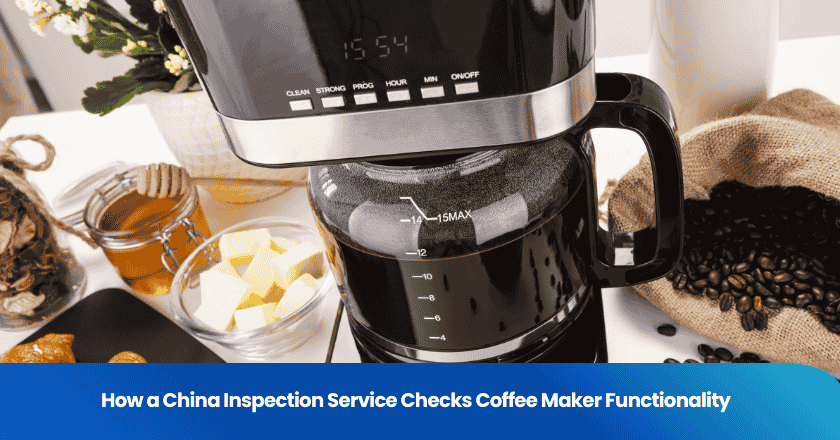
You've confirmed your order, the factory says the coffee makers are ready to ship — and then a friend who imported the same product last year tells you half her units failed the brew test on arrival. The question isn't whether to inspect; it's what a proper inspection actually looks like. A professional China inspection service doesn't just eyeball the box. It runs a structured, multi-layer process that covers everything from document verification to brewing real coffee on the factory floor. Here's the full picture.
Key Takeaways
- A complete coffee maker inspection follows at least 6 distinct steps, starting with safety testing before any function check begins.
- Electrical safety tests — including hi-pot and earth continuity — are non-negotiable under IEC 60335-2-15, the governing international standard for liquid-heating appliances.
- The application test (brewing actual coffee) is the only way to confirm the unit performs as marketed — no paper review can replace it.
- Real-time reporting lets importers make go/no-go decisions before containers are loaded, not after they arrive in Los Angeles or Rotterdam.
Why Coffee Makers Demand Specialized Inspection
They Sit at the Intersection of Electrical and Food Safety
A coffee maker isn't just an electrical appliance — it's also a food-contact appliance. The water tank, tubing, heating element, and carafe all touch the liquid a consumer will drink. This dual nature means any China inspection service working on coffee makers must evaluate two separate risk domains simultaneously: electrical hazards (shock, fire, overheat) and material safety (food-grade plastics, BPA-free components, scale-resistant heating chambers).
The primary international safety standard is IEC 60335-2-15:2024, which covers household appliances for heating liquids. Its 2024 edition added surface temperature limits and improved spillage testing protocols specifically for coffee makers with removable carafes — an update directly relevant to importers sourcing drip or espresso machines for the US, EU, or UK markets.
Common Defects Inspectors Find in Chinese Factories
According to documented inspection case data, the most frequently discovered defects on coffee makers sourced from Chinese factories fall into three categories:
| Defect Category | Typical Examples | Risk Level |
|---|---|---|
| Critical / Fatal | Electric leakage, fire hazard, failed hi-pot test | Immediate rejection — zero tolerance |
| Major | Unit doesn't brew, item wobbles, intermittent function, damaged cable | High — return or rework required |
| Minor | Surface scratches, misaligned logo, loose packaging insert | Tracked — accepted within AQL limits |
Understanding this hierarchy matters because inspectors use it to calculate the AQL (Acceptable Quality Limit) result. For coffee makers destined for consumer electronics retail, a typical configuration runs AQL 0.0 for critical defects, AQL 2.5 for major, and AQL 4.0 for minor — though your specific product spec may tighten those numbers. According to ASQ 2024 research cited, properly configured AQL inspection reduces defect pass-through rates by up to 35%.
The 6-Step Inspection Process: What Actually Happens on the Factory Floor
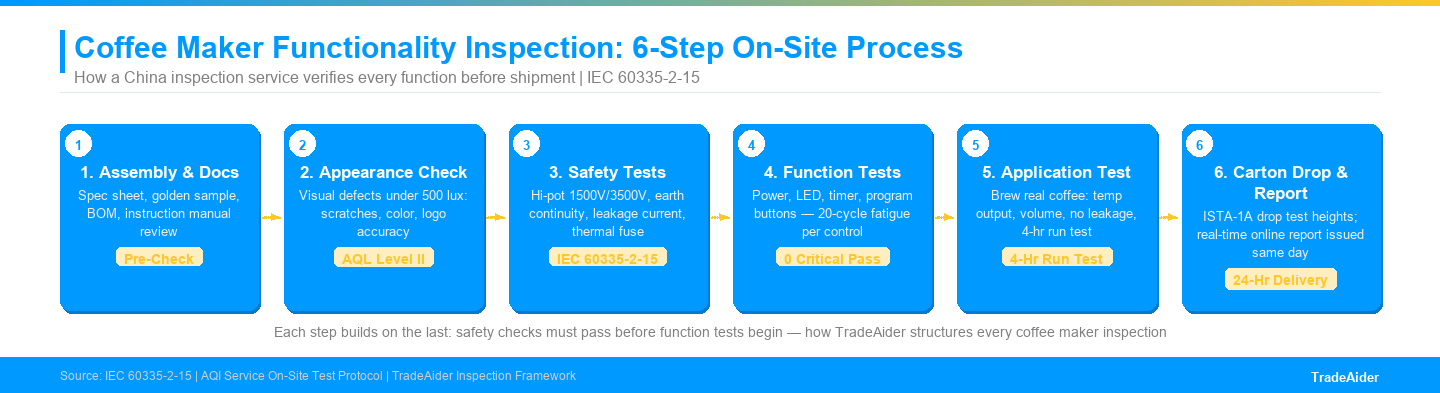
Each step builds on the last: safety checks must pass before function tests begin — this sequencing is how a professional China inspection service structures every coffee maker audit
Step 1 — Assembly and Documentation Review
Before the inspector touches a single unit, they compare the shipment against the approved golden sample and review the Bill of Materials, product specification sheet, and instruction manual. This pre-check catches configuration mismatches — for instance, a factory substituting a cheaper heating element that isn't listed on the approved component form. Review TradeAider's inspection standard to see how golden sample comparison is formalized in a professional checklist.
Step 2 — Appearance and Workmanship Inspection
The cosmetic check is conducted under proper illumination (typically 500+ lux). Inspectors view each unit from roughly arm's length and classify visible defects. They also perform adhesion tests on silk-screen printing and rating labels using 3M tape, and rub checks on electro-plated surfaces. It sounds basic, but this step frequently catches branding errors and surface defects that would trigger customer returns if they reached a consumer.
Step 3 — Electrical Safety Tests (The Non-Negotiables)
This is where a professional inspection diverges most sharply from a factory self-check. The three core electrical safety tests are:
- Hi-pot test: 1,500V (Class I) or 3,500V (Class II) applied for 3 seconds. The unit must not arc, spark, or show current leakage. This verifies insulation integrity throughout the entire electrical circuit.
- Earth continuity test: 25A applied for 1 second; resistance between accessible earthed metal parts and the ground pin must be ≤ 0.1Ω. A single failing unit here is a critical defect.
- Thermal fuse / dry-boiling test: The thermostat is deliberately shorted to verify the thermal fuse cuts power safely. The fuse must not be damaged after the thermostat trips, confirming the unit won't become a fire hazard if left unattended without water.
These tests are for pre-shipment coffee machine checks. Importers sourcing for the EU market additionally need to verify CE marking compliance — but the underlying electrical safety tests are the same.
Step 4 — Functional Tests and Fatigue Cycling
With safety confirmed, the inspector moves to functional verification. This covers every control interaction claimed on the product's gift box and instruction manual: power on/off, LED indicator, timer programming, hour/minute buttons, and any "keep warm" or auto-brew modes. Each button and plug undergoes a 20-cycle fatigue test — press-release repeated 20 times to simulate months of daily use compressed into a few minutes.
The TradeAider Service on-site test protocol also includes an input power check: the measured wattage must fall within +5%/−10% of the rated value for units above 200W, or ±10% for units between 25W and 200W. A coffee maker rated at 1,000W that draws 900W has a material discrepancy the importer needs to know about before it ships.
Step 5 — The Application Test (Brewing Actual Coffee)
This step separates a professional inspection from a perfunctory one. The inspector loads ground coffee, fills the water tank to rated capacity, and runs the machine through a complete brew cycle — recording water output volume, temperature, brew time, and any steam or leakage events. A continuous running test of at least 4 hours at ±10% rated voltage further validates thermal management and the thermostat's cut-off behavior under sustained load.
Think of it this way: an importer selling a "12-cup drip coffee maker" on Amazon expects 12 cups of coffee at the correct temperature. If the machine only produces 9 cups or the heating plate doesn't maintain 80°C, that's a functional defect that will generate one-star reviews — the kind of feedback that destroys a listing's conversion rate. Catching it at the factory costs nothing compared to a recall or FBA removal.
For importers who want proactive quality monitoring beyond a single inspection event, During Production Inspection (DPI) allows you to catch functional issues while the production line is still running — giving the factory time to correct before the batch is complete.
Step 6 — Carton Drop Test and Real-Time Report
The final stage tests whether the packaging protects the product during international shipping. Using ISTA-1A height calculations, the carton is dropped on 6 sides, 3 edges, and 1 corner. For a coffee maker weighing under 9.5 kg, the required drop height is 30 inches onto a concrete floor. Post-drop, the unit is powered on again to confirm no shipping-induced damage affects function.
The inspector then compiles a complete report — photos, measurements, test readings — delivered online. With a real-time reporting platform, you don't wait 48 hours for a static PDF. You can see inspection progress as it happens and raise questions with the inspector while they're still on-site. That real-time visibility is the difference between reactive quality management and proactive control.
What to Include in Your Coffee Maker Inspection Checklist
If you're briefing a China inspection service for the first time on a coffee maker order, ensure your checklist specifies at minimum:
- Golden sample reference and approved component list (BOM)
- AQL levels for critical, major, and minor defects
- Target market (US/EU/AU/UK) — this determines which electrical safety standard applies
- Required certifications to verify on product label (CE, UL, CCC)
- Specific functional tests: brew volume, temperature range, timer accuracy
- Packaging drop test requirement and carton marking verification
The more specific your checklist, the more useful the report. A generic "check that it works" instruction produces a generic result. Use TradeAider's inspection standard templates as a starting point, then customize for your specific product variant.
How TradeAider Approaches Coffee Maker Inspections
TradeAider's inspectors combine the standard on-site test protocol above with real-time reporting through the TradeAider platform. When an inspector is on the factory floor running the application test, the importer can see timestamped photos and readings as they're captured — not after the inspector has left the site. If an issue is found, the buyer can immediately communicate with the inspector about whether to approve, rework, or reject the batch.
This matters particularly for high-volume or private-label coffee makers where the brand equity is on the line. A Shopify brand or Amazon FBA seller sourcing under their own label can't afford to absorb a batch of units with intermittent brew failures. Transparent, real-time inspection is how you prevent that outcome.
TradeAider's transparent pricing at $199/man-day with no hidden fees makes it straightforward to budget inspection into your cost of goods — especially when the alternative is a return shipment or an Amazon suspension.
Frequently Asked Questions
What is the most important test in a coffee maker inspection?
The hi-pot (high-potential) dielectric test is the most critical from a safety standpoint — a failure here means the unit poses a shock or fire risk and must be rejected entirely. From a commercial standpoint, the application test (actually brewing coffee) is the most practically revealing, since it's the only way to confirm the unit performs as marketed under real-world conditions. A complete inspection requires both.
Which standard governs coffee maker inspections for export from China?
For most markets, IEC 60335-2-15 is the primary international standard covering electrical safety requirements for liquid-heating appliances including coffee makers. The US additionally references ANSI/UL 1082. EU exports require CE marking under the Low Voltage Directive, which references the IEC standard. Chinese domestic market products must carry CCC certification.
Can I do a coffee maker inspection during production, or only before shipment?
Both are possible and often advisable for large orders. A Pre-Shipment Inspection (PSI) is the most common choice — it happens when 80%+ of production is complete and all units are packaged. A During Production Inspection (DPI) runs earlier, checking components and sub-assemblies while the line is still active, giving you more options to correct course if a defect pattern appears.
How long does a coffee maker inspection take?
A standard pre-shipment inspection for a coffee maker order is typically completed in one man-day. However, the application test requires at least 4 hours of continuous running time, so the inspector needs a full working day on-site. Large orders requiring a larger AQL sample size may extend to two man-days.
What happens if units fail the inspection?
Depending on severity, the options are: (1) full batch rejection and return to factory for rework; (2) partial acceptance of conforming units with rejection of failed ones; or (3) conditional acceptance pending specific corrective action by the supplier. The inspection report documents every finding with photos and measurements, giving you the evidence needed to negotiate with the factory. TradeAider's real-time platform means you're making these decisions with the inspector still on-site — not days later from a PDF.
Ready to book a coffee maker inspection for your next China shipment? Contact our team to schedule your inspection or get a free quote using TradeAider's inspection calculator.

Related Articles

Grow your business with TradeAider Service
Click the button below to directly enter the TradeAider Service System. The simple steps from booking and payment to receiving reports are easy to operate.

