
To book a Pre-Shipment Inspection in China, confirm the goods are finished and mostly packed, prepare the buyer file pack, define the checklist and AQL rules, schedule the factory visit before final payment, and review the report before shipment release. The booking process is simple when the buyer controls timing and files early.
Many importers treat PSI booking as a last-minute task. They wait until the supplier says the goods are ready, then ask for an inspector the same week. Sometimes that works. More often, it creates avoidable stress: missing files, unclear defect rules, inaccessible cartons, supplier pressure, and no time for correction.
A good booking process starts before production ends. The buyer should know what evidence will be needed to release the shipment. The inspector needs criteria. The supplier needs timing. The buyer needs enough calendar space to act on the report. Booking is not just a calendar reservation; it is the setup for the release decision.
- Ready lot: 100% completed and sufficiently packed for a representative check.
- File pack: PO, spec, sample, labels, barcodes, carton marks, packing list, AQL settings.
- Factory access: address, contact, goods location, working hours, cartons accessible.
- Buyer decision: release, rework, reinspect, hold, or concession after report review.
The Direct Answer
Book PSI as a release gate: files first, factory confirmation second, inspection third, decision last.
TradeAider's Pre-Shipment Inspection is designed for finished goods when 100% of order quantity is completed and at least 80% is packed for export. This threshold helps the inspector sample goods that represent the shipment instead of checking a partial production snapshot.
Buyers who want a smoother booking workflow can also review TradeAider's web app information and the inspection calculator before confirming scope. The key is still the same: provide enough order detail for a practical quotation and checklist.
If the order is not finished, the buyer should not force a PSI just to satisfy a calendar date. A During Production Inspection may be the better control if the issue is process status, production progress, or early defect risk. PSI should confirm the release of finished goods, not compensate for missing production management.
PSI Booking Timeline
The best booking process creates time to correct before shipment pressure begins.
| Timing | Buyer Task | Supplier Task | Risk If Skipped |
|---|---|---|---|
| 7-10 days before target inspection | Confirm production schedule and shipment deadline | Share expected finish and packing date | No correction window |
| 5-7 days before | Send PO, specs, sample reference, artwork, AQL, risk notes | Confirm factory address and contact | Inspector lacks criteria |
| 2-4 days before | Confirm inspection date, SKU list, packed quantity, access | Make cartons and records available | Partial or blocked inspection |
| Inspection day | Stay reachable for clarifications | Provide goods, packing list, and cooperation | Findings remain unresolved |
| Report day | Review report and issue decision | Rework, sort, relabel, or prepare release | Shipment moves without evidence |
The exact timing can change by product and factory location, but the sequence should not. A buyer who sends files late and books inspection after the truck is waiting has already reduced the value of the report.
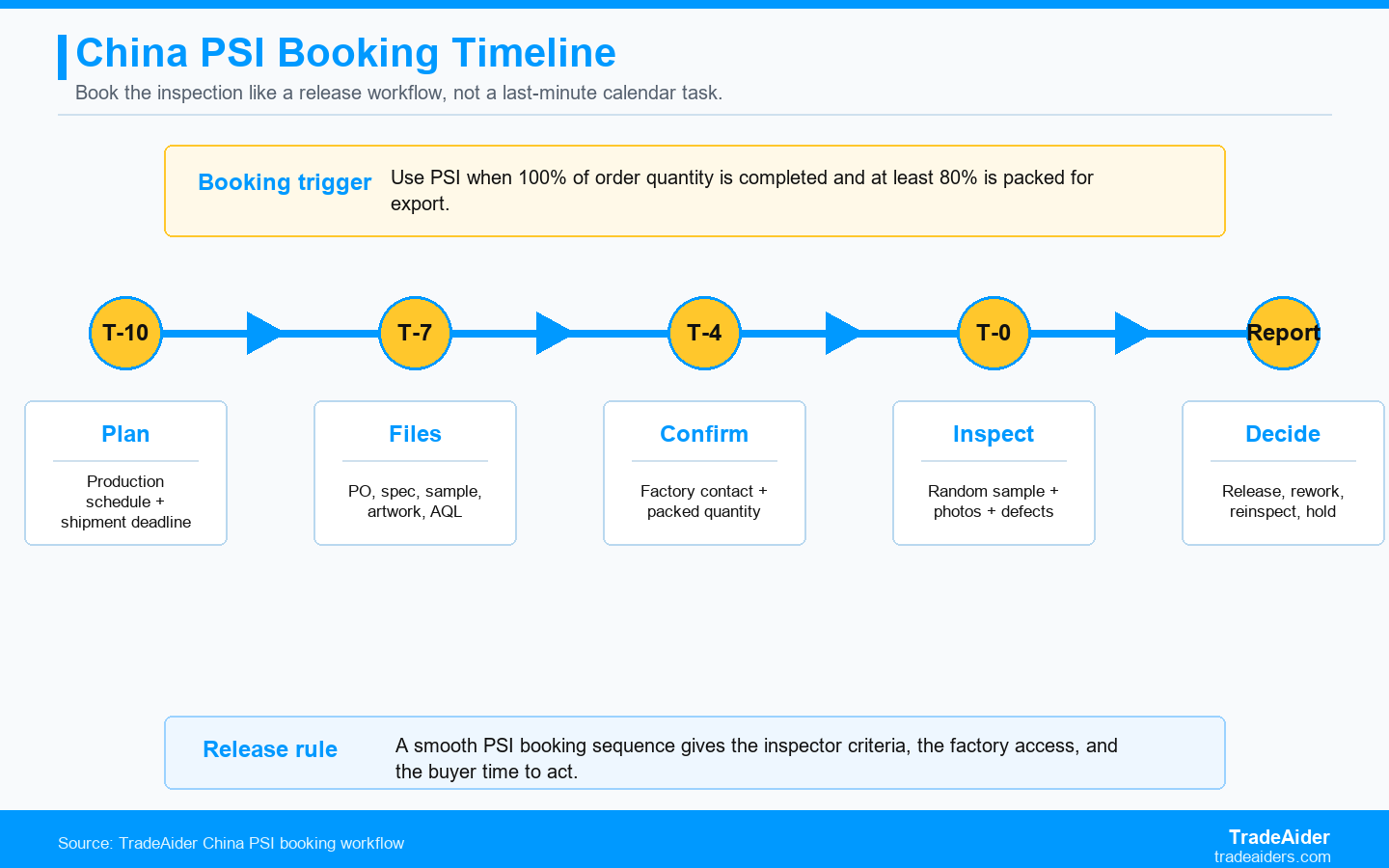
A smooth PSI booking sequence gives the inspector criteria, the factory access, and the buyer time to act.
Step-By-Step Booking Walkthrough
Each booking step prevents a common inspection failure.
#1 Confirm the shipment is ready for PSI
The buyer should confirm production completion, packed percentage, SKU split, available quantity, and factory access before booking. A PSI booked too early may inspect an unrepresentative lot.
#2 Prepare the buyer file pack
Send the PO, product spec, approved sample reference, packaging artwork, barcode list, carton marks, packing list, AQL settings, and special risk notes. These files turn inspection from visual checking into buyer-specific verification.
#3 Define the checklist and defect rules
Agree what counts as critical, major, and minor. Add product-specific checks for function, dimensions, accessories, label location, packaging sequence, or known supplier issues.
#4 Choose the inspection date and factory contact
Book before final payment and before loading pressure removes leverage. Confirm address, contact person, working hours, product location, and whether all cartons are accessible.
#5 Review the report and decide the action
After inspection, read the verdict, quantity, AQL result, photos, notes, and recommended action. Decide release, rework, reinspection, hold, or concession in writing.
What To Send Before Booking
The buyer file pack is the cheapest way to improve report quality.
A PSI report can only judge what the inspection criteria make visible. If the buyer sends a vague product name and a factory address, the inspector may still check quantity and visible defects, but buyer-specific requirements remain weak. The file pack should include the purchase order, SKU list, product specification, measurement tolerance, approved sample reference, packaging artwork, barcode list, label file, carton mark, packing list, AQL level, and special instructions.
If there is a known risk from earlier orders, send it directly. For example, if previous lots had weak glue, missing screws, color drift, wrong insert language, or barcode confusion, add that to the checklist. The inspector should not have to discover the same pattern from scratch.
The file pack also helps supplier negotiation. If the report shows that the physical lot does not match the approved file, the buyer can point to a documented requirement instead of debating memory, screenshots, or chat messages.
Common China PSI Booking Mistakes
Most booking failures are operational, not technical.
One common mistake is booking the inspector before confirming where the goods actually are. A supplier may have production in one building, packing in another, and finished cartons in a warehouse outside the main factory gate. If the inspector arrives and the goods are split, sealed away, or not accessible, the visit can become incomplete. The buyer should confirm the exact address, goods location, access rules, and factory contact before the inspection date.
Another mistake is using the freight deadline as the inspection deadline. If the buyer schedules PSI on the same day as loading, a failed result becomes hard to act on. The supplier may argue that the truck is waiting, the freight booking will be lost, or the buyer should accept a discount. The better approach is to inspect early enough that rework or relabeling is still realistic.
A third mistake is leaving the supplier to define readiness. The buyer should ask for packed quantity, total order quantity, SKU split, carton count, and whether retail packs are sealed. If the goods are not sufficiently packed, some packaging, label, carton mark, and mixed-SKU risks cannot be checked properly. Readiness should be a condition of the booking, not a surprise discovered on site.
A fourth mistake is not assigning a decision-maker. During inspection, questions can arise: the label is slightly different from artwork, the sample has a color variation, the factory says a component substitution was approved, or the carton mark uses an abbreviation. If nobody on the buyer side can respond, the report may become delayed or less decisive. A small importer should stay reachable during the inspection window.
| Booking Mistake | Operational Symptom | Preventive Step | Buyer Benefit |
|---|---|---|---|
| Wrong or vague location | Inspector cannot access all goods | Confirm address, building, contact, and goods location | Avoids wasted visit |
| Inspection too close to loading | Supplier pressures buyer to accept defects | Leave correction time before truck booking | Preserves leverage |
| Supplier-defined readiness | Partial quantity or missing cartons are inspected | Ask for packed quantity and SKU split | Protects sample validity |
| No buyer decision-maker | Clarifications stall during inspection | Keep responsible person reachable | Speeds report action |
These mistakes are avoidable because they do not require a bigger budget. They require discipline. A buyer who books PSI with clear files, clear readiness, and clear access gets a stronger report from the same inspection visit.
Where TradeAider Fits In China PSI Booking
TradeAider fits when the buyer wants a clear path from booking to report to release decision.
TradeAider can support the buyer through the practical PSI workflow: confirm scope, align files, inspect the finished lot, provide report evidence, and help the buyer understand whether the next step is release, rework, reinspection, hold, or concession. The relevant service page is Pre-Shipment Inspection.
If production is still moving and the buyer wants to catch issues earlier, During Production Inspection may be the better service. If the buyer is uncertain whether the supplier can handle future orders, a factory audit answers that supplier-capability question separately.
The business fit is practical coordination. A China PSI booking touches the buyer, supplier, inspector, and freight schedule. TradeAider helps convert that coordination into evidence before the shipment becomes harder to control.
SPAR Scenario: A Better Booking Saved The Inspection
The buyer avoided a wasted visit by confirming readiness before the inspector arrived.
Situation: A US home-goods importer plans a PSI for 6,000 bamboo organizers at a Guangdong factory. The supplier says production will be ready on Friday.
Problem: Two days before inspection, the packing list shows only 70% of quantity packed and one SKU still in assembly. A rushed PSI would not represent the final shipment.
Action: The buyer asks TradeAider to move the inspection to Monday, sends the full artwork and barcode file, and adds accessory-count checks because the previous order had missing dividers.
Result: The inspector checks a representative packed lot, finds one barcode mismatch before loading, and the supplier corrects it. The booking delay prevents a weak report and protects the shipment release decision.
Action Card: Book PSI Without Chaos
Do the paperwork before the inspection day, not after defects appear.
- Confirm production completion, packed percentage, SKU split, and carton accessibility.
- Send PO, product spec, approved sample reference, artwork, barcode list, carton marks, packing list, and AQL settings.
- Book before final payment and before the loading deadline.
- Keep the buyer decision-maker reachable during the inspection window.
- Review the report the same day and document the release, rework, reinspection, hold, or concession decision.
After the first booking, save the file pack and the inspection notes as a reusable China PSI folder. The next order should not start from a blank message thread. A repeatable folder with approved files, old defect photos, carton marks, and decision rules makes the next inspection easier to book and easier to interpret. It also reduces supplier ambiguity.
The buyer should also update the supplier's order instructions after each report. If the report found label confusion, make label control part of the next PO. If the report found mixed accessories, require pre-packing confirmation before PSI. This closes the loop between inspection evidence and supplier process improvement.
If you need to book PSI in China, send TradeAider the factory address, contact person, SKU list, quantity, packing status, target inspection date, buyer files, and shipment deadline. The next step is to ask TradeAider to schedule the China PSI around your release deadline.
Frequently Asked Questions
When should I book PSI in China?
Start arranging PSI several days before the target inspection date, and schedule the actual visit when goods are completed and sufficiently packed for a representative check.
Can PSI happen before all goods are finished?
That is usually not ideal for PSI. If the buyer needs production status evidence before completion, During Production Inspection may be a better fit.
What files are most important for booking PSI?
The most important files are the PO, product spec, approved sample reference, packing list, label files, barcode list, carton marks, AQL settings, and known risk notes.
Should I pay the supplier before the PSI report?
For meaningful shipments, buyers usually preserve leverage by reviewing the PSI report before releasing final balance or shipment approval.
Related Articles


Grow your business with TradeAider Service
Click the button below to directly enter the TradeAider Service System. The simple steps from booking and payment to receiving reports are easy to operate.

