
To choose a factory auditor in China, start with the business decision the audit must support, then ask about audit scope, auditor competence, evidence standards, checklist customization, and follow-up corrective-action handling. The right auditor is not simply the cheapest person who can visit the factory; it is the person or team who can produce evidence the buyer can use before placing, scaling, or continuing orders.
A factory audit can prevent the wrong supplier decision, but only if the audit is scoped correctly. Many importers ask for a factory audit as if it were one universal service. In reality, a supplier capability audit, quality-system audit, social-compliance audit, process audit, and follow-up audit can produce very different answers.
Choosing the auditor matters because the audit report may influence deposit payment, supplier approval, order volume, corrective action, or whether the buyer walks away. A weak audit can create false confidence. A strong audit helps the buyer understand risk before the purchase order becomes expensive to unwind.
- Scope: what decision the audit must support.
- Competence: whether the auditor understands factory systems and product risk.
- Evidence: what proof the report includes.
- Customization: whether the checklist matches the buyer's product and order.
- Follow-up: how findings become corrective action.
The Direct Answer
Choose a China factory auditor by matching audit type, auditor competence, evidence depth, checklist customization, and follow-up process to your supplier decision.
The International Trade Administration advises businesses to perform due diligence on foreign partners and markets before committing. Factory audits are one practical way importers gather supplier evidence before deeper exposure. Source: International Trade Administration due diligence guidance.
ISO 19011 provides guidance for auditing management systems, and the ISO page shows the 2026 edition of the standard. Buyers do not need to quote the standard in every supplier email, but the principle matters: audit planning, auditor competence, evidence, and reporting discipline make the audit useful. Source: ISO 19011:2026.
The buyer should not ask only how much the audit costs. The better question is what decision the report will support. Supplier approval? Risk ranking? Corrective action? Order-size decision? Process improvement? The auditor should be chosen for that answer.
Five Questions To Ask Before Booking
Each question prevents a common audit failure.
#1 What audit scope fits my decision?
Supplier selection, social compliance, quality system, production capability, process control, and follow-up audits answer different questions.
#2 Who will audit and what competence do they have?
The auditor should understand the product category, audit method, factory operations, evidence collection, and local manufacturing context.
#3 What evidence will the report include?
A useful report should show photos, documents reviewed, interviews, facility observations, findings, severity, and recommended corrective actions.
#4 How is the checklist customized?
Generic checklists miss product-specific risks. The buyer should add process, material, equipment, testing, and packaging questions tied to the order.
#5 What happens after the audit?
The buyer needs a follow-up process: CAPA, deadline, responsible factory contact, evidence review, and possible follow-up visit.
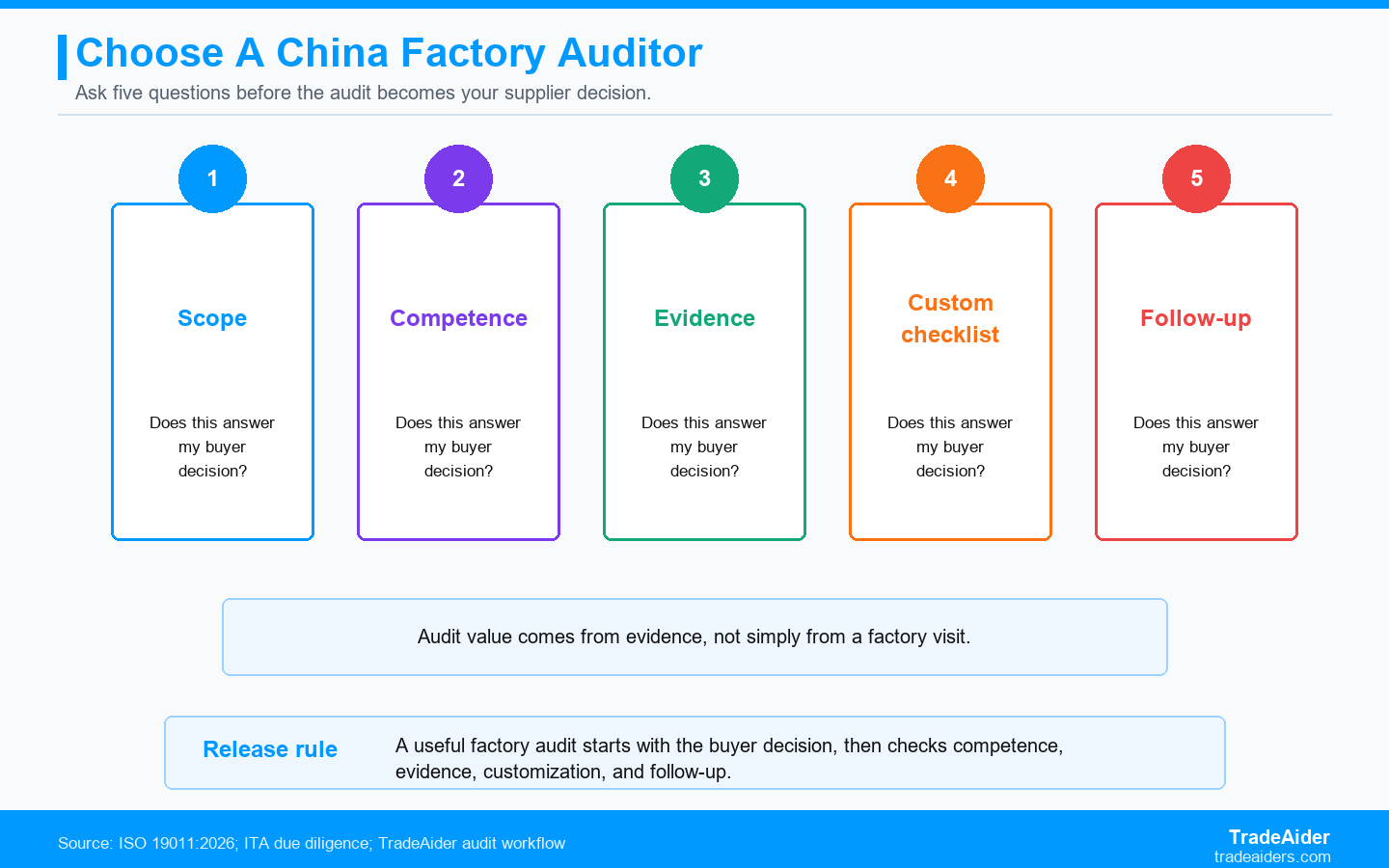
A useful factory audit starts with the buyer decision, then checks competence, evidence, customization, and follow-up.
Audit Types Are Not Interchangeable
The buyer should choose the audit type before choosing the auditor.
| Audit Type | Question It Answers | Common Evidence | When To Use |
|---|---|---|---|
| Supplier capability audit | Can this factory make my product at the required scale? | Equipment, capacity, workforce, production records | Before first PO or volume increase |
| Quality system audit | Does the factory control quality consistently? | QC records, inspection points, calibration, defect handling | When quality risk is meaningful |
| Process audit | Is this product's production process controlled? | Line flow, work instructions, fixtures, material controls | For complex or repeat-defect products |
| Social or compliance audit | Does the factory meet required labor or buyer standards? | Policies, records, facility, interviews | Retailer or brand requirement |
| Follow-up audit | Did the factory correct prior findings? | CAPA evidence, updated records, physical changes | After failed audit or major finding |
A buyer who needs to know whether the factory can make a complex assembled product should not book only a generic facility visit. A buyer who needs retailer social-compliance evidence should not rely on a basic quality-system check. Scope comes first.
What A Strong Audit Report Should Include
A strong report should let the buyer act without guessing what the auditor saw.
The report should include factory identity, address, business scope, production areas observed, products reviewed, documents checked, photos, interview notes where appropriate, finding severity, risk explanation, and corrective-action recommendations. It should distinguish observed evidence from factory claims.
Photo evidence matters, but photos alone are not enough. The report should explain why a finding matters. A blocked inspection area, missing calibration record, incomplete incoming-material check, or weak final QC station should be connected to buyer risk. Otherwise the report becomes a photo album instead of a decision tool.
The report should also be honest about limitations. If the factory denied access to records, if production was not running, if a key process was subcontracted, or if the auditor could not verify a claim, that limitation should appear in the report. Hidden uncertainty is dangerous.
Red Flags When Choosing An Auditor
Some auditor-selection problems are visible before the audit is booked.
A red flag is a provider that cannot explain the audit scope beyond a generic checklist. Another red flag is a report sample with many photos but little severity explanation. A third red flag is no clear follow-up process after findings. The buyer needs more than attendance; the buyer needs decision-quality evidence.
The buyer should also be cautious when the factory is allowed to control too much of the audit process. If the factory chooses the auditor, controls all records, prevents independent photos, or limits access without explanation, the report may become weaker. The auditor should be able to state limitations clearly and preserve independence.
| Selection Red Flag | What It Suggests | Question To Ask | Buyer Risk |
|---|---|---|---|
| Only generic checklist | Audit may miss product-specific risk | Can you add process and product checkpoints? | False confidence |
| No auditor profile | Competence is unclear | Who audits and what experience do they have? | Weak findings |
| Photo-only report | Little interpretation or severity | How are findings ranked and explained? | No action path |
| No CAPA follow-up | Audit ends at the report | How do we verify corrections? | Repeat findings |
| Factory controls access | Evidence may be incomplete | Will limitations be stated clearly? | Hidden uncertainty |
These red flags do not always mean the auditor is unusable, but they do mean the buyer should ask more questions before booking. If the audit will influence supplier approval, ambiguity is not harmless.
Where TradeAider Fits In Factory Auditor Selection
TradeAider fits when the buyer wants the audit to support a real sourcing decision.
TradeAider's factory audit service can help buyers assess supplier capability, production conditions, quality systems, and corrective-action needs before or during supplier relationships.
If the buyer already has an active order, the audit may be combined with later DPI or PSI depending on whether the risk is supplier capability, process drift, or finished-lot release.
The business fit is decision clarity. TradeAider helps the buyer move from vague supplier trust to evidence: approve, conditionally approve, request CAPA, reduce order size, add inspection controls, or reject the supplier.
SPAR Scenario: The Buyer Asked The Right Five Questions
The buyer avoided a generic visit and got an audit that changed the sourcing decision.
Situation: A US importer is considering a new factory for metal storage racks. The factory has good samples and a confident sales team.
Problem: The buyer's main risk is not whether the factory exists. It is whether welding, coating, packing, and final QC are stable enough for repeat orders.
Action: Before booking, the buyer asks TradeAider to scope a capability and quality-system audit, confirms auditor product familiarity, requires photo/document evidence, adds welding and coating checkpoints, and defines CAPA follow-up rules.
Result: The audit finds weak coating records and incomplete final inspection discipline. The buyer still works with the factory, but starts with a smaller PO, adds DPI, and requires corrective action before scaling.
Action Card: Choose The Auditor
Select the auditor by evidence quality, not only by availability.
- Define the supplier decision before choosing audit type.
- Ask who will audit and whether they understand the product and factory process.
- Require evidence: photos, documents checked, findings, severity, and CAPA recommendations.
- Customize the checklist around product, process, material, and buyer risk.
- Plan follow-up before the first audit report is delivered.
After the audit, the buyer should not file the report and move on. The report should update the supplier approval decision, purchase order risk controls, DPI need, PSI checklist, and follow-up CAPA calendar.
What To Confirm In The Quote
The audit quote should describe deliverables, not only price and date.
Before booking, confirm audit duration, factory address, audit type, auditor language, report language, expected deliverables, photo rules, document-review scope, and whether the report includes severity levels and CAPA recommendations. If the quote says factory audit but does not define these items, the buyer may receive a visit report rather than a decision report.
The buyer should also ask what happens if the factory is not ready. If production is stopped, records are unavailable, management is absent, or access is restricted, the auditor should document the limitation. A weak provider may simply produce a thin report; a useful auditor explains what could not be verified and why that matters.
| Quote Item | What To Confirm | Why It Matters | Buyer Action |
|---|---|---|---|
| Audit scope | Capability, quality system, process, social, or follow-up | Prevents wrong audit type | Match to sourcing decision |
| Report deliverable | Photos, documents, severity, CAPA, limitations | Defines evidence quality | Reject vague report promise |
| Auditor fit | Product/process experience and language | Improves finding relevance | Ask before booking |
| Access limits | How denied records or closed areas are reported | Protects transparency | Treat limitation as risk |
A good quote makes the audit easier to evaluate before it happens. The buyer should know what evidence will arrive, how fast, and how it will support approval, conditional approval, CAPA, or supplier rejection.
After the report arrives, keep the quote, scope, checklist, and report together. If the audit later proves too shallow, the buyer can see whether the problem was poor scope, poor execution, or changed supplier risk after the visit.
That record also helps the buyer brief the next auditor faster and avoid repeating the same vague request.
It shortens future preparation.
Good scope is reusable knowledge.
The buyer should also record which questions were answered well and which remained uncertain, because unresolved audit uncertainty should feed into DPI, PSI, payment terms, and order-size decisions.
That is how one audit improves the whole sourcing workflow and future supplier control.
If you need to choose a China factory auditor, send TradeAider the supplier name, product type, order plan, audit purpose, known concerns, and required buyer standards. The next step is to ask TradeAider to scope the right factory audit before you book.
Frequently Asked Questions
Is every factory audit the same?
No. Capability, quality-system, process, compliance, and follow-up audits answer different questions. Scope should match the sourcing decision.
Should I choose the cheapest auditor?
Not if the report will influence supplier approval or order volume. Evidence quality, competence, and follow-up value matter more than the lowest visit fee.
Can a factory audit replace PSI?
No. A factory audit evaluates supplier systems and capability. PSI checks the finished shipment before release.
What should I do after the audit?
Review findings, set CAPA deadlines, decide supplier approval status, and update order controls such as DPI, PSI, or follow-up audit.
Related Articles
Grow your business with TradeAider Service
Click the button below to directly enter the TradeAider Service System. The simple steps from booking and payment to receiving reports are easy to operate.

