
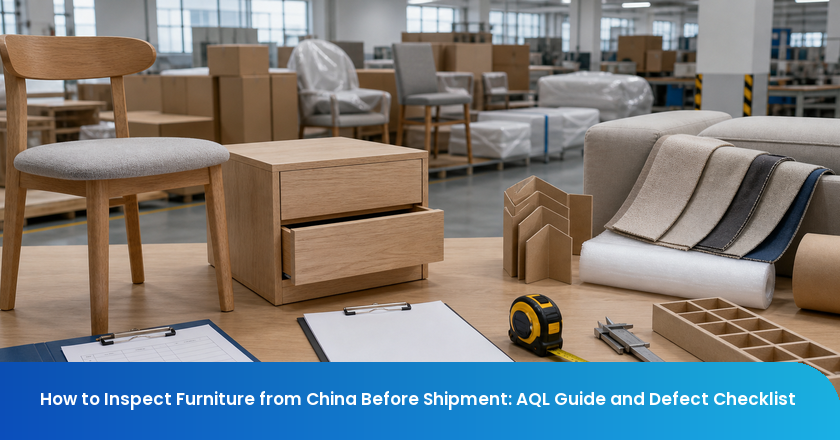
Furniture inspection before shipment should combine AQL sampling with furniture-specific checks for structure, dimensions, finish, hardware, stability, upholstery, assembly, packaging, labels, and carton protection. A passed furniture inspection should show that the actual lot matches the approved sample, specification, packaging file, safety requirements, and buyer release rule before the goods leave the factory.
Furniture is hard to inspect well because defects can be visual, structural, functional, dimensional, packaging-related, or safety-related. A sofa may look good but have weak stitching. A table may pass color checks but fail assembly alignment. A cabinet may look stable in photos but have poor drawer glide, missing hardware, weak anti-tip instructions, or carton protection that cannot survive transport.
A generic AQL inspection is not enough unless the checklist is furniture-specific. The buyer should define sampling level, AQL limits, defect classes, product tests, packaging checks, and market-specific safety files before the inspector arrives. The supplier should know that the inspection will cover more than surface appearance.
- AQL layer: lot size, sample size, defect class, accept and reject numbers.
- Furniture layer: structure, finish, dimensions, hardware, stability, assembly, upholstery, and packaging.
- Safety layer: tip-over, flammability, labels, warnings, and destination-specific requirements where applicable.
- Decision rule: inspect both sellable product quality and the packed shipment's ability to arrive intact.
The Direct Answer
Inspect China furniture with an AQL plan plus a category-specific checklist that covers visible finish, structure, fit, assembly, stability, upholstery, hardware, labels, and packaging.
ISO 2859-1:2026 is the current ISO standard for AQL-indexed sampling procedures for lot-by-lot inspection by attributes. Source: ISO 2859-1:2026.
CPSC guidance for clothing storage units explains the mandatory US rule under 16 CFR part 1261 for defined clothing storage units manufactured after September 1, 2023. Source: CPSC clothing storage units guidance.
CPSC upholstered furniture guidance explains that 16 CFR part 1640 sets flammability requirements for upholstered furniture and incorporates California TB 117-2013. Source: CPSC Flammable Fabrics Act guidance.
These sources do not mean every furniture item has the same legal requirement. A dining table, sofa, cabinet, dresser, upholstered chair, and children's furniture product can have different risk profiles. The practical point is that inspection should not only check cosmetic defects; it should also verify whether product type and destination create safety or documentation requirements.
Furniture AQL Setup
Sampling rules should be clear before the inspector opens cartons.
| AQL Element | Furniture Application | Buyer Decision | Common Risk |
|---|---|---|---|
| Lot definition | Separate sofa, table, cabinet, color, size, or PO line where needed | What goods belong to one release decision? | High-risk SKU hidden inside mixed lot |
| Inspection level | Use risk-based level for first orders, complaint history, or complex assembly | How much evidence is needed? | Too small a sample for new furniture |
| Critical defects | Unsafe sharp edge, severe instability, wrong warning, blocked assembly, severe contamination | Usually zero tolerance | Treating safety as cosmetic |
| Major defects | Wrong dimension, broken part, visible finish defect, missing hardware, failed assembly | Strict AQL limit | Customer cannot use or sell item |
| Minor defects | Small hidden rub mark, slight underside scuff, minor carton blemish | Track frequency | Minor defects become brand problem in volume |
Furniture buyers should avoid one-number AQL instructions. A scratch on the underside of a table may be minor, while a scratch on the tabletop may be major. A missing screw can be major or critical depending on whether the item becomes unsafe. Defect severity should follow product use and customer expectation.
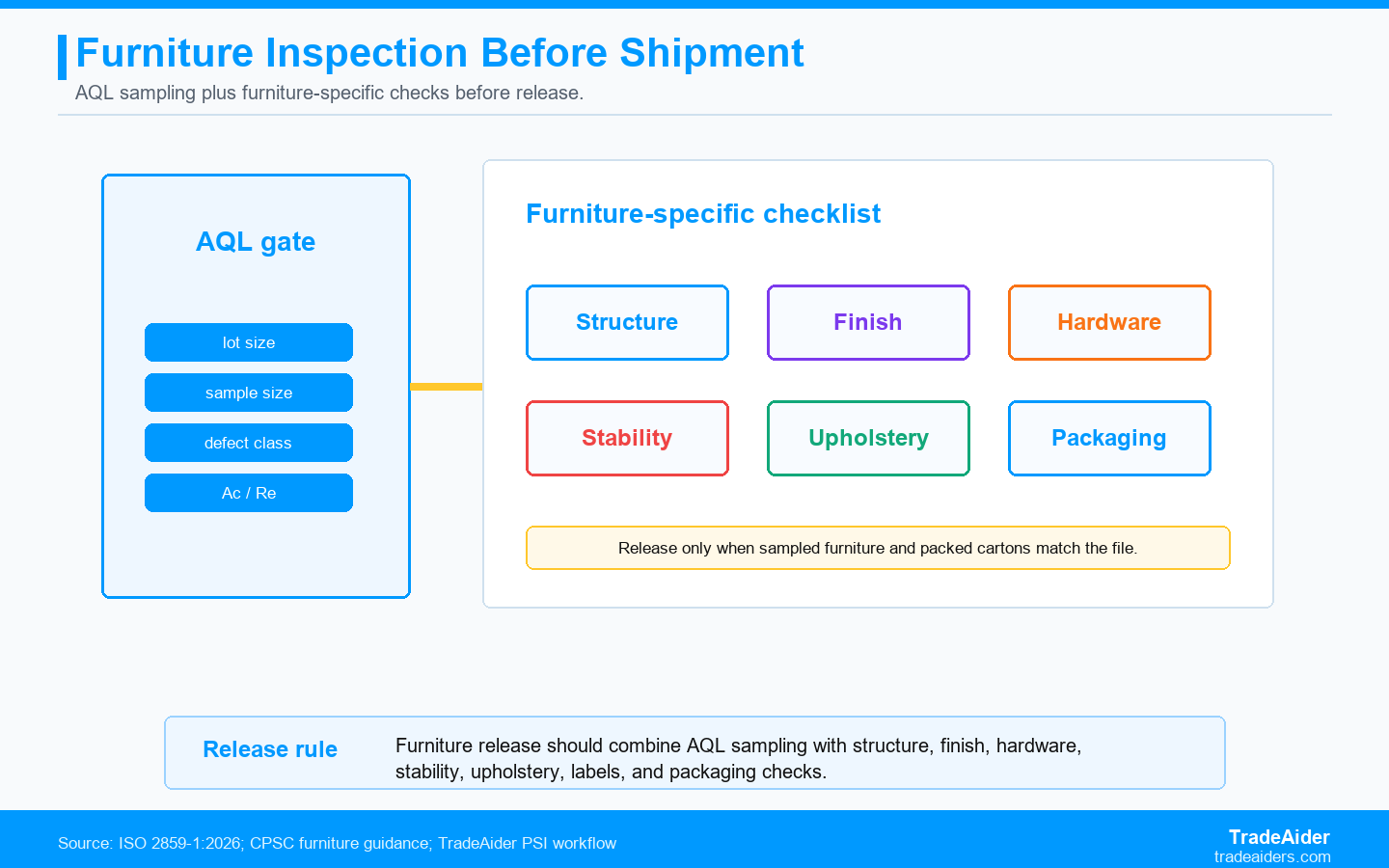
Furniture release should combine AQL sampling with structure, finish, hardware, stability, upholstery, labels, and packaging checks.
Step 1: Check Structure, Dimensions, And Assembly
Furniture must be inspected as an assembled product, not only as loose components.
The inspector should check dimensions against the specification, including height, width, depth, seat height, tabletop thickness, drawer gap, leg length, hole position, and key tolerances. Even small dimensional errors can create assembly failure or visual misalignment after the customer opens the box.
For knock-down furniture, the inspector should assemble sampled units or at least verify critical fit points. Hardware holes, cam locks, dowels, screws, brackets, hinges, rails, and threaded inserts should align. Missing or wrong hardware can make the product unusable even if panels look perfect.
Structural checks should include wobble, loose joints, cracks, split wood, weak welding, broken frames, unstable legs, failed drawer glide, uneven doors, sharp burrs, and poor load-bearing areas. The buyer should provide product-specific functional tests whenever the item has moving parts or load expectations.
Step 2: Check Finish, Upholstery, And Customer-Facing Appearance
Furniture is often judged by first-viewport appearance after unpacking.
Finish checks include color match, veneer, paint, coating, stain, gloss, fabric shade, visible scratches, dents, chips, glue marks, sanding marks, stains, odor, mold, exposed staples, uneven seams, and poor edge banding. The inspector should compare the lot with approved samples and buyer photos, not only supplier memory.
For sofas and upholstered furniture, checks should include fabric shade, sewing, seam strength, tufting, cushion shape, foam feel, zipper function, loose threads, fabric damage, frame noise, leg attachment, and label placement. Upholstery defects can become high-return issues because customers notice them immediately.
For cabinets and tables, checks should include visible faces, tabletop finish, corners, doors, drawers, handles, leg finish, surface flatness, and gap consistency. The buyer should decide which surfaces are customer-facing and classify visible defects more strictly than hidden defects.
Step 3: Check Packaging And Transit Protection
Furniture can pass product checks and still arrive damaged if packaging fails.
Furniture packaging should be inspected as part of product quality. The inspector should check carton strength, edge protection, corner blocks, foam, honeycomb board, hardware bags, instruction sheets, inner separation, moisture protection, retail labels, carton marks, palletization where relevant, and barcode accuracy.
The buyer should ask the inspector to open packed samples and verify that heavy parts do not rub against finished surfaces. A tabletop and metal leg packed together without protection can create scratches during transport. Hardware bags should be secured so they do not damage visible surfaces or disappear inside the carton.
Drop testing, carton compression review, moisture checks, or transit simulations may be needed for some furniture programs. Standard PSI can document visible packaging design, but severe logistics risk may require separate packaging validation.
Where TradeAider Fits In Furniture Inspection
TradeAider fits by combining AQL sampling with furniture-specific release evidence.
TradeAider can use Pre-Shipment Inspection to check furniture lot size, sample size, workmanship, dimensions, assembly, hardware, upholstery, labels, carton marks, and packaging before release.
For higher-risk furniture, During Production Inspection can check frames, panels, upholstery, finish, and packing method before the full lot is completed. If supplier capability is uncertain, factory audit service can review production controls and quality records.
The business fit is preventing expensive bulky-goods mistakes. Furniture is costly to return, rework, warehouse, and replace. TradeAider helps buyers find issues while the factory can still sort, repair, repack, or replace affected units.
SPAR Scenario: The Sofa Looked Good Until Assembly
The buyer needed assembly evidence, not only surface photos.
Situation: A buyer orders upholstered sofas from China for a retail launch. The supplier sends attractive sample photos and says production is ready.
Problem: PSI finds acceptable fabric appearance, but assembled samples show uneven leg height, missing washers, and loose back-frame screws. Cartons also place metal legs against fabric cushions without enough separation.
Action: TradeAider classifies missing washers and loose screws as major, requires supplier sorting, adds hardware-bag verification, and asks the factory to repack legs with added separation. Reinspection focuses on corrected assembly and packaging.
Result: The buyer avoids a shipment that would have created customer assembly complaints and fabric damage during transit.
Action Card: Furniture Inspection Checklist
Send the inspector product files and furniture-specific defect priorities.
- Send approved sample photos, drawings, dimensions, tolerances, finish references, and assembly instructions.
- Define critical, major, and minor furniture defect examples by product type.
- Require assembly or fit checks for knock-down furniture and moving parts.
- Check upholstery, fabric shade, seam quality, frame noise, and cushion shape for sofas.
- Check drawer glide, door gap, hinge alignment, tabletop flatness, leg stability, and hardware completeness.
- Inspect packaging, carton marks, barcode, hardware bag, instructions, edge protection, and moisture risk.
The buyer should also classify safety-related defects before inspection. A sharp edge, unstable dresser, missing anti-tip instruction, broken load-bearing part, or severe flammability documentation gap should not be treated like a small cosmetic mark. Furniture risks can become safety and liability issues.
For first orders, inspect more deeply and assemble more samples. For repeat orders, review customer complaints and return reasons before each inspection. Furniture defects often repeat when the factory uses the same jigs, packaging method, material supplier, or rushed finishing process.
Special Furniture Checks Buyers Often Forget
Furniture inspection should include the checks that customers discover only after unpacking.
Assembly simulation is one of the most important forgotten checks. A factory may show perfect finished samples, but the customer's carton may contain panels, screws, cams, rails, and instructions that do not fit together smoothly. The inspector should assemble sampled units when practical or at least verify critical holes, hardware count, rail direction, hinge position, and instruction accuracy.
Load and stability checks should be defined carefully. The inspector should not invent unsafe stress tests at the factory, but the buyer can define simple, reasonable checks such as wobble, drawer glide, chair balance, table level, leg attachment, shelf fit, or cushion support. Formal safety testing still belongs in the right lab or compliance program where required.
Moisture and odor checks are also important for wood, composite panels, upholstery, and long ocean shipments. Damp cartons, mold spots, swelling panels, strong chemical smell, rusted hardware, or soft packaging can turn into major arrival problems. The inspector should photograph carton condition, storage environment where visible, and any odor or moisture-related finding.
Instruction sheets and spare parts deserve attention. Many furniture returns are not caused by broken panels but by unclear instructions, missing screws, wrong hole diagrams, unlabeled parts, or mismatched hardware bags. A furniture PSI should open sampled hardware kits and compare them with the instruction sheet, not only count finished cartons.
Buyers should also require a packaging photo plan. For bulky furniture, the report should show not only the outside carton but also internal protection, corner guards, edge pads, hardware placement, instruction placement, and how visible surfaces are separated from metal parts. Those photos become valuable if the shipment later arrives with rubbing damage or crushed corners.
For mixed furniture orders, the inspector should show sample distribution by SKU, color, size, and carton type. A sofa, table, and cabinet should not be treated as one blended furniture lot if each product has different risks and packaging construction.
Finally, connect inspection to payment. If the lot fails due to major defects, the purchase order should allow hold, rework, sorting, reinspection, or delayed balance payment. Without that rule, the buyer may have evidence but weak leverage.
If you need a furniture inspection plan, send TradeAider the product drawings, sample photos, SKU list, order quantity, packaging plan, and defect history. The next step is to ask TradeAider to build a furniture AQL checklist before shipment.
Frequently Asked Questions
Is AQL enough for furniture inspection?
AQL is necessary for sampling, but furniture also needs product-specific checks for assembly, structure, finish, hardware, upholstery, stability, and packaging.
Should furniture be assembled during PSI?
Yes, sampled assembly or fit checks are important for knock-down furniture, moving parts, and items where hole alignment or hardware completeness matters.
Do furniture inspections check legal compliance?
Inspection can verify visible labels, warnings, and shipment conformity, but lab testing or legal review may still be needed for flammability, stability, or market-specific rules.
What is the biggest furniture inspection mistake?
Checking appearance while ignoring packaging and assembly. Many furniture complaints happen after unpacking, assembly, or transit damage.
Related Articles



Grow your business with TradeAider Service
Click the button below to directly enter the TradeAider Service System. The simple steps from booking and payment to receiving reports are easy to operate.

