
A product spec Chinese factories will actually follow is a measurable, version-controlled instruction file that connects the approved sample, materials, dimensions, function, labels, packaging, defect definitions, and inspection criteria. It should tell the factory what to make and tell the inspector how to decide whether the goods are acceptable.
A weak spec creates room for interpretation. The supplier may think the product is acceptable because it looks close to the sample. The buyer may reject it because the finish, barcode, accessory, carton, warning label, or assembly detail is wrong. Both sides can be sincere and still disagree because the acceptance rule was never written clearly.
A strong product spec is not a long design essay. It is an operational document. It should be short enough for production teams to use, detailed enough for quality teams to inspect, and controlled enough that everyone knows which version applies to the current purchase order.
- Spec purpose: define what the supplier must produce.
- Inspection purpose: define what evidence proves the goods match.
- Release purpose: define what happens when the goods pass, fail, or need rework.
- Revision purpose: prevent old files, old labels, or old samples from entering production.
The Direct Answer
A good China product spec should be written as an inspection-ready checklist, not just a design description.
TradeAider uses product specs as the bridge between buyer requirements and factory-floor evidence: the clearer the spec, the more useful the inspection report becomes for release, rework, or hold decisions.
The International Trade Administration due diligence guidance recommends evaluating markets and partners to reduce problems, loss, and liability. For importers, that logic should extend to product files. A buyer is not only selecting a supplier; the buyer is also giving that supplier the operating standard for production.
Product standards also matter. The Trade.gov product standards page notes that products may face country-specific standards, CE marking, China Compulsory Certification, WTO technical regulation notices, and ISO references. A factory spec should not pretend to be legal advice, but it should clearly state which compliance files, warnings, labels, or test reports the physical goods must match.
The practical result is simple: if the spec cannot be inspected, it is not ready for mass production. A factory may still produce something, but the buyer will have weak leverage when the output does not match the buyer's unstated expectation.
Product Spec Structure That Works In China Sourcing
The best product spec separates design intent, production requirements, and inspection acceptance rules.
Use one master PDF or controlled spreadsheet as the source of truth. Keep supporting artwork, CAD, labels, barcodes, photos, and test reports attached as named files. Every file should have a revision date and status. The purchase order should identify the exact spec version that applies.
| Spec Section | What To Include | Why It Matters For Inspection |
|---|---|---|
| Product identity | SKU, model, version, destination market, PO, approved sample reference | Prevents factory or inspector from checking the wrong item |
| Materials and components | Material grade, component version, supplier-approved substitutes, restricted materials | Controls hidden changes that may not be obvious visually |
| Measurements and tolerance | Dimensions, weight, thickness, color reference, acceptable variation | Turns subjective arguments into measurable checks |
| Function and performance | Assembly, working test, load, battery, fit, movement, or durability checks | Links product use to factory release criteria |
| Packaging and labels | Retail box, barcode, warning, insert, carton mark, packing method | Catches the errors that cause warehouse and marketplace problems |
| Defect classification | Critical, major, minor defects, AQL level, hold rules | Tells the buyer, factory, and inspector what happens after findings |
This structure keeps the spec usable. The supplier can produce from it. The inspector can check from it. The buyer can make a release decision from it. That is the whole point.
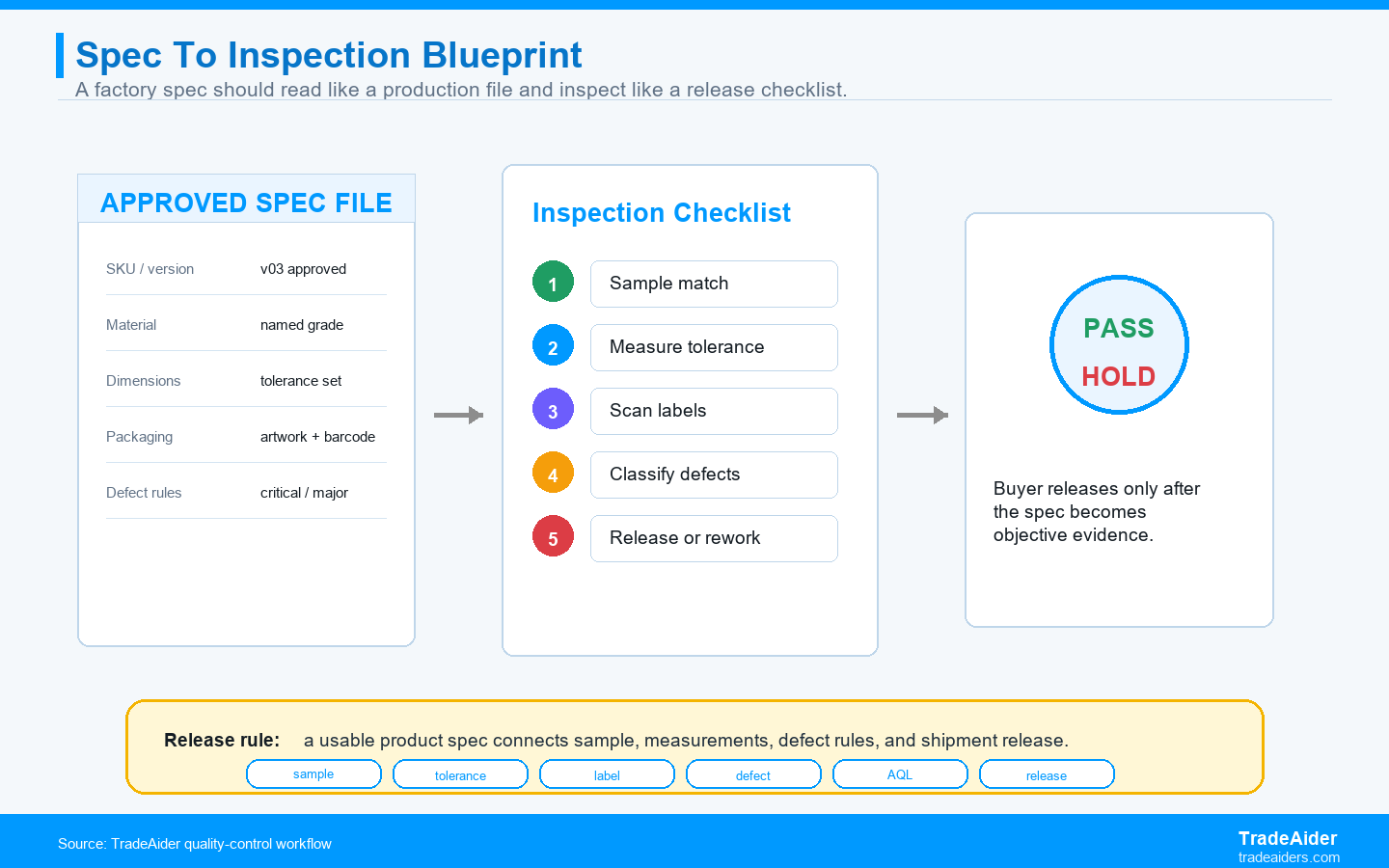
A usable product spec connects the approved sample to measurable checks, defect rules, and shipment release.
How To Turn A Spec Into An Inspection Checklist
An inspection checklist should be the product spec translated into observable evidence.
A product spec can be rich and still fail at inspection time if the checklist does not translate it into field checks. The buyer should take each spec section and ask what the inspector can verify at the factory. Material can become material marking, component version, color, finish, weight, or supplier-declared document evidence. Dimensions can become measurement points and tolerance limits. Packaging can become retail box artwork, warning label, barcode scan, carton mark, carton count, and packing method.
Not every spec detail belongs in the same inspection stage. Some details belong in Pre-Production Inspection because they concern materials, components, tooling, or setup. Some belong in During Production Inspection because they concern process stability. Some belong in Pre-Shipment Inspection because they concern finished goods, packed cartons, labels, quantity, and sample match. Splitting the checklist by stage makes the spec more useful and avoids asking the final inspector to solve problems that should have been caught earlier.
The buyer should also mark which checks are critical. A wrong country-of-origin mark, missing safety warning, failed function, mixed barcode, or unapproved material may require shipment hold. A small cosmetic mark may be a minor defect if it stays within the agreed AQL limit. A spec that does not rank defect severity leaves the buyer arguing after the fact.
The most useful checklist is short enough to execute and specific enough to defend. It should not ask the inspector to judge whether the product feels premium. It should ask the inspector to check surface finish against approved sample, measure defined dimensions, test defined functions, scan defined barcodes, compare defined label files, and record defect counts by category.
Common Product Spec Mistakes To Avoid
Most product spec failures come from vague language, uncontrolled revisions, or missing packaging details.
#1 Writing a feature list instead of measurable acceptance criteria
Factories can follow measurable requirements: material, dimensions, tolerance, color reference, finish, function, label, packaging, and defect limits. They cannot reliably follow vague language such as premium finish, strong material, or retail quality.
#2 Leaving the approved sample disconnected from the document
A sample is useful only when the spec says which sample is approved, which revision it represents, and which details the factory must match. Otherwise, the supplier may treat the sample as inspiration rather than a release standard.
#3 Forgetting packaging, barcode, carton, and label requirements
Many China sourcing problems are not product-function problems. They are wrong barcode, missing warning, weak carton, mixed retail insert, wrong color label, or bad carton mark problems.
#4 Not defining critical, major, and minor defects
The supplier needs to know which findings stop shipment and which findings require sorting or concession. A product spec should translate quality expectations into inspection decisions.
#5 Sending changes through scattered chat messages
A factory may follow the newest file, the easiest file, or the message that reached the production manager. Revision control protects both sides from accidental drift.
Where TradeAider Fits In The Product Spec Workflow
TradeAider fits when the buyer wants the product spec converted into inspection evidence before shipment release.
TradeAider's Pre-Production Inspection can check whether materials, components, samples, tooling, and setup match the approved spec before mass production goes too far. This is useful when a supplier is making the first order, changing a component, using custom packaging, or producing a product with tight tolerances.
During production, During Production Inspection can compare actual output against the spec while defects are still correctable. At the end, Pre-Shipment Inspection checks the completed lot when 100% of the order quantity is completed and at least 80% is packed for export.
The business fit is straightforward: TradeAider does not replace the buyer's product decisions. It helps the buyer turn those decisions into site evidence: what was checked, what matched, what failed, what needs rework, and whether shipment should be released.
How To Control Revisions Without Slowing The Factory
Revision control is useful only when it is simple enough for the factory to follow.
A buyer does not need an enterprise document-control system for a normal consumer-goods order. The buyer does need file names, dates, and status labels that remove ambiguity. Use names such as SKU-1042-product-spec-v03-approved-2026-05-22.pdf, barcode-list-v02-approved.xlsx, and retail-box-artwork-v05-approved.pdf. The word approved matters because factories often receive draft files during sampling and may reuse them accidentally.
When a change is approved, summarize what changed and which old files are obsolete. If a label file changes, the buyer should say whether old printed labels may be used, must be scrapped, or may be used only for a domestic trial lot. If a component changes, the buyer should state whether old components are allowed in current production. These small decisions prevent mixed-version shipments.
Finally, make the PO reference the approved spec package. If the PO only says 'as per sample' and the real requirements live across chat messages, the buyer has weak evidence when the supplier follows the wrong instruction. A PO that references the approved spec version turns the spec into a commercial release document.
SPAR Scenario: The Spec That Stopped A Packaging Failure
The buyer solved the dispute by turning expectations into release criteria before the second order.
Situation: A US kitchenware importer orders 5,000 silicone storage bags from a Guangdong factory. The first order passes basic function checks but arrives with mixed retail insert versions and weak export cartons.
Problem: The original spec focused on product size and color, while packaging requirements lived in email attachments. The factory says it used the newest files it received. The buyer says the old insert should never have been packed.
Action: For the reorder, the buyer creates a controlled spec with insert revision, barcode list, warning text, carton mark, carton strength requirement, approved sample reference, and critical defect rules. TradeAider uses the spec during PSI and finds that two carton batches still use the old insert.
Result: The buyer holds release, the factory sorts affected cartons, and the shipment moves after reinspection. The dispute becomes solvable because the spec named the file, revision, and release rule.
Action Card: Product Spec For China Factories
Write the spec so a production manager can make it and an inspector can verify it.
- Use one controlled spec version per purchase order.
- Attach approved sample reference, label files, barcodes, carton marks, and packaging artwork.
- Write measurable dimensions, tolerances, material rules, and function checks.
- Define critical, major, and minor defects before inspection.
- State that final payment and shipment release depend on acceptable inspection findings.
If your supplier is about to start production but the spec is still scattered across emails, send TradeAider the PO, approved sample status, product files, label files, packaging files, and known defect risks. The next step is to ask TradeAider to turn the product spec into an inspection-ready checklist before production drift becomes packed inventory.
Frequently Asked Questions
What is the most important part of a China product spec?
The most important part is measurable acceptance criteria. The spec should say exactly what the factory must make and what the inspector must verify.
Should I rely on the approved sample instead of a written spec?
No. The approved sample should be referenced inside the written spec. The sample shows the target, while the spec defines measurable requirements and release rules.
How detailed should packaging instructions be?
Packaging instructions should be as detailed as product instructions. Include retail box, insert, warning label, barcode, carton mark, packing method, and approved artwork version.
Can TradeAider inspect against my own checklist?
Yes. TradeAider can inspect against buyer-approved specifications, samples, labels, packaging files, AQL rules, and special checkpoints.
Related Articles



Grow your business with TradeAider Service
Click the button below to directly enter the TradeAider Service System. The simple steps from booking and payment to receiving reports are easy to operate.

