
- About Us

- Our Services
- Your Industry
- Resources
- News & Blog
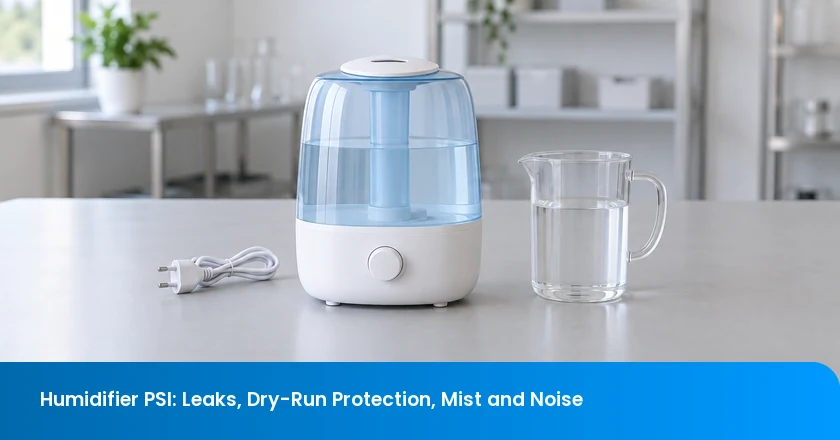
Humidifier pre-shipment inspection (PSI) should verify water containment, the intended low-water response, output under defined conditions, and noise in the specified operating mode. Record those results separately: a visible plume does not prove the rated output, and a low-water light does not establish electrical safety. Check the supplied instructions and packing as well. The most useful report explains what was tested, against which reference, and what remains unresolved before the buyer approves shipment.
Four Results to Keep Separate
- Leakage: where water escaped and whether it could reach electrical parts.
- Dry-run protection: the actual control response under the approved low-water procedure.
- Mist output: the measured result, operating conditions and any unintended water loss.
- Noise: the mode, measurement setup and background conditions behind the reading.
Set the Humidifier Type and Inspection Limits
Start with the humidifier design and intended market. A tabletop ultrasonic unit, an evaporative model and a heated-water model do not behave identically. Identify the mains supply or adapter, tank arrangement, controls and any heated mode. Keep the inspection specification tied to the exact model revision rather than a similar-looking retail product.
IEC 60335-2-98:2023 addresses the safety of household and similar electric humidifiers, including atomizing, heated-water and moist-element designs. Its published scope excludes humidifiers intended for heating, ventilation or air-conditioning systems, medical equipment and exclusively industrial applications. The public summary identifies scope; it does not supply the complete test procedures or establish which national requirements apply to your shipment.
The importer and responsible technical specialist should identify the applicable market requirements, standard editions and supporting reports. Factory PSI can record agreed construction and functional observations, but it is not a substitute for product safety qualification. Tests requiring controlled abnormal conditions, electrical measurements or specialized apparatus belong with appropriately qualified personnel and facilities. Include report references and model identification in the brief so the inspection team can reconcile the paperwork with the goods.
Specify the Operating Conditions Before Testing
Assess the inspection organization, then confirm whether the proposed visit can support the particular equipment, duration and method your checks require. Provider background and assignment scope answer different questions. For the first part of that review, use TradeAider’s company background.
Agree the model, operating mode, water specification, electrical supply and acceptance reference before comparing results. Record the starting fill level, tank seating, nozzle position and any filter, cartridge or accessory required by the instructions. A low-mist cool setting should not be compared with a high-output heated setting simply because both operate on the same appliance.
For timed measurements, define the stabilization period, observation duration and measurement boundary. State whether the method weighs the complete appliance or a specified component. Water moving from a removable tank into the base can change a tank-only reading without leaving the appliance. Confirm instrument suitability and how starting and ending readings will be taken safely.
Prepare an approved sample or controlled reference, but do not rely on appearance alone. The specification should identify the expected response, permitted variation and action when a method cannot be completed. If the factory lacks the agreed instrument or suitable environment, record the limitation and arrange another setting instead of improvising a pass.
Humidifier Inspection Checklist: Method and Record
Give each promised check its own method reference and result. Sample identity, operating state and any limitation make the record usable when a buyer must compare findings or request a correction. An entry saying only “function OK” does not explain whether leakage, low-water response, output and sound were all examined.
| Inspection area | Conditions to establish | Evidence to record | Reason to escalate |
|---|---|---|---|
| Leakage | Fill level, tank seating, orientation and observation period | Leak location, water path and photographs | Water at unintended joints or near electrical parts |
| Dry-run protection | Approved low-water procedure and expected response | Indicator, misting or heating response and restart behavior | Unexpected continued operation or unavailable safe method |
| Mist output | Mode, water, measurement boundary and duration | Starting and ending mass or specified output result | Leakage, refilling or inconsistent conditions invalidate the inference |
| Noise | Mode, instrument, position and background | Specified acoustic result plus abnormal sound observations | Unsuitable background or unrepeatable setup |
| Post-test packing | Drainage, drying and approved accessories | Dry water-contact parts, manual and carton condition | Residual water, missing accessories or wet packaging |
Photograph the initial assembly before adjustments, then document the relevant condition rather than collecting unlabelled close-ups. Keep wet-test samples identifiable through draining, drying and any further examination. If a check changes a sample, state that change so a later measurement is not mistaken for the as-delivered condition.
Use inspection-standard guidance to discuss defect reporting and general inspection criteria. Add the humidifier-specific methods, quantities and acceptance limits to that basis. The inspector should be able to distinguish a completed check, a failed criterion and an unperformed check without using one broad result to conceal the others.
Leakage: Locate the Water Path Before Continuing
Trace leakage to its source before deciding what the wet area means. Inspect tank seams, caps, seals, valves, base interfaces and the intended water route. Begin with correctly assembled parts and the specified fill level on a suitable level surface. Record whether water appears during filling, tank installation, stationary observation or operation.
The September 2014 Great Innovations humidifier recall described water entering the base, causing the circuit board to short circuit and overheat. This was a specific recalled ultrasonic model, but the mechanism explains why the water path matters: a small external drip and water reaching electrical components can require different responses. A cosmetic defect count cannot resolve the latter concern.
Separate confirmed leakage from water spilled while filling and droplets deposited by the mist outlet. Photograph the first wet location, its relation to the tank and the direction in which water travels. A collection tray alone does not prove a seal leak if it also catches mist. Use the agreed procedure to identify the source without blocking outlets or altering how the product operates.
If water may have reached electrical parts, stop the check and have the unit safely isolated by qualified personnel. Do not continue running it to finish a timed output measurement. Preserve the finding for technical assessment; never open an energized base or treat drying its exterior as proof that it is safe to restart.
After an approved correction, verification should address the original leak location and operating conditions. Identify the affected component revision or production scope where possible. A replacement seal that stops one visible drip still needs the agreed follow-up checks before the buyer accepts the correction.
Dry-Run Protection: Verify the Intended Low-Water Response
Dry-run protection checks should establish the intended low-water response, not force the appliance to operate until it overheats. Obtain the manufacturer-approved procedure and the expected state of the atomizer, heater, indicators and other controls. What should stop, and what may remain powered, depends on the design.
For example, Levoit’s OasisMist 450S product information describes automatic shutoff when its tank runs out of water. That statement is a model-specific function, not a universal shutdown threshold for all humidifiers. It also does not reveal the complete safety test procedure. Use the actual supplied model’s controlled instructions and technical requirements to decide what response to verify.
Record the starting condition and the observed transition under the accepted method. If a refill indicator appears, note whether the functions that should cease actually stop. Where the procedure permits a refill or restart check, document the resulting behavior. A glowing warning symbol by itself is insufficient if the specification also requires the misting or heating function to stop.
Do not bypass a float, bridge a sensor, disconnect a protective device or improvise an abnormal-operation test during routine inspection. Such changes can create hazards and invalidate the observation. A required test that cannot be performed safely with the available setup should remain open for a qualified test arrangement.
Keep the conclusion narrow. A successful normal low-water response supports that checked function under those conditions. It does not establish temperature limits, insulation performance or behavior after a component fault. The technical file and any required laboratory work must address those separate questions.
Mist Output: Measure Water Loss Without Counting Leakage
Water loss can indicate consumption, but it does not automatically measure intended mist output. Leakage, spills and water moving across the chosen measurement boundary can change the result. Define that boundary and account for unintended loss before attributing a falling mass or water level to the humidifying function.
For a mass-based comparison, record the starting and ending readings, elapsed time and operating conditions required by the agreed method. Exclude refilling and unrecorded handling changes. Use the specified stabilization and measurement sequence; a quick plume photograph cannot replace a timed result. Do not convert a mass result to a volume rating without the appropriate method and assumptions.
Check the required operating levels against their own references. Automatic humidity control may reduce operation when its target is reached, while a manual maximum setting may behave differently. Record any cycling instead of treating a pause as either a defect or evidence of low output without examining the control state.
TradeAider’s pre-shipment inspection service is scheduled when 100% of the order quantity is complete and at least 80% is packed for export. Its finished-goods scope includes agreed functional, measurement and packaging checks. Confirm the time, instruments and suitable conditions for the requested humidifier measurements before the visit; the service description alone does not promise a particular laboratory output test.
An output result affected by a leak needs two decisions: how to investigate the leak and whether the recorded output inference is valid. Do not simply subtract an estimated puddle and issue a new rated value. Once containment is corrected and safe operation is established, repeat the accepted method with the necessary records. The illustrative calculation below shows why the original inference can fail.
Noise: Compare the Same Mode in a Suitable Environment
Noise readings are useful only when the operating mode and measurement conditions are comparable. Identify whether the specification concerns sound pressure at a stated location or sound power determined by a test method. These are different quantities; an unqualified decibel number is not enough to select the procedure or decide acceptance.
IEC 60704-1:2021 provides a general test code for airborne acoustical noise from household and similar electrical appliances. Its public description includes requirements concerning background noise and climatic conditions. Use the applicable full method and product specification for the actual assessment. The public summary does not provide a universal humidifier noise limit or make a busy factory floor suitable for a low-noise claim.
Record the instrument, its relevant verification status, microphone position, distance, operating mode and background conditions. Keep the water level, tank seating and supporting surface consistent. Check for rattling, loose-panel vibration, abnormal fan sounds and intermittent gurgling as appropriate to the product. Those observations can identify a defect even when the location cannot support a defensible low-level acoustic measurement.
A quiet-mode claim should be checked in that mode, with any automatic changes documented. Compare startup, steady operation and relevant transitions if the agreed plan requires them. Avoid repositioning a vibrating appliance until the original condition has been recorded; an uneven support and a loose component call for different corrections.
If background noise masks the result, mark the acoustic check as limited or uncompleted and arrange a suitable environment. Do not invent a correction by subtracting ordinary decibel values. Retain useful abnormal-sound observations, but keep them separate from acceptance of the declared numerical rating.
Drain, Dry and Inspect the Packed Product
Wet checks create a final handling task: the tested humidifier must be drained and dried under the approved instructions before repacking. Track its detachable tank, cap, nozzle, filter and other supplied parts. Reassemble them correctly and keep moisture away from the carton and accessories.
The EPA’s home humidifier care guidance advises cleaning and drying parts before storage and explains how ultrasonic humidifiers can disperse minerals from their water. It also distinguishes evaporative units, which deliver moisture invisibly. For inspection, select the prescribed water and cleaning approach for the model, and avoid treating a visible plume as the universal sign of humidifier function. This care guidance is not a factory acceptance standard.
Check the supplied instructions, electrical markings, accessories and packing against the approved version. Confirm that units selected for wet tests have not returned to cartons with residual water. Record any damaged packaging separately from the original functional finding so the correction addresses both conditions.
For agreed workmanship sampling, an acceptance quality limit (AQL) plan can organize the sample decision; TradeAider’s AQL calculator supports that calculation. Keep safety concerns and invalid or unperformed tests visible alongside the sampling result. An acceptable count of cosmetic defects cannot turn an unresolved leak or unsuitable measurement into a verified pass.
Illustrative Example: A Leak Inflates the Output Figure
Consider an illustrative example involving an order of 1,000 tabletop ultrasonic humidifiers. Finished, packed goods are available for the agreed checks. The approved comparison sample contained water correctly, but 1 production unit is found to leak. Its record reports 240 g of appliance water loss over one hour and treats the entire amount as output. A separate collection establishes 60 g of external leakage, distinguished from deposited mist. Assume no refilling or other mass changes in this simplified account. These are hypothetical figures, not TradeAider test results.
In this illustrative calculation, 240 g minus 60 g leaves at most 180 g for all remaining water paths during the hour. The original 240 g/h output inference is therefore unsupported. The 180 g remainder is an upper bound in this simplified account, not a certified mist rating: other losses or method limitations could still matter. No universal acceptance threshold is assumed.
The buyer keeps the affected goods on hold while the technical owner establishes the leak cause and production scope. One observed leaking sample does not define the whole order’s defect rate or prove the remaining units acceptable. Suspected water ingress into electrical parts requires safe isolation; nobody should continue an unsafe run merely to collect a full hour of data.
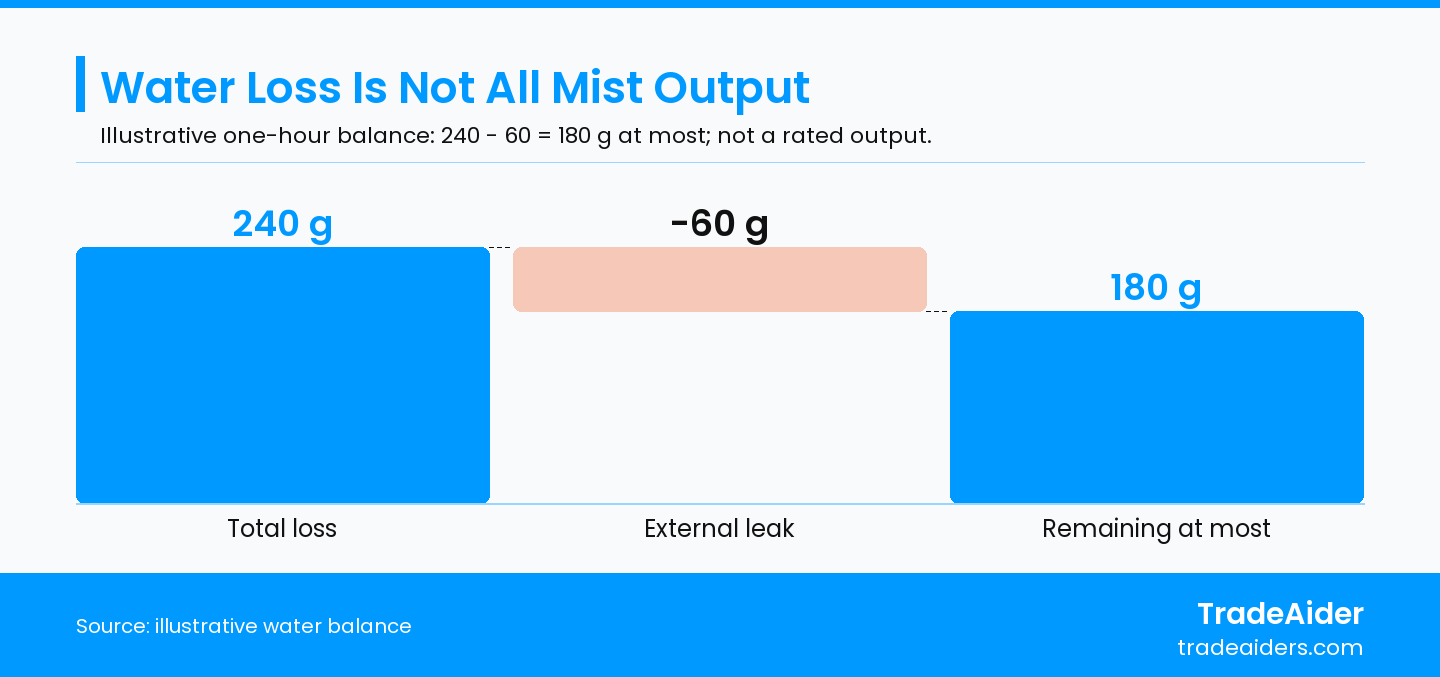
Illustrative one-hour accounting. The remaining mass is an upper bound, not a certified output rating.
After the technical owner approves a correction, the factory implements it within the identified scope. Verification first confirms containment under the agreed conditions, then repeats the proper output measurement after safe operation is established. Retain the original and corrected records with sample identities, readings and conditions. The buyer can then evaluate the corrected goods using valid evidence instead of adjusting an invalid figure on paper.
Send a Testable Humidifier Inspection Brief
Prepare the model and revision, destination, operating modes, water requirements and approved instructions. Add the inspection methods, acceptance criteria and instrument needs for leakage, low-water response, output and noise. Include relevant technical reports and clearly identify any outstanding finding or measurement limitation.
Provide order quantity, packing status and factory access details. Ask the team to confirm which checks are feasible during the visit and which need separate arrangements. The requested report should identify sampled goods, functional and measurement results, construction and packaging observations, photographs and scope limitations. That makes it easier to assign a correction or decide what further evidence is needed.
With those references ready, Contact TradeAider to plan your humidifier inspection.
Frequently Asked Questions
Does tank capacity establish the humidifier’s hourly output?
No. Stored water volume and hourly delivery are different quantities. A large tank may extend the refill interval without increasing the selected output rate. Check capacity against its own definition and assess output under the agreed operating method. Do not derive a rated delivery figure from the tank size and a marketing runtime alone.
Can a phone app verify a quiet-operation claim?
Not by itself; use the agreed instrument and acoustic method. A phone recording may help communicate a rattle or intermittent sound, but microphone response, automatic processing and calibration affect its usefulness as a measurement. Keep that recording as supplementary evidence and identify the conditions rather than presenting it as a certified noise result.
Should every humidifier leak be classified the same way?
No. Classify the finding by its water path, consequence and agreed criteria. Water potentially reaching electrical parts needs immediate technical attention, while an identified filling spill is a different observation. Document the source and circumstances before classification. If the route is uncertain, retain that uncertainty and escalate rather than assigning a convenient cosmetic category.
Do connected models need checks beyond the local controls?
Yes, when app, timer or remote functions are included in the approved specification. Define the supported connection, software version, permissions and intended response before the visit. Confirm the agreed basic commands and relevant transitions, then record limitations. Successful local operation alone does not demonstrate the connected functions, and a network failure should be distinguished from a product fault.
Related Articles
Grow your business with TradeAider Service
Click the button below to directly enter the TradeAider Service System. The simple steps from booking and payment to receiving reports are easy to operate.

