
Incoterms 2020 affect quality control leverage because they define delivery, cost, risk, transport, insurance, and document responsibilities, but they do not decide whether the goods meet the buyer's specification. The importer with the most leverage is usually the importer who places inspection, rework, payment, and shipment release before the commercial handoff becomes hard to reverse.
Buyers often choose trade terms for freight convenience, then discover that the quality decision was never placed in the schedule. That is the wrong order. The trade term should be translated into a quality-control timeline: when can the goods still be inspected, sorted, relabeled, retested, repacked, or held without creating a freight crisis?
The best Incoterm for leverage is not always the term that puts the most logistics responsibility on the seller or the buyer. EXW can give early control but also early exposure. FOB creates a natural pre-loading gate. CIF can feel convenient while hiding the fact that risk may transfer earlier than arrival. DAP and DDP can push delivery responsibility later, but they do not replace acceptance evidence.
- Incoterms question: who handles delivery, freight, risk, documents, insurance, and customs steps?
- Quality question: when do you still have power to stop or correct the shipment?
- Leverage question: is inspection tied to payment and shipment release?
- Practical rule: choose the term, then place the inspection gate before leverage falls.
The Direct Answer
FOB and FCA often give importers the clearest quality-control leverage because they create a defined handoff before main carriage, but any Incoterm can work if inspection and payment release happen before the goods move beyond correction control.
TradeAider treats Incoterms as a release-timing issue: the trade term defines the logistics handoff, while the inspection plan defines whether the shipment should move at all.
The International Trade Administration Incoterms overview explains that Incoterms define buyer and seller responsibilities for shipment, insurance, documentation, customs clearance, cost, and risk. It also notes that Incoterms do not cover every sale condition, including payment timing, title transfer, dispute resolution, or liability for failure to provide conforming goods. That gap is exactly where quality-control planning belongs.
The ICC guidance on Incoterms 2020 emphasizes that the named place or port is critical because it identifies where delivery, risk, and cost allocation operate. For quality control, the named place should trigger a second question: can the importer still reject, hold, or correct the goods before that place becomes the real handoff?
A buyer can have a strong legal argument and weak practical leverage at the same time. If goods are already in a container, on the water, or arriving at a warehouse, the cost of correction has changed. The inspection gate should therefore sit before final payment, before port cut-off pressure, before container loading when possible, and before the seller or buyer commits freight beyond easy reversal.
Incoterms 2020 Compared By Quality-Control Leverage
Quality-control leverage is strongest where the importer can still connect inspection findings to rework, sorting, payment, and shipment release.
The comparison below is not legal advice and does not replace a freight forwarder or trade lawyer. It is a buyer-side operating view for importers sourcing finished goods from China. The goal is to see how the trade term changes the moment when inspection must be completed.
| Incoterm Group | Typical Control Pattern | Quality-Control Leverage | Inspection Timing Rule |
|---|---|---|---|
| EXW | Buyer control starts at seller premises or named place | High control if inspection is before pickup; high exposure if pickup happens first | Inspect before buyer-arranged truck leaves the factory or warehouse |
| FCA | Seller hands goods to buyer's carrier at named place | Often strong for containerized goods because the carrier handoff can be named clearly | Inspect before carrier handoff and require release approval |
| FOB | Seller delivers goods on board at named port of loading | Strong when PSI is completed before port delivery and vessel loading | Finish PSI before FOB loading pressure begins |
| CFR / CIF | Seller arranges main carriage to destination port, while delivery may occur earlier | Moderate; convenience can hide an early risk handoff | Approve goods before seller releases shipment into freight chain |
| DAP / DDP | Seller manages delivery further toward destination | Useful for logistics convenience, but factory leverage may still disappear early | Keep acceptance evidence before goods leave supplier correction control |
The table shows why a trade term cannot be judged only by who pays freight. A buyer under EXW may have control but also responsibility before the goods are fully checked. A buyer under CIF may feel protected because the seller arranged freight, yet quality acceptance may still be unresolved. A buyer under FOB may have a clean handoff, but only if the inspection gate is placed before port movement.
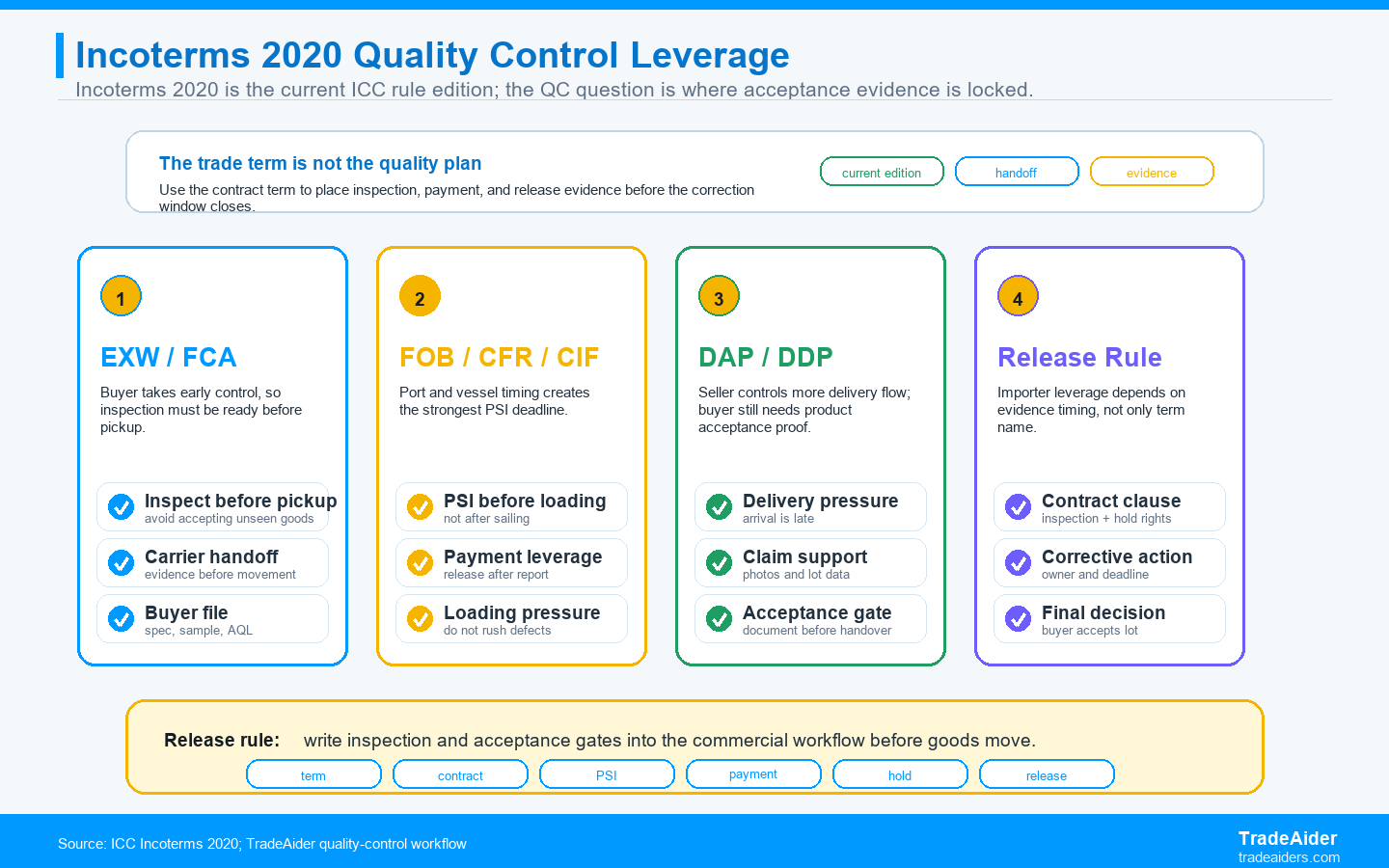
Importer leverage depends less on the trade term name and more on whether inspection happens before the goods leave the correction window.
EXW And FCA: Early Control Needs Early Inspection
EXW and FCA can give the buyer early operational control, but early control is useful only when quality evidence is already complete.
The ICC discussion of EXW and FCA notes practical complications around using EXW for international transactions, especially around loading and export steps. For importers, the quality lesson is simple: do not take control of the goods before the acceptance decision is documented.
EXW can look attractive because the buyer controls pickup and freight. That control becomes a problem if the forwarder collects cartons before labels, barcodes, accessories, carton marks, and visible workmanship are checked. Once the goods move to a warehouse or forwarder's facility, the factory may no longer have the same people, tools, spare parts, packaging, and authority available to fix problems quickly.
FCA can give a cleaner handoff if the named place is specific and the buyer can coordinate inspection before the carrier receives the goods. For containerized shipments, many buyers prefer a term that avoids pretending vessel-side control is practical when goods are handed over earlier. The key is not the label itself. The key is that the purchase order says inspection acceptance must happen before carrier handoff and before final release.
FOB, CFR, And CIF: Port Pressure Can Replace Quality Leverage
FOB, CFR, and CIF all require the buyer to separate freight movement from product acceptance.
FOB creates a visible handoff at the named port of loading, and the ICC Academy FOB discussion is useful because it highlights the loading obligation and the importance of instructions around the port stage. Quality control should happen before that stage, not while the supplier is rushing to meet a vessel cut-off.
CFR and CIF can be more confusing because the seller arranges carriage to a named destination, while delivery and risk questions can still operate earlier than arrival. Under CIF, insurance is part of the commercial arrangement, but insurance is not a cure for wrong labels, poor workmanship, missing accessories, failed function, or product noncompliance. A convenient freight term does not equal accepted goods.
The ICC Academy explanation of C and D rules is a good reminder that the destination named in a C term is not necessarily the place where delivery occurs. For a buyer, that means the inspection gate should happen before the supplier releases goods into the freight chain, even if the seller is arranging transport and insurance.
Where TradeAider Fits In The Incoterms Leverage Window
TradeAider fits where the buyer needs evidence before the Incoterms handoff turns a factory problem into a logistics problem.
TradeAider's Pre-Shipment Inspection is the core quality gate for Incoterms leverage. A PSI is conducted when 100% of the order quantity is completed and at least 80% is packed for export. That timing lets the buyer inspect a shipment-ready lot while the goods are still close enough to the factory for rework, sorting, relabeling, repacking, or hold decisions.
For production-risk items, During Production Inspection can protect leverage before final packing. This matters when the main risk is material substitution, wrong component, color drift, process instability, or packaging that will be expensive to fix after all cartons are sealed. For loading-stage evidence, Container Loading Supervision can document container condition, loading sequence, quantity, and seal details after the product has already been accepted.
The business value is not that TradeAider chooses the Incoterm for the buyer. The value is that TradeAider helps the buyer convert the Incoterm into a release process: inspect at the right point, document findings, decide rework or hold, and keep payment and shipment release tied to evidence.
How To Write Quality Leverage Into The Purchase Order
The purchase order should say what the Incoterm does not say about quality acceptance.
A strong PO should name the Incoterm and named place, but it should also name the approved sample, product specification, material, dimensions, function checks, packaging file, label artwork, barcode rules, country-of-origin mark, acceptable quality limits, compliance evidence, inspection timing, reinspection responsibility, and release conditions. Without those quality terms, the buyer may know where risk transfers but still not know what counts as acceptable goods.
The payment milestone is especially important. If the final balance is paid before inspection, the supplier has less commercial pressure to correct defects. If the PO says final payment and shipment release depend on acceptable inspection findings, the quality gate has leverage. That does not mean every minor defect should block shipment. It means the buyer and supplier agreed in advance which findings trigger hold, sort, rework, replacement, or concession.
The PO should also say who pays for reinspection after a failed result, how long rework may take, whether partial shipment is allowed, and who approves substitutions. These details matter more than the Incoterm label when a shipment is under time pressure. A vague clause like 'goods must be good quality' gives both sides room to argue. A release clause tied to inspection evidence gives both sides a process.
SPAR Scenario: The CIF Shipment With Weak Factory Leverage
The buyer's mistake was not choosing CIF; the mistake was allowing CIF freight movement before quality acceptance.
Situation: A Canadian importer orders 6,000 bathroom organizers from a Zhejiang supplier under CIF Vancouver. The seller handles ocean freight and insurance. The buyer assumes this convenience means the supplier is responsible until arrival.
Problem: The supplier books freight before PSI. Two days before loading, the buyer asks for photos and notices that the retail label uses an old barcode. The cartons are sealed, the vessel cut-off is close, and the seller says relabeling will miss the sailing.
Action: The buyer holds final balance, books a PSI before shipment release, and finds barcode mismatch in 21% of sampled retail boxes plus mixed accessory packs in several cartons. The supplier sorts and relabels affected units, then rebooks the shipment one week later.
Result: The buyer loses a week of schedule, but avoids importing a mixed-label lot. The next PO keeps CIF for freight convenience but adds a release clause: no final shipment release until TradeAider PSI confirms barcode, label, accessory, carton mark, and sample match.
Action Card: Incoterms 2020 Quality Leverage
Use the Incoterm to locate the handoff, then place inspection before that handoff reduces correction options.
- Name the Incoterm version, named place or port, and responsibility for freight documents.
- Write quality acceptance terms separately from delivery and risk-transfer terms.
- Schedule PSI before pickup, carrier handoff, FOB loading, or seller-arranged shipment release.
- Use DPI when process drift could make final inspection too late.
- Keep final payment tied to acceptable inspection findings and reinspection after rework.
If your Incoterm is chosen but the quality-control gate is still vague, send TradeAider the trade term, named place or port, payment milestone, production status, packing status, freight deadline, and defect concerns. The next step is to ask TradeAider to place the inspection gate before your Incoterms handoff so freight movement does not replace quality leverage.
Frequently Asked Questions
Which Incoterm gives importers the most quality-control leverage?
FOB and FCA often give importers the clearest leverage because they create a defined handoff before main carriage. The leverage still depends on whether inspection, payment, and release are tied to evidence before that handoff.
Does Incoterms 2020 decide who is responsible for product defects?
No. Incoterms allocate delivery, cost, risk, and logistics responsibilities, but product defects are governed by the contract, specification, acceptance terms, warranty, law, and evidence.
Is CIF safer for quality control because the seller arranges freight?
CIF is convenient for freight, but it is not automatically safer for quality control. The buyer still needs inspection and acceptance evidence before the seller releases goods into the freight chain.
Should PSI happen before or after FOB loading?
PSI should happen before FOB loading. A PSI is conducted when 100% of the order quantity is completed and at least 80% is packed for export, while the goods are still available for correction.
Can TradeAider help if the buyer has not chosen the Incoterm yet?
Yes. TradeAider can help the buyer map inspection timing around EXW, FCA, FOB, CIF, DAP, or DDP so the final trade term supports a practical release process.
Related Articles
Grow your business with TradeAider Service
Click the button below to directly enter the TradeAider Service System. The simple steps from booking and payment to receiving reports are easy to operate.

