
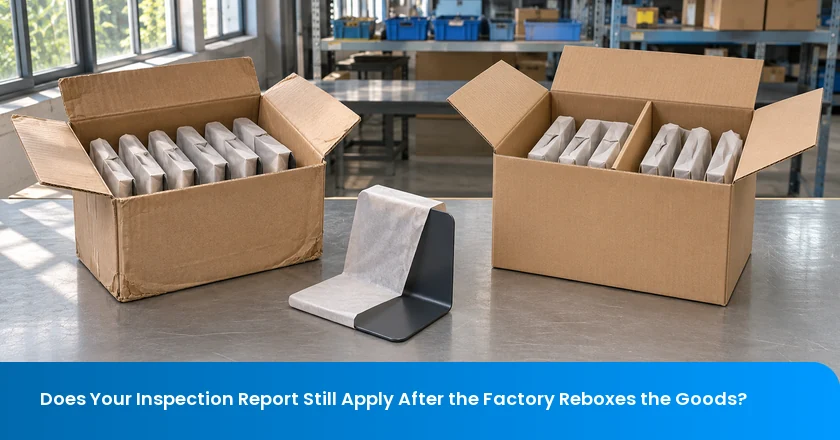
The original inspection report can still support some decisions after reboxing. First confirm that the goods in the replacement cartons belong to the inspected lot and that the properties you are relying on were unaffected. Use fresh evidence for the new cartons and for damage or mix-ups that repacking could have introduced. If the factory cannot trace the affected goods back to the inspected lot, hold that group and agree what verification is needed before release.
Read the original report against the change
An inspection report records the goods, condition and checks observed at the time of the visit. Ask the factory which old cartons were opened, what was removed, why the cartons changed and when the transfer happened. Compare its answer with the report’s product identifiers, carton list, checked samples, packaging photos and agreed criteria. The product code or purchase order (PO) alone may be shared by more than one production lot.
- Keep applicable product observations for traceable goods where the observed property was unaffected.
- Verify the replacement cartons, shipping marks and any packaging or product condition the transfer could have changed.
- Record unresolved identity, quantity or handling exceptions by carton range before approving dispatch.
The NIST Engineering Statistics Handbook describes acceptance sampling as drawing from a defined lot to support a decision about that lot. An old measurement of a product dimension may remain useful for the original sampled units if the dimension was unaffected. A sampled lot result still refers to the original lot and selection. Movement into new cartons does not create a fresh pass for them or for a subset selected for dispatch.
TradeAider performs pre-shipment inspection when the order quantity is 100% complete and at least 80% is packed for export. Look at what was actually packed and checked on the day. A photo of an old carton verifies its recorded condition at that point; the artwork, closure and physical fit of the replacement carton need current evidence.
Build the old-to-new carton record
Link every affected old carton to its current destination and reconcile quantities by product and lot. Ask for the signed or system-exported transfer record and the packing list for the goods offered now. Separate the cartons left untouched, cartons replaced one for one, and goods redistributed across new cartons. For each group, establish which original report and packing-list version it came from.
The GS1 Global Traceability Standard explains that traceability depends on recording the links between packaging groupings and the products they contain. Apply that principle with the identifiers used on your order. A carton ID identifies the package in the transfer log. A separate product or lot mark establishes what was inside, at the level of detail it provides.
Record quantities at each transfer
Record a separate line for each transfer from an old carton into a new one. Include the original and current carton IDs, product code and lot mark, unit count transferred, transfer time and operator. Record the state of the inner packs and any units removed for damage, retained for review or set aside. If one old carton feeds several new cartons, repeat the old ID on each movement line. If several old cartons feed one new carton, list each contribution against the same destination.
Sum the transfer lines in both directions. For each old carton, the starting quantity must be accounted for by the units transferred, retained or removed. For each new carton, the incoming quantity must agree with the current packing list and verified packed quantity. List additions separately with their origin so a replacement unit cannot silently cancel a shortage. Check these balances by product code and lot as well as for the whole order.
Check what the packing records can prove
A quantity balance has to agree with evidence of product and lot identity. Match the transfer lines to inner-pack marks, scans or observed transfers and the old and new carton labels. An export of the packing list can show expected contents, while an observed or recorded transfer supports what actually moved. Apply the same check to any carton the factory describes as untouched if it was stored in the same area and could have been included in the work.
If lot marks exist only on discarded cartons, review contemporaneous evidence of the transfer and segregation. Ask when similar stock could enter the packing area, who controlled the move and whether the evidence covers the full affected range. Resolve a recoverable record gap before shipment. If rows cannot be tied to the inspected lot, keep those goods on hold and agree fresh verification for the actual goods presented. Avoid giving a reported sample unit a new carton identity unless you can trace that specific unit.
Match the follow-up to the packing or handling change
Check the change that occurred, including damage the extra handling could have introduced. Supply the approved pack specification and the current packaging revision. Agree which fields the supplier can document and which checks need independent observation on site. Use the following table to define the check, its population and the evidence required for release.
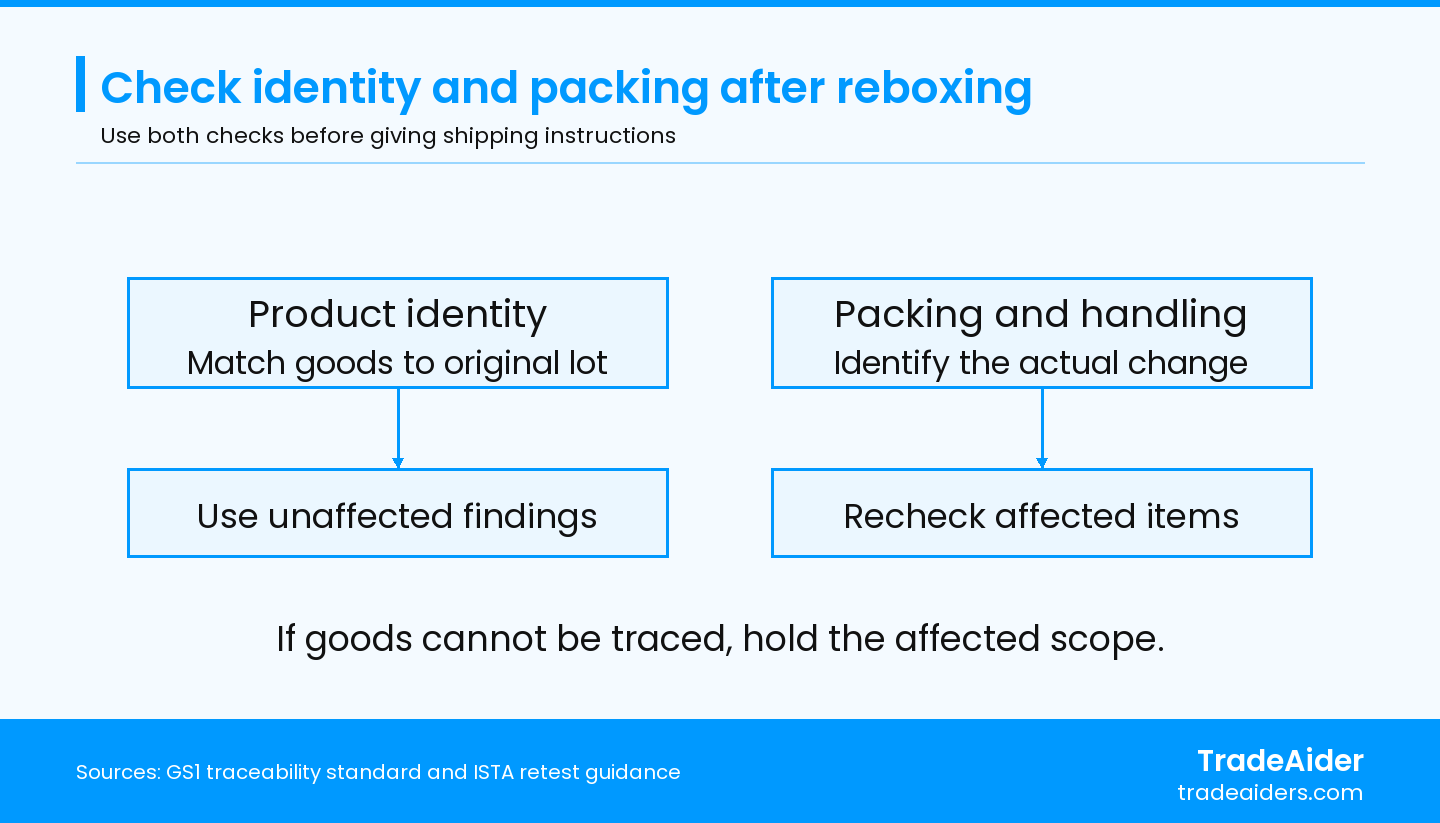
Match the current goods to the original lot before using earlier findings. Check changed packing and handling for the affected carton range.
What changedEvidence still usefulVerification to agree nowLike-for-like outer carton replacement, inner packs intactTraceable original product and inner-pack observationsNew carton IDs, marks, count and closureNew carton size, board, insert, orientation or pack countOriginal product observations where unaffectedNew specification, fit, protection, count and any required pack testInner packs opened or products handled againEarlier observations for unaffected features of confirmed goodsExposure-specific checks such as finish, parts, inner labels or functionUnknown origin, unresolved balance or possible substitutionOriginal report as a reference for requirements and past findingsHold the affected group, restore trace or verify the actual lot afresh
Where an order relies on an ISTA protocol, ISTA’s retesting guidance directs users to repeat testing when changes can affect packaged-product performance. If the factory changes the carton board, cushioning or layout, compare the actual build with the configuration in the earlier test. Ask the party responsible for the test requirement to confirm whether a new result is needed before release. A field check can record the new material, fit and marks. A performance test answers how the specified package and product respond under the chosen test conditions.
Use TradeAider’s inspection standard as a starting point when confirming the follow-up brief. Specify which current cartons the inspector can open and what qualifies as an acceptable result. For a suspected mix-up, a label photo shows the outside mark, so request a check of the corresponding contents. If the repacking crew opened every inner pack in one group, define condition checks for that exposed group and agree the required coverage.
Thirty original cartons become thirty-one
Illustrative scenario. The original report covers 360 powder-coated steel bookends packed as 30 cartons of 12. It includes sampled finish and base-flatness observations as well as checks of the original carton configuration. Before dispatch, the factory replaces 10 export cartons. Warehouse records and inner labels link the transferred units to the same product lot. The buyer reviews the original findings and tracks the three current groups separately.
The unit count can stay the same while the packaging configuration and checks change. Here is how the current packing list reconciles to the original scope:
- O01 through O20. The 20 cartons still contain 240 units. Verify the boxes were outside the move and remain identifiable and in the expected condition. Use the original findings within their recorded scope.
- O21 through O25 to N21 through N25. Five cartons of 12 still hold 60 units. The inner sleeves stay intact and the replacement outer cartons use the same specification. Verify the ID map, carton count, new marks and closure. Earlier product observations continue to inform the decision for this traceable stock.
- O26 through O30 to R01 through R06. Five cartons of 12 become six cartons of 10, still holding 60 units. The crew changed the divider layout and opened the sleeves. Check count, packing layout and finish condition following the extra handling. The original base-flatness readings document the original samples; if handling introduced a plausible bend risk, include flatness in the new check.
For the redistributed group, the transfer log shows O26 sent 10 units to R01 and two to R02. O27 sent eight to R02 and four to R03. Those entries account for both old cartons and all 10 units in R02, whose contents came from two sources. The log must also explain the six units needed to finish R03 and the rest of the destinations before the buyer can rely on the new list.
The revised packing list has 31 cartons and 360 units. The buyer keeps the six R cartons pending agreement on the new pack configuration and evidence of current finish condition. If a mismatch in the transfer log leaves one R carton’s contents uncertain, hold the range that may share the same unresolved transfer until it can be isolated. The other carton groups are eligible for separate release review only if their identity and separation are supported and the order permits it.
Record which cartons can ship and why
Document the current carton ranges, the evidence used and the conditions attached to each release decision. Keep the original report number and date. Put the old-to-new transfer record, latest packing list, photos and any follow-up results beside it. Mark what was accepted based on earlier scope, what was verified on the replacement cartons and what remains open. For checked attributes, record the actual scope, method and findings, including any exceptions by new carton ID.
Give the shipping team a release or hold list it can match to the cartons at pickup. Name the person who can approve an exception or take a group off hold, and specify which documents or observations they need. Ask the factory to report any further substitution or packing change before loading so the recorded release scope can be confirmed again.
If you need a follow-up before dispatch, contact TradeAider with the original report, the revised packing list, the transfer log and the approved packing specification. Identify the cartons involved and ask which packing, contents and handling checks can be agreed for the visit.
FAQ
Do replacement cartons need new numbers?
Use the numbering required by the order or receiving system and make each current carton unambiguous in the transfer record. If a replacement keeps the same visible number, distinguish the old and current package in the log by recording the replacement event, date and any applicable label revision. Record separate destination IDs if an old carton was split.
Can photos alone close a reboxing check?
Photos can close a visible check if they clearly identify the current carton and show the required detail. For example, a legible picture can show the new shipping mark. An image of a closed carton gives no view of the number or condition of the units inside. Specify which items require a verified count, opening check or separate test.
Should the inspector change the date on the original report?
Keep the original inspection date and use a dated addendum or separate follow-up report for new observations. Reference the original report and the current carton IDs. If the change is a correction to a clerical entry, keep the correction history so the reader can distinguish updated records from checks performed on a later date.
Related Articles

Grow your business with TradeAider Service
Click the button below to directly enter the TradeAider Service System. The simple steps from booking and payment to receiving reports are easy to operate.