
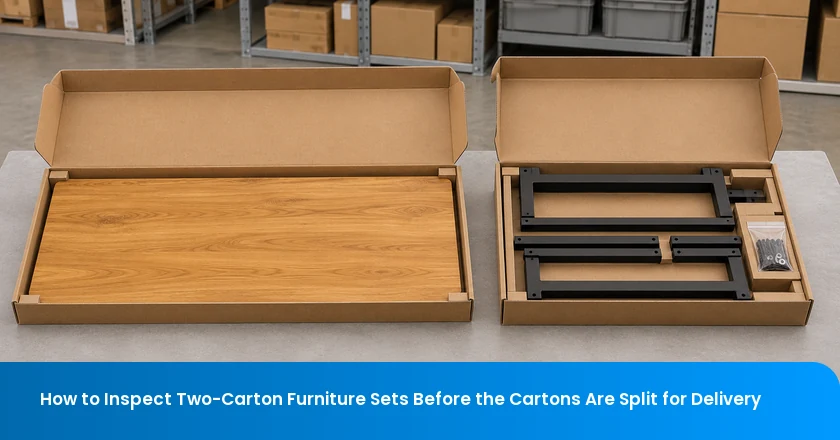
Verify the pair before the cartons leave the staging area. Define which carton 1 and carton 2 can go together, then reconcile the number of eligible pairs by compatible model and revision or by assigned set ID. Open both cartons from selected pairs and assemble using the parts, hardware and instructions actually packed. Before dispatch, link both package IDs to a distinct pair record for each set, including when one order line contains several sets.
Set a rule for what makes a complete pair
Define a complete set as one eligible carton of each required role paired under the approved compatibility rule. “1 of 2” and “2 of 2” are carton roles. Put the furniture model, finish, size and applicable revision next to those roles on the packing plan. Identify which parts and hardware go inside each box, and whether the cartons can be exchanged within a compatible group or must stay with a particular mate.
- Use the approved pack-out and parts list to confirm what belongs in carton 1 and carton 2.
- Reconcile set quantities by eligible carton pairs. Include assembly findings and exceptions in the release record.
- Record each pair on the order line with its two physical package IDs before separate dispatch.
For a real packaging example, IKEA lists a top and an underframe as the two packages of one MITTZON conference table configuration. For your order, use the supplier’s approved layout and parts list to confirm the contents of both cartons. A similar desk may store fasteners in the top carton, in the frame carton, or in both.
TradeAider performs pre-shipment inspection when the order quantity is 100% complete and at least 80% is packed for export. For two-carton sets, confirm that both roles for each required configuration are available for the agreed inspection. Check later-packed cartons under the agreed dispatch controls before they enter the release count.
Count complete sets before the cartons separate
Count usable sets within the approved pairing groups or by verified shared set ID. Compare the packing list with cartons actually staged and separate cartons on hold. The table shows what to record when the pairing rule, contents or distribution setup changes which cartons can go together.
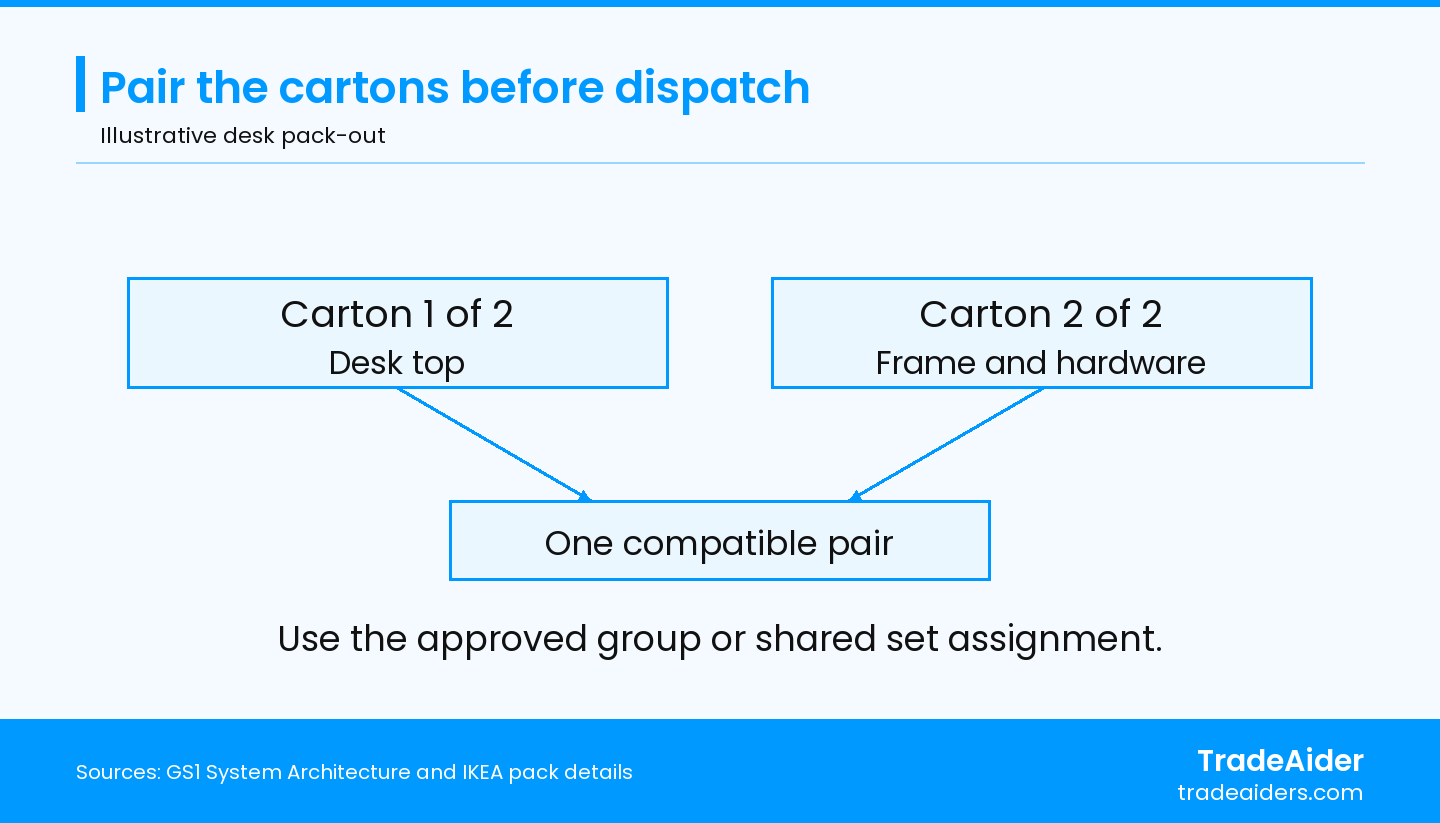
Match one carton of each role under the approved pairing rule. Use actual packed pairs for sample assembly.
What to establishEvidence to recordDecision before dispatchInterchangeable carton rolesEligible counts by model, variant and approved compatibility groupUse the smaller count in each groupIndividually assigned pairShared set ID with a verified distinct package ID for each roleCount only confirmed matches and resolve duplicatesCross-carton fit and completenessBoth sampled carton IDs, hardware location, parts and build resultHold the affected scope if a mismatch interrupts the buildSeparate dispatchOrder line, distinct pair record, both package IDs, roles and transfer statusKeep any missing or unverified mate visible
Match interchangeable cartons by compatibility group
For fully interchangeable cartons in a verified group, the smaller eligible count sets the maximum number of pairs. If an approved desk variant has more top cartons than compatible frame cartons, set the extra tops aside until matching frames are verified. Calculate each group separately and add the results. Use usable stock by role, excluding missing, damaged or unverified cartons from the applicable counts until resolved.
Confirm interchangeability with the approved configuration or a written compatibility list. A carton label may show the correct finish while the frame inside uses a different bracket revision. Require a suitable identification and verification step if the carton mark cannot distinguish the relevant build. Where a component is shared by several variants, assign each physical carton to only one pair and reconcile the shared stock before totaling the customer allocations.
Match assigned cartons by their shared set ID
When a specific pair is required, verify both roles against the same approved set assignment. That may apply to matched wood grain, selected finishes or a factory-fitted pair. Keep each carton’s unique package ID separate from the shared set ID or the record that links the pair. Two cartons with the same role or a duplicate package ID need reconciliation before either is counted as part of a confirmed set.
The GS1 System Architecture distinguishes an individual trade item piece from a specific piece instance identified with a serial number. Use the identifiers required by your order and receiving system. To illustrate why the distinction matters, if staged tops belong to sets A and B and staged frames belong to sets A and C, only set A has both assigned roles. Resolve the missing mates for B and C before assigning those orders to dispatch.
Assemble from actual paired cartons
Use the actual cartons that would go together and record the hardware and instructions from those cartons. Select pairs from finished packed stock under the agreed plan. Identify both exterior labels before opening, keep their contents together, and record which carton supplies the instructions, accessories and every required fastener group. Follow the current bill of materials, the approved list of parts and quantities, and the shipped instruction revision.
For a desk, lay out the top and frame together. Check that the bolts from the actual hardware bag fit the threaded inserts in the top and that the frame meets the specified mounting points. Verify required washers, brackets or feet against the parts list and observe how the parts mate during the build. Record mismatches at the step where they prevent assembly. Photograph the two labels alongside the relevant part or bag so the factory can trace the failure to the correct carton range and pack revision.
Keep loose factory stock out of the recorded build. If a replacement fastener is supplied after the inspector finds a shortage, first record the shortage in the original pair. Record the corrected build and the source of the replacement separately. Agree how the factory will locate other affected kits, verify the corrections, reseal the cartons and update the packing record.
The NIST Engineering Statistics Handbook describes acceptance sampling as drawing from a defined lot to support a decision about that lot. Record the exact coverage of the assembly observation, especially if the build was a targeted check outside the sampling plan. Use the stock reconciliation to count pairs, and report the sampled build evidence separately. An assembled pair demonstrates the fit and parts observed in that build.
Use TradeAider’s inspection standard when preparing the brief. Add your pairing list, the approved build criteria and the assembly scope by configuration. If a feature needs a separately specified performance test, track that evidence requirement independently of the build observation.
Why equal carton totals can leave three desks incomplete
Illustrative scenario. A buyer orders 120 flat-pack desks, 60 in oak finish and 60 in walnut finish. Each desk uses a top carton and a frame carton with its fittings and finish-specific trim. The rules allow any eligible top and frame carton within the same finish and revision. The current list shows 120 top cartons and 120 frame cartons. The individual counts by finish tell a different story.
Balanced carton totals across the order can conceal shortages in individual pair groups. The buyer checks the labels against the staging record and allocates one of each eligible role per approved group:
- Oak, current revision. The 60 tops and 63 frames can make 60 pairs. Set aside the three extra frames.
- Walnut, current revision. The 60 tops and 57 frames can make 57 pairs. Set aside the three unmatched tops.
- Combined. There are 117 compatible pairs for count purposes. Completing the order requires three verified matching walnut frames. The spare oak frames cannot fill that shortage under the approved configuration.
Open a pair from each finish as part of the agreed assembly scope and tie the result to its carton IDs and hardware revision. If those builds meet the criteria, record that result alongside the 117-pair reconciliation. Separately authorize the 117 pairs only if the other required checks and order terms allow partial dispatch. If a build exposes an incorrect fitting, hold the scope that may share the affected hardware before confirming the dispatch count. A group with enough cartons may still have an unresolved assembly issue.
Give dispatch both package IDs for each set
Give each physical pair its own dispatch record with both package IDs before the cartons move apart. On the dispatch manifest, give each pair a unique allocation within its order line. Record the approved set or group and, for each of the two roles, the package ID, tracking reference and current status. Include any sampling, hold or sorting record the warehouse needs. Confirm the assignment against the physical cartons or scans at staging. If the roles are interchangeable, reserve the chosen carton IDs at that point to avoid allocating a carton twice.
If one order line contains two desks, give it two pair records. For example, pair 01 links top T041 with frame F105, and pair 02 links T044 with F109. If F109 is late, the manifest identifies which desk is awaiting a frame. Tell the receiving team to expect two packages per pair and record the handoff of each one. Keep the second role open until its own shipment or delivery event is recorded. If a carton is damaged or missing, flag the order with its outstanding role and keep the previous ID in the exception record. Verify any replacement against the pairing rule before updating the manifest and the receiving instruction.
To plan a split-carton inspection, contact TradeAider with the pack-out, pairing rules, current carton counts and the assembly checks the buyer needs. State when the cartons will separate and which observations must be recorded against both package IDs.
FAQ
Can the warehouse replace a damaged carton with another one?
A substitute is possible when it satisfies the approved pairing rule and its contents, condition and identity have been verified. For an individually matched set, obtain authorization before breaking the assignment. Link the new and superseded package IDs and update both the inventory and receiving record.
What if the carrier collects the two cartons on different days?
Keep both carton IDs assigned to the same dispatch pair and record the pickup of each separately. Include the expected pickup or delivery window for the second package and the contact responsible for following up if it misses that window. Keep the packing and assembly evidence tied to the confirmed pair.
How many desk sets should the inspector assemble?
Set the number and configuration coverage in the inspection brief before selection. Consider which variations change parts, hardware or assembly, and whether the build can be repacked in saleable condition. Agree how the inspector will handle a missing configuration or a build that cannot be safely returned to stock.
Related Articles

Grow your business with TradeAider Service
Click the button below to directly enter the TradeAider Service System. The simple steps from booking and payment to receiving reports are easy to operate.