
- 会社概要

- 当社のサービス
- あなたの業界
- リソース
- ニュース&ブログ
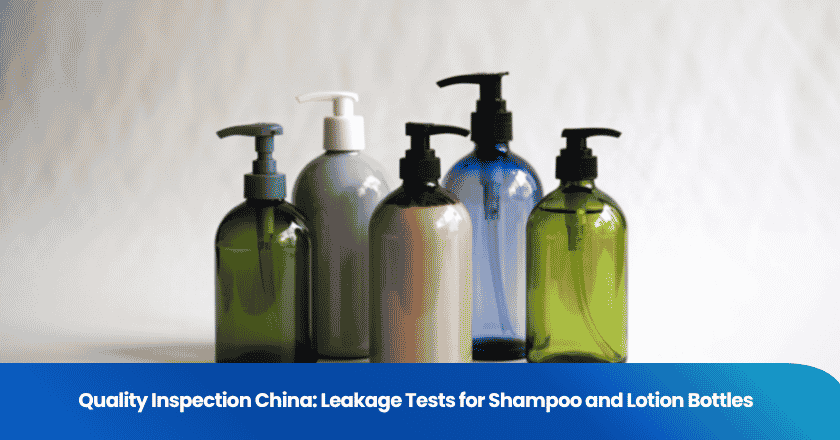
A leaking shampoo bottle discovered in a customer's shower isn't just an inconvenience — it's a refund, a negative review, and quite possibly a chargeback. For importers sourcing hair care or body care packaging from China, leakage is one of the most common and most preventable quality failures. The good news: a thorough quality inspection that includes dedicated leakage testing can catch the vast majority of these defects before they ever board a container. According to cosmetic packaging testing specialists at Keystone Compliance, industry standards like ASTM F2338 specifically address seal strength testing for hair care packaging. This guide explains exactly how leakage testing works, what methods apply to different bottle types, and what importers should require on their QC checklist. To learn more about TradeAider's inspector training and methodology, visit the why TradeAider page.
Key Takeaways
- Leakage in shampoo and lotion bottles most commonly originates at two points — the bottle neck/cap interface and the pump or dispenser mechanism.
- Multiple test methods are used depending on bottle type — inversion tests, pressure tests, and vacuum simulation each catch different failure modes.
- Testing with actual product — or a close formula substitute — is more reliable than water alone, since viscosity and chemical composition affect seal behavior.
Why Leakage Is a Persistent Problem in Shampoo and Lotion Packaging
Liquid personal care products are particularly demanding on packaging. Shampoos tend to foam during filling, requiring precise headspace management. Lotions vary widely in viscosity, which affects how pump mechanisms prime and dispense. Both product types may contain surfactants, preservatives, or fragrance compounds that interact with plastic resins and seal materials in ways that a basic visual inspection will never reveal.
Leakage points are predictable. According to packaging testing research from Labthink's cosmetic packaging testing guides, the two most likely failure sites on any cosmetic bottle are the hot seal area and the bottle mouth — specifically the interface between the bottle neck and the closure or pump mechanism. For shampoo and lotion bottles, this means cap torque, pump lock mechanism, and dip tube alignment are the three functional areas that demand the most scrutiny during a China quality inspection.
The Four Core Leakage Test Methods
A well-designed leakage testing protocol for shampoo and lotion bottles combines multiple methods, since each one reveals a different category of failure. Here's how each method works and what it catches.
1. Inversion Test
This is the most straightforward leakage check and should be a baseline minimum in any inspection. According to cosmetic packaging specialists, filled bottles are turned upside down and held inverted for a defined period — typically 30 minutes to 2 hours depending on product type. After the test period, the bottle neck, cap interface, and pump mechanism are inspected for any sign of moisture. This test is particularly relevant for products with thin consistencies like toners or facial mists, but it's a useful first-pass screen for shampoos and body washes as well.
The weakness of inversion testing alone is that it doesn't simulate the pressure changes or mechanical stresses of international shipping. It should always be paired with at least one additional method.
2. Pressure / Positive Pressure Test
This method is more thorough than simple inversion and is especially effective for detecting micro-cracks, molding defects, and weak seal points that won't reveal themselves under gravity alone. As cosmetic packaging testing experts explain, the positive pressure method can evaluate not just ordinary package sealing but is also capable of testing additional sample types with appropriate attachments — including flexible tubes, blow heads, bottle caps, and bag seals. Inspectors apply controlled internal pressure to the sealed bottle and monitor for pressure loss or visible leakage.
For shampoo bottles with snap-on caps or screw tops, this test can reveal cap threading defects that cause intermittent leaks — the kind that might pass an inversion test on a stable surface but fail under the vibration of cargo transit.
3. Vacuum / Negative Pressure Test
The vacuum test is essential for any importer whose products will travel by air — which, for e-commerce brands shipping via FBA or direct-to-consumer routes, is nearly everyone. The bottle is placed in a sealed testing chamber, and air pressure is reduced to simulate the low-pressure environment of an aircraft cargo hold. Any seal failure becomes apparent as the liquid inside expands toward the path of least resistance.
This test is particularly important for lotion bottles with airless pump mechanisms. The vacuum condition inside an airplane hold can overwhelm a marginal pump seal that performed fine at sea level. Importers who skip this test and ship by air often discover leakage issues only after delivery — at which point remediation is expensive and slow.
4. Torque and Closure Test
For screw-cap shampoo bottles, cap torque is a critical measurement. Too little torque and the cap backs off during transit. Too much torque and consumers can't open the bottle without difficulty — leading to complaints even when there's no actual leakage. A calibrated torque tester applies measured rotational force to both fasten and release the cap, and results are compared against the buyer's specified tolerance range.
For pump bottles, the equivalent check is the locking mechanism test: the pump lock must prevent accidental dispensing during shipping, and the dip tube must remain properly positioned to stay submerged in the product rather than allowing air to enter.
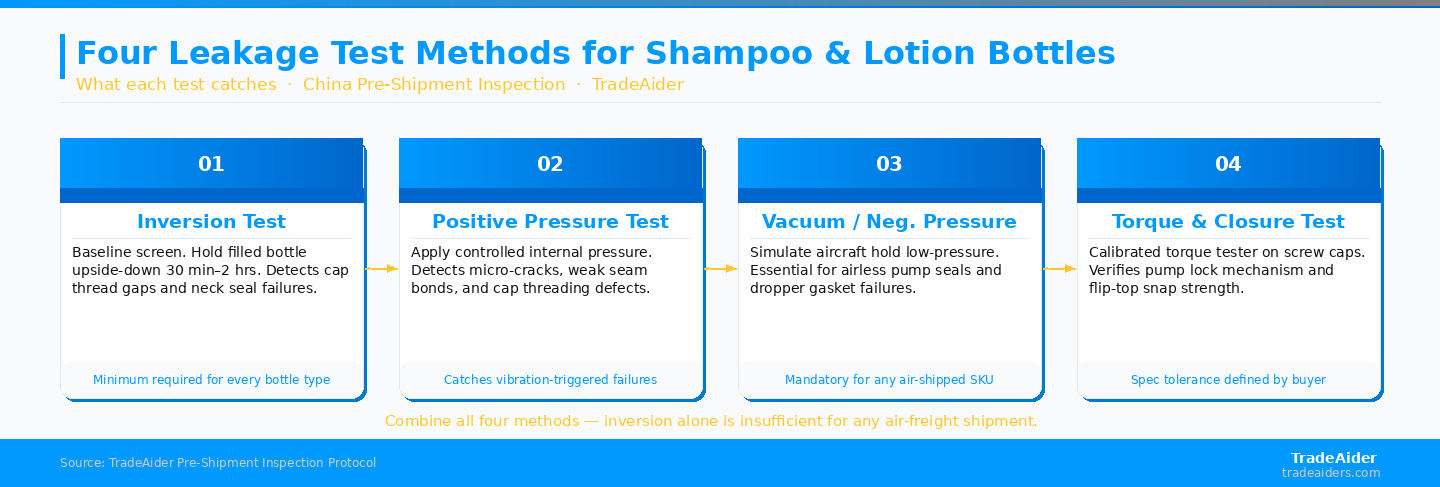 The four leakage test methods — mapped to the failure modes each one is designed to catch.
Testing With the Right Liquid
Most on-site inspections in China use water as the test fill liquid for leakage checks — which is reasonable, cost-effective, and appropriate for initial screening. But importers should be aware of a practical limitation: water behaves differently from shampoo formulas, which are typically more viscous, and from lightweight toners or essences, which are thinner. As experienced packaging quality professionals point out, a bottle that performs well with water doesn't necessarily perform the same way with toner, serum, or lotion.
For higher-value SKUs or products where formula-packaging compatibility is a known concern (for example, essential oil serums in plastic bottles, or alcohol-based toners in certain PET containers), importers should specify that leakage testing be conducted with the actual formula or a compatible proxy liquid. The FDA's guidelines on cosmetic safety underscore the importance of contamination prevention in packaging — a standard that formula-specific testing directly supports.
What a Complete Leakage Testing Checklist Looks Like
| Bottle Type | Required Tests | Pass Criteria |
|---|---|---|
| Screw-cap shampoo bottle | Inversion (1hr), Torque test, Positive pressure | No moisture at neck; torque within spec; no pressure loss |
| Pump lotion bottle | Inversion (30 min), Dip tube check, Lock mechanism test, Vacuum test (if air freight) | No leakage at pump base; lock prevents accidental dispensing; dip tube properly seated |
| Airless pump bottle | Vacuum test, Piston movement check, Seal integrity test | Piston moves smoothly; no air ingress; vacuum seal maintained |
| Conditioner flip-top bottle | Inversion (2hrs), Positive pressure, Snap-strength test | No leakage at flip-top hinge; snap closure holds under pressure |
Common Leakage Defects Found During China Inspections
Experienced inspectors encounter the same failure modes repeatedly across factories. Knowing what to look for — and naming it precisely in your checklist — improves inspection yield significantly. The most common leakage-related defects in shampoo and lotion packaging include: misaligned pump dip tubes that allow air ingress; cap threads that are either under-torqued from the assembly line or cross-threaded; micro-cracks at bottle neck seams caused by molding temperature inconsistencies; pump gaskets that are the wrong durometer (hardness) for the closure and therefore don't form a reliable seal; and flip-top hinges with insufficient snap strength that spring open under carton compression.
A well-structured inspection report will classify each defect as critical (functional failure that makes the product unusable or unsafe), major (likely to cause customer complaints), or minor (cosmetic issues that don't affect function). For leakage-related findings, any seal failure should be treated as at least a major defect under standard AQL frameworks.
How TradeAider Conducts Leakage Inspections for Personal Care Packaging
TradeAider's inspection team approaches shampoo and lotion bottle QC with a product-specific mindset. Before inspection day, the checklist is calibrated to the bottle type, closure mechanism, and shipping method. Inspectors arrive at the factory with clear pass/fail criteria for each leakage test, and findings — including photos of any defect specimens — are uploaded to the client platform in real time. The official report is delivered within 24 hours of inspection completion.
For importers who've had leakage issues in previous shipments, a During Production Inspection (DPI) earlier in the manufacturing cycle can catch mold defects or assembly errors before they affect the full batch. This is particularly valuable for high-volume shampoo packaging orders where a tooling issue can affect thousands of units before it's identified at final inspection. For a broader overview of how DPI fits into the inspection lifecycle, see TradeAider's inspection standards guide.
Frequently Asked Questions
Do I need leakage testing if my factory claims to do 100% QC internally?
Yes. A supplier's internal QC is conducted by their own team, which has an inherent interest in passing goods — and may not have calibrated testing equipment or structured AQL protocols. Third-party inspection provides an independent, impartial assessment against your specific criteria. The two types of QC are complementary, not interchangeable. Regulatory guidelines for cosmetic products consistently emphasise contamination prevention as a packaging responsibility — independent third-party verification is the most reliable way to confirm your packaging meets this standard.
How many bottles should be tested for leakage in a pre-shipment inspection?
The sample size should follow your agreed AQL plan. For a shipment of 5,000 shampoo bottles at AQL 2.5, the standard sample size under ANSI/ASQ Z1.4 General Inspection Level II is approximately 200 units. Of those, functional tests like leakage checks are typically performed on a subset — your inspection company should specify how many units will receive which tests. Use TradeAider's AQL calculator to verify the numbers before confirming your inspection scope.
What should I do if the inspection finds leakage defects?
The inspection report should clearly quantify how many defective units were found and what type of leakage defect was observed. If the defect count exceeds your AQL threshold, the shipment should be held. Depending on the defect type, options include: requesting 100% sorting by the factory (appropriate for cap torque issues), requiring rework of specific components (pump gasket replacement), or rejecting the batch and requesting a remake. Your TradeAider inspector can advise on the most practical path based on what they observed on-site.
Have a shampoo or lotion packaging shipment coming up? Get in touch with our team to schedule a pre-shipment inspection with full leakage testing — and get your report within 24 hours of the inspection date.
関連記事

TradeAiderサービスでビジネスを成長させる
下のボタンをクリックして、TradeAiderサービスシステムに直接入ります。予約から支払い、報告書の受け取りまでの簡単な手順は操作が簡単です。

