
- 会社概要

- 当社のサービス
- あなたの業界
- リソース
- ニュース&ブログ

Third-party quality assurance is not a way to outsource quality ownership; it is a way to add independent, decision-ready evidence between supplier self-checks and buyer release commitments. The practical answer is to inspect the risks that can still be changed, record the evidence that proves conformity, and decide whether to release, hold, sort, rework, test, or reinspect before the shipment moves beyond buyer control.
Key Takeaways
- Third-party QA adds independent evidence: it does not replace supplier process control or buyer requirements.
- Use it at decision points: supplier approval, production correction, shipment release, testing, payment, or escalation.
- Keep methods clear: audits, PPI, DPI, PSI, AQL inspection, testing, and loading checks answer different questions.
- Require action-ready reports: findings should support release, hold, sort, rework, test, reject, or reinspect decisions.
What Role Should Third-Party Quality Assurance Play?
Third-party quality assurance should provide independent evidence for buyer decisions while leaving quality ownership with the supplier and requirement ownership with the buyer.
The role becomes clear when we separate systems, inspection, and release. ISO 9001 supports quality management systems that help organizations meet requirements and improve processes. ISO/IEC 17020:2026 focuses on inspection competence, impartiality, and consistent operation. Third-party QA sits between these ideas: it observes, verifies, samples, tests, reports, and escalates evidence, but it does not manufacture the product or define the buyer's tolerance.
The role of third-party QA is evidence independence, not magic quality control. A supplier's internal QA is essential because the supplier controls the process every day. A buyer's product file is essential because it defines what acceptable means. The third party adds a separate view at critical decision points where the buyer needs current evidence.
Third-party QA works best when the buyer defines requirements before the inspector arrives. If the product file is vague, the third party can document ambiguity, but it cannot invent a valid tolerance after the fact.
Third-Party QA Compared With Supplier and Buyer QA
A strong supply chain uses all three layers: supplier QA, buyer QA, and third-party QA. Confusing the roles creates gaps. The supplier controls the process. The buyer controls the requirements. The third party checks defined evidence and reports exceptions independently.
| QA Layer | Primary Role | Strength | Limit to Respect |
|---|---|---|---|
| Supplier QA | Control daily production quality. | Immediate process correction | Not independent from factory incentives |
| Buyer QA | Define requirements and release rules. | Owns product and market expectations | May not be on site every day |
| Third-party QA | Verify evidence independently. | Fresh report before decision | Cannot replace process ownership |
| Laboratory testing | Prove hidden claims. | Technical proof for defined tests | Does not inspect every shipment detail |
| Loading checks | Verify handover evidence. | Carton count, container, seal, photos | Does not replace product inspection |
This role separation prevents unrealistic expectations. A third-party inspector can verify a lot, classify defects, photograph evidence, check measurements, review labels, and recommend hold or release. The inspector cannot make a weak supplier strong overnight, and cannot prove hidden safety claims without the right tests.
A third-party report should make the buyer's next action clearer, not merely make the file look heavier.
What Third-Party QA Should Verify
Third-party QA should verify the things that matter to the buyer decision: product requirements, sample match, dimensions, function, workmanship, labels, packaging, quantities, documents, sample plan, and defect severity. BLS describes quality control inspectors as examining products and materials for defects or deviations from specifications, while O*NET lists tasks such as inspecting, testing, sorting, sampling, measuring, and reporting.
That work becomes valuable only when it is tied to a release rule. A report that lists defects but does not show severity, count, sample spread, carton identity, or action recommendation is hard for the buyer to use. A report that shows concentration by SKU, size, color, material lot, or carton range helps the buyer decide whether to release the whole lot, hold a subgroup, sort, rework, test, or reinspect.
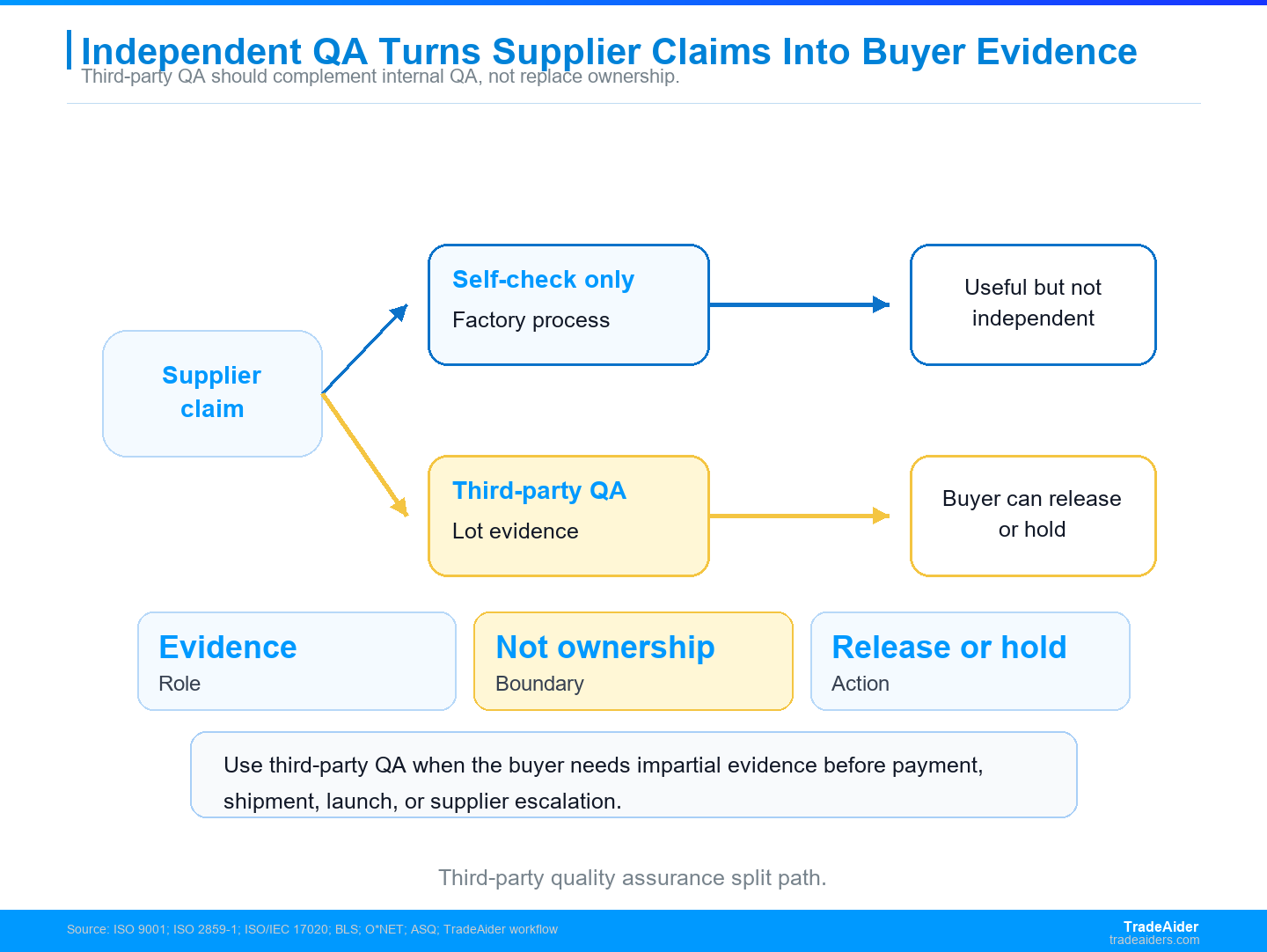
Third-party quality assurance adds independent evidence between supplier self-checks and buyer release decisions without replacing internal quality ownership.
Inspection evidence should be current and lot-specific
Supplier history matters, but release decisions need current evidence. A supplier that passed last year's audit can still ship a poor lot if materials changed, production moved, a label file was revised, or a rush order created process shortcuts. Third-party QA should therefore verify the actual lot, the actual packing status, and the actual product file used for the order under review.
A supplier that passed an audit 2 years ago can still produce one weak shipment today. Third-party QA should therefore check the current lot, current product file, current packing status, and current defect history. The buyer needs evidence tied to this PO, not a general memory of supplier performance.
Testing evidence should be separated from visual inspection
Visual inspection can verify appearance, workmanship, dimensions, labels, packaging, quantities, and some simple function checks. It cannot prove chemical composition, long-term durability, electrical safety, flammability, food-contact status, or restricted-substance compliance without appropriate testing. Third-party QA can coordinate samples and documents, but the report should clearly separate inspection findings from laboratory conclusions.
A visual inspection can last 1 day and still leave a hidden claim unresolved. Chemical, electrical, flammability, food-contact, or durability questions may need a 5-day lab cycle and a defined sample identity. Keeping those evidence types separate protects the buyer from treating a visual pass as a technical certificate.
AQL Sampling Gives Third-Party QA a Decision Structure
AQL sampling helps third-party QA move from subjective impressions to a defined lot decision. ISO 2859-1:2026 provides current AQL-indexed sampling schemes for inspection by attributes, and ASQ explains acceptance sampling as a way to accept or reject based on sampled evidence. For importers, that means the sample size, defect severity, and acceptance number should be agreed before inspection.
AQL is useful, but it has boundaries. It does not guarantee that every unit is defect-free, and it does not replace testing for hidden claims. It also depends on correct lot definition. If the sample does not represent the cartons, SKUs, colors, sizes, production dates, or high-risk subgroups, the third-party report may create false confidence.
Defect classification protects the buyer decision
The buyer should define critical, major, and minor defects before inspection. A wrong safety label, failed function, broken component, missing accessory, or severe appearance defect may trigger hold even if the total count looks small. Defect classification is not clerical language. It is the bridge between sample findings and the buyer's financial decision.
Three severity levels usually carry different actions. A critical defect can stop release, a major defect can fail AQL, and a minor defect may be accepted within limits. Third-party QA should record the class, count, and location so the buyer can act on the finding rather than simply collect photos.
Sample spread protects against easy-carton bias
Third-party QA should record which cartons, pallets, SKUs, colors, sizes, or production dates were sampled. If every checked unit comes from the front of the warehouse, the report may miss late-packed or reworked goods. A strong report makes sample spread visible so the buyer knows what the result actually represents.
If a warehouse presents 30 convenient cartons near the door, the inspector still needs the buyer's lot map. Sampling should cover carton ranges, SKUs, colors, sizes, and production dates where relevant. Without spread evidence, a report can look independent while still missing the subgroup most likely to fail.
Modern Industries Need Third-Party QA Because Supply Chains Are Layered
Modern industries often involve multiple suppliers, subcontracted processes, separate packaging vendors, different test labs, destination-market labels, and tight delivery windows. One buyer requirement can pass through many hands before the finished product ships. Third-party QA gives the buyer a timed checkpoint in that chain.
The trade history also shows why independent preshipment evidence matters. The WTO Agreement on Preshipment Inspection treats preshipment inspection as a defined trade practice, which is a useful reminder for private importers: the report should support a decision about goods, documents, and shipment status, not just provide reassurance.
The need is especially clear when the buyer is remote. Time zones, language, supplier incentives, and distance can make it hard to verify whether a corrected defect is actually corrected or only promised. Independent photos, measurements, defect counts, sample identity, carton spread, and release notes help the buyer act without being physically present.
The key insight is that third-party QA does not remove complexity. It makes the complexity visible enough to decide. When a supply chain is simple, repeatable, and low risk, the buyer may use fewer third-party checks. When products are new, high value, regulated, rushed, subcontracted, or defect-prone, independent evidence becomes more valuable.
Scenario Estimate: Independent QA Before Balance Payment
Scenario estimate: assume a 15,000-unit order. The supplier self-check misses a defect cluster affecting 12 percent of units because the issue is concentrated in one late production subgroup. A third-party inspection identifies the cluster before balance payment and shipment booking.
Calculated from the scenario assumptions, 15,000 units x 12 percent x USD 0.24 equals about USD 432 of direct sorting exposure. That number is not the full business risk. The more important value is that the buyer can hold or sort a subgroup instead of releasing the whole lot blindly.
This estimate assumes the defect is visible and the buyer can act on the report. If the risk is hidden, testing may be the stronger control. If the supplier is unreliable, an audit or earlier production check may be needed before final inspection.
Calculated from the same third-party QA scenario, every 500 affected units at USD 0.24 equals USD 120 of sorting exposure before delay or replacement cost. Calculated from a 12 percent defect cluster, the buyer is deciding on 1,800 affected units rather than a vague supplier promise. Calculated from a 2-day hold, independent evidence means the buyer can trade a short delay for a cleaner release file. Calculated from 3 QA layers, supplier QA, buyer QA, and third-party QA means 3 separate owners for process, requirements, and evidence. Calculated from 15,000 units, a blind release means 15,000 units move as one risk instead of a held subgroup. Calculated from 7 final report fields, missing carton spread means the buyer loses the subgroup signal.
Where TradeAider Fits in Third-Party Quality Assurance
TradeAider provides third-party QA services that turn buyer requirements into inspection, testing, audit, and release evidence.
For supplier selection, factory audit services can assess basic capability, processes, and readiness. Before production, Pre-Production Inspection can verify product files, materials, labels, and setup. During production, During Production Inspection can identify defect spread and correction evidence.
Before shipment, Pre-Shipment Inspection can use AQL sampling, photos, measurements, function checks, label review, packing checks, and defect classification to support a release decision. Where hidden claims matter, TradeAider can coordinate product testing services so inspection findings do not overstate what a lab should prove.
If you need third-party QA for an upcoming order, send TradeAider the PO, approved sample, product specification, packaging file, order quantity, production status, defect history, and shipment date. The next step is to choose the QA checkpoints that match your release decision.
SPAR Scenario: Supplier Self-Check Missed a Subgroup
Situation: A buyer was ready to pay balance on a 15,000-unit order after the supplier shared a self-check summary.
Problem: The summary did not show carton spread, and a late production subgroup had a higher defect rate.
Action: TradeAider sampled across cartons, separated findings by production date, photographed the defect cluster, and recommended holding the affected subgroup.
Result: The buyer released clean cartons, held the concentrated subgroup for sorting, accepted a two-day delay, and changed the next order's report template to require carton spread and production-date evidence.
Third-Party QA Checklist for Buyers
Use this checklist before hiring a third-party QA provider or booking inspection. It keeps the service focused on decisions rather than vague reassurance.
- Define the buyer decision: supplier approval, production correction, shipment release, balance payment, testing, or escalation.
- Share the current PO, product file, approved sample, tolerances, labels, packaging, and defect definitions.
- Choose audit, PPI, DPI, PSI, loading supervision, product testing, or a combined plan.
- Define lot size, SKUs, colors, sizes, cartons, production dates, and high-risk subgroups.
- Require photos, counts, measurements, sample spread, defect severity, and action recommendations.
- Separate inspection findings from laboratory testing and regulatory conclusions.
Third-party QA is strongest when the buyer knows exactly what decision the report must support.
Related Guides
For related decision workflows, read third-party inspection for importers, quality inspection methods, and quality inspection standards. TradeAider buyers can use these guides to decide which third-party QA checkpoint belongs before payment, shipment, launch, or supplier escalation.
Frequently Asked Questions
What is third-party quality assurance?
Third-party quality assurance is an independent layer of verification performed by a party separate from the supplier and buyer. It may include supplier audits, product inspection, AQL sampling, testing coordination, loading checks, reporting, and release recommendations based on buyer requirements.
Does third-party QA replace supplier quality control?
No. Supplier quality control still owns daily process control, materials, operators, equipment, and corrective action. Third-party QA adds independent evidence at selected decision points, but it cannot replace a supplier's internal quality system or the buyer's product requirements.
When should buyers use third-party QA?
Use third-party QA when a buyer needs independent evidence before supplier approval, production correction, balance payment, shipment release, product testing, customer launch, or supplier escalation. It is most valuable for new suppliers, new products, high-risk orders, remote production, or repeated defects.
What should a third-party QA report include?
A useful report should include product file reference, inspection date, lot status, sample size, sample spread, defect photos, defect counts, severity, measurements, function checks, label and packing evidence, exceptions, and a clear release, hold, sort, rework, test, or reinspection recommendation.
Can third-party QA guarantee perfect quality?
No. Third-party QA reduces uncertainty by providing independent evidence, but it cannot guarantee that every unit is perfect. Sampling has limits, hidden claims may require testing, and supplier process control still matters after the inspection visit.
関連記事

TradeAiderサービスでビジネスを成長させる
下のボタンをクリックして、TradeAiderサービスシステムに直接入ります。予約から支払い、報告書の受け取りまでの簡単な手順は操作が簡単です。

