

Successful quality inspections in manufacturing are not built from more checklist items; they are built from a procedure that turns product requirements, lot readiness, sampling, evidence, and corrective action into one defensible release decision. The practical answer is to inspect the risks that can still be changed, record the evidence that proves conformity, and decide whether to release, hold, sort, rework, test, or reinspect before the shipment moves beyond buyer control.
Key Takeaways
- Start with the product file: inspection criteria should come from drawings, samples, tolerances, labels, packaging, and defect rules before the inspector arrives.
- Match timing to risk: incoming, during-production, final, and loading checks each close a different control gap.
- Separate random sampling from known-risk checks: an AQL sample supports the lot decision, while targeted checks protect subgroups that changed during production.
- Make reporting action-ready: a report should support release, hold, sort, repair, retest, or reinspection without another round of guessing.
What Makes a Manufacturing Quality Inspection Procedure Work?
A working manufacturing inspection procedure connects four things: the requirement, the lot being inspected, the evidence collected, and the action the buyer can still take. If any one of those links is weak, the inspection becomes a record of uncertainty rather than a quality decision.
ISO 9001:2015 remains current as of 2026 and frames quality management around meeting requirements, controlling processes, and improvement. ISO/FDIS 9001 is already in approval for the next edition, which makes the 2026 rewrite important: buyers should keep their inspection logic current while still anchoring daily work in clear requirements and evidence.
ISO's own quality-management guidance also describes quality management as a process approach of planning, doing, checking, and acting on findings through improvement. That is why ISO quality management guidance is useful for a manufacturing inspection procedure: it keeps inspection tied to process control rather than a one-off product judgment.
For third-party inspection, ISO/IEC 17020:2026 is especially relevant because it defines inspection as determining conformity with requirements through competent, impartial, and consistent operation. In practice, that means a manufacturing inspection procedure should not begin with the inspector's personal preference. It should begin with the buyer's product file, approved sample, tolerance table, packing rule, defect classification, and release rule.
The strongest procedure protects correction leverage. A defect found at incoming material inspection may be isolated to one lot. A defect found during production may still be corrected before the next output wave. A defect found after final packing may require carton opening, sorting, relabeling, or delayed shipment. The procedure should make that timing logic explicit.
Procedure 1: Lock the Product File Before the Inspector Arrives
The product file is where inspection quality is won or lost. If the PO says one thing, the approved sample shows another, and the packing instruction sits in an old email, the inspector cannot produce a reliable decision. The procedure should name one controlled set of requirements for the order.
A good manufacturing file includes product name, SKU, material, color, size range, dimensions, function, approved sample status, artwork, barcode, inner packing, export carton, shipping mark, destination label, tolerance, defect severity, and any regulatory or customer requirement that affects release. That may sound basic, but most inspection disputes begin with one missing or outdated requirement.
Treat the product file as the first inspection tool
Before any sample is drawn, the inspector should confirm what standard will be used. For TradeAider projects, this is where buyer instructions, inspection standard, product category requirements, and the approved sample are converted into a current checklist. The buyer should also decide which deviations are critical, major, or minor before the factory has an incentive to argue after defects are found.
In a 15,000-unit manufacturing order, a missing tolerance can affect every unit before the inspector sees a defect. A useful product file therefore names dimensions, material, color, artwork, function, packing, sample status, and defect severity before the factory invites inspection. If the file is vague, the report can only describe disagreement.
Keep sampling separate from targeted risk checks
ISO 2859-1:2026 defines AQL-indexed sampling schemes for lot-by-lot inspection by attributes, while ASQ distinguishes attributes sampling from variables sampling. That distinction matters on the factory floor. Scratches, missing parts, and wrong labels are usually attribute checks. Length, weight, torque, resistance, and fill volume may need measurement data.
A normal AQL sample can represent the general lot, but it may not close a known high-risk subgroup. If one color, mold, line, or component changed during production, the report should keep the random sample result and the targeted review separate. Combining them hides the concentration signal the buyer needs.
Procedure 2: Choose the Right Inspection Stage
Manufacturing inspection is not one event. It is a staged control system. The buyer should choose the inspection stage based on where the defect can still be changed, not only on when the supplier says the goods are convenient to see.
Use Pre-Production Inspection when materials, components, samples, or setup risk can still block a wrong start. Use During Production Inspection when output has begun and the buyer needs to catch process drift before it spreads. Use Pre-Shipment Inspection when the order is 100 percent complete and at least 80 percent packed for export, so the report reflects finished-lot evidence.
| Inspection Stage | Best Use | Evidence to Require | Buyer Decision |
|---|---|---|---|
| Incoming or PPI | Materials, samples, setup, labels | Lot identity, condition, documents, first pieces | Approve start or hold |
| DPI | Process drift and early defects | Line output, defect concentration, correction proof | Correct now or escalate |
| PSI | Finished-lot release | AQL sample, packing, labels, photos, counts | Release, hold, sort, or reinspect |
| Loading check | Carton handling and container risk | Container condition, count, seal, loading sequence | Load or stop loading |
The mistake is treating PSI as the only serious inspection. PSI is powerful when the order is ready, but it is late for material substitutions, tooling problems, poor operator training, unstable bonding, or packaging artwork errors that were visible earlier. A staged procedure gives the buyer a smaller and cheaper decision unit.
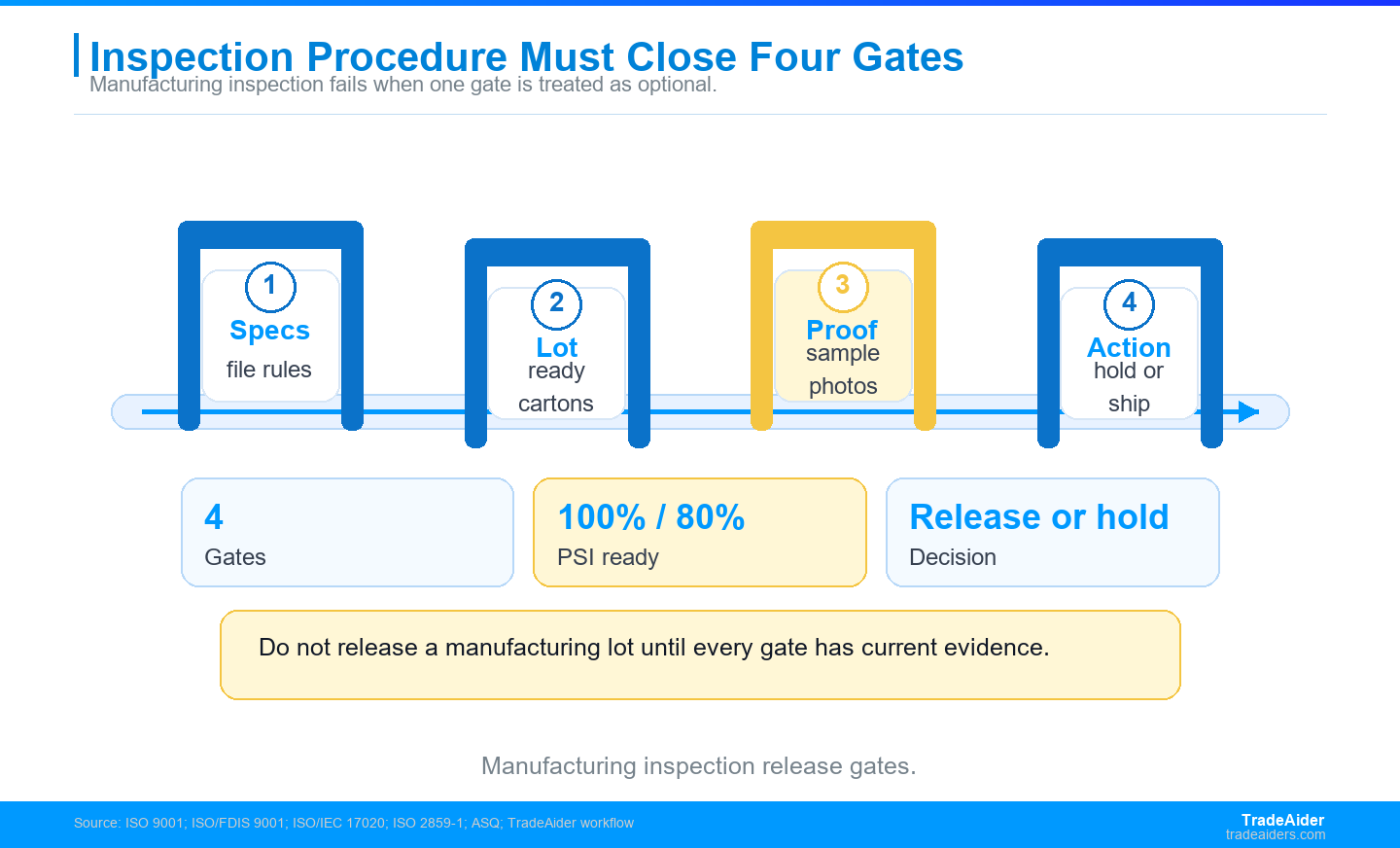
Successful quality inspections in manufacturing work as release gates: requirements, lot readiness, sampling, evidence, and corrective action must all close before shipment moves.
Procedure 3: Build the Checklist Around Evidence, Not Memory
A checklist should not simply list every possible product feature. It should tell the inspector what evidence is needed, how many units or cartons to check, what tool to use, and what result changes the release decision. Memory is not a control method; repeatable evidence is.
For most manufacturing goods, the checklist should include appearance, workmanship, dimensions, function, assembly, material indicators, markings, barcode, user manual, inner packing, export carton, carton drop or packing protection when relevant, quantity, and shipment documents. The buyer should also identify high-risk checkpoints that come from past claims or supplier changes.
BLS describes quality control inspectors as examining products and materials for defects or deviations from specifications, while O*NET lists tasks such as measuring products, writing inspection reports, and recommending corrective actions. Those task descriptions are a useful reality check for a buyer checklist: the procedure should cover measurement, disposition, reporting, and corrective-action evidence, not only a visual pass/fail scan.
A buyer can make the checklist more practical by separating checkpoints into four groups. First are specification checks, such as dimensions, materials, color, and artwork. Second are process checks, such as assembly sequence, bonding, torque, or fill consistency. Third are shipment checks, such as labels, carton marks, count, and packing strength. Fourth are escalation checks, such as lab testing, reinspection, or management approval when defects affect safety, function, or customer promises.
Make corrective action a release condition
Corrective action is not complete when the factory says it has trained workers or adjusted a process. It is complete when the affected lot is identified, the repair or sorting method is defined, corrected goods are rechecked, and remaining risk is visible in the report. That is the difference between a meeting note and buyer evidence.
A defect found during DPI is useful only if the buyer knows what changed before release. The report should identify the affected quantity, the supplier action, the rechecked subgroup, and the remaining risk. Otherwise the same problem can look solved in the meeting and reappear in the cartons.
Scenario Estimate: One Missed Procedure Gate Can Become a Lot Hold
Assume a 15,000-unit order and a process change that affects 6 percent of units. If direct sorting and handling cost is USD 0.36 per affected unit, the immediate handling exposure is USD 324. That number looks small until the buyer adds opened cartons, replacement parts, reinspection time, vessel cutoff pressure, and customer delivery risk.
The more important point is not the exact dollar amount. It is the decision shape. If the issue is found at DPI, the buyer may isolate 900 units and require correction proof before the rest of the lot is packed. If it is found after PSI, the same issue may become a finished-lot hold with weaker root-cause visibility.
Calculated from the same manufacturing scenario, every 1,000 affected units at USD 0.36 equals USD 360 of direct sorting exposure before freight or customer delay. Calculated from 4 inspection gates, one missed gate means the buyer moves from prevention to detection. Calculated from 15,000 units and a 6 percent concentrated subgroup, the buyer is deciding on 900 units rather than a vague defect trend. Calculated from a 2-day reinspection window, 2 x 24 hours equals 48 hours of release pressure even when the factory accepts responsibility. With 7 report fields, missing one field such as carton range can make a hold decision harder to defend.
Where TradeAider Fits in the Procedure
TradeAider's role is to turn buyer requirements into inspection evidence. That can include product-file review, inspection standard alignment, AQL sampling, on-site measurements, photos, defect classification, report comments, and a clear release recommendation. When hidden safety, composition, or performance risk matters, the inspection plan can also connect to product testing instead of pretending a visual check proves everything.
For importers, this evidence also supports commercial and compliance discipline. CBP basic importing guidance notes that importers and exporters share responsibility for compliance, so a manufacturing inspection report should help the buyer preserve the facts behind the purchase order, product identity, labels, packing, and corrective decisions.
For importers that do not have a large internal QA team in China, the practical workflow is simple: send the PO, approved sample details, packing requirements, destination requirements, known risk points, and release rule before booking. Then use the report to decide whether to release, hold, sort, repair, retest, or book another inspection through TradeAider contact.
- Confirm one controlled product file before inspection.
- Choose PPI, DPI, PSI, testing, or loading check based on when the risk can still be changed.
- Separate AQL sampling from targeted checks on changed materials, colors, lines, or cartons.
- Require photos, counts, locations, and severity, not just a pass/fail label.
- Tie every defect group to release, hold, sort, repair, retest, or reinspection.
Frequently Asked Questions
What are the key procedures for quality inspections in manufacturing?
The key procedures are product-file review, inspection-stage selection, lot readiness confirmation, sampling plan setup, checklist execution, defect classification, corrective-action review, report writing, and release decision. The strongest procedure connects each finding to buyer action, so the inspection does not become a general factory visit with no clear consequence for shipment.
When should a manufacturing quality inspection happen?
A manufacturing quality inspection should happen at the production stage where the specific risk can still be changed economically. Use PPI for materials and setup, DPI for process drift, PSI when goods are 100 percent finished and at least 80 percent packed, and loading checks when carton count, container condition, or loading sequence is the main risk.
Is AQL enough for a manufacturing inspection?
AQL is useful for lot-based visible defect decisions, but it is not enough by itself for a complete manufacturing inspection. Buyers also need a product file, defect severity rules, subgroup visibility, measurement methods, photo evidence, and targeted checks for known risks such as changed materials, new molds, new artwork, or late production changes.
What should be in a manufacturing inspection report?
A useful manufacturing inspection report should include product identity, inspected quantity, sample size, defect counts, severity, photos, measurements, carton or lot spread, packaging and label checks, special comments, and a clear release recommendation. The report should help the buyer decide whether to ship, hold, sort, repair, test, or reinspect with confidence.
Related Articles


Grow your business with TradeAider Service
Click the button below to directly enter the TradeAider Service System. The simple steps from booking and payment to receiving reports are easy to operate.

